pISSN 2233-8233 · eISSN 2233-8241 Clin Exp Reprod Med 2020;47(3):227-232
Efficacy of dual progesterone administration
(intramuscular and vaginal) for luteal support in
fresh day 3 or day 4 embryo transfer cycles
Eun Jee Nho1,*, Yeon Hee Hong1,2,*, Ju Hee Park2,3, Seul Ki Kim1,2, Jung Ryeol Lee1,2, Byung Chul Jee1,2, Seok Hyun Kim2
1Department of Obstetrics and Gynecology, Seoul National University Bundang Hospital, Seongnam; 2Department of Obstetrics and Gynecology,
Seoul National University College of Medicine, Seoul; 3Sarang I Infertility Clinic, Seoul, Korea
Objective: The aim of this study was to compare in vitro fertilization outcomes between fresh day 3 or day 4 embryo transfer cycles with dual progesterone (P) administration (intramuscular and vaginal) and cycles with single intramuscular P administration for luteal support.
Methods: We selected 124 cycles from 100 women (under age 40 years) who underwent oocyte pick-up (number of trials ≤3, 4–14 oocytes obtained) and transfer of two or three day 3 or day 4 embryos at two infertility centers from January 2014 to June 2019. Dual P (intramuscular P [50 mg] daily+vaginal P) was used in 52 cycles and a single intramuscular administration of P (50 mg daily) was used in 72 cycles.
Results: Women’s age, infertility factors, number of oocytes retrieved, number of transferred embryos, and mean embryo score were similar between the dual P group and the single P group. Although the number of trial cycles was significantly higher (1.9 vs. 1.5), and the mean endo-metrial thickness on the trigger day (10.0 mm vs. 11.0 mm) was significantly lower in the dual P group, the implantation rate, clinical pregnancy rate, ongoing pregnancy rate, and miscarriage rate for both day 3 and day 4 transfers were similar between the two groups.
Conclusion: In fresh day 3 or day 4 embryo transfer cycles, dual P administration did not demonstrate any clinical advantages. Intramuscular P alone appears to be sufficient for luteal support.
Keywords: Embryo transfer; Pregnancy; Progesterone
Introduction
In fresh embryo transfer (ET) cycles, luteal support is a routine pro-cedure because it is known to enhance the clinical pregnancy rate, ongoing pregnancy rate, and live birth rate [1]. The main rationale is that pituitary suppression during ovarian stimulation negatively af-fects corpus luteum function, leading to decreased progesterone (P)
levels. Altered P levels could compromise embryo implantation po-tential. The oocyte pick-up procedure results in the loss of some granulosa cells, which may lead to impaired corpus luteum function [2].
Administration of P, which is now the main method of luteal sup-port, can be done by intramuscular, subcutaneous, vaginal, and oral routes. The intramuscular route generally results in a higher serum P level than the vaginal route, but serum P levels may not reflect actual P levels in the endometrial tissue [3-5]. Intramuscular P administra-tion can frequently cause pain and, in rare cases, abscess formaadministra-tion. In contrast, the vaginal route avoids the first-pass metabolism of P in the liver, resulting in high actual P levels in the endometrial tissue [3]. Both intramuscular and vaginal administration of P has been report-ed to yield similar clinical pregnancy rates and miscarriage rates in in
vitro fertilization (IVF) cycles [1,6]. Various vaginal formulations (gels,
Received: December 18, 2019 ∙ Revised: February 7, 2020 ∙ Accepted: March 16, 2020 Corresponding author: Byung Chul Jee
Department of Obstetrics and Gynecology, Seoul National University Bundang Hospital, 82 Gumi-ro 173beon-gil, Bundang-gu, Seongnam 13620, Korea Tel: +82-31-787-7254 Fax: +82-31-787-4054 E-mail: [email protected]
*These authors contributed equally to this article.
This is an Open Access article distributed under the terms of the Creative Commons Attribution Non-Commercial License (http://creativecommons.org/licenses/by-nc/4.0/) which permits unrestricted non-commercial use, distribution, and reproduction in any medium, provided the original work is properly cited.
inserts, rings, and suppositories) have also been reported to lead to similar clinical pregnancy rates and live birth rates [7,8].
Recently, attempts have been made to combine several forms of P to provide more intense luteal support. The combination of intra-muscular and vaginal P is used by some clinicians, but little is known about its efficacy [4]. In a study by Pabuccu et al. [4], women who re-ceived dual luteal support (intramuscular P [50 mg]+vaginal P [200 mg] three times) had a significantly higher implantation rate than those who received vaginal P only, but the clinical pregnancy rate and ongoing pregnancy rate were similar [4]. No study has yet com-pared fresh ET cycle outcomes between patients who receive intra-muscular P and vaginal P and those who receive intraintra-muscular P alone.
At our centers, some clinicians prefer a combination of intramuscu-lar P (50 mg daily) and vaginal P with various formulas as luteal sup-port in fresh ET cycles. Thus we retrospectively compared the clinical efficacy of fresh day 3 or day 4 ET cycles with dual P administration (intramuscular and vaginal) and cycles with intramuscular P alone as luteal support.
Methods
We selected 124 cycles from 100 women who underwent oocyte pick-up at two infertility centers (84 cycles at Seoul National Universi-ty Bundang Hospital and 40 cycles at Sarang I InfertiliUniversi-ty Clinic) from January 2014 to June 2019. The inclusion criteria were (1) women under age 40 years; (2) first, second, or third IVF-ET trials; (3) 4–14 oo-cytes obtained; and (4) two or three day 3 or day 4 embryos trans-ferred. The Institutional Review Board of the Seoul National Bundang Hospital approved this study (IRB No. B-1912-582-111).
Ovarian stimulation was performed using recombinant follicle-stimulating hormone (FSH; Gonal-F; Merck-Serono, Darmstadt, Ger-many), recombinant FSH with recombinant luteinizing hormone (Pergoveris, Merck-Serono), or purified human menopausal gonado-tropin (Menopur, Ferring, Germany). Pituitary suppression was per-formed by a flexible gonadotropin-releasing hormone (GnRH) an-tagonist protocol (118 cycles) or a luteal long protocol of GnRH ago-nist (6 cycles). Once ultrasound monitoring revealed two or more fol-licles ≥18 mm in diameter, 250 μg of recombinant human chorionic gonadotrophin (hCG; Ovidrel, Merck-Serono) was given. Oocyte pick-up was performed 36–38 hours after the hCG injection.
Starting on the day of oocyte pick-up, luteal support was started. Dual P (intramuscular and vaginal) was used in 52 cycles (12 cycles at Seoul National University Bundang Hospital and 40 cycles at Sarang I Infertility Clinic) and single intramuscular P alone was used in 72 cy-cles. In the dual P group, 50 mg of intramuscular P (Sugest, Sanzyme, Hyderabad, India) daily and 100 mg of vaginal utrogestan (Lutinus,
Ferring) two times every other day were used. In the single intramus-cular P group, a daily dose of 50 mg of Sugest or Genifer P (Watson Laboratories Inc., Parsippany, NJ, USA) or Taiyu P (Jaytech Biogen, Seoul, Korea) was used. Luteal support was continued until 8–9 ges-tational weeks, if pregnant.
Mature oocytes were inseminated by the conventional method (60 cycles), intracytoplasmic sperm injection (48 cycles), or combined methods (16 cycles). Fertilization was confirmed the next day by ob-serving two pronuclei. Embryo quality was evaluated by morpholog-ical criteria based on the degree of fragmentation and the regularity of blastomeres on day 3 or day 4 after insemination. Embryos were graded as follows: grade A, 0% anucleate fragments, regularity of blastomeres, no apparent morphological abnormality; grade B, <20% anucleate fragments, regularity of blastomeres, no apparent morphological abnormality; grade C, 20%–50% anucleate frag-ments, irregularity of blastomeres, no apparent morphological ab-normality; and grade D, >50% anucleate fragments, irregularity of blastomeres, and apparent morphological abnormalities.
Two or three embryos were transferred on day 3 (109 cycles) or day 4 (15 cycles). At the time of ET, the embryo was scored using the Steer method [9]. After multiplying the cell number by the grading score (A, 4; B, 3; C, 2; D, 1), each score was summed. The mean em-bryo score was obtained as the summed emem-bryo score divided by the number of embryos. A compaction was considered as a super-staged 8-cell with a score of 5 and a morula was considered as a 12-cell with a score of 6.
Serum hCG levels were determined 14 days after oocyte pick-up. Clinical pregnancy was defined as visibility of an intrauterine gesta-tional sac. Ongoing pregnancy was defined as clinical pregnancy persisting beyond 12 gestational weeks. Miscarriage was defined as termination of clinical pregnancy before 12 gestational weeks. The implantation rate was calculated as the number of gestational sacs divided by the number of embryos transferred.
Statistical analysis was performed using SPSS ver. 25 (IBM Corp., Ar-monk, NY, USA). The Student t-test or the Mann-Whitney U-test was used as appropriate to compare numerical data between the two groups. The chi-square test or the Fisher exact test was used to com-pare ratios. Multiple logistic analysis was performed to identify spe-cific parameters that affected clinical pregnancy. Receiver operating characteristic curve analysis was performed to obtain a cutoff value for a specific parameter. A p-value <0.05 was considered to indicate statistical significance.
Results
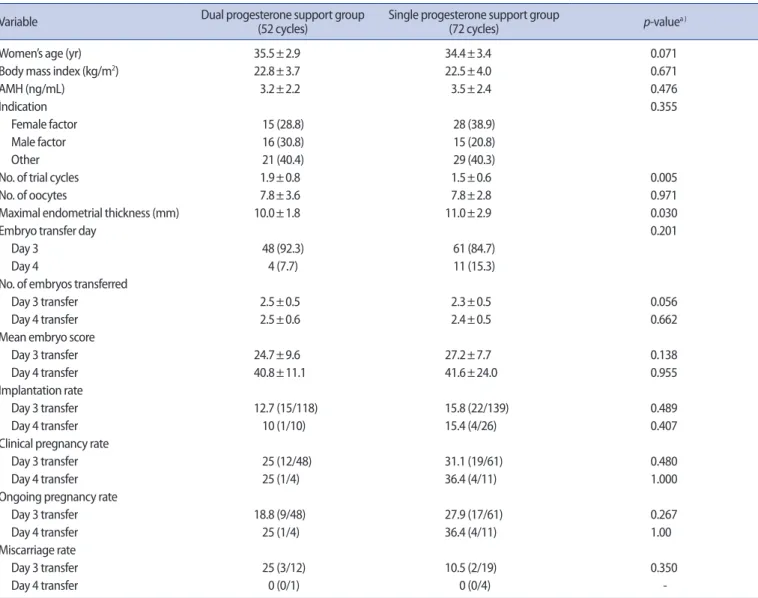
Patients’ demographic characteristics and cycle outcomes are pre-sented in Table 1. Women’s age, infertility factors, the number of
oo-cytes retrieved, and the number of embryos transferred were similar between the dual P group and the single P group. However, the number of trial cycles was significantly higher, and the mean endo-metrial thickness on the trigger day was significantly lower, in the dual P group. Nonetheless, the implantation rate, clinical pregnancy rate, ongoing pregnancy rate, and miscarriage rate, both for day 3 and day 4 transfers, were similar between the two groups.
Multiple logistic analysis revealed that maximal endometrial thick-ness had a significant effect on clinical pregnancy (Table 2). Women’s age, trial cycle number, ET day, the number of embryos transferred, the method of luteal support, and the infertility center were not sig-nificant factors. The best cut-off value of maximal endometrial thick-ness for predicting clinical pregnancy was 10.65 mm (area under the curve, 0.643; 95% confidence interval, 0.537–0.749; p=0.013;
sensi-tivity, 63.9%; specificity, 63.2%).
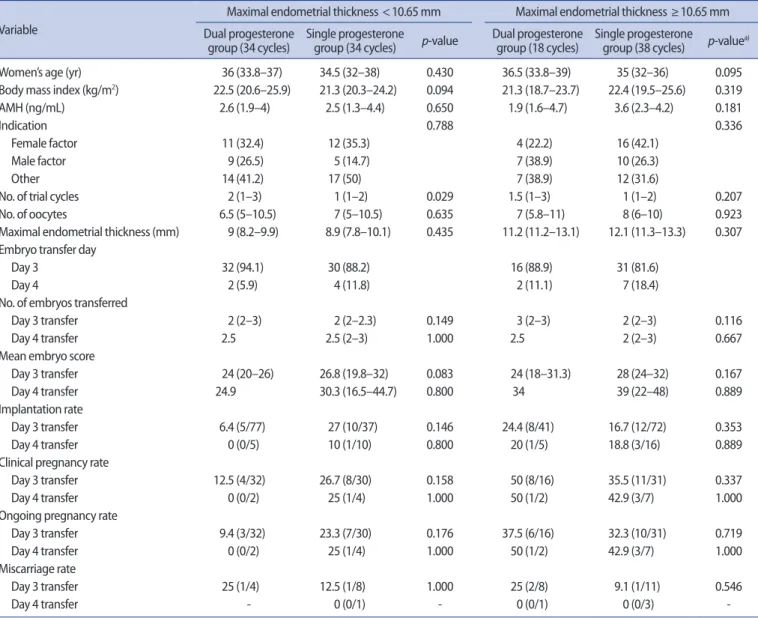
A subgroup analysis was performed according to the maximal en-dometrial thickness cutoff of 10.65 mm (Table 3). In cycles with a
Table 1. Demographic and cycle information in the dual progesterone support group and the single progesterone support group Variable Dual progesterone support group (52 cycles) Single progesterone support group (72 cycles) p-valuea )
Women’s age (yr) 35.5±2.9 34.4±3.4 0.071
Body mass index (kg/m2) 22.8±3.7 22.5±4.0 0.671
AMH (ng/mL) 3.2±2.2 3.5±2.4 0.476
Indication 0.355
Female factor 15 (28.8) 28 (38.9)
Male factor 16 (30.8) 15 (20.8)
Other 21 (40.4) 29 (40.3)
No. of trial cycles 1.9±0.8 1.5±0.6 0.005
No. of oocytes 7.8±3.6 7.8±2.8 0.971
Maximal endometrial thickness (mm) 10.0±1.8 11.0±2.9 0.030
Embryo transfer day 0.201
Day 3 48 (92.3) 61 (84.7)
Day 4 4 (7.7) 11 (15.3)
No. of embryos transferred
Day 3 transfer 2.5±0.5 2.3±0.5 0.056
Day 4 transfer 2.5±0.6 2.4±0.5 0.662
Mean embryo score
Day 3 transfer 24.7±9.6 27.2±7.7 0.138
Day 4 transfer 40.8±11.1 41.6±24.0 0.955
Implantation rate
Day 3 transfer 12.7 (15/118) 15.8 (22/139) 0.489
Day 4 transfer 10 (1/10) 15.4 (4/26) 0.407
Clinical pregnancy rate
Day 3 transfer 25 (12/48) 31.1 (19/61) 0.480
Day 4 transfer 25 (1/4) 36.4 (4/11) 1.000
Ongoing pregnancy rate
Day 3 transfer 18.8 (9/48) 27.9 (17/61) 0.267
Day 4 transfer 25 (1/4) 36.4 (4/11) 1.00
Miscarriage rate
Day 3 transfer 25 (3/12) 10.5 (2/19) 0.350
Day 4 transfer 0 (0/1) 0 (0/4)
-Values are presented as mean±standard deviation, number (%), or percent (number). AMH, anti-Müllerian hormone.
a)Student t-test.
Table 2. Multiple logistic analysis of factors affecting clinical pregnancy
Parameter Linear correlation coefficient (r) p-value
Women’s age 0.009 0.551
Trial cycle number 0.070 0.290
Maximal endometrial thickness 0.046 0.035
Embryo transfer day –0.007 0.956
No. of embryos transferred –0.150 0.154
Method of luteal support –0.114 0.459
maximal endometrial thickness <10.65 mm and ≥10.65 mm, the implantation rate, clinical pregnancy rate, ongoing pregnancy rate, and miscarriage rate were also similar between the dual and single P groups.
Discussion
In the present study, the IVF outcomes were similar between fresh day 3 or day 4 ET cycles with dual P support and cycles with single intramuscular P support. Therefore, intramuscular P alone appears to be sufficient for luteal support. This indicates that intramuscular P alone is sufficient to achieve physiologically necessary P levels.
Intramuscular P generally results in higher serum P levels than
vagi-nal P [3-5]. In fresh IVF-ET cycles, the serum P level during the mid-lu-teal phase has been reported to be 94.3±8.8 ng/mL when intramus-cular (P 100 mg) was administered and 57.7 ±7.4 ng/mL when a vaginal 8% progesterone gel was used (p<0.01) [10]. Although the actual P level in the endometrial tissue may be higher after vaginal P than after intramuscular P, our findings suggest that P might work well in the endometrial tissue after intramuscular P administration, similar to after vaginal P administration.
In non-stimulated frozen ET cycles, the absolute effects of P admin-istration can be identified, because the corpus luteum is absent [11]. In our experience, the serum P level at the time of frozen ET was ~35 ng/mL after intramuscular P (Sugest; 50 mg/day) was administered for 3 days. A recent study reported that women with serum P levels
Table 3. Subgroup analysis according to maximal endometrial thickness Variable
Maximal endometrial thickness <10.65 mm Maximal endometrial thickness ≥10.65 mm Dual progesterone
group (34 cycles) Single progesterone group (34 cycles) p-value Dual progesterone group (18 cycles) Single progesterone group (38 cycles) p-valuea)
Women’s age (yr) 36 (33.8–37) 34.5 (32–38) 0.430 36.5 (33.8–39) 35 (32–36) 0.095
Body mass index (kg/m2) 22.5 (20.6–25.9) 21.3 (20.3–24.2) 0.094 21.3 (18.7–23.7) 22.4 (19.5–25.6) 0.319
AMH (ng/mL) 2.6 (1.9–4) 2.5 (1.3–4.4) 0.650 1.9 (1.6–4.7) 3.6 (2.3–4.2) 0.181
Indication 0.788 0.336
Female factor 11 (32.4) 12 (35.3) 4 (22.2) 16 (42.1)
Male factor 9 (26.5) 5 (14.7) 7 (38.9) 10 (26.3)
Other 14 (41.2) 17 (50) 7 (38.9) 12 (31.6)
No. of trial cycles 2 (1–3) 1 (1–2) 0.029 1.5 (1–3) 1 (1–2) 0.207
No. of oocytes 6.5 (5–10.5) 7 (5–10.5) 0.635 7 (5.8–11) 8 (6–10) 0.923
Maximal endometrial thickness (mm) 9 (8.2–9.9) 8.9 (7.8–10.1) 0.435 11.2 (11.2–13.1) 12.1 (11.3–13.3) 0.307
Embryo transfer day
Day 3 32 (94.1) 30 (88.2) 16 (88.9) 31 (81.6)
Day 4 2 (5.9) 4 (11.8) 2 (11.1) 7 (18.4)
No. of embryos transferred
Day 3 transfer 2 (2–3) 2 (2–2.3) 0.149 3 (2–3) 2 (2–3) 0.116
Day 4 transfer 2.5 2.5 (2–3) 1.000 2.5 2 (2–3) 0.667
Mean embryo score
Day 3 transfer 24 (20–26) 26.8 (19.8–32) 0.083 24 (18–31.3) 28 (24–32) 0.167
Day 4 transfer 24.9 30.3 (16.5–44.7) 0.800 34 39 (22–48) 0.889
Implantation rate
Day 3 transfer 6.4 (5/77) 27 (10/37) 0.146 24.4 (8/41) 16.7 (12/72) 0.353
Day 4 transfer 0 (0/5) 10 (1/10) 0.800 20 (1/5) 18.8 (3/16) 0.889
Clinical pregnancy rate
Day 3 transfer 12.5 (4/32) 26.7 (8/30) 0.158 50 (8/16) 35.5 (11/31) 0.337
Day 4 transfer 0 (0/2) 25 (1/4) 1.000 50 (1/2) 42.9 (3/7) 1.000
Ongoing pregnancy rate
Day 3 transfer 9.4 (3/32) 23.3 (7/30) 0.176 37.5 (6/16) 32.3 (10/31) 0.719
Day 4 transfer 0 (0/2) 25 (1/4) 1.000 50 (1/2) 42.9 (3/7) 1.000
Miscarriage rate
Day 3 transfer 25 (1/4) 12.5 (1/8) 1.000 25 (2/8) 9.1 (1/11) 0.546
Day 4 transfer - 0 (0/1) - 0 (0/1) 0 (0/3)
-Values are presented as median (interquartile range) or number (%).
AMH, anti-Müllerian hormone.
<10 ng/mL at the time of frozen ET showed a significantly lower clinical pregnancy rate and live birth rate than those with levels ≥10 ng/mL [12]. Another study indicated that women with serum P levels <10.64 ng/mL before the day of frozen ET showed a significantly lower live birth rate and significantly higher miscarriage rate [13]. In donor cycles, recipients with serum P levels <20 ng/mL at the time of ET were less likely to achieve clinical pregnancy [14].
In fresh ET cycles, it is difficult to assess the absolute physiological P level due to the growth of the corpus luteum and other iatrogenic factors, such as pituitary suppression, controlled ovarian stimulation, and the ovum pick-up procedure [2]. Therefore, further research is needed to determine the lowest effective serum P level in fresh ET cycles. Intramuscular P alone appears to be sufficient to lower uter-ine contractility and endometrial wave activity. Uteruter-ine contractility was reported to significantly decrease after intramuscular P adminis-tration in frozen ET cycles [11]. Furthermore, intramuscular P has a longer half-life (over 1 day) than vaginal P; therefore, it can effectively maintain uterine quiescence [11].
As far as we know, this is the first study to compare the clinical effi-cacy of cycles with dual P administration (intramuscular and vaginal) and cycles with intramuscular P alone as luteal support in fresh ET cycles. We included only fresh cycles with two or three embryos transferred on day 3 or day 4 to avoid the possible confounding ef-fect induced by multiple ET.
The main limitation of this study is that intramuscular P alone was used at only one center. Differences in the culture conditions and personnel at the two centers may have affected the pregnancy rate. A further randomized trial could confirm our findings. In conclusion, fresh IVF outcomes were similar between fresh day 3 or day 4 ET cy-cles with dual P support and cycy-cles with single intramuscular P sup-port. Therefore, intramuscular P alone appears to be sufficient for lu-teal support.
Conflict of interest
Byung Chul Jee has been an editor of Journal of Clinical and Experi-mental Reproductive Medicine since 2018; however, he was not in-volved in the peer reviewer selection, evaluation, or decision process of this article. No other potential conflict of interest relevant to this article was reported.
ORCID
Eun Jee Nho https://orcid.org/0000-0002-8214-1434 Yeon Hee Hong https://orcid.org/0000-0002-9709-4175 Ju Hee Park https://orcid.org/0000-0001-5094-1640 Seul Ki Kim https://orcid.org/0000-0002-1647-6711
Jung Ryeol Lee https://orcid.org/0000-0003-3743-2934 Byung Chul Jee https://orcid.org/0000-0003-2289-6090 Seok Hyun Kim https://orcid.org/0000-0003-0649-3224
Author contributions
Conceptualization: BCJ. Data curation: all authors. Formal analysis: BCJ, EJN, YHH, JHP. Methodology: BCJ, EJN, YHH, SKK, JRL. Project ad-ministration: BCJ, EJN, YHH, SKK, JRL. Writing–original draft: BCJ, EJN, YHH. Writing–review & editing: all authors.
References
1. van der Linden M, Buckingham K, Farquhar C, Kremer JA, Met-wally M. Luteal phase support for assisted reproduction cycles. Cochrane Database Syst Rev 2015;2015:CD009154.
2. Fatemi HM, Popovic-Todorovic B, Papanikolaou E, Donoso P, Dev-roey P. An update of luteal phase support in stimulated IVF cy-cles. Hum Reprod Update 2007;13:581-90.
3. Shapiro D, Boostanfar R, Silverberg K, Yanushpolsky EH. Examin-ing the evidence: progesterone supplementation durExamin-ing fresh and frozen embryo transfer. Reprod Biomed Online 2014;29 Sup-pl 1:S1-14.
4. Pabuccu EG, Pabuccu R, Evliyaoglu Ozdegirmenci O, Bostancı Durmus A, Keskin M. Combined progesterone (IM + V) versus vaginal progesterone for luteal support in cleavage-stage em-bryo transfer cycles of good prognosis patients. Gynecol Endo-crinol 2016;32:366-9.
5. Hershko Klement A, Samara N, Weintraub A, Mitri F, Bentov Y, Chang P, et al. Intramuscular versus vaginal progesterone ad-ministration in medicated frozen embryo transfer cycles: a ran-domized clinical trial assessing sub-endometrial contractions. Gynecol Obstet Invest 2018;83:40-4.
6. Zarutskie PW, Phillips JA. A meta-analysis of the route of admin-istration of luteal phase support in assisted reproductive tech-nology: vaginal versus intramuscular progesterone. Fertil Steril 2009;92:163-9.
7. Doody KJ, Schnell VL, Foulk RA, Miller CE, Kolb BA, Blake EJ, et al. Endometrin for luteal phase support in a randomized, con-trolled, open-label, prospective in-vitro fertilization trial using a combination of Menopur and Bravelle for controlled ovarian hy-perstimulation. Fertil Steril 2009;91:1012-7.
8. Stadtmauer L, Silverberg KM, Ginsburg ES, Weiss H, Howard B. Progesterone vaginal ring versus vaginal gel for luteal support with in vitro fertilization: a randomized comparative study. Fertil Steril 2013;99:1543-9.
cumula-tive embryo score: a prediccumula-tive embryo scoring technique to se-lect the optimal number of embryos to transfer in an in-vitro fer-tilization and embryo transfer programme. Hum Reprod 1992; 7:117-9.
10. Chantilis SJ, Zeitoun KM, Patel SI, Johns DA, Madziar VA, McIntire DD. Use of Crinone vaginal progesterone gel for luteal support in in vitro fertilization cycles. Fertil Steril 1999;72:823-9.
11. Casper RF. Luteal phase support for frozen embryo transfer cycles: intramuscular or vaginal progesterone? Fertil Steril 2014;101:627-8. 12. Cedrin-Durnerin I, Isnard T, Mahdjoub S, Sonigo C, Seroka A,
Comtet M, et al. Serum progesterone concentration and live
birth rate in frozen-thawed embryo transfers with hormonally prepared endometrium. Reprod Biomed Online 2019;38:472-80. 13. Gaggiotti-Marre S, Martinez F, Coll L, Garcia S, Álvarez M, Parriego
M, et al. Low serum progesterone the day prior to frozen embryo transfer of euploid embryos is associated with significant reduc-tion in live birth rates. Gynecol Endocrinol 2019;35:439-42. 14. Brady PC, Kaser DJ, Ginsburg ES, Ashby RK, Missmer SA, Correia
KF, et al. Serum progesterone concentration on day of embryo transfer in donor oocyte cycles. J Assist Reprod Genet 2014;31: 569-75.