1532
ⓒ The Korean Society of Food Science and Technology
Antioxidant and Acetylcholinesterase Inhibition Activity of Mulberry
Fruit Extracts
Young Ju Lee1, Ka-Hwa Lee, Chang-Bum Ahn, Soon-Sil Chun1, and Jae-Young Je* School of Food Technology and Nutrition, Chonnam National University, Yeosu, Jeonnam 550-749, Korea
1Department of Food and Nutrition, Sunchon National University, Suncheon, Jeonnam 540-742, Korea
Abstract The objective of this study was to evaluate the antioxidant effects and acetylcholinesterase (AChE) inhibition
activity of mulberry fruit extracts prepared by hot water (MFH) and 80% ethanol (MFE). Total polyphenolic contents of MFH and MFE were 195±3.4 mg gallic acid equivalents/g MFH and 185±2.8 mg gallic acid equivalents/g MFE. MFH and MFE significantly quenched 2,2-diphenyl-1-picrylhydrazyl (DPPH), hydrogen peroxide dose-dependently, and showed high chelating ability and reducing power in non-cellular systems. MFH and MFE also inhibited the formation of intracellular reactive oxygen species and lipid peroxidation, and elevated intracellular glutathione (GSH) levels in RAW264.7 cells. In addition, MFH and MFE also dose-dependently suppressed AChE activity.
Keywords: mulberry fruit, antioxidant, free radical, lipid peroxidation, acetylcholinesterase (AChE) Introduction
Antioxidants are molecules that delay or prevent the oxidation of cellular oxidizable substrates by scavenging of free radical and reactive oxygen species (ROS), preventing the generation of free radicals and ROS, and/or activating a battery of detoxifying proteins. Many types of ROS can be generated in human body as an unavoidable consequence in aerobic organisms during respiration, and also generated by cells under pathophysiological conditions. These free radicals and ROS are mainly removed by antioxidant enzymes such as catalase, superoxide dismutase, and various peroxidases as well as non-enzymes including vitamin C, vitamin E, and glutathione. However, over formation of ROS under pathophysiological conditions is leading to many health disorders such as cancer, neurodegenerative diseases, ischemic reperfusion, arthritis, and inflammatory diseases because ROS can react rapidly with DNA, membrane lipids, and proteins (1-4). Several synthetic antioxidants such as butylated hydroxyanisole (BHA), butylated hydroxytoluene (BHT), and t-butyl hydroquinone
(TBHQ) commonly used in order to maintain foodstuffs, however, these antioxidants have been restricted for use in foods as they are suspected to be carcinogenic (5).
Acetylcholine (ACh) is considered as a neurotransmitter in both the peripheral nervous system (PNS) and central nervous system (CNS), where it functions as a neuro-modulator. ACh is released to choline and acetate by acetylcholinesterase (AChE), which is a oligomeric enzyme that attaches to the neuromuscular junction, and plays a fundamental role in impulse transmission through the breakdown of the neurotransmitter acetylcholine at neuro-muscular junction and brain cholinergic synapses (6,7). Currently, AChE inhibitors are widely use in Alzheimer’s
disease patients to inhibit the hydrolysis of ACh, thereby activating the central cholinergic system and alleviating cognitive deficits.
Mulberry fruit (Morus alba L.) is a traditional Chinese
edible fruit that is used effectively in folk medicines to treat fever, protect liver from damage, strengthen the joints, facilitate discharge of urine, and lower blood pressure (8). However, its biological and pharmacological activities are still poorly understood. Therefore, in this study, we prepared two kinds of mulberry fruit extracts using hot water and 80% ethanol, and their total phenolic content, and antioxidant activity in non-cellular and cellular system and AChE inhibitory activity were investigated.
Materials and Methods
Materials and chemicals Mulberry fruit, which is cultivated in Buan-gun, in dry powder form was purchased from local markets (Suncheon, Korea). All chemicals including 2,2-diphenyl-1-picrylhydrazyl (DPPH), gallic acid, ethylenediaminetetraacetic acid (EDTA), Folin-Ciocalteau’s phenol reagent, H2O2,
2,2-azino-bis(3-ethylbenzthiazoline)-6-sulfonic acid (ABTS), 2,2-azobis-(2-amidinopropane)-hydrochloride (AAPH), thio-barbituric acid (TBA), trichloroacetic acid (TCA), peroxidase, potassium ferricyanide, electric-eel AChE, ACh, 5,5'-dithiobis[2-nitrobenzoic acid] (DTNB), and ferrozine were purchased from Sigma-Aldrich (St. Louis, MO, USA). Fluorescence probes such as monobromobimane (mBBr), 3-(4,5-dimethyl-2-yl)-2,5-diphenyltetrazolium bromide (MTT), diphenyl-1-pyrenylphosphine (DPPP), and 2,7-dichlorofluorescein diacetate (DCFH-DA) were obtained from Molecular Probes Inc. (Eugene, OR, USA). The other materials required for culturing cells were purchased from Gibco BRL, Life Technologies (Grand Island, NY, USA).
Preparation of mulberry fruit extracts Mulberry fruit powder (20 g) was extracted in 200 mL hot water or 80% ethanol under reflux for 3 hr at their boiling points, *Corresponding author: Tel: +82-61-659-3416; Fax: +82-61-659-3419
E-mail: [email protected]
Received July 1, 2009; Revised September 5, 2009; Accepted September 15, 2009
(Na2CO3). The mixture was shaken for 2 hr at room
temperature, and then a 200µL aliquot of the mixture was
added to each well of a 96-well microplate. Absorbance was measured at 720 nm using microplate reader (ELx 808TM; BioTek, Winooski, VT, USA). All tests were
performed in triplicate. Gallic acid was used as a standard. The concentration of total phenolic compounds in the sample was expressed as mg gallic acid equivalents (GAE)/g of extract.
Antioxidant effects of MFEs in non-cellular systems
The DPPH scavenging activities of MFH and MFE were measured according to the slightly modified method of Blois (10). DPPH solution (1.5×10⁻⁴ M, 100µL) was mixed
without and with each extract (100µL), and the mixture
was incubated at room temperature for 30 min. After standing for 30 min, absorbance was recorded at 517 nm by microplate reader (GENios®; Tecan Austria GmbH,
Grödig, Austria).
Hydrogen peroxide scavenging activity was determined according to the method of Müller (11). A 100µL of 0.1 M
phosphate buffer (pH 5.0) and the sample solution were mixed in a 96-well microplate. A 20µL of H2O2 was
added to the mixture, and then incubated at 37oC for 5 min.
After the incubation, 30µL of 1.25µmM ABTS and 30µL
of peroxidase (1 unit/mL) were added to the mixture, and then incubated at 37oC for 10 min. The absorbance was
recorded at 405 nm by microplate reader.
The reducing powers of MFH and MFE were determined according to the method of Oyaizu (12). A sample solution was mixed with 0.5 mL of 0.2 M phosphate buffer (pH 6.6) and 0.5 mL potassium ferricyanide (1%). The mixture was incubated at 50oC for 20 min. After incubation, 0.5
mL TCA (10%) was added to the mixture and centrifuged at 1,036×g for 10 min. From the upper layer of solution, a 0.5 mL aliquot was mixed with 0.5 mL distilled water and 0.1 mL FeCl3 (0.1%), and the absorbance was measured at
700 nm. The increase in absorbance of the reaction mixture indicates the increase in reducing power.
The ferrous ion chelating activity was measured by Singh and Rajini (13). The sample solution was mixed with 0.1 mM FeCl2 and then set at room temperature for 30 sec.
The reaction was initiated by the addition of 0.25 mM ferrozine for 10 min and the absorbance was measured at 562 nm.
Antioxidant effects of MFEs in cellular systems
RAW264.7 cells were obtained from the American Type Culture Collection (Manassas, VA, USA) and were grown
previously described method, employing the oxidation sensitive dye DCFH-DA as the substrate (14). The RAW264.7 cells growing in black microtiter 96-well plates were labeled with 20µM DCFH-DA in Hank’s buffered
salt solution (HBSS) for 20 min in the dark. The cells were then treated with different concentrations of MFH or MFE and incubated for 1 hr. After washing the cells 3 times with PBS, 500µM H2O2 (in HBSS) was added. The formation
of 2,7-dichlorofluorescein (DCF), due to the oxidation of DCFH in the presence of various ROS, was read after 100 min at an excitation wavelength of 485 nm and an emission wavelength of 528 nm. Following a maximum rate of fluorescence increase, each well was normalized to cell numbers using the MTT cell viability assay.
The intracellular lipid hydroperoxide level was determined by the fluorescence probe, DPPP, to assess the degree of membrane lipid oxidation, using a previously described method with slight modifications (15). For this experiment, the RAW264.7 cells growing in culture dishes were washed 3 times with PBS and labeled with 13µM DPPP
(dissolved in DMSO) for 30 min at 37oC in the dark. The
cells were then washed 3 times with PBS and seeded into fluorescence microtiter 96-well plates at a density of 1×10⁸
cells/mL using serum-free media. Following complete attachment, the cells were treated with predetermined concentrations of MFH or MFE and incubated for 1 hr. After incubation, 3 mM AAPH in PBS was added and DPPP oxide fluorescence intensity was measured after 6 hr
(λexcitation=361 nm, λemission=380 nm) using a GENios®
microplate reader. The fluorescence values were normalized to cell numbers using the MTT cell viability assay.
Cellular GSH level was determined using mBBr as a thiol-staining reagent (16). For this experiment, the RAW264.7 cells were seeded into fluorescence microtiter 96-well plates at a density of 1×10⁷ cells/mL. Following
attachment, the cells were treated with determined concentrations of MFH or MFE for 30 min. The cells were then labeled with 40µM mBBr for 30 min at 37oC in the
dark. After staining, mBBr-GSH fluorescence intensity was measured (λexcitation=360 nm, λemission=465 nm) using
the same fluorescence microplate reader mentioned above.
AChE inhibition assay The AChE inhibition assay was conducted via the spectrophotometric method developed by Ellman et al. (17). ACh was employed as a substrate to
assay the inhibition of AChE. The reaction mixture contained: 140µL of 100 mM sodium phosphate buffer
(pH 8.0), 20µL of test sample solution, and 20µL of
15 min at room temperature. The reactions were then initiated via the addition of 10µL of DTNB (0.5 mM) and
10µL of ACh (0.6 mM). The hydrolysis of ACh was
monitored by the following formation of yellow 5-thio-2-nitrobenzoate anion at 412 nm for 15 min, which resulted from the reaction of DTNB with thiocholine, released by the enzymatic hydrolysis of ACh.
Statistical analysis All experiments were performed in triplicate. The data are presented as mean±standard error (SE). Statistical significance was determined by Student’s
t-test. Values of p<0.05 were considered significant.
Results and Discussion
TPC and antioxidant activities in non-cellular system
TPCs of MFH and MFE were determined and recorded 195±3.4 mg GAE/g MFH and 185±2.8 mg GAE/g MFE, respectively (data not shown). Antioxidant activities of MFH and MFE regarding DPPH scavenging, hydrogen peroxide scavenging, ferrous ion chelating, and reducing power were evaluated. As shown in Fig. 1, MFH and MFE were showed a broad spectrum of antioxidant abilities but the abilities were different. MFE possessed DPPH scavenging activity with IC50 value of 0.091 mg/mL, hydrogen
peroxide scavenging activity with IC50 value of 0.160 mg/
mL, ferrous ion chelating activity with IC50 value of 3.21
mg/mL and high reducing power. While, MFH possessed DPPH scavenging activity with IC50 value of 0.18 mg/mL,
hydrogen peroxide scavenging activity with IC50 value of
0.25 mg/mL, ferrous ion chelating activity with IC50 value
of 1.18 mg/mL, and low reducing power. Both extracts showed dose-dependent antioxidant activity. BHA and BHT were also tested as reference compounds, in which the antioxidant activities of MFH and MFE were lower than those of BHA or BHT (data not shown).
Mulberries are containing various sugars, acids, and anthocyanin pigments, and exhibit several biological activities such as antidiabetic, anti-inflammatory, and antihyperlipidemic actions that are derived from polyphenol including anthocyanins (18-20). Several researches revealed that antioxidant abilities were augmented by increasing the TPC but our study was disagreed with these results (21,22). It is suggested that antioxidant abilities of MFH and MFE are derived both polyphenols and others components such as sugars and acids.
Antioxidant activities of MFH and MFE in RAW264.7 macrophage cells In order to prove the beneficial antioxidant effects of MFH and MFE, we employed several cell assay systems including the determination of intracellular ROS formation, cell membrane lipid peroxidation Fig. 1. Antioxidant activities of MFH and MFE. (A) DPPH radical scavenging activity, (B) hydrogen peroxide scavenging activity, (C)
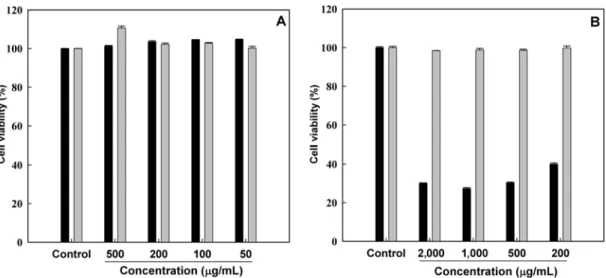
inhibition, and measurement of intracellular GSH level. Prior to checking these abilities, the cytotoxicity of MFH and MFE was determined in order to avoid interference at the tested concentrations, using RAW264.7 macrophage cells. As shown in Fig. 2, the cytotoxicity of MFH and MFE was determined by a MTT cell viability assay and no significant (p>0.05) toxic effects of MFE were observed
the tested concentrations. However, MFH exhibited toxicity when incubation for 48 hr at the tested concentrations. Therefore, based on this result, non-toxic concentrations and incubation time of MFH and MFE were used for all experiments.
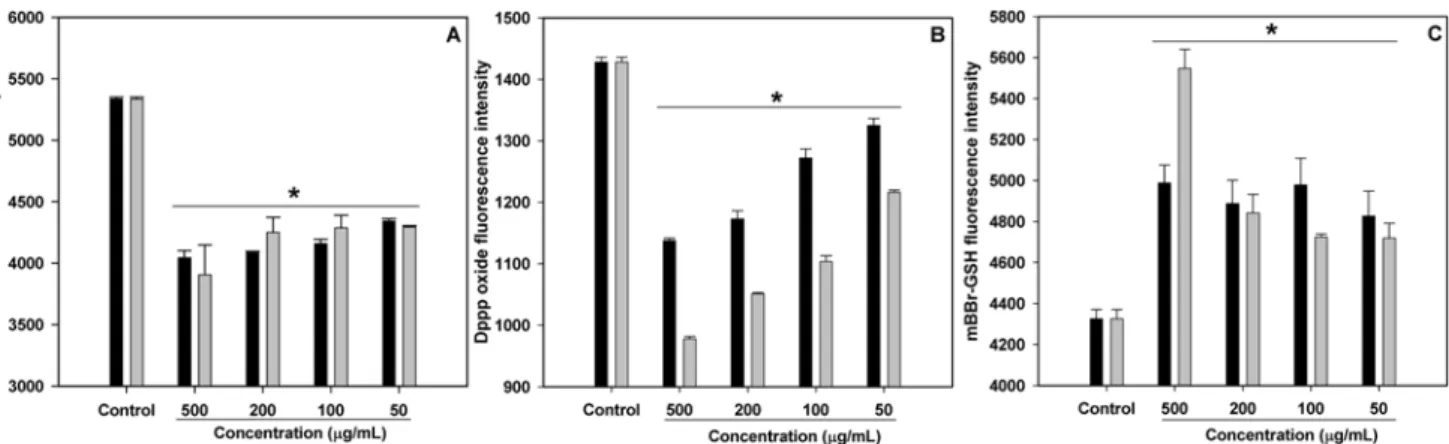
Firstly, intracellular radicals were determined using the fluorescence sensitive dye, DCFH-DA, as described previously. During labeling, the non-fluorescent DCFH-DA dye, which freely penetrates into cells, was hydrolyzed by intracellular esterases to DCFH and trapped inside the cells. As shown in Fig. 3A, both MFH and MFE decreased DCF fluorescence intensity with dose-dependant manner, and the activity was no significant (p>0.05).
Unsaturated fatty acids in cell membranes are one of the major targets of free radical-mediated oxidation. In order to investigate the effect of MFH and MFE on the inhibition of cell membrane lipid peroxidation, DPPP, a sensitive fluorescence probe, was used to determine the lipid hydroperoxide levels of RAW264.7 cells exposed to AAPH. DPPP itself is not fluorescent, but DPPP oxide the resulting product of reaction with hydroperoxide, is fluorescent with a high fluorescence yield. Hydroperoxides preferably react with DPPP molecules, which are easily incorporated into the cell membrane (15). As shown in Fig. 3B, after treatment with AAPH, a strong alkyl radical generator, DPPP oxide fluorescence intensity was increased (control), indicating lipid peroxidation was accelerated by AAPH. However, pretreatment of MFH and MFE reduced DPPP oxide fluorescence dose-dependently by inhibiting lipid peroxidation, and MFE showed more potent lipid peroxidation inhibition ability than MFH.
GSH is a key cellular reductant, reducing numerous oxidizing compounds, including ROS. Therefore, depleted
GSH levels are regularly observed in preserving a normal cellular redox state. The synthesis and metabolism of GSH are well balanced in normal cells. However, many disease conditions are associated with low GSH levels, indicating oxidative stress (23). Thus, the action of antioxidants in maintaining and improving GSH levels is an important factor to be determined. As shown in Fig. 3C, significantly increased mBBr-GSH fluorescence was observed after treatment of both MFH and MFE as compared to the control group (p<0.05).
AChE inhibition activity AChE inhibitors have been
well-characterized in clinical studies as the most promising Alzheimer’s disease therapeutic agents. In particular, AChE inhibitors increase the endogenous levels of ACh and cholinergic neurotransmission in the brain of Alzheimer’s type dementia patients (24). As a result, numerous reversible AChE inhibitors such as tacrine, donepezil, rivastigamine, galanthamine, huperzine, and other drugs currently being used in clinical trials (25). However, some of these chemically synthesized inhibitors appear to be giving rise to severe side effects such as nausea, vomiting, bradycardia, anorexia, and sweating (26). Therefore, naturally occurring AChE inhibitors without side effects has become a priority. Both MFH and MFE showed high potent AChE inhibitory ability in a dose-dependent manner and the IC50 values
were 0.629±0.021 and 0.636±0.015 mg/mL, respectively. In summary, mulberry fruit extracts, MFH and MFE, exhibited high antioxidant abilities toward DPPH scavenging, hydrogen peroxide scavenging, ferrous ion chelating, and reducing power. Furthermore, MFH and MFE showed beneficial antioxidant effects on cellular systems regarding inhibiting ROS formation, lipid peroxidation, and increasing GSH level. In addition, MFH and MFE also inhibited AChE activity. However, no significant antioxidant and AChE inhibition activity were observed between MFH and MFE (p>0.05). Therefore, isolation and determination of
bioactive components would be promising as an ingredient of functional food and/or pharmaceuticals.
Fig. 2. Cytotoxic effects of MFH and MFE on RAW264.7 macrophage cells. Different concentrations of MFH (■) and MFE (▒)
References
1. Butterfield DA, Castegna A, Pocernich CB, Drake J, Scapagnini G, Calabrese V. Nutritional approaches to combat oxidative stress in Alzheimer’s diseases. J. Nutr. Biochem. 13: 444-461 (2002) 2. Debashis DD, Bhattacharjee BM, Banerjee RK. Hydroxyl radicals
is the major causative factor in stress-induced gastric ulceration. Free Radical Bio. Med.23: 8-18 (1997)
3. Sussman MS, Bulkley GB. Oxygen derived free radicals in reperfusion injury. Methods Enzymol. 186: 711-723 (1990) 4. Vajragupta O, Boonchoong P, Wongkrajang Y. Comparative
quantitative structure-activity study of radical scavengers. Bioorg. Med. Chem. 8: 2617-2628 (2000)
5. Kumar KS, Ganesan K, Rao PVS. Antioxidant potential of solvent extracts of Kappaphycus alvarezii (Doty) Doty - An edible seaweed. Food Chem. 107: 289-295 ( 2008)
6. Choi RCY, Siow NL, Zhu SQ, Tsim KWK. The cAMP-dependent protein kinase mediates the expression of AChE in chick myotubes. Neuroreport 11: 801-806 (2000)
7. Leonetti F, Catto M, Nicolotti O, Pisani L, Cappa A, Stefanachi A, Carotti A. Homo-and hetero-bivalent edrophonium-like ammonium salts as highly potent, dual binding site AChE inhibitors. Bioorg. Med. Chem. 16: 7450-7456 (2008)
8. Bae SH, Suh HJ. Antioxidant activities of five different mulberry cultivars in Korean. LWT- Food Sci. Technol. 40: 955-962 (2007) 9. Singleton VL, Orthofer R, Lamuela-Raventos RM. Analysis of total
phenols and other oxidation substrates and antioxidants by means of Folin-Ciocalteu reagent. Methods Enzymol. 299: 152-178 (1999) 10. Blois MS. Antioxidant determination by the use of a stable free
radical. Nature 181: 1533-1535 (1958)
11. Müller HE. Detection of hydrogen peroxide produced by microorganism on an ABTS-peroxidase medium. ZBL Bakt. -Int. J. Med. M. 259: 151-158 (1985)
12. Oyaizu M. Studies on product of browning reaction prepared from glucose amine. Jpn. J. Nutr. 44: 307-315 (1986)
13. Singh N, Rajini PS. Free radical scavenging activity of an aqueous extract of potato peel. Food Chem. 85: 611-616 (2004)
14. Engelmann J, Volk J, Leyhausen G, Geurtsen WJ. ROS formation and glutathione levels in human oral fibroblasts exposed to TEGDMA and camphorquinone. J. Biomed. Mat. Res. Part B 75:
272-276 (2005)
15. Takahashi M, Shibata M, Etsuo N. Estimation of lipid peroxidation of live cells using a fluorescent probe, diphenyl-1-pyrenylphosphine. Free Radical Bio. Med. 31: 164-174 (2001)
16. Poot M, Verkerk A, Koster JF, Jongkind JF. De novo synthesis of glutathione in human fibroblasts during in vitro ageing and in some metabolic diseases as measured by a flow cytometric method. Biochim. Biophys. Acta 883: 580-584 (1986)
17. Ellman GL, Courtney D, Andres KDV, Featherstone RM. A new and rapid colorimetric determination of acetylcholinesterase activity. Biochem. Pharmacol. 7: 88-95 (1961)
18. Asano N, Yamashita T, Yasuda K, Ikeda K, Kizu H, Kameda Y, Kato A, Nash RJ, Lee HS, Ryu KS. Polyhydroxylated akaloids isolated from mulberry trees (Morus alba L.) and silkworms (Bombyx mori L.). J. Agr. Food Chem. 49: 4208-4213 (2001) 19. Kim HB, Kim SY, Ryu KS, Lee WC, Moon JY. Effect of methanol
extract from mulberry fruit on the lipid metabolism and liver function in cholesterol-induced hyperlipidemia rats. Korean J. Sericul. Sci. 43: 104-108 (2001)
20. Kim SY, Park KJ, Lee WC. Antiinflammatory and antioxidative effects of Morus spp. fruit extract. Korean J. Med. Crop Sci. 6: 204-209 (1998)
21. Lu Y, Foo LY. Antioxidant and free radical scavenging activities of selected medicinal herbs. Life Sci. 66: 725-735 (2000)
22. Oki T, Masuda M, Furura S, Nishibia Y, Terahara N, Suda I. Involvement of anthyocyanins and other phenolic compounds in radical-scavenging activity of purple-fleshed sweet potato cultivars. J. Food Sci. 67: 1752-1756 (2002)
23. Reid M, Jahoor F. Glutathione in diseases. Curr. Opin. Clin. Nutr. 4: 65-71 (2001)
24. Yu SQ, Utsuki HW, Brossi T, Greig ANH. Synthesis of novel phenserine-based-selective inhibitors of butyrylcholinesterase for Alzheimer’s disease. J. Med. Chem. 42: 1855-1861 (1999) 25. Jia P, Sheng R, Zhang J, Fang L, He Q, Yang B, Hu Y. Design,
synthesis, and evaluation of galanthamine derivatives as acetylcholinesterase inhibitors. Eur. J. Med. Chem. 44: 772-784 (2009)
26. Giacobini, E. Cholinesterase inhibitors: New roles and therapeutic alternatives. Pharmacol. Res. 50: 433-440 (2004)
Fig. 3. Antioxidant activities of MFH (■) and MFE (▒) on RAW264.7 macrophage cells. (A) Cellular radical scavenging activity,
(B) membrane lipid peroxidation inhibition activity, and (C) effect of cellular GSH levels. Data are presented as mean±SE from 3 independent determinations. *Significantly different at p<0.05 vs. control group.