J Korean Acad Community Health Nurs (지역사회간호학회지) https://doi.org/10.12799/jkachn.2017.28.3.240
A Comparative Study about Risk Factors Influencing Suicide Ideation
between Korean and Multicultural Adolescents
Lee, Hanju
Department of Nursing, Sangmyung University, Cheonan, Korea
Purpose: In South Korea, suicide mortality has rapidly increased, so it has become a major public health concern.
Multicultural adolescents are regarded as a high-risk group due to their situation. In this study, we compared the prev-alence and risk factors of suicide ideation between Korean and multicultural adolescents. Methods: Data from the eleventh Korean Youth Risk Behavior Web-based Survey (2015), collected by the Korean Centers for Disease Control and Prevention, were statistically analyzed using the descriptive statistics and multivariate logistic regression. The total participants were 63,376 in numbers. They were composed of 62,649 (98.9%) Korean and 727 (1.1%) multicultural adolescents. Results: I found that the prevalence of suicide ideation was significantly higher among the multicultural adolescents (15.8%) compared with those of Korean (11.3%). The risk factors of suicide ide-ation in the Korean group were co-residence without family, poor perceived health status, depressive mood, high stress level, poor perceived happiness level, and experience of violence. Conversely, the risk factors of the multi-cultural group were smoking, depressive mood, and experience of violence. Conclusion: These findings suggest that appropriate and practical prevention strategies should focus on psychological and environmental factors in order to prevent suicide ideation and reduce suicide behavior in Korean and multicultural adolescents.
Key Words: Adolescents, Cultural diversity, Suicidal ideation
Corresponding author: Lee, Hanju
Department of Nursing, Sangmyung University, 31 Sangmyungdae-gil, Dongnam-gu, Cheonan 31066, Korea. Tel: +82-41-550-5429, Fax: +82-41-550-5545, E-mail: [email protected]
Received: Mar 10, 2017 / Revised: Jul 6, 2017 / Accepted: Jul 9, 2017
This is an open access article distributed under the terms of the Creative Commons Attribution Non-Commercial License (http://creativecommons.org/licenses/ by-nc/3.0), which permits unrestricted non-commercial use, distribution, and reproduction in any medium, provided the original work is properly cited.
INTRODUCTION
In the past few years, the number of marriage immi-grants and foreign workers living in South Korea has in-creased rapidly. According to statistics from the Ministry of Interior in 2015, of the 1,711,013 foreign nationals living in South Korea, 144,912 (8.05%) were married to immi-grants and 93,249 (5.4%) were married to naturalized per-sons; 83~89% of these individuals were women [1]. This increasing number of international marriages and migrant workers has led to an increasing number of adolescents from multicultural backgrounds. Indeed, according to youth statistics from 2016, the number of students from multicultural families reached 82,536 in 2015, or 1.4% of the total number of students, which was an 24.0% increase from 2012 [2]. Since South Korea is rapidly transforming into a multicultural society, it would be important task to ensure that people with diverse backgrounds can
success-fully integrate into and live safely within Korean society. Adolescence is a psychologically unstable developmental stage, and when adolescents' interaction with their sur-rounding environment is problematic, they are at high risk of developing extreme thoughts and taking extreme action, such as death with despair [3]. suicide ideation is a logical precedent of suicide attempts and behaviors. Indeed, the stronger the suicide ideation, the greater the likelihood of at-tempting suicide [4]. Adolescents are known to be more like-ly to express their thoughts of suicide [5]. According to sta-tistics released by the Stasta-tistics Korea, suicide is the main cause of deaths among adolescents in South Korea from 2007. In 2014, it was reported that the rate of suicide was 7.4 per 100,000 people [2]. The Korea Youth Policy Insti-tute conducted a “survey on the mental health status of 2012 Korean children and adolescents” in 8,745 elemen-tary, middle and high school students. In this sample, 23.4 % of respondents indicated that they had thought about
suicide [6].
It has been reported that, in the adolescent period, when individuals are typically beginning to form their identity, children of multicultural families are at an increased risk to experience identity crisis and confusion that is more severe than that experienced by their Korean families [7]. Not only are these individuals possibly more vulnerable to anxiety about social acceptance and the fear of rejection, but they al-so tend to not receive support at home [8]. Therefore, it is not surprising that one study found a rate of depression in this population of 18.2%[9]. Further, in a study comparing suicide behaviors among adolescents of multicultural fami-lies and adolescents in the general population, Kim and Kim [10] reported that the risk of suicide was higher when the father, or if both parents were foreigners.
Researchers have shown that being from a multicultural family can influence adolescents' psychology, including their likelihood of attempting suicide. In particular, chil-dren of multicultural families in South Korea tend to expe-rience emotional difficulties because of social prejudice and discrimination [11], low socioeconomic status, and psychological and social maladjustment [12]. These fac-tors in turn generate stress and increase the likelihood of negative coping behaviors [34]. Such coping behaviors in-clude health risk behaviors such as drinking and smoking, the likelihood of which is already high in adolescence [13,14]. Another report has shown that drugs, depression, school violence, drinking, and family conflicts are relate to suicidal thoughts [15].
Conversely, as the level of mother's education increased, and as income level of the family increases, the level of child's achievement motivation, self-esteem, and learning activity also increases. There have also been studies re-porting that the level of psychological behavioral develop-ment of multicultural adolescents is higher than typical adolescents [16]. In other words, multicultural families should not be considered as a homogeneous group and should not be necessarily perceived as vulnerable. This is because the academic and psychological development lev-els of their children often vary according to environmental factors, such as parental education and income level. There-fore, rather than providing support for multicultural ado-lescents only by considering the specificity of multicultu-ralism, the development of integrated programs, which include Korean adolescents in crisis and keeps the com-monalities of all adolescents in mind, can be more effective at incorporating multicultural adolescents into Korean so-ciety and increasing the acceptance of multicultural ado-lescents by Korean adoado-lescents.
While the precise factors have differed among
research-ers, in general, the factors influencing suicidal behavior can be grouped into social, home environment, personality, mental-health-related, and stressful-life-event-related fac-tors. In particular, mental-health-related factors such as de-pression and anxiety have been attracting attention as ma-jor contributors to suicidal thoughts and attempts [17,18]. Park [19] conducted a study on suicide attempts of Korea adolescents based on the 2006 youth online survey data. Park stated that the factors influencing suicide attempts were varied, and included personal characteristics and health behavior. This was especially true for suicidal thoughts, factors related to mental health (depression, stress, and happiness), health risk behaviors (perceived health status, drinking, smoking, drug use, sexual activity, absence of breakfast, presence of disease), and personal characteristics (co-residence type, academic achievement). Based on the data of the youth online survey in 2012, Park et al., who conducted studies on suicide ideation in multi-cultural adolescents, found that health-related variables (alcohol, drugs), mental health (happiness, depression), economic conditions, and school violence experience af-fected suicide ideation [15]. These two studies occurred at different time points, only one group was examined for factors influencing suicide ideation and attempts, and some of the variables explored were also different. There-fore, it is difficult to directly compare what factors influ-enced suicide attempts and ideation among Korean and multicultural adolescents in Korea. Thus, it cannot be ar-gued that the factors influencing suicidal ideation are the same or different between the two groups.
The present study was conducted to investigate and compare the risk factors influencing suicide ideation among adolescents from multicultural families and Korean fami-lies by same dataset, and to provide basic data for the de-velopment of one comprehensive programs for the pre-vention of suicide of adolescents itself not differentiate Korea or multicultural. The specific purposes of this study are as follows: (1) to analyze the rates of suicide ideation among adolescents from multicultural and Korean fami-lies; (2) to analyze what general characteristics of these two groups of adolescents relate to suicide ideation; (3) and to determine and compare the relationship between general characteristic factor, health risk behavior, psychological variables and suicide ideation in two groups.
METHODS
1. Study Design
random-ized sample of adolescents in Korea. This study is a secon-dary data analysis wherein I compared suicide ideation between adolescents of multicultural and Korean families and identified the factors that influence suicide ideation. Data were taken from the 2015 Korean Youth Risk Behavi-or Web-Based Survey (KYRBWS). The KYRBWS is a gov-ernment-approved statistical survey that has been perfor-med annually by the Korea Centers for Disease Control and Prevention since 2005 in order to monitor health risk be-haviors among Korean adolescents. It uses a stratified mul-tistage cluster sampling design to obtain a nationally rep-resentative sample of middle and high school students. After the survey was fully explained to potential partici-pants, those who provided their informed consent com-pleted the anonymous, self-administered web-based sur-vey during a regular class period. The KYRBWS collects no identifiers (e.g., students' names, schools, telephone numbers, home addresses, or social security numbers).
2. Study Participants
A total of 70,362 students from 400 middle schools and 400 high schools participated in the survey (response rate= 96.7%). So, the final sample of this study was 63,376 stu-dents (32,715 boys and 30,661 girls, mean age=14.96±1.74 years, range=12~18 years). They were composed of 62,649 (98.9%) Korean adolescents and 727 (1.1%) multicultural adolescents. Additional details about the sampling meth-odology and survey procedure are available elsewhere [20].
3. Measures
1) Multicultural families
The following questions were asked: “Was your father born in Korea?” and “Was your mother born in Korea?” If both parents were native Koreans, adolescents were classi-fied as being from a Korean family. Adolescents whose fa-ther or mofa-ther (or both) was foreign born were classified as being from a multicultural family.
2) Socio-demographic variables
Socio-demographic variables included age, gender, res-idence (size of city), co-resres-idence status, perceived family economic status, and perceived academic achievement. Residence was classified as rural area, small city, or large city. Co-residence status was classified as living with fam-ily or living with others. Perceived famfam-ily economic status and academic achievement were both assessed using 5- point Likert.
3) Health behavior variables
Health behavior variables included perceived health status, alcohol drinking, and smoking. Perceived health status was assessed using a 5-point Likert scale (very healthy, healthy, normal, a little unhealthy, and very un-healthy). Smoking was assessed with the following ques-tion (with possible responses of “yes” or “no”: “Have you smoked a cigarette in the last 1 month?” Alcohol drinking was assessed with a similar question (also yes/no): “Have you drank alcohol in the last 1 month?”
4) Psychological variables
Psychological variables were perceived stress, depres-sion, perceived happiness, experience of violence (by fri-ends, elders, etc.). The level of perceived stress was meas-ured with the following question: “How much stress do you usually feel?” Participants responded using a 5-point Likert scale (very much, a lot, an average amount, a little, and not feel) Depression was assessed with the following yes/no question: “Have you ever felt sad or desperate enough to stop your daily life over two weeks in the last 12 months?” The level of perceived happiness was measured with the following question: “How happy do you feel?” Responses were made on a 5-point Likert scale (very hap-py, a lot, an average amount, a little unhaphap-py, and very unhappy) Experience of violence was assessed with the following yes/no question: “Have you ever experienced hospital treatment for violence?”
5) Suicide ideation
Suicide ideation was assessed with the yes/no question: “Have you seriously thought of committing suicide dur-ing the past 12 months?”
4. Data Analysis
Descriptive statistics were used to identify general char-acteristics, health behavior, psychological variables, sui-cide ideation rate of two groups. The x2 test was used to
compare study variables according to presence of suicide ideation in adolescents from multicultural and Korean fa-milies. Logistic regression analyses were performed to de-termine the factors that influence the odds of suicide idea-tion. Odds ratios (ORs) and 95% confidence intervals (CIs) were calculated, with suicide ideation as the main out-come variable and health behaviors and psychological variables as the main predictors, after controlling for gen-der, residence, co-residential status, perceived economic status, and perceived academic performance. The purpose of this study was to compare the factors affecting suicide
ideation in Korean adolescents and the factors affecting suicide ideation in adolescents in multicultural families. Therefore, the two groups were separated and analyzed statistically within each group. All analyses took into ac-count the sampling design parameters, including weight-ing, clusterweight-ing, and stratification. Specifically, partic-ipants' general characteristics were weighted according to each respondent's probability of being selected for the sex-, grade-, and school-type-specific distributions for the region [20]. The finite population correction factor was used to avoid overestimation when developing variance estimates for population parameters.
5. Ethical Considerations
This was a secondary analysis of the data from a study approved as an official project by the institutional review board of the Korea Centers for Disease Control and Pre-vention in 2014 (2014-06EXP-02-P-A). The private infor-mation of each participant was coded during data analysis in order to blind researchers. As such, this study did not need the approval of an institutional review board.
RESULTS
1. Demographic Characteristics and Suicide
Idea-tion of Participants
Of the 63,376 respondents, 727 (1.1%) were from multi-cultural families (54.2% were male and 45.8% were fe-male), 62, 649 (98.9%) were adolescents from general Ko-rean families (52.0% were male and 48.0% were female).
Among multicultural adolescents, the regional distri-bution was as follows: 323 (49.8%) resided in small and medium sized cities, 232 (35.1%) resided in metropolitan cities and 172 (15.1%) resided in the rural area. Among Korean adolescents, 29,844 (50.2%) resided in small and medium sized cities, 27,941 (43.8%) resided in metropoli-tan cities and 4,864 (5.9%) resided in the rural area. The difference in residential area between the two groups were statistically significant (p<.001).
The average economic status of multicultural adoles-cents was 169 (25.5%) high, 352 (46.4%) medium and 206 (28.1%) low, respectively. Among Korean adolescents' house-holds, the economic status were as follows: 23,446 (37.6%) upper-class, 29,805 (47.4%) middle-class, and 9,398 (15.0%) lower-class. The differences in socioeconomic status be-tween the two groups was significant (p<.001).
The academic achievement level was as follows: 315 multicultural students (43.3%) answered “low”, which was
higher than Korean adolescent (20,815, 33.4%, p<.001). A total of 492 (67.4%) of the multicultural adolescents an-swered that they were healthy in their subjective health perception, which was less than that of the Korean adoles-cents (45,916, 73.1%, p=.003).
Among the students who reported alcohol use, the per-centage of students who answered that they had con-sumed alcohol within the past month was not significantly different between the two groups. However, among stu-dents who had ever smoked a cigarette, 76 (55.1%) of the multicultural respondents said that they had smoked within the past month, compared with 4,358 (43.1%) of Korean adolescents (p=.004).
In the perception of happiness, 77 (10.9%) of the multi-cultural adolescents responded as unhappy, which was more than Korean adolescents 4,770 (7.8%, p=.005). Addi-tionally, 296 (41.6%) multicultural respondents answered that they had experienced stress which was a higher rate than the 21,807 (35.1%) Korean adolescents who answered the same way. Further, there were more multicultural ado-lescents who reported depression (p=.003). In addition, more multicultural household adolescents reported that they experienced violence (p<.001). The prevalence of sui-cide ideation was 15.8% among adolescents of multi-cultural families, which was significantly higher than the 11.3% among adolescents of Korean families (Table 1).
2. Association between Variables and Suicide
Idea-tion by Family Origin
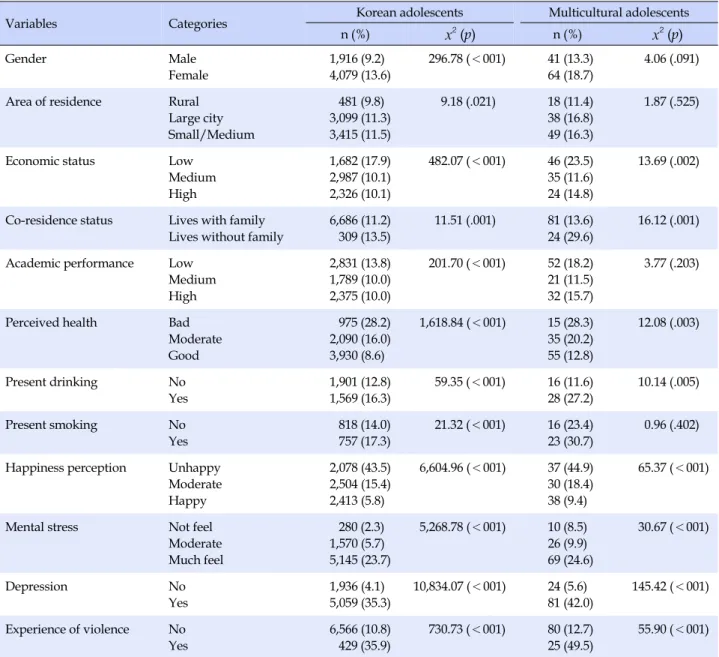
The relationships between demographic characteristics and suicide ideation was analyzed in both multicultural and Korean families (Table 2). In both types of family, age was not associated with suicide ideation. The significant factors associated with suicide ideation in Korean adoles-cents were gender, residence, perceived economic status, co-residence status, and perceived academic performance. Girls had a higher prevalence of suicide ideation than did boys (13.6% vs. 9.2%, respectively), while adolescents liv-ing in rural areas had a lower prevalence (9.8%) compared adolescents living in large and small cities (11.3% and 11.5%, respectively). Additionally, adolescents with a low perceived economic status (17.9%) had a higher preva-lence than did those with a “middle” and “high” status (both 10.1%). The suicide ideation prevalence was higher among those who were not living with family members (13.5%) than among those living with family members (11.2%). Perhaps with a low academic performance had a suicide ideation prevalence of 13.8%, which was higher than the 10.0% among those with middle and high
perfor-Table 1. Demographic Characteristics and Prevalence of Suicide Ideation of Participants (N=63,376) Variables Categories Korean adolescents Multicultural adolescents x2 or t (p) M±SD, n (%) M±SD, n (%) Age (year) 15.07±0.02 14.85±0.06 2.77 (.006) Gender Male Female 32,339 (52.0) 30,310 (48.0) 376 (54.2) 351 (45.8) 1.24 (.280) Area of residence Rural
Large city Small/Medium city 4,864 (5.9) 27,941 (43.8) 29,844 (50.2) 172 (15.1) 232 (35.1) 323 (49.8) 95.47 (<.001)
Economic status Low
Medium High 9,398 (15.0) 29,805 (47.4) 23,446 (37.6) 206 (28.1) 352 (46.4) 169 (25.5) 92.42 (<.001)
Co-residence status Lives with family Lives without family
60,116 (96.4) 2,533 (3.6)
640 (86.6) 87 (13.4)
165.75 (<.001) Academic performance Low
Medium High 20,815 (33.4) 17,709 (28.3) 24,125 (38.3) 315 (43.3) 177 (24.1) 235 (32.6) 26.84 (<.001)
Perceived health Bad
Moderate Good 3,477 (5.6) 13,256 (21.3) 45,916 (73.1) 52 (7.0) 183 (25.6) 492 (67.4) 10.09 (.003) Present drinking† No Yes 14,806 (59.8) 9,784 (40.2) 145 (57.6) 110 (42.4) 0.46 (.493) Present smoking† No Yes 5,832 (56.9) 4,358 (43.1) 70 (44.9) 76 (55.1) 8.18 (.004) Happiness perception Unhappy
Moderate Happy 4,770 (7.8) 16,248 (26.3) 41,631 (65.9) 77 (10.9) 192 (27.6) 458 (61.5) 9.70 (.005)
Mental stress Not feel
Moderate Much feel 13,175 (20.7) 27,667 (44.3) 21,807 (35.1) 146 (18.8) 285 (39.6) 296 (41.6) 11.47 (.002) Depression No Yes 48,287 (76.9) 1,4362 (23.1) 532 (72.1) 195 (27.9) 7.74 (.003) Experience of violence No Yes 61,542 (98.1) 1,197 (1.9) 675 (91.8) 52 (8.2) 126.06 (<.001) Suicide ideation No Yes 55,654 (88.7) 6,995 (11.3) 622 (84.2) 105 (15.8) 12.06 (.001) Total 62,649 (98.9) 727 (1.1) †
Limited to those who have ever smoked or alcohol drink.
mance.
Among participants of multicultural families, the prev-alence of suicide ideation was influenced only by per-ceived economic status and co-residential status. Specifi-cally, suicide ideation was more likely among those with a low perceived economic status (23.5%) than among those with a middle (11.6%) or high (14.8%) economic status. Furthermore, adolescents living with non-family
mem-bers had a higher suicide ideation prevalence (29.6%) than did those living with family members (13.6%).
Among adolescents of multicultural families, perceived health status, drinking, perceived happiness, perceived stress, depression, and experience of violence were all re-lated to suicide ideation.
Specifically, those with a poorer perceived health tend-ed to have higher suicide ideation. Furthermore,
adoles-Table 2. Association between Variables and Suicide Ideation (Yes) by Family Origin
Variables Categories Korean adolescents Multicultural adolescents
n (%) x2(p) n (%) x2(p) Gender Male Female 1,916 (9.2) 4,079 (13.6) 296.78 (<001) 41 (13.3) 64 (18.7) 4.06 (.091) Area of residence Rural
Large city Small/Medium 481 (9.8) 3,099 (11.3) 3,415 (11.5) 9.18 (.021) 18 (11.4) 38 (16.8) 49 (16.3) 1.87 (.525)
Economic status Low
Medium High 1,682 (17.9) 2,987 (10.1) 2,326 (10.1) 482.07 (<001) 46 (23.5) 35 (11.6) 24 (14.8) 13.69 (.002)
Co-residence status Lives with family Lives without family
6,686 (11.2) 309 (13.5)
11.51 (.001) 81 (13.6) 24 (29.6)
16.12 (.001) Academic performance Low
Medium High 2,831 (13.8) 1,789 (10.0) 2,375 (10.0) 201.70 (<001) 52 (18.2) 21 (11.5) 32 (15.7) 3.77 (.203)
Perceived health Bad Moderate Good 975 (28.2) 2,090 (16.0) 3,930 (8.6) 1,618.84 (<001) 15 (28.3) 35 (20.2) 55 (12.8) 12.08 (.003) Present drinking No Yes 1,901 (12.8) 1,569 (16.3) 59.35 (<001) 16 (11.6) 28 (27.2) 10.14 (.005) Present smoking No Yes 818 (14.0) 757 (17.3) 21.32 (<001) 16 (23.4) 23 (30.7) 0.96 (.402) Happiness perception Unhappy
Moderate Happy 2,078 (43.5) 2,504 (15.4) 2,413 (5.8) 6,604.96 (<001) 37 (44.9) 30 (18.4) 38 (9.4) 65.37 (<001)
Mental stress Not feel
Moderate Much feel 280 (2.3) 1,570 (5.7) 5,145 (23.7) 5,268.78 (<001) 10 (8.5) 26 (9.9) 69 (24.6) 30.67 (<001) Depression No Yes 1,936 (4.1) 5,059 (35.3) 10,834.07 (<001) 24 (5.6) 81 (42.0) 145.42 (<001) Experience of violence No Yes 6,566 (10.8) 429 (35.9) 730.73 (<001) 80 (12.7) 25 (49.5) 55.90 (<001)
cents who engaged in alcohol drinking had a higher prev-alence than did those who did not engage in this behavior (27.2% vs. 11.6%). Participants with poorer perceived hap-piness tended to have a higher suicide ideation prevalence (44.9% unhappy vs. 18.4% moderate happy, 9.4% happy), as did adolescents with high stress (i.e., >average), de-pression (42.0% with dede-pression vs. 5.6% without depres-sion) and experience of violence (49.5% with experience of violence vs. 12.7% without).
Among adolescents of Korean families, suicide ideation was associated with perceived health status, alcohol drink-ing, smokdrink-ing, perceived happiness, perceived stress, de-pression, and experience of violence, showing roughly the
same patterns as the adolescents of multicultural families for perceived health status, alcohol drinking, happiness, and stress as well as experience of violence. But the associ-ation for smoking were significant different from adoles-cents of multicultural.
3. Determinants of Suicide Ideation by Family Origin
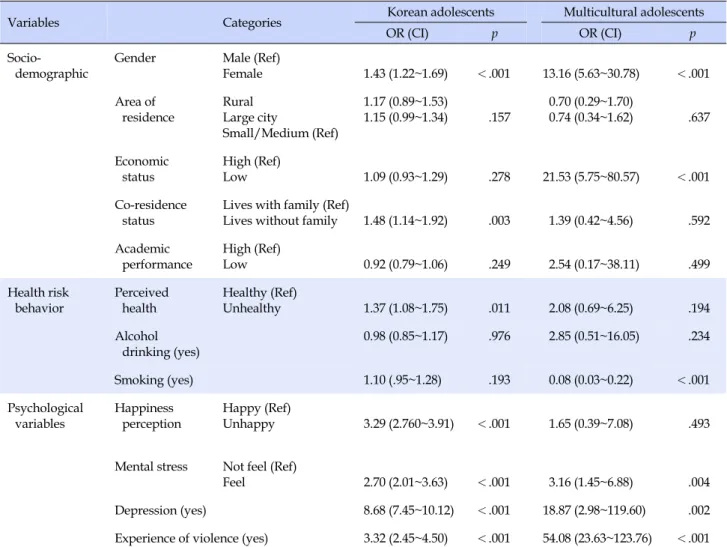
Among adolescents of Korean families, the following characteristics were significantly related to odds of report-ing suicide ideation: age, gender, co-residence status, per-ceived health, depression, perper-ceived stress, perper-ceived hap-piness, and experience of violence (Table 3). Morespecifi-Table 3. Determinants of Suicide Ideation by Family Origin
Variables Categories Korean adolescents Multicultural adolescents
OR (CI) p OR (CI) p
Socio-demographic
Gender Male (Ref)
Female 1.43 (1.22~1.69) <.001 13.16 (5.63~30.78) <.001 Area of residence Rural Large city Small/Medium (Ref) 1.17 (0.89~1.53) 1.15 (0.99~1.34) .157 0.70 (0.29~1.70) 0.74 (0.34~1.62) .637 Economic status High (Ref) Low 1.09 (0.93~1.29) .278 21.53 (5.75~80.57) <.001 Co-residence status
Lives with family (Ref)
Lives without family 1.48 (1.14~1.92) .003 1.39 (0.42~4.56) .592 Academic
performance
High (Ref)
Low 0.92 (0.79~1.06) .249 2.54 (0.17~38.11) .499
Health risk
behavior Perceived health Healthy (Ref)Unhealthy 1.37 (1.08~1.75) .011 2.08 (0.69~6.25) .194 Alcohol drinking (yes) 0.98 (0.85~1.17) .976 2.85 (0.51~16.05) .234 Smoking (yes) 1.10 (.95~1.28) .193 0.08 (0.03~0.22) <.001 Psychological variables Happiness perception Happy (Ref) Unhappy 3.29 (2.760~3.91) <.001 1.65 (0.39~7.08) .493 Mental stress Not feel (Ref)
Feel 2.70 (2.01~3.63) <.001 3.16 (1.45~6.88) .004
Depression (yes) 8.68 (7.45~10.12) <.001 18.87 (2.98~119.60) .002 Experience of violence (yes) 3.32 (2.45~4.50) <.001 54.08 (23.63~123.76) <.001
OR=odds ratio; CI=confidence interval; Ref=reference.
cally, older age (OR=0.86 for every 1 year), female gender (OR=1.43), living without family members (OR=1.39), poor perceived health status (OR=1.37), depressive mood (OR= 8.68), >average perceived stress (OR=2.70), >average perceived happiness (OR=3.29), and experience of vio-lence (OR=3.32) were all positively associated with in-creased odds of suicide ideation.
For adolescents of multicultural families, the following characteristics were statistically significantly related to odds of reporting suicide ideation: gender, perceived economic status, smoking, perceived stress, depression, and experi-ence of violexperi-ence. Specifically, female gender (OR=13.16), ≤average perceived economic status (OR=21.53), smoking (OR=13.14), depression (OR=18.87), >average perceived stress (OR=3.16) and experience of violence (OR=54.07) had positive and significant associations with odds of sui-cide ideation.
DISCUSSION
This study was a secondary analysis of national survey data. The purpose of the current study was to compare the rate of suicide ideation and the factors of multicultural and Korean adolescents. A composite sample analysis method was used to analyze survey data designed to re-flect the gender, age, and demographic structure of the population [20]. As a result of the survey, the percentage of Korean and multicultural adolescents were 99% to 1%, respectively. According to 2015 statistics, the percentage of multicultural household adolescents (middle and high school students) in Korea was 1.4%, As the current data re-flects the percentage, it is likely to accurately depict the ac-tual situation of multicultural adolescents in Korea [2].
To our knowledge, this is the first nationally representa-tive study which compare the prevalence of suicide idea-tion and influencing factors among adolescents from
mul-ticultural families and Korean families using same dataset in South Korea. As noted above, the suicide rate among Korean adolescents is a serious public health issue. In this study, the suicide ideation rate of adolescents was 11.3% among adolescents from Korean families and 15.8% among adolescents from multicultural families. This result is low-er than that of Park [19], who reported that 23% of Korean adolescents attempted suicide, in a study using 2006 youth online data. Further, the current rate is lower than 2011 da-ta where suicide attempts were reported by 22.4% of mul-ticultural adolescents [12], and 2012 data where suicidal thoughts of multicultural adolescents were reported at 21.2%[15]. Although the suicide rate of adolescents is de-creasing, deaths from suicide are still ranked as the num-ber one cause of adolescent death. It is possible that the rate of adolescents thinking about suicide is artificially low. This is because these individuals may avoid thinking about the pain of reality. However, this does not accu-rately represent the high rate of actual attempts among those who feel suicidal. Therefore, Korean society still must take preventive measures against suicidal ideation in youth.
In this study, the general characteristics that related to the suicide ideation of adolescents were different in two groups. There were notable differences in characteristics related to suicide ideation between Korean and multicul-tural families. Among Korean adolescents, gender, area of residence, perceived economic status, co-residence type, and academic performance. but in multicultural adoles-cents, gender, area of residence, academic achievement were not significant.
In a previous study [22], gender demonstrated a signi-ficant relationship with suicide ideation in Korean adoles-cents. These results are inconsistent with a study that shows that the relationship between gender and suicide ideation was not significant in multicultural adolescents [15]. However, in the logistic analysis of the current study, gender affected suicide ideation in both groups, with fe-male being 1.43 times more likely in the Korean group and 13.16 times more likely in multicultural group to display suicide ideation, when compared to males.
Also, area of residence and academic performance was not related to suicide ideation in adolescents from multi-cultural families, but it was in adolescents from Korean families. In the logistic analysis, neither the residence area, nor academic achievement of the two groups had any ef-fect on suicide ideation. This result is different from pre-vious studies, which reported academic achievement as a factor influencing suicide ideation among Korean adoles-cents [6], and worry about academic achievement and
ad-mission to upper school as factors that caused suicidal thoughts among multicultural adolescents [2].
Perceived economic status and co-residence type were also common characteristics related to suicide ideation in both groups of adolescents. However, in the logistic analy-sis, it was found that Korean adolescents were influenced by their co-residence type while perceived economic sta-tus influenced multicultural adolescents. This is consistent with the results of a study in which suicide attempts were more frequent among families of lower socioeconomic sta-tus [10], and among single parent families and adolescents raised by their grandparents [6]. In other words, living with family members in a stable living environment, whether Korean or multicultural, increases psychological stability, resulting in less suicide ideation.
Overall, the home environment variables appear more influential of the suicide ideation of adolescents than do individual factors such as academic performance. This ac-cords with a meta-analysis of the protective factors asso-ciated with suicide ideation in adolescents [23], wherein the effect size of the family environment variables was statistically significant.
In the analysis of the prevalence of suicide ideation ac-cording to health risk behaviors and psychological factors, the factors associated with suicide ideation among adoles-cents from Korean families were perceived health status, alcohol drinking, smoking, perceived happiness, percei-ved stress, depression, and experience of violence. Those among adolescents from multicultural families, perceived health status, alcohol drinking, perceived happiness, per-ceived stress, depression, and experience of violence were related to suicide ideation.
Notably, the odds of suicide ideation were higher in on-ly Korean adolescents when they perceived themselves as unhealthy. This agrees with one study showing that great-er pgreat-erceived health was associated with lowgreat-er suicide ide-ation [7]. However, it is not consistent another study [15] reporting that suicide ideation and health status were not related. This discrepancy is perhaps because health status is how one feels about one's physical condition at the time of investigation; as such, it is perhaps unrelated to con-tinuous or repetitive suicide ideation.
Alcohol drinking and smoking were related to suicide ideation in adolescents from Korean families, among mul-ticultural adolescents, only alcohol drinking was related to suicide ideation. However, in logistic analysis, smoking alone was a significant factor for suicide ideation among adolescents in multicultural families. These results are somewhat consistent with a study wherein suicide idea-tion was higher among alcohol drinking and smokers [7],
as well as a study wherein suicide ideation was only re-lated to alcohol drinking [15]. Health risk behaviors such as alcohol drinking and smoking can serve as a mecha-nism for the release of mental pressure. In other words, health risk behaviors such as drinking and smoking may lead to suicidal thoughts, while those who actually com-mit suicide may reduce their thoughts by drinking and smoking. This is because smoking rates and drinking rates of adolescents in multicultural families are lower than those of Korean families [24], and smoking rates and drinking rates of multicultural families are higher than those of gen-eral household adolescents [25]. Therefore, this relation-ship seems to require further research to analyze what are the causes and long-term results through longitudinal study.
Perception of happiness was associated with suicide ideation in both groups, but logistic analysis showed that suicidal ideation among Korean adolescents were more associated with the perception of unhappiness. The results regarding happiness is consistent with a previous study showing the same [7].
Stress was associated with suicide ideation in both groups. The more stress one perceived, the more suicide ideation occurred. The magnitude of the relationship of suicide ideation with stress appears to vary from research-er to researchresearch-er, with one study [15] reporting that stress was not significantly related, and another [26] noting that it was.Jeon et al.[26] reported that stress related to family, peer, and teacher relationships were main factors influ-encing adolescents' suicide ideation. The relationship be-tween suicide ideation and stress in adolescents seems to reflect a special situation of adolescents in Korea, and their experience of stress due to overly competitive academic environment.
Depression was associated with suicide ideation in both groups. Depression is considered to be the most direct cause of suicide, and in a study of college students in Korea, depression has proven to significantly predict suicidal ide-ation [27]. However, around 14.3% of children of married immigrants have been reported to experience depression or helplessness [28], thus indicating that adolescents from multicultural families are more likely to feel depressed and experience suicide ideation than are Korean adoles-cents. Thus, the former population would require partic-ular management.
The experience of violence was related to suicide idea-tion in both Korean and multicultural adolescents. This is consistent with the results of previous studies [29]. Note that violence in this study is not only physical violence but also verbal and emotional violence. If adolescents in
mul-ticultural families experience difficulties in adapting to school because of differences in appearance and language development or linguistic and emotional conflicts with peers or seniors, it may lower their confidence and in-crease their depression and stress. This, in turn, would predict a likelihood of suicide ideation.
These results suggest that Korean adolescents and mul-ticultural adolescents display similar causes of suicide ide-ation such as stress, depression, and violence victimiza-tion experiences. Korean adolescents were more likely to display suicide ideation when they did not live with their families or considered themselves unhappy. However, multicultural adolescents displayed more suicidal when they felt that their economic status was bad. Living with one's family and economic status are the family environ-ment factors surrounding adolescents. This suggests that it is necessary to provide a supplementary program that can substitute for a negative family environment for both groups, as negative family environment may effect adoles-cents emotionally and result in suicide.
This study has a clear strength in its inclusion of data from 72,060 adolescents from a nationally representative sample in South Korea, which improves the external val-idity of the study results. However This study has the fol-lowing limitations in the application and interpretation of our results.
First, it cannot capture adolescents' period of residence in South Korea, their frequency of use of the Korean lan-guage, or their country of birth. These are likely to affect participants' level of adaptation, and thus their likelihood of suicide. Second, depressive mood and perceived stress was only measured with a single item each, rather than with standardized multi-item measures. This may limit the validity of the measurements of these variables. Third, this study is a cross-sectional study, so it is difficult to en-sure causality in epidemiological studies, and has limi-tation in generalize. it will be interpretate only for adoles-cents in South Korea.
CONCLUSION
Even within the context of these limitations, the results of the present study indicate that approximately 11.3% and 15.8% of adolescents from Korean and multicultural families, respectively, engaged in suicide ideation, which in turn, were associated with family environment and psy-chological problems. Therefore, rather than only provid-ing support for local communities of multicultural adoles-cents by considering the specificity of multiculturalism, the development of integrated programs that include all
adolescents in crisis could be more effective in helping multicultural adolescents to assimilate to Korean society.
However, the cross-sectional nature of this study limits our understanding of the influencing factors; thus, future prospective studies are required in order to identify the casual relationships among suicide ideation and various risk factors.
REFERENCES
1. Ministry of the Interior. Status of foreign residents 2015 [Inter-net]. Seoul: Ministry of the interior. 2016 [cited 2017 May 3]. Available from:
http://www.moi.go.kr/frt/bbs/type010/commonSelectBoar dArticle.do?bbsId=BBSMSTR_000000000018&nttId=56680 2. Statistics Korea. 2016 Korea youth statistics [Internet]. Seoul:
Statistics Korea. 2016 [cited 2017 May 3]. Available from: http://kostat.go.kr/wnsearch/search.jsp
3. Lee GJ, Cho SH. Psychological characteristics of high risk group on adolescent suicide. KoreanJournal of Counseling and Psychotherapy. 2004:16(4):667-685.
4. Pfeffer CR, Kleman GL, Hurt SW, Lesser M, PeskinJR, Siefker CA. Suicidal children grow up: Demographic and clinical risk factors for adolescent suicide attempts.Journal of the American Academy of Child and Adolescents Psychiatry. 1991;30(4):609- 616.
5. Brent DA. Correlates of medical lethality of suicide attempts in children and adolescent.Journal of the American Academy of Child and Adolescents Psychiatry. 1987;26(1):87-91.
6. National Youth Policy Institute. The survey of children and adolescents' mental health in 2012. Research Report. Sejong: National Youth Policy Institute; 2012 December. Report No.: 12-R15.
7. Park HS, YuJH, Park BY. The relationship between stress and suicide ideation among the Korean multicultural family ado-lescents.Journal of the Korea Institute of Electronic Commu-nication Sciences, 2013;8(5):771-777.
https://doi.org/10.13067/JKIECS.2013.8.5.771
8. JunJI, Shin HS. The effects of the life environments of multi-cultural families' children on their school maladjustment. Jour-nal of Social Welfare Development. 2008;14(3):251-283. 9. Ministry of Gender Equality & Family. Annual report on the
multicultural family. Research Report. Seoul: Ministry of Gen-der Equality & Family; 2016January. Report No.: 2016-03. 10. Kim HS, Kim DS. Predictors of suicide attempts in the Korean
adolescent population. Child Health Nursing Research. 2005; 11(1):34-42. http://www.dbpia.co.kr/Article/NODE01148775 11. ParkJH, NamJS. The language development and psychoso-cial adjustment of multicultural children. Studies on Korean Youth. 2010;21(2):129-152.
12. Choi YM, Im ST. The relationships between stress and school ad-justment of adolescents with multicultural family background. Journal of Evaluation on Counseling. 2012;5(2):15-26. 13. Pascoe EA, Richman LS. Perceived discrimination and health:
A meta-analytic review. Psychological Bulletin. 2009;135(4):531- 554. https://doi.org/10.1037/a0016059
14. CaldwellJT, Takahashi LM. Does attending worship mitigate racial/ethnic discrimination in influencing health behaviors? Results from an analysis of the California health interview sur-vey. Health Education & Behavior. 2014;41(4):406-413. https://doi.org/10.1177/1090198114529127
15. Park GY, Che YR, Kim BR. The analysis of risk factors influenc-ing adolescent suicide ideation in a multicultural family-based on the 2012 Korean youth health risk behavior on-line survey. The KoreanJournal of Health. 2013;7(1):155-165.
https://doi.org/10.12811/kshsm.2013.7.1.155
16. Yang KM, Kim SK, Kim YY. Longitudinal study for the fol-low-up of the developmental process among children & ado-lescents of multicultural families III. Research Report. Seoul: National Youth Policy Institute; 2012 December. Report No.: 12-R08.
17. KimJY, Chung YK, LeeJS. The moderating effect of social sup-portive relationship in the contribution of adolescents' experi-ence of domestic child abuse to suicide ideation. Korean Jour-nal of Social Welfare Research. 2009;21:119-144.
18. Prinstein MJ, Nock MK, Simon V, AikinsJW, Cheah-Charissa SL, Spirito A. Longitudinal trajectories and predictors of ado-lescent suicide ideation and attempts following inpatient hospitalization.Journal of Consulting and Clinical Psychol-ogy. 2008;76(1):92-103.
https://doi.org/10.1037/0022-006x.76.1.92
19. Park EO. The influencing factors on suicide attempt among adolescents in South Korea.Journal of Korean Academy of Nursing. 2008;38(3):465-473.
20. Korea Association of Survey Research. Sample design for 2015 youth health behavior online survey [Internet]. Cheongju: Ko-rea Centers for Disease Prevention and Control. 2015 [cited 2016January 16]. Available from: http://www.prism.go.kr/ 21. Lee BS, KimJS, Kim KS. Factors that affect the subjective health
status of adolescents in multicultural families.Journal of Ko-rean Public Health Nursing. 2013;27(1):64-75.
https://doi.org/10.5932/JKPHN.2013.27.1.64
22. Song SH. Influencing factors on suicide attempts among high school students. Korean Public Health Research. 2009;35(2): 29-38.
23. Moon DK, Kim YH. A meta-regression analysis on related trig-gering variables of adolescents' suicide ideation. Korean Jour-nal of Counseling. 2011;12(3):945-964.
24. Kim H, Han MA, ParkJ, Ryu SY, Choi SE. Health behavior of North Korean, multicultural and Korean family adolescents in
Korea: The Korea youth risk behavior web-based survey 2011- 2013. Health Policy Management. 2015;25(1):22-30.
25. Kim HJ. Health behavior of multicultural and general family adolescents in Korea: The Korea youth risk behavior web-based survey, 2011-2013 [master's thesis]. [Gwangju]: Chosun Uni-versity; 2015. 31 p.
26. Jeon GS, Park SY, Cho SH. Gender differences in correlates of depression and suicide ideation among Korean adolescents. Korean Society of Health Service Management. 2012;6(4):295- 308. https://doi.org/10.12811/kshsm.2012.6.4.295
27. Nam SI, Choi KH, MinJA. Gender differences of adolescent suicidality: Focused on the general strain theory. Korean Jour-nal of Social Welfare Studies. 2011;42(2):467-491.
28. Kang MC, Cho HJ, LeeJS. A latent profile analysis of depres-sion, anxiety, shame, and suicidal ideation. The Korean Jour-nal of Counseling and Psychotherapy. 2013;25(4):873-896. 29. KimJN, Nam YO. The influence of school-violence
victimiza-tion experience on suicide behavior in early adolescents: Focu-sing on the moderating effects of protective factors.Journal of Adolescent Welfare. 2013;15(4):83-104.