INTRODUCTION
Polymers have become crucial materials in modern man-ufacturing processing and offer a wider range of chemical and mechanical properties applicable to biomaterials, a substitute for metal, etc. However, the surface properties of polymers have precluded their application (Oshsner et al. 1993; Koh et al. 2001; Yedji and Ross 2006). Thus, numer-ous research activities have been peformed to modify the surface by various methods such as corona discharge, plasma treatment, ion beam (Nakao et al. 1998; Kim et al. 2002). Changes in chemical and physical properties of polymers at the surface can be brought about by variations of functionality, surface roughness, carbonization etc., through these method (Choi et al. 1999; Cho et al. 2000). These methods offer advantages for surface modification of polymers: the modification can be surface-specific, leaving the bulk polymer and mechanical properties unaffected; and numerous surface treatment with a wide variety of gas
precursor can be possible (Park et al. 2006).
In this articles, Ar ions were implanted into polystyrene (PS) at 100 keV with fluences from 1×10¹³to 1×10¹⁷ ions cm-2at room temperature and the implantation effect was
investigated. Wettability of water on PS was tested by measuring the contact angle of sessile drops on PS at vari-ous fluences and the chemical changes on the surface of PS was investigated by X-ray photoelectron spectroscopy (XPS) and FT-IR.
MATERIALS AND METHODS
Ion implantationPS petri dishes (untreated, SPL10035) were purchased from SPL Life Science. The implantation was carried out with Ar ion at an energy of 100 keV with fluences 1×10¹³ to 1×10¹⁷ ions cm-2at room temperature. The pressure in
the implanter target chamber was 10-5 torr, and the ion
beam current density was lower than 0.5µA cm-2 to
prevent the increase of the specimen temperature.
Journal of Radiation Industry 1 (1) : 35~38 (2007)
─ ─ 35 ──
Effect of Ion Implantation on Surface Properties of Polystyrene
Chan-Hee Jung, Ho-Je Kwon, Dong-Ki Kim and Jae-Hak Choi*Advanced Radiation Technology Institute, Korea Atomic Energy Research Institute, Jeongeup 580-185, Korea
Abstract -- Ion implantation on polystyrene (PS) was carried under various conditions to figure
out the ion implantation effect on the surface. Ar ion implantation was performed at an energy of 100 keV with fluences from 1××1013 to 1××1017 ions cm-- 2at room temperature. The surface
properties of implanted polystyrene were investigated by means of FT-IR, contact angle and XPS analysis. The contact angles gradually decreased up to 58��with increasing fluences up to 1××1015
ions cm--2, beyond which it increased. On the basis of XPS results, it was observed that the O/C
atomic ratio also increases with increasing fluences up to 1××1015 ions cm-- 2, beyond which it
decreased.
Key words : Ion implantation, Surface modification, Polystyrene
* Corresponding author: Jae-Hak Choi, Tel. +82-63-570-3062, Fax. +82-63-570-3079, E-mail. [email protected]
Contact angle measurement
The contact angle was measured with a sessile drop method using a Contact Angle Analyser (Pheonix 300, Surface Electro Optics Company). Redistilled water (10µl) was gently placed on the ion implanted surface. Each value of the contact angles was taken as an average value measur-ed from five different samples fabricatmeasur-ed under the same experimental conditions.
XPS analysis and FT-IR analysis
The chemical state environment of ion implanted poly-mer surface was investigated using X-ray Photoelectron Spectrometer (MultiLab 2000, Thermo electron corpora-tion, England) employing Mg-Kαradiation. The applied power was 14.5 keV and 20 mA and the base pressure of the analysis chamber was less than ~10-9.
The analyses of decompositional processes and new functional groups in the ion implanted specimens were pre-formed by using Fourier transform infrared spectroscopy (Bruker, Tensor 37).
RESULTS AND DISCUSSION
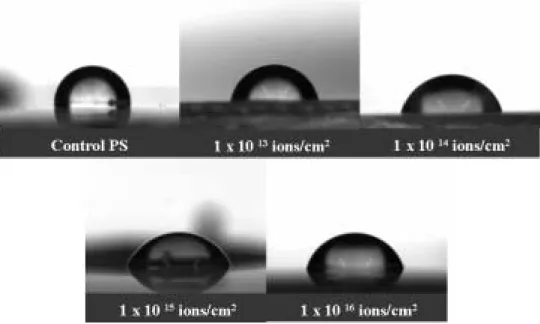
WettabilityFig. 1 and 2 shows the water contact angle for Ar ion
implanted PS as a function of fluence at an energy of 100 keV. As shown in Fig. 1 and 2, the contact angle of water on a pristine specimen is approximately 87�. The contact angles gradually decreased up to 58�with increasing fluence up to 1×10¹⁵ ions cm-2, beyond which it
decreas-ed.
Surface chemical composition
XPS analysis was performed to investigated the chemical composition of the PS samples. Table 1 shows the surface composition of the control and implanted samples. Similar Chan-Hee Jung, Ho-Je Kwon, Dong-Ki Kim and Jae-Hak Choi
36
Fig. 1. Contact angle of water as a function of the fluence.
Fig. 2. Sessile drop of water as a function of the fluence.
0 1×10¹³ 1×10¹⁴ 1×10¹⁵ 1×10¹⁶ Dose (ions cm-2) 100 90 80 70 60 50 40 30 20 10 0 Contact angle (degree)
to the results of contact angle measurement, the O/C atomic ratio also increased with increasing doses up to 1×10¹⁵ ions cm-2, beyond which it decreased.
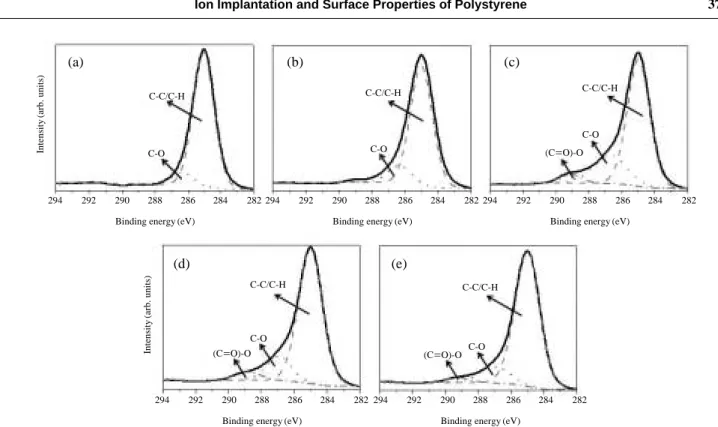
Fig. 3 shows the C1s region of XPS spectra of the control sample and samples implanted with fluences of 1×10¹³, 1 ×10¹⁴, 1×10¹⁵, and 1×10¹⁶ ions cm-2. As seen in Fig. 3
(a), the C-C and C-H peak of control PS appeared at 284.6 eV. In case of samples treated with Ar ion implantation, the intensity C-C peak decreased at the dose of 1×10¹⁴ over which began to increase, but that of the C-O peak (286.0 eV), and (C==O)-O peak (288.8 eV) inversely increased respectively to the extent and then decrease. This results could be ascribed to the fact that, as the increase of dose up to 1×10¹⁴, the C-O and ((C==O)-O) bond in the surface of
implanted PS is formed through the reaction between the radicals formed on the implanted surface and the oxygen in the air after irradiation, but, beyond 1×10¹⁴, the carboniza-tion on the irradiated surface mainly occurs (Choi et al. 1999). The results of XPS analysis are in line with that of contact angle measurement.
Ion Implantation and Surface Properties of Polystyrene 37
Fig. 3. C1s region of XPS spectra of (a) the control sample and samples implanted with fluences of (b) 1×10¹³, (c) 1×10¹⁴, (d) 1×10¹⁵, and
(e) 1×10¹⁶ions cm-2.
Table 1. The surface composition (in wt%) of the control and implanted PS samples Ion fluences (Ions cm-2) 0 1×10¹³ 1×10¹⁴ 1×10¹⁵ 1×10¹⁶ C1s 93.22 86.36 80.23 82.49 88.15 C-C/H 85.97 67.82 57.62 65.99 74.45 C-O 7.25 9.77 19.08 12.24 11.24 (C==O)-O 8.79 3.53 4.26 2.46 O1s 6.78 13.63 19.76 17.5 11.85 [O]/[C] ratio 0.07 0.16 0.24 0.21 0.13 (d) (b) (e) (c) (a) Wavenumber (cm-1) 3500 3000 2500 2000 1500 1000 Absorbance aromatic CH aliphatic CH bezene ring
Fig. 4. FT-IR spectra for (a) the control sample and samples im-planted with fluences of (b) 1×10¹³, (c) 1×10¹⁴, (d) 1×
1015, and (e) 1×10¹⁶ ions cm-2.
294 292 290 288 286 284 282
Binding energy (eV)
C-C/C-H C-C/C-H C-C/C-H C-C/C-H C-C/C-H C-O C-O C-O C-O C-O (C==O)-O (C==O)-O (C==O)-O Intensity (arb. units) Intensity (arb. units) 294 292 290 288 286 284 282
Binding energy (eV)
294 292 290 288 286 284 282
Binding energy (eV)
294 292 290 288 286 284 282
Binding energy (eV)
294 292 290 288 286 284 282
Binding energy (eV)
(a) (b) (c)
FT-IR was employed in order to identify the formation of new functional group caused by ion implantation. Fig. 4 shows FT-IR spectra for (a) the control sample and as-implanted samples. the aromatic C-H bands present in unimplanted PS appeared at 3010, 1600, and 1475 cm-1,
respectively. In case of Ar-ions implanted samples, the absorbances such as at 3400 cm-1due to the formation of
OH, 1710 cm-1due to formation of C==O, and 1000~1200
cm-1due to C-C or C-O bonds were identified. Changes in
the intensity of these peaks showed a similar tendency to the results of the above-mentioned XPS analysis.
CONCLUSION
In this study, ion-beam irradiation induced changes in surface properties of PS. Wettability of the surface-modifi-ed PS was improvsurface-modifi-ed by Ar ion implantation. The contact angles gradually decreased up to 58�with an increasing fluence up to 1×10¹⁵ions cm-2, beyond which it increased.
On the basis of XPS analysis, it was observed that hydro-philic groups was largely generated by a chemical reaction between radicals formed by ion implantation at the lower fluence and the carbonization began to occur at the higher fluence. Consequently, the changes in contact angles of PS implanted by Ar ion resulted from the formation of hydro-philic groups and carbonzation at higher fluence. These results are in line with those of FT-IR analysis.
REFERENCES
Cho JS, Beag YW, Han S, Cho J and Koh SK. 2000.
Hydro-philic surface formation on materials and its application. Surf. Coat. Tech. 128-129:66-70.
Choi SC, Choi WK, Jung HJ, Park JG and Chung BC. 1999. Relation between hydrophilicity and cell cultring on poly-styrene petri dish modified by ion-assisted reaction. J.
Appl. Polym. Sci. 73:41-46.
Choi SC, Han S, Choi, WK, Jung HJ and Koh SK. 1999. Hy-drophilic group formation of on hydrocarbon polypro-pylene and polystyrene by ion-assited reaction in an O2
environment. Nucl. Instr. and Meth. B 152(8):291-300. Kim Y, Lim H, Han S, Lee Y and Kim Y. 2002. Wettability
and aging effect of polystyrene film treated by PSII accor-ding to the molecular weight. Aanal. Sci. Tec. 15(3):229-235.
Koh SK, Cho JS, Yom SS and Beah YW. 2001. Hydrophilic surface formation on polymers and its application. Curr.
Appi. Phys. 1:133-138.
Nakao A, Suzuki Y and Iwaki M. 1998. Water wettability and zeta-potential of polystyrene surface modified by Ne or Na implantation. J. Colloid. Interf. Sci. 197:257-262.
Ochsner R, Kluge A, Zechel-Malonn S, Gong L and Ryssel H. 1993. Improvement of surface properties of polymers.
Nucl. Instr. and Meth. B 80/81:1050-1054.
Park JW, Sohn CW and Choi BH. 2006. Some characteristics of materials surface-modified by ions beam bombardment.
Curr. Appi. Phys. 6:188-193.
Yedji M and Ross GG. 2006. Effect of electric charge accumu-lation on the surface properties of PS samples irradiated with low energy ions. Nucl. Instr. and Meth. B 256:396-401.
Manuscript Received: May 18, 2007 Revision Accepted: June 7, 2007 Chan-Hee Jung, Ho-Je Kwon, Dong-Ki Kim and Jae-Hak Choi