P1-58 / H. K. Yu
IMID 2009 DIGEST •
Abstract
Preferred orientation of MgO protection layer is controlled via adjusting diffusion of adatom between (111) plane with highest neighbor atoms and (200) plane with lowest neighbor atoms. The diffusion of adatom could be modulated by the factors such as substrate temperature, deposition rate, and extra energy applied on adatom like ion beam energy.
1. Introduction
For the low power consumption of PDPs, a lot of researches have been reported to increase secondary electron emission (SEE) of MgO protection layer. Especially, the effect of crystal orientation on SEE is a matter of primary concern in the past decade.[1] Although several studies have been made on the MgO orientation with high SEE coefficient (γ), they failed to explain the exact growth mechanism of MgO preferred orientation due to high polycrystallinity of MgO film on dielectrics. MgO films are known to have preferred texturing during growth just like rock-salt nitride films such as TiN and TaN. Although there has been no study that tired to explain the preferred orientation of MgO films, several models have been proposed for the case of TiN films. Pelleg et al. proposed that the preferred orientation of TiN films is the results of minimizing the overall film energy composed of surface energy and strain energy. In this model, TiN films should initially be (001), corresponding to the lowest surface energy plane, then evolve toward (111) with increasing film thickness due to lower strain energy of (111) plane.[2] However, thin film synthesis takes places far from
thermo-dynamical equilibrium due to high melting point of TiN (3563K) and MgO (3103K). Moreover, strain energy of MgO (111) plane has highest value among several planes due to lower elastic compliance of S44/2
than S11-S12.[3] Therefore, Pelleg’s model is not
appropriate in MgO film growth. Later, Greene et al. explained the preferred orientation phenomena of TiN using kinetic approach; incident particle energy. However, it is very complex due to a lot of sputtering variables such as Ar/N2 gas ratio, ion/metal flux, total
gas pressure, radio frequency power, negative bias voltage, and distance target from substrate.[4] Owing to this complexity of sputtered TiN film, it is difficult to explain the preferred orientation formation using kinetics approach. To solve the complexity of adatom, we evaporated MgO pellet using simple electron beam evaporation method. In this method, several variables are could be controlled easily such as substrate temperature, deposition rate, and extra energy applied on adatom using ion beam assisted deposition (IBAD).
2. Experimental
An n-type (100) silicon substrate doped with arsenic was used as a starting substrate. The substrate was cleaned with acetone, ethyl alcohol, and deionized water. The native oxide of a silicon wafer was removed by HF treatment. MgO films were deposited by electron beam evaporation using high-purity MgO pellets. The MgO pellets were produced by pressing 99.995% purity MgO powder (from Mitsubishi Materials Co.) and heat-treated. MgO films were grown at a base pressure on the order of 10-7 Torr. The
chamber pressure was maintained at about 10-6 Torr
during deposition and substrate temperature was
A theoretical approach to the preferred orientation formation
of MgO protection layer using adatom diffusion
Hak Ki Yu and Jong-Lam Lee
Dept. of Materials Science and Engineering, Pohang University of Science and Technology (POSTECH), Pohang, Kyungbuk 790-784, Korea
TEL:82-54-279-2152, e-mail: [email protected] Keywords : MgO, Secondary electron emission, adatom mobility,
P1-58 / H. K. Yu
• IMID 2009 DIGEST
controlled from room temp to 450oC using SiC based
heating element. For the IBAD, nitrogen gas was inserted and gas pressure was set 0.2 mTorr and ion beam voltage was set 150 V. In-lab X-ray diffraction is measured by powder X-ray diffractometry (XRD; 18 kW, Mac Science, M18XHF22) using monochromated Cu Kα radiation and a scintillation detector.
3. Results and discussion
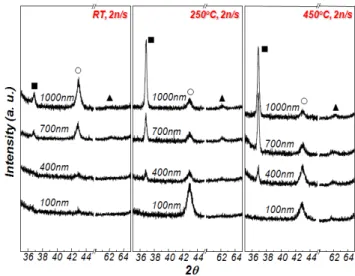
Figure 1 shows XRD pattern of MgO films on Si (100) substrate with film thickness deposited at room temp, 250oC, and 450oC. Generally, (200) diffraction peak was dominant at the initial stage of MgO growth and the preferred orientation in (111)-textured films developed gradually with film thickness considering the JCPDS intensity ratio between (111) and (200) diffraction peak; 4 of (111) and 100 of (200). Comparing with MgO film deposited on amorphous SiO2 (not shown here), initial (200) diffraction is
originated form lattice matching structure with Si (100). Due to high lattice mismatch, MgO (200) on Si(100) system follow the Volmer-Weber growth mode (3D island growth mode) after critical thickness. According to Volmer-Weber growth mode, MgO film grows with a mixed orientation including both (111) and (200) oriented grains. In the case of rock salt structure, a Mg adatom arriving at (111) or (200) plane has 3 or 1 nearest neighbors, respectively. As the nearest neighbors of adatom increases, diffusion mobility of adatom decreases and film gets higher and grows fast.[5] As a result, the strong (111) preferred orientation was appeared by overgrowing (200) oriented grains as the film thickened. For the case of room temp deposition, these phenomena do not happen due to low adatom mobility and (111) and (200) mixed orientation happened. The adatom mobility also could be adjusted by using ion beam assisted deposition (IBAD).
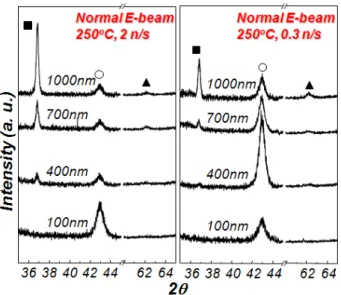
Figure 2 shows the XRD pattern of MgO films on Si (100) with film thickness deposited using normal E-beam and IBAD. The (111) preferred orientation did not happened up to 1μm film thickness and (200) and (111) mixed orientation was shown continuously for the IBAD. These results could be understood same phenomena of low adatom mobility due to blocking of adatom by energetic ions. In other words, energetic ions block the lateral movement of adatom arriving at (200) surface and (111) grains could not overgrow (200) grains.
Figure 3 shows the effect of adatom flux on (111) preferred orientation formation. As the deposition rate increased from 0.3n/sec to 2n/sec, (111) preferred orientation appeared earlier and more intensively.
Figure 1. Change of XRD profiles with film thickness for the different substrate temp; () : MgO (111) peak, (○) : MgO (200) peak, and (▲) : MgO (220) peak.
\
Figure 2. Change of XRD profiles with film thickness for the normal e-beam and IBAD; () : MgO (111) peak and (○) : MgO (200) peak.
P1-58 / H. K. Yu
IMID 2009 DIGEST •
Figure 3. Change of XRD profiles with film thickness for the different deposition rate; () : MgO (111) peak, (○) : MgO (200) peak, and (▲) : MgO (220) peak.
4. Summary
In this work, we control the preferred orientation of MgO protection layer by adjusting adatom diffusion. From our experimental results, we could know that the flux and mobility of adatom play an important role in determining preferred orientation of MgO film. These results open the fundamental understand of polycrystalline MgO film growth and preferred orientation control.
4. Acknowledgements
This research was supported in part by the Program for the Growth Engine of Korea which was conducted by the Ministry of Commerce, Industry and Energy of the Korean Government, and in part by WCU (World Class University) program through the Korea Science and Engineering Foundation funded by the Ministry of Education, Science and Technology (Project No. R31-2008-000-10059-0).
5. References
[1] J. P. Boeuf, J. Phys. D : Appl. Phys. 36, R53 (2003).
[2] J. Pelleg, L. Z. Zevin, S. Lungo, and N. Croitoru,
Thin Solid Films. 197, 117 (1991).
[3] R. W. Hertzberg, Deformation and Fracture
Mechanics of Engineering Materials. chap 1, 14
(1996).
[4] D. Gall, S. Kodambaka, M. A. Wall, I. Petrov, and J. E. Greene, J. Appl. Phys. 93, 9086 (2003). [5] P. Ghekiere, S. Mahieu, G. D. Winter, R. D. Gryse,