
3658 Bull. Korean Chem. Soc. 2014, Vol. 35, No. 12 Notes http://dx.doi.org/10.5012/bkcs.2014.35.12.3658
Crystal Structure and Physical Properties of Silver(I) Coordination Polymer
with Helical Looped-Chain Topology
Huiyeong Ju, Eunji Lee, Suk-Hee Moon,† Shim Sung Lee, and Ki-Min Park*
Department of Chemistry and Research Institute of Natural Science, Gyeongsang National University, Jinju 660-701, Korea. *E-mail: [email protected]
†Department of Food and Nutrition, Kyungnam College of Information and Technology, Busan 617-701, Korea Received August 2, 2014, Accepted August 23, 2014
Key Words : Helical looped-chain, Silver complex, Unsymmetrical dipyridyl ligand, Crystal structure
A large number of coordination polymers with helical structures have received much attention in recent years owing to not only their intriguing architectures but also their practical applications as functional materials in catalysis chemistry, biomimetic chemistry, molecular recognition, and nonlinear optics.1,2 In this area of research, symmetrical dipyridyl ligands consisting of two terminal pyridines with same substituted nitrogen positions have been used mainly for the synthesis of coordination polymer because of their easy preparation and the constructability of predictable coordination polymer.
On the other hand, a few of novel coordination polymers based on unsymmetrical dipyridyl ligands composed of two terminal pyridines with different substituted nitrogen positions were reported.2,3 Especially, the unsymmetrical dipyridyl ligand with 2- and 3-pyridyl terminal groups exhibit a ten-dency to form helical coordination polymers2 or metallo-macrocyclic compounds3 through the reaction of Ag(I) ion with linear geometry. We and Gao groups reported some helical frameworks constructed by the reaction of silver salts with unsymmetrical dipyridyl ligands.2a,b
In extending this work on interesting helical Ag(I) coordi-nation polymers, N-(pyridine-2-ylmethyl)pyridine-3-amine (L) as an unsymmetrical dipyridyl ligand was prepared according to the previously reported method.4 The reaction of Ag(I) ion with the unsymmetrical ligand L afforded a Ag(I) coordination polymer (1) with an intriguing infinite helical framework made up of looped-chain. Herein we report crystal structure and physical properties of 1.
Pale yellow crystalline product of formula {[Ag(L)2]·BF4}n
(1) suitable for X-ray analysis were obtained by vapor diffu-sion of diethyl ether into the DMSO solution of the white precipitate afforded by the reaction of silver(I) tetrafluoro-borate with L in the molar ratio 1:1 in methanol. The IR spectrum of the product 1 displays the characteristic broad band of uncoordinated tetrafluoroborate anion at 1061 cm−1
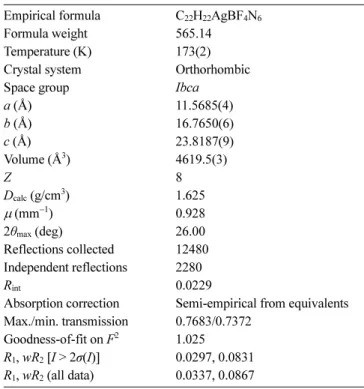
(Figure S1 in Supporting Information). The product 1 crystallized in an orthorhombic system with space group Ibca and Z = 8. Crystallographic data including experimental details and refinement results for 1 is listed in Table 1. Selected geometric parameters relevant to the coordination geometry presented in Table 2 and the X-ray crystal struc-ture of 1 is depicted in Figure 1.
The asymmetric unit of 1 contains one molecule of L, a half of Ag(I) atom located on a twofold rotation axis, and a half of tetrafluoroborate anion located on a twofold rotation axis. The crystallographic analysis reveals that each silver(I) atom in 1 is four-coordinate, being bound to four pyridine nitrogen atoms from four different L ligands, adopting distorted tetrahedral, with the tetrahedral angles falling in the range of 89.11(12)-122.05(7)o (Figure 1(a)).
The skeletal structure of 1 is composed of Ag(I) ions and the unsymmetrical ligand L in a 1:2 molar ratio. Two sym-metry-related ligands link two Ag(I) ions to form a
16-Table 1. Crystallographic data and structure refinement for 1 Empirical formula C22H22AgBF4N6
Formula weight 565.14
Temperature (K) 173(2)
Crystal system Orthorhombic
Space group Ibca
a (Å) 11.5685(4) b (Å) 16.7650(6) c (Å) 23.8187(9) Volume (Å3) 4619.5(3) Z 8 Dcalc (g/cm3) 1.625 µ (mm−1) 0.928 2θmax (deg) 26.00 Reflections collected 12480 Independent reflections 2280 Rint 0.0229
Absorption correction Semi-empirical from equivalents Max./min. transmission 0.7683/0.7372
Goodness-of-fit on F2 1.025 R1, wR2 [I > 2σ(I)] 0.0297, 0.0831 R1, wR2 (all data) 0.0337, 0.0867
Notes Bull. Korean Chem. Soc. 2014, Vol. 35, No. 12 3659
membered metallomacrocycle, in which a Ag···Ag separa-tion is 6.7959(3) Å (Figure 1(a)). The metallomacrocycles are linked by the Ag centers to give a looped-chain 1D
coordination polymer. The fascinating feature is that the looped-chain of 1 exhibits a helical framework caused by twofold screw-axis along the a axis (Figure 1(b)). Each turn in helical looped-chain consists of two loops and the helical pitch is 11.5685(4) Å. This helical looped-chain structure of 1 is comparable with the single-stranded helical structure2a of the perchlorate containing Ag(I) coordination polymers with same unsymmetrical ligand L reported previously. Such structural difference could be ascribed to the anion effect. To the best of our knowledge, the topology of the helical looped-chain in Ag(I) coordination chemistry is the first structurally characterized example.
As shown in Figure 1(c), right- and left-handed helical looped-chains are alternately arrayed via π···π stacking inter-actions between parallel N1-conatining pyridine rings of L ligands with the centroid-to-centroid distance being 3.87 Å,5 resulting in the formation of a two-dimensional supramole-cular network extending parallel to the ab plane. Further-more, the 2D networks interact with the non-coordinating BF4− anions via intermolecular N-H···F hydrogen-bonds
(N3···F1 2.881(3) Å, Table S2 in Supporting Information). These interactions lead to the construction of a three-dimensional supramolecular network.
The thermal behavior of the coordination polymer 1 was monitored by thermogravimetric analysis (TGA) (Figure S2 in Supporting Information). TGA curve shows that 1 is stable up to 182 oC and then gradually decomposes. Finally, the remnants are 41.02%, which should be Ag2O (calcd.
40.67%). The thermal stability of 1 may be derived from the intermolecular π···π interaction and N-H···F hydrogen-bonds mentioned above.
Solid-state photoluminescence properties of coordination polymers 1 and the free ligand have also been investigated at room temperature (Figure 2). The free ligand was found to be non-emissive. In contrast, the coordination polymer 1 exhibits a fluorescent emission band with maximum at 367 nm upon excitation at 330 nm. The emission of 1 can be assigned to the metal-to-ligand charge transfer (MLCT).6
Figure 1. Crystal structures of coordination polymer 1 {[Ag(L)2]·BF4}n: (a) one metallomacrocycle showing the coordination geometry of Ag(I) ion. (b) Perspective view of the helical looped-chain. (c) 3-D supramolecular network connected by N-H···F hydrogen bonds (yellow) between the helical looped-chains and anions, and π···π stacking interactions (red) between the helical looped-chains. H atoms are omitted. [Symmetry codes: (i) 0.5+x, 0.5−y, 1−z; (ii) 1.5−x, y, 1−z; (iii) 1−x, 0.5−y, z; (iv) −0.5+x, 0.5−y, 1−z; (v) 0.5+x, 0.5−y, 1−z; (ii) 2−x, 0.5−y, z.].
Table 2. Selected bond lengths (Å) and bond angles (°) for 1
Ag1-N1 2.351(2) Ag1-N2i 2.304(2)
N1-Ag1-N1ii 89.11(12) N1-Ag1-N2i 106.40(8)
N1-Ag1-N2iii 122.05(7) N1ii-Ag1-N2i 122.05(7) Niii-Ag1-N2iii 106.40(8) N2i-Ag1-N2iii 110.44(11)
Symmetry codes: (i) x−1/2, −y+1/2, −z+1; (ii) −x+1, −y+1/2, z; (iii) −x+3/ 2, y, −z+1.
Figure 2. Solid-state emission spectra of coordination polymer 1 and free ligand L at room temperature. Excitation wavelength, 330 nm.
3660 Bull. Korean Chem. Soc. 2014, Vol. 35, No. 12 Notes
Such solid-state photoluminescent property of 1 is very similar with those of 2-D honeycomb type Ag(I) coordi-nation polymers with same unsymmetrical ligand L.3a
In summary, an air-stable Ag(I) coordination polymer {[Ag(L)2]·BF4}n (1) based on unsymmetrical ligand L has
been prepared and structurally characterized. The coordi-nation polymer 1 adopts an unusual 1-D helical looped-chain topology. The photophysical property of 1 shows that the nature of emission can be attributed to the metal-to-ligand charge transfer. Further investigation on the synthesis, crystal structures and physical properties of novel coordi-nation polymers using unsymmetrical ligands is underway.
Experimental
All chemicals were of analytical regent grade and used without further purification. The IR spectra were recorded on a VERTEX 80v FT-IR spectrometer with KBr pellet in the range 4000-400 cm−1. Elemental analysis was carried out on a CHNS-932 elemental analyzer. Thermogravimetric analysis (TGA) was performed under nitrogen on a SDT Q600 thermogravimetric analyzer. The sample was heated using a 10 oC/min heating rate from 25 to 800 oC. The solid-state excitation and emission spectra were performed on a RF-5301 spectrophotometer.
Preparation of N-(Pyridine-2-ylmethyl)pyridine-3-amine (L). L was synthesized according to literature procedure.4
Synthesis of {[Ag(L)2]·BF4}n (1). A MeOH (5 mL) solu-tion of AgBF4 (52.4 mg, 0.270 mmol) was added to the
MeOH solution (10 mL) of L (50.0 mg, 0.270 mmol) at room temperature. The white precipitate in 78% yield formed immediately. The precipitate was filtered off, washed with methanol and diethyl ether, and dried in vacuo. Single crystals suitable for X-ray analysis were obtained by vapor diffusion of diethyl ether into DMSO solution. Yield: 37%. Anal. Calc. for C22H22AgBF4N6 (%): C, 46.76; H, 3.92; N, 14.87.
Found: C, 46.85; H, 3.67; N, 14.58. IR (KBr pellet, cm−1): 3371, 3114, 3072, 2885, 1604, 1585, 1487, 1440, 1423, 1375, 1296, 1259, 1199, 1061 (BF4−), 814, 758, 702, 623,
552, 517. mp 244-245 °C (decomp.).
X-ray Crystallography: Single crystal diffraction data of 1 was collected on a Bruker Smart diffractometer equipped with a graphite monochromated MoKα (λ = 0.71073 Å) radiation source and a CCD detector. The 45 frames of two dimensional diffraction images were collected and processed to obtain the cell parameters and orientation matrix. Decay was monitored by 50 standard data frames measured at the beginning and end of data collection. The crystal showed no significant decay. The frame data were processed to give structure factors using the SAINT.7 The structure was solved by direct methods and refined by full matrix least squares methods on F2 for all data using SHELXTL software.8 The
non-hydrogen atoms were refined anisotropically. All hydro-gen atoms except that of amine were placed in calculated positions and refined with a riding model. The H atom of amine was located from difference Fourier map and refined with riding constraints. Crystallographic data and structural refinement data for compounds 1 is summarized in Table 1. Crystallographic data for the structures reported here have been deposited with CCDC (Deposition No. CCDC-1017336 for 1). These data can be obtained free of charge via http:// www.ccdc.cam.ac.uk/conts/retrieving.html or from CCDC, 12 Union Road, Cambridge CB2 1EZ, UK, E-mail: [email protected] (or FIZ, D-76344, Eggenstein-Leopoldshafen, Germany, E-mail: [email protected]).
Acknowledgments. This work was supported by NRF (2010-0022675 and 2012R1A4A1027750) projects.
Supporting Information. Supplementary crystal data, Hydrogen bonding geometries and TGA for 1 are included. This material is available free of charge via the internet at http://www.kcsnet.or.kr/bkcs.
References
1. (a) Heine, J.; Holyńska, M.; Reuter, M.; Haas, B.; Chatterjee, S.; Koch, M.; Gries, K. I.; Volz, K.; Dehnen, S. Cryst. Growth Des. 2013, 13, 1252. (b) Wang, C.; Zhang, T.; Lin, W. Chem. Rev. 2012, 112, 1084. (c) Zheng, X. D.; Lu, T. B. CrystEngComm 2010, 12, 324. (d) Gruselle, M.; Train, C.; Boubekeur, K.; Gredin, P. Coord. Chem. Rev. 2006, 250, 2491. (e) Zhang, W.; Ye, H.; Xiong, R. G. Coord. Chem. Rev. 2009, 253, 2980. (f) Kitagawa, S.; Kitaura, R.; Noro, S. Angew. Chem., Int. Ed. 2004, 43, 2334. 2. (a) Zhang, Z.-Y.; Deng, Z.-P.; Huo, L.-H.; Zhao, H.; Gao, S. Inorg.
Chem. 2013, 52, 5914. (b) Moon, S.-H.; Park, K.-M. Acta Cryst. 2014, E70, m233. (c) Uemura, K.; Kumamoto, Y.; Kitagawa, S. Chem. Eur. J. 2008, 14, 9595. (d) Shin, D. M.; Lee, I. S.; Chung, Y. K.; Lah, M. S. Inorg. Chem. 2003, 42, 5459.
3. (a) Lee, E.; Ryu, H.; Moon, S.-H.; Park, K.-M. Bull Korean Chem. Soc. 2013, 34, 3477. (b) Moon, S.-H.; Park, K.-M. Acta Cryst. 2013, E69, m575. (c) Khlobystov, A. N.; Brett, M. T.; Blake, A. J.; Champness, N. R.; Gill, P. M. W.; O’Neill, D. P.; Teat, S. J.; Eilson, C.; Schröder, M. J. Am. Chem. Soc. 2003, 125, 6753. (d) Jung, O.-S.; Kim, Y. J.; Lee, Y. A.; Park, K.-M.; Lee, S. S. Inorg. Chem. 2003, 42, 844.
4. (a) Foxon, S. P.; Walter, O.; Schindler, S. Eur. J. Inorg. Chem. 2002, 111. (b) Lee, S.; Park, S.; Kang, Y.; Moon, S.-H.; Lee, S. S.; Park, K.-M. Bull. Korean Chem. Soc. 2008, 29, 1811.
5. Janiak, C. J. Chem. Soc., Dalton Trans. 2000, 3885.
6. (a) Xiong, R. G.; Zuo, J. L.; You, X. Z.; Fun, H. K.; Raj, S. S. S. Organometallics 2000, 19, 4183. (b) Collin, J. P.; Dixon, I. M.; Sauvage, J. P.; Williams, J. A. G.; Barigelletti, F.; Flamigni, L. J. Am. Chem. Soc. 1999, 121, 5009.
7. Bruker, SAINT (ver. 6.22): Area Detector Control and Integration Software; Bruker AXS Inc.; Madison, Wisconsin, USA, 2000. 8. Bruker, SHELXTL (ver. 6.10): Program for Solution and
Refine-ment of Crystal Structures; Bruker AXS Inc.; Madison, Wisconsin, USA, 2000.
![Figure 1. Crystal structures of coordination polymer 1 {[Ag(L) 2 ]·BF 4 } n : (a) one metallomacrocycle showing the coordination geometry of Ag(I) ion](https://thumb-ap.123doks.com/thumbv2/123dokinfo/4871115.32810/2.892.81.419.132.770/figure-crystal-structures-coordination-polymer-metallomacrocycle-coordination-geometry.webp)
