A Scheme of Primary Path Switching for Mobile Terminals
using SCTP Handover
DONG PHIL KIM
1, SEOK JOO KOH
1, YONG JIN KIM
21
Department of Computer Science, Kyungpook National University
1370 Sankuk-dong, Buk-gu Daegu 702-701, KOREA
2
Modacom Incorporation, KOREA
{dpkim,sjkoh}@cs.knu.ac.kr, [email protected]
Abstract: - Stream Control Transmission Protocol (SCTP) is a new transport layer protocol for end-to-end data
transport. SCTP can be used to support soft handover for mobile terminal with the help of the SCTP multi-homing feature. For SCTP handover, a mobile terminal is required to switch the primary path to one of the promising alternative paths. This paper proposes a new scheme of the primary path switching for SCTP handover, which is based on the absolute gap and relative ratio of the Round Trip Times (RTTs) measured for the primary and alternative paths. For experiments, we consider the ping-pong movement pattern, which a mobile terminal moves around the two different IP networks. From the experiments we see that a conservative scheme is preferred for primary switching in the networks with relatively small absolute gaps of RTTs, whereas an aggressive scheme needs to be considered in the cases with large absolute RTT gaps.
Key-Words: - SCTP, Handover, Primary Path Switching, Ping-pong Movement Pattern, Round Trip Time
1 Introduction
As the next generation network (NGN) has been toward the so-called ‘all-IP’ based architecture of wireless and wired networks, the issues on IP mobility and handover have been focused so far. With this trend, a lot of the protocols have been proposed to support the IP mobility. Those protocols include Mobile IP (MIP) [1], Session Initiation Protocol (SIP) [2], Stream Control Transmission Protocol (SCTP) [3], etc. In particular, it is noted that the SCTP can be used to support the soft handover for mobile terminals with the help of the SCTP multi-homing feature [4].
As defined in the IETF RFC 2960, the SCTP is an end-to-end transport layer protocol, next to TCP and UDP. In particular, the SCTP multi-homing feature enables each SCTP endpoint to support multiple IP addresses in an association. Each endpoint can send and receive messages over any of the several IP addresses. For data transport, one of those IP addresses will be designated as the ‘primary’ address during the SCTP transmission, which is called ‘SCTP primary path.’
With the help of the multi-homing feature, SCTP can be used to support the soft handover for mobile terminals. SCTP handover allows SCTP endpoints to dynamically add a new IP address and delete an existing IP address, as the mobile terminal (MT)
moves across the two different IP networks. During the SCTP handover, the MT is required for switching the primary path from the old path to a new path. For this purpose, a rule of the primary path switching will be used, for example, by considering the network conditions such as Round Trip Time (RTT) or signal strength of the concerned wireless links. One of the challenging issues on the SCTP handover is to determine when an MT should switch the primary path to another alternate path during handover from the perspective of throughput enhancement.
A study on the SCTP primary path switching [5] proposed to compare the relative ratio of RTTs measured for the primary and alternate paths. In the study, the authors suggest that the primary path will be switched to an alternate path, when the RTT for the current primary path (RTTP) is greater than the RTT
for an alternative path (RTTA); that is, if RTTP > α
RTTA, where a is a fixed constant (e.g., α = 3) and
called ‘switching coefficient’ for primary path switching in the paper.
This paper considers the primary path switching for SCTP handover in the mobile networks. We propose a new primary path switching scheme which is based on the ‘absolute gap’ of RTTs (|RTTP - RTTA |) as well as
the ‘relative ratio’ (RTTP > α RTTA). The main idea of
(α) needs to be differently configured, depending on the network conditions that are represented by the absolute gap of RTTs. The proposed primary switching scheme is evaluated for SCTP handover, in which an MT moves across two different mobile networks with a random ‘ping-pong’ movement pattern.
This paper is organized as follows. Section 2 briefly describes the SCTP handover mechanism and compares the existing schemes with the SCTP handover. In Section 3, we propose a new scheme of primary path switching for MTs using the SCTP handover. Section 4 discusses the experimental results of the proposed scheme. Section 5 will conclude this paper.
2 SCTP Handover
This section describes SCTP handover and compares the existing mobility protocols.
2.1 SCTP Handover Mechanism
The SCTP is featured by ‘multi-streaming’ and ‘multi-homing’. In particular, the multi-homing feature of SCTP can be used to provide the handover capability for the mobile terminals (MT) by adding a new IP address and deleting the old IP address during the active session [6, 7].
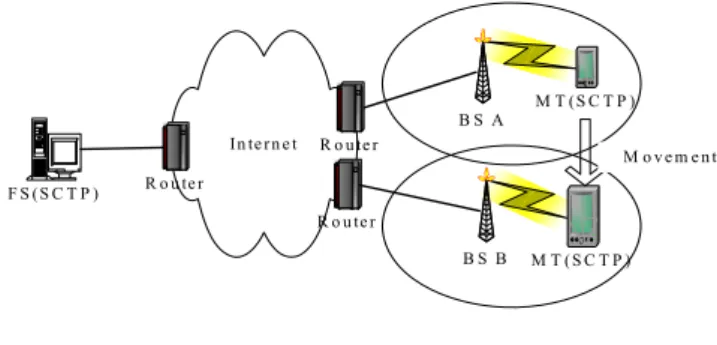
Figure 1 sketches the SCTP handover for a mobile terminal (MT) between the two different IP networks, where the MT is moving from Base Station (BS) A to B. In te rn e t F S (S C T P ) B S A M T ( S C T P ) R o u te r R o u te r B S B M T (S C T P ) M o v e m e n t R o u te r Fig. 1. SCTP Handover
In the figure, we assume that an MT initiates an SCTP association with a Fixed Server (FS). For the SCTP association, FS has ‘IP address 1’, whereas MT uses ‘IP address 2’.
Then, the overall SCTP handover procedures could be performed as follows:
(1) When the MT moves from BS A toward BS B, now it is in the overlapping region. In this phase, the MT obtains a new address ‘IP address 3’ from the BS B by using an address configuration scheme such as Dynamic Host Configuration Protocol (DHCP).
(2) The newly obtained IP address 3 will be informed by MT to FS in the transport layer. This is done by sending an SCTP Address Configuration (ASCONF) chunk to FS. The MT receives the responding ASCONF-ACK chunk from the FS. This is called the ‘Add-IP’ operation.
(3) The MT is now in a dual homing state. The old IP address is still used as the primary address, until the new IP address 3 is set to be the “Primary Address” by the MT. Before the new primary address is set, IP address 3 is used as a backup path.
(4) As the MT further continues to move towards BS B, it needs to change the new IP address into its primary IP address according to an appropriate rule. Once the primary address is changed, the FS sends the outgoing data packets over the new primary IP address of MT (IP address 3). This is called the ‘Primary-Change’ operation.
(5) As the MT progresses to move toward B, it will delete the old IP address from the association. This is called the ‘Delete-IP’ operation.
The procedural steps described above will be repeated each time the MT moves to a new BS.
2.2 Comparison of Mobility Protocols
It is noted that the Mobile IP (MIP) and Session Initiation Protocol (SIP) can be used to support the IP mobility.
Table 1 summarizes the comparison of the existing mobility protocols: MIP, SIP and SCTP.
Table 1.Comparison of the mobility protocols
MIP SCTP SIP Operation Layer Network Layer Transport Layer Application Layer Location Management
Provided Not Provided
(May be used
with MIP) Mobility Agents HA, FA (MIPv4) No need of mobility agents SIP Servers (e.g. Registrar) Route Optimization Need an extension for route opt. Intrinsically provided Intrinsically provided Handover Support Limited handover by MIP, (FMIP as extension)
Provided Limit handover
in the application
layer
Fist of all, the MIP [8] operates at the IP network layer to support the mobility. The MIP needs the route optimization extension to avoid the so-called triangular routing problem. Furthermore, the MIP provides the location management but supports the limited handover with the help of the mobility agents such as Home Agent (HA) and Foreign Agent (FA). In order to support the fast and seamless handover, the MIP needs to be extended as the Fast Handover to MIP (FMIP) [9].
Secondly, the SCTP can be used to provide the seamless handover in the transport layer. The SCTP does not support the location management, but it can be used along with the MIP or SIP for location management. On the other hand, the SCTP does not require any additional mobility agents. It intrinsically provides the route optimization for data transport
Finally, the SIP [10, 11] is an application layer signaling protocol. The SIP could provide the location management. It is noted that most of the next-generation network systems consider the SIP as a signaling protocol for IP-based multimedia services. However, the SIP could not support seamless handover.
3 SCTP Handover
Before describing the proposed scheme, in the viewpoint of throughput performance, we note that the SCTP primary path switching can be affected by the following two factors:
1) RTT: comparison of the RTTs measured for the current primary path and a promising alternate path
2) cwnd: reduction of the SCTP congestion window
(cwnd) incurred by primary path switching.
In the existing switching rule, RTTP > α RTTA, if we
consider the first RTT factor, then a smaller α will be preferred so as to benefit from the path with a shorter
RTT. However, this may incur too much frequent primary path switching and thus result in the degradation of SCTP throughput, since the primary path switching event will enforce SCTP congestion control to enter the slow-start mode over the new primary path. That is, from the second factor of cwnd, a larger α may be preferred which prevents the primary path from being switched too much frequently. Accordingly, we need to consider the trade-off relationship between RTT factor and cwnd factor in the design of the SCTP primary path switching scheme. The choice of a suitable α may give a significant impact on throughput of SCTP handover.
Based on the description given above, we suggest a new adaptive scheme for primary path switching, which uses the two different rules for primary switching, conservative and aggressive, depending on the absolute gap of the measured RTTs in the network. The conservative rule with a larger α is used when the absolute gap of RTTs is relatively small, whereas the aggressive rule with a smaller a will be preferred when the absolute gap of RTTs is large. That is, the primary path will be conservatively switched in the networks, where the gaps of RTTs for the primary and alternate paths are small, to avoid the unnecessarily frequent primary switching events. In the opposite case, the primary path will be switched aggressively to exploit the path with a shorter RTT.
Let α1 and α2 be the switching coefficients used to
compare the relative ratio of RTTs (we assume α1 >
α2). We also define β as a pre-configured threshold
(e.g., β = 1 second), which is used to determine whether the conservative or aggressive rule is employed for the primary path switching. Then the proposed primary path switching scheme can be summarized as follows:
Conservative Rule: when | RTTP - RTTA| < β,
If RTTP > α1 RTTA,
then the primary path is switched to the alternate path.
Aggressive Rule: when | RTTP - RTTA | > β,
If RTTP > α2 RTTA,
then the primary path is switched to the alternate path.
4 SCTP Handover
To evaluate the performance of the proposed primary path switching scheme, we construct a small testbed network using the LK-SCTP [12] and NISTNET emulator [13].
Over the testbed, the two SCTP hosts (an MT and correspondent terminal) communicate each other, and the MT continues to move across the two neighboring areas in the overlapping region with a random ‘ping-pong’ movement pattern. In the experiment, we will focus on the ping-pong movement pattern, since such a movement pattern is known to be most tricky to handle for performance analysis. The NISTNET software is employed to emulate the variations of RTTs between the two end hosts in the network.
Figure 2 shows the ping-pong movement pattern for MT employed in the experiment. In the figure it is shown that the MT moves around in the overlapping region with irregular movement directions. The MT will perform the SCTP handover operations: ADD-IP, Primary Switching (P-S), and Delete-IP.
ADD-IP DELETE-IP
P-S
Area 1 Area 2
MT
Fig. 2 Ping-pong movement pattern for an MT In the overlapping region, the MT will be connected to each of the Access Points (APs) located in the two areas. By ping-pong movement, the MT will receive the different signal strength from each AP. In the experiment, we emulate the RTTs between the two end hosts using the NISTNET tool, which assumes that the RTTs depend on the wireless signal strength between AP and MT. That is, the RTT will be proportional to the distance between MT and the concerned AP.
For experiment, we configured the two test networks: the first case with small gaps of RTTs (less than 1 second) and the second case with large gaps of
RTTs (ranged from 1 to 9 seconds). The first case corresponds to the network in which the RTT deviations from the two APs are relatively small, whereas the second case considers the network in which the RTT deviations are relatively large.
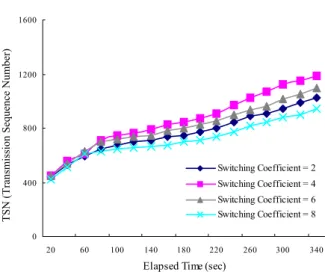
Figure 3 compares the throughputs by SCTP handover for the two test scenarios, in which the Transmission Sequence Number (TSN) values are plotted for the SCTP data chunks exchanged between the two hosts, as the elapsed time goes on.
0 20000 40000 60000 80000 20 40 60 80 100 120 140 160 180
Elapsed Time (sec)
T S N (T ra ns m is si on S eq ue nc e N um be r) Switching Coefficient = 2 Swithcing Coefficient = 4 Switching Coefficient = 6 Switching Coefficient = 8
(a) Results in networks with small RTT gaps
0 400 800 1200 1600 20 60 100 140 180 220 260 300 340
Elapsed Time (sec)
TSN (Transmission Sequence Number)
Switching Coefficient = 2 Switching Coefficient = 4 Switching Coefficient = 6 Switching Coefficient = 8
(b) Results in networks with large RTT gaps Fig. 3 Throughputs by SCTP handover for different
switching coefficients
Figure 3(a) shows the results for the test network with the small absolute gaps of RTTs. In the figure, we can see that the SCTP throughput gets better for a larger α (e.g., α = 8), which implies that the ‘conservative’
switching rule is preferred so as to avoid the frequent primary path switching. In this case, it seems that the
cwnd factor gives more significant impact on the
SCTP throughput, compared to the RTT factor. Figure 3(b) shows the results for the test networks with the large absolute gaps of RTTs. In the figure, we see that the experiment with α = 4 gives the best throughput, not the case with α = 2 or 8. This implies that there exists a suitable α for optimizing the SCTP throughput from the trade-off relationship between the RTT factor and the cwnd factor. That is, we need to consider the aggressive primary path switching rule in the networks where the gap of RTTs is large.
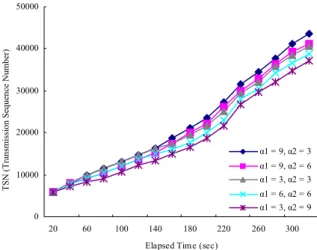
On the other hand, Figure 4 shows the results for the test network where has together with the large absolute gaps and small absolute gap of RTTs. For the experiment, we employed the proposed scheme and then differently configured the switching coefficient α1 for the conservative rule and α2 for the aggressive
rule. 0 10000 20000 30000 40000 50000 20 60 100 140 180 220 260 300
Elapsed Time (sec)
TSN (Transmission Sequence Number)
α1 = 9, α2 = 3 α1 = 9, α2 = 6 α1 = 3, α2 = 3 α1 = 6, α2 = 6 α1 = 3, α2 = 9
Fig. 4 Throughputs by SCTP handover in the networks with large RTT gap and small RTT gap
In the figure, we see that the experiment with the switching coefficient α1 = 9 and α2 = 3 gives the best
throughput, whereas the experiment with the switching coefficient α1 = 3 and α2 = 9 gives the worst
throughput. This implies that the proposed scheme which the primary path switching is adaptively performed according to the absolute gap of RTTs makes the better throughput in the test network where has together with the small RTT gap and the large RTT gap, as discussed in Figure 3.
From the results, it seems that the conservative scheme is preferred for primary path switching in the case that the gaps of RTTs are relatively small,
whereas the aggressive scheme needs to be considered when the gaps of RTTs are relatively large. Furthermore, it is shown that the proposed scheme gives the better throughput in the networks where are scattered together with the relatively small RTT gap and large RTT gap throughout the some experiments.
5 Conclusion
In this paper, we propose a new scheme of the primary path switching for the mobile terminals during SCTP handover, which is based on the absolute gap and relative ratio of RTTs measured for primary and alternate paths. For the experiments, we consider the ping-pong movement pattern between two different IP networks with the Linux based test environment, and then analyze the throughput of SCTP during handover.
From the numerical results, it seems that a conservative scheme is preferred in the network where the gaps of the measured RTTs are small, whereas an aggressive scheme needs to be considered in the network that the gaps of RTTs are relatively large.
Acknowledgement
This research was supported by the BK21
(INFORMATION TECHNOLOGY MANPOWER
DEVELOPMENT PROGRAM) of Korea
References:
[1] Perkins C., IP mobility Support for IPv4, IETF RFC 3344, August 2002.
[2] Handley M., et al., SIP: Session Initiation Protocol, IETF RFC 2543, March 1999.
[3] Stewart R., et al., Stream Control Transmission Protocol, IETF RFC 2960, October 2000.
[4] Snoeren C., et al., “An End-to-End Approach to Host Mobility,” Proceeding MobiCom, August 2000, pp. 155-166.
[5] Junichi, F., et al., “A Study on Primary Path Switching Strategy,” Workshop on Cooperative Computing, Internetworking and Assurance (WCCIA 2005), April 2005, pp. 536-541.
[6] Stewart R., et al., SCTP Dynamic Address Reconfiguration, IETF Internet Draft, draft-ietf-tsvwg-addip-sctp-16.txt, October 2006. [7] Koh S., et al., “mSCTP for Soft Handover in
Transport Layer,” IEEE Communications Letters, Vol. 8, No. 3, March 2004, pp. 189 - 191.
[8] Charlie P., Mobility Support in IPv6, IETF RFC 3775, June 2004.
[9] Koodli, R., et al., Fast Handovers for Mobile IPv6, IETF RFC 4068, July 2005.
[10] Rosenberg J., et al., “SIP: Session Initiation Protocol”, IETF RFC 3261, June 2002.
[11] Elin Wedlund et al., “Mobility Support using SIP”, Proceeding of WoWMoM, 1999, pp. 76-82. [12] Linux Kernel SCTP Project, Available from
http://lksctp.sourceforge.net/
[13] NISTNET Network Emulation Package, Available from http://snad.ncsl.nist.gov/itg/nistnet