Journal of Information Processing Systems, Vol.7, No.4, December 2011 http://dx.doi.org/10.3745/JIPS.2011.7.4.627
Partial Bicasting with Buffering for Proxy Mobile
IPv6 Handover in Wireless Networks
Ji-In Kim* and Seok-Joo Koh*
Abstract—This paper addresses the Proxy Mobile IPv6 (PMIP) handover using bicasting in mobile/wireless networks. The bicasting scheme can be used to support the PMIP handover, which tends to waste the network resources of wireless links and incurs data losses during handover. We propose an enhanced scheme of PMIP handover, called the partial bicasting with buffering for PMIP (PBB-PMIP). In the PBB-PMIP handover, the bicasting is performed in the “partial” region between the Local Mobility Anchor (LMA) and the Mobile Access Gateway (MAG), when a mobile node is in the handover area. The data packets are buffered at the new MAG during handover to reduce data losses and are then forwarded to mobile nodes after handover. By ns-2 simulations, the proposed PBB-PMIP scheme is compared with the existing schemes of PMIP and PMIP with bicasting. The proposed scheme can benefit from the reduction of handover delay and packet loss, and the effective use of the network resources of wireless links, as compared to the existing handover schemes.
Keywords—Proxy Mobile IPv6, Handover, Partial Bicasting, Buffering, Simulation Analysis
1.
I
NTRODUCTIONThe Proxy Mobile IPv6 (PMIP) [1] was designed as a network-based mobility scheme. Some works have been made to support the PMIP handover, which include Fast Handovers for Proxy Mobile IPv6 (PFMIP) [2]. In the PFMIP handover, a “handover tunnel” is used between the two neighboring Mobile Access Gateways (MAGs), as done in the Fast Handovers for MIPv6 [3]. However, such a handover tunnel will be established between two MAGs, in addition to the “PMIP tunnel” between the MAG and Local Mobility Anchor (LMA). Moreover, it is not easy to effectively manage such a tunnel during handover.
In this paper, we consider bicasting [4] for handover, which can be used to minimize packet loss at a mobile node (MN) during handover. In particular, this can remove the “timing ambigui-ty” regarding when to start sending data packets to the new link of the MN. However, when the bicasting function is used to support the PMIP handover, the following concerns still need to be disposed. First, the PMIP handover with bicasting tends to waste the network resources of yje wireless link by sending duplicated data packets. Next, the bicasting scheme may still incur data ※ This research was supported by the Basic Science Research Program of the NRF (2011-0026529), the ITRC program
of NIPA (NIPA-2011-C1090-1121-0002), and the IT R&D support program of KCA (KCA-2011-10913-05004) Manuscript received April 27, 2011; accepted June 14, 2011.
Corresponding Author: Seok-Joo Koh
Partial Bicasting with Buffering for Proxy Mobile IPv6 Handover in Wireless Networks
losses by link switching during handover.
To address such issues, we propose a new scheme of Partial Bicasting with Buffering for PMIP handover (PBB-PMIP). In the proposed scheme, the bicasting is done by using the PMIP tunnel in the partial network region between LMA and MAGs. In addition, the data packets are buffered at the new MAG to reduce data losses that may occur by handover. The proposed scheme can benefit from the reduction of handover delay and packet loss, and the effective use of the network resources of wireless links, as compared to the existing handover schemes.
This paper is organized as follows: Section 2 describes the proposed scheme with the existing handover schemes of PMIP [1] and PMIP with bicasting (B-PMIP) [4]. In Section 3, we com-pare the performances of candidate handover schemes by ns-2 simulation. Section 4 concludes this paper.
2.
PMIP
V6
H
ANDOVER WITHB
ICASTING2.1 Network Model
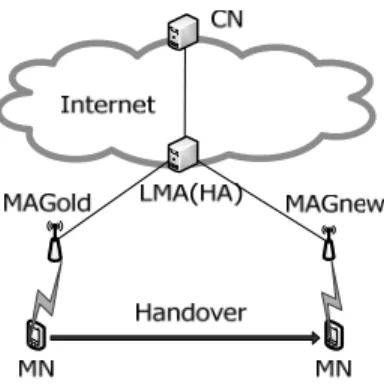
To describe the existing and proposed PMIP handover schemes, we consider a simplified network model, as shown in Fig. 1. In the figure it is assumed that the Home Agent (HA) is co-located with the LMA, and that the MN moves from MAGold to MAGnew during communication with a correspondent node (CN).
2.2 Existing PMIP and B-PMIP Handovers
We describe the existing handover schemes: PMIP [1] and PMIP with bicasting (B-PMIP) [4]. To support handover, we considered the following link-layer triggers of a new link: Link-Detected and Link-Up, which are defined in the Media Independent Handover (MIH) [5]. We noted that the Link-Detected trigger contains the information of a new MAG of MN.
Fig. 2 shows the operations of the existing PMIP handover. In the figure, when MN detects a new link, it sends an associated link layer-signaling message (e. g., MIH message) to the MA-Gold. Then, the MAGold will release the old PMIP tunnel by exchanging the Proxy Binding Up-date (PBU) and the Proxy Binding ACK (PBA) messages with the LMA, as shown in the figure, or by using an appropriate timer. When the MN gets a Link-Up trigger for the new link, it
Ji-In Kim and Seok-Joo Koh
lishes a link connection with the MAGnew, and then the MAGnew begins to establish a new PMIP tunnel with LMA.
Fig. 3 shows the B-PMIP handover with bicasting, which is based on [4]. When MAGold rece-ives a link layer-signaling message from the Link-Detected, it requests the MAGnew to establish a new PMIP tunnel with the LMA by sending a Handover INIT message. The MAGnew will send a PBU to LMA, and then the LMA transmits data packets to both MAGold and MAGnew. From this phase, the bicasting transmissions begin, in which LMA may employ the transient binding scheme for PMIP [6]. When the new link is established, MAGnew sends a Handover ACK mes-sage to MAGold, and then MAGold requests LMA to stop the bicasting transmissions and to re-lease the old PMIP tunnel by sending the PBU message.
2.3 Proposed PBB-PMIP Handover
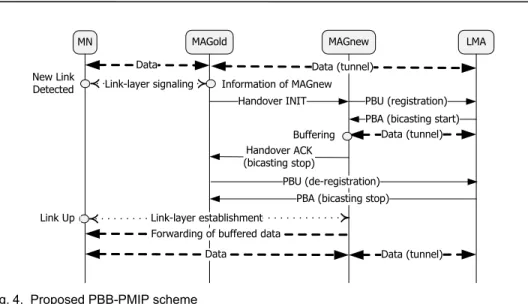
Fig. 4 shows the proposed PBB-PMIP handover, in which the initial handover operations are the same as those of B-PMIP, which include the transmission of Handover INIT from the MA-Gold to the MAGnew, and the exchange of the PBU and PBA messages between the MAGnew and the LMA. Then, the bicasting transmission will be performed in the “partial” network region between the LMA and the MAGnew. On reception of PBA from the LMA, the MAGnew will be-gin to buffer the data packets arriving from the LMA, and will request for the MAGold, so as to
Fig. 2. PMIP handover
Partial Bicasting with Buffering for Proxy Mobile IPv6 Handover in Wireless Networks
stop the bicasting by sending a Handover ACK message. In turn, the MAGold will release the old PMIP tunnel by sending a PBU message to the LMA. When the new link is established, the MAGnew forwards the buffered data packets to the MN. After that, the normal data transfer oper-ation is performed between the MN and the LMA.
In the PBB-PMIP handover, the bicasting is performed in the partial region between the LMA and the MAGnew, and thus we do not have to use the network resources of the wireless link dur-ing handover. In addition, data losses durdur-ing handover can be reduced by usdur-ing bufferdur-ing at MAGnew.
3.
P
ERFORMANCEA
NALYSIS BY NS-2
S
IMULATIONSFor performance analysis, we compare the proposed PBB-PMIP scheme with the existing PMIP and B-PMIP schemes by using the ns-2 simulator [7].
Fig. 5 depicts the network topology used in ns-2 simulations. As shown in the figure, the link between CN and LMA has a network bandwidth of 100 Mbps and link delay of 50 ms, and the wired links between the LMA and the MAG are configured with a bandwidth of 100 Mbps and a transmission delay of 10 ms. On the other hand, the wireless link between MAG and MN has bandwidth of 11 Mbps and a link delay of 10 ms, with random delay variations. During simula-tion, CN transmits CBR data packets over the UDP with a packet size of 1,000 bytes at the rate of 100 packets per second. The link switching delay is set to 100 ms by default, which will vary for performance analysis.
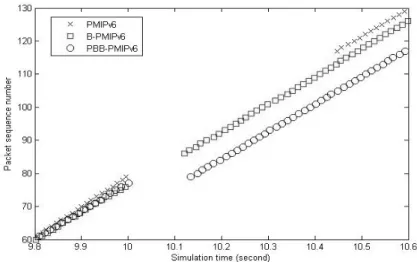
Fig. 6. shows the experimental results, in which the handover delays and packet losses are de-picted for the three candidate schemes: PMIP, B-PMIP, and PBB-PMIP.
From the figure, we can see that the PMIP handover incurs severe packet losses and large handover delays, compared to the bicasting handovers of B-PMIP and PBB-PMIP. On the other hand, it is noted that the proposed PBB-PMIP scheme provides much lower packet losses than the existing B-PMIP handover. This is because the proposed scheme uses the buffering at the MAGnew to reduce data losses during handover.
MAGold LMA MN MAGnew Data (tunnel) Data Link-layer establishment Data (tunnel) New Link Detected Link Up Handover ACK (bicasting stop) Information of MAGnew
Handover INIT PBU (registration) PBA (bicasting start)
PBA (bicasting stop) PBU (de-registration)
Buffering
Data
Forwarding of buffered data
Data (tunnel) Link-layer signaling
Ji-In Kim and Seok-Joo Koh
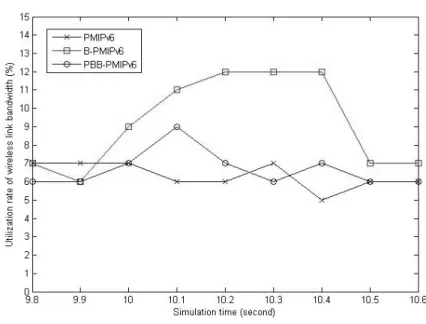
Fig. 7 compares the utilization ratios of bandwidths for the wireless link that the MN is at-tached to. In the B-PMIP scheme, the link bandwidth tends to be severely wasted, compared to the PMIP and PBB-PMIP schemes, during handover (over the time interval from 10.0 to 10.5 seconds). This is because in the B-PMIP scheme the duplicated packets are transmitted to the MN over wireless links. In the meantime, the proposed PBB-PMIP scheme uses the network resources effectively at the same level with the PMIP handover.
Fig. 8 compares the handover delays of the three candidate schemes for different link switch-ing times. In the figure we can see that the handover delays increase, as the link switchswitch-ing time gets larger for all the candidate schemes. It is noted that the bicasting schemes of B-PMIP and PMIP give lower handover delays than the pure PMIP handover. Both B-PMIP and PBB-PMIP provide almost similar handover delays for all the link switching times.
MAG2 MAG1 MN LMA CN Duplex-link 100Mbps Delay: 50ms Duplex-link 100Mbps Delay: 10ms Duplex-link 100Mbps Delay: 10ms Duplex-link 11Mbps Delay: 10ms (with random variations)
Duplex-link 11Mbps Delay: 10ms (with random variations) Fig. 5. Simulation topology
Partial Bicasting with Buffering for Proxy Mobile IPv6 Handover in Wireless Networks
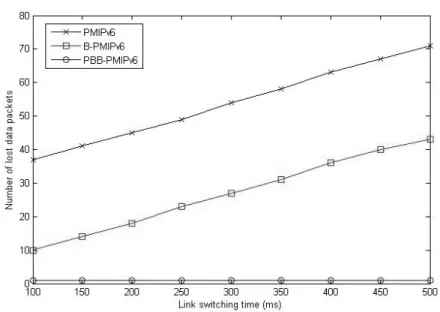
Fig. 9 shows the number of data packets that have been lost during handover. From the figure, we can see that the existing PMIP and B-PMIP schemes incur some packet losses, and the amount of lost packets get larger, as the link switching time increases. The proposed scheme is more effective when the link switching time is relatively large. In the meantime, the PBB-PMIP scheme gives almost zero packet loss, even though the link switching time increases. This is because in the proposed PBB-PMIP scheme the data packets are buffered at the MAGnew and are then forwarded to the MN when it is attached to the MAGnew.
Fig. 7. Comparison of resource utilizations over a wireless link
Ji-In Kim and Seok-Joo Koh
4.
C
ONCLUSIONThis paper presented partial bicasting with buffering for enhancing the performance of PMIP handover. In the proposed scheme, the bicasting is performed in the partial area between the LMA and the MAG, and the data packets are buffered at the new MAG during handover to re-duce data losses.
From the simulation results, we can see that the proposed handover scheme can reduce han-dover delays and packet losses during hanhan-dover, and that it can also effectively use the network resource of wireless links, compared to the existing handover schemes.
R
EFERENCES[1] IETF RFC 5213, Proxy Mobile IPv6, August, 2008.
[2] IETF RFC 5949, Fast Handovers for Proxy Mobile IPv6, September, 2010. [3] IETF RFC 4068, Fast Handovers for Mobile IPv6, July, 2005.
[4] Mortaza S. Bargh, et al., “Reducing handover latency in future IP-based wireless
net-works: Proxy Mobile IPv6 with Simultaneous Bindings,” Proceeding of WoWMoM 2008,
June, 2008.
[5] IEEE 802.21, Media Independent Handover Services.
[6] IETF RFC 6058, Transient Binding for Proxy Mobile IPv6, March, 2011. [7] NS-2 Network Simulator, http://www.isi.edu/nsnam/ns/
Partial Bicasting with Buffering for Proxy Mobile IPv6 Handover in Wireless Networks
Ji-In Kim
He received his B.S. and M.S. degree in Electrical Engineering and Computer Science from Kyungpook National University in 2008 and 2010, respectively. He is now as a Ph. D student at the School of Computer Science and Engineering in the Kyungpook National University, Korea. His current research interests include Wireless Communication, Internet Mobility, and Future Internet.
Seok-Joo Koh
He received his B.S. and M.S. degrees in Management Science from KAIST in 1992 and 1994, respectively. He also received his Ph.D. degree in Industrial Engineering from KAIST in 1998. From August 1998 to February 2004, he worked for the Protocol Engineering Center in ETRI. He has been a Professor with the School of Computer Science and Engineering at Kyungpook National University since March 2004. His current research interests include mobility management in the future Internet, IP mobility, multicasting, and SCTP. He has so far participated in the international standardization as an editor for the ITU-T SG13 and ISO/IEC JTC1/SC6.
![Fig. 3 shows the B-PMIP handover with bicasting, which is based on [4]. When MAG old rece- rece-ives a link layer-signaling message from the Link-Detected, it requests the MAG new to establish a new PMIP tunnel with the LMA by sending a Handover INIT me](https://thumb-ap.123doks.com/thumbv2/123dokinfo/5122790.86364/3.723.89.620.118.586/handover-bicasting-signaling-message-detected-requests-establish-handover.webp)