아이소맵을 이용한 결함 탐지 비교 연구
A Comparative Study on Isomap-based Damage Localization
고 봉 환*∙정 민 중** Koh, Bong-Hwan∙Jeong, Minjoong 1)
요 약
The global coordinates generated from Isomap algorithm provide a simple way to analyze and manipulate high dimensional observations in terms of their intrinsic nonlinear degrees of freedom. Thus, Isomap can find globally meaningful coordinates and nonlinear structure of complex data sets, while neither principal component analysis (PCA) nor multidimensional scaling (MDS) are successful in many cases. It is demonstrated that the adapted Isomap algorithm successfully enhances the quality of pattern classification for damage identification in various numerical examples.
keywords : Isomap Algorithm, Damage Detection, Principal Component Analysis
1. Introduction
PCA has been widely employed to discriminate the effect of non-damage features such as environmental factors, for example, temperature variation Dimensionality reduction is the transformation of high-dimensional data into a meaningful representation of reduced dimensionality. Ideally, the reduced representation should have a dimensionality that corresponds to the intrinsic dimensionality of the data. Isomap is one of widely used dimensional reduction method, where geodesic distance on a weighted graph is incorporated with the classical MDS. In contrast to the traditional linear techniques, the nonlinear techniques have the ability to deal with complex nonlinear data. In particular for real-world data, these nonlinear dimensionality reduction techniques may offer and advantage, because real-world data is likely to be highly nonlinear.
This study intends to compare the performance of PCA and Isomap in terms of classifying damage-sensitive features such as patterns of modal frequency variation. Here, damage in a structure is simulated by reducing stiffness of specific location of finite element of cantilevered beam model. Preliminary results using numerical simulation show that Isomap is an effective tool for classifying the pattern of modal frequency shift, which can be exploited to solve
** 동국대학교 기계로봇에너지공학과 조교수 [email protected]
** 한국과학기술정보연구원(KISTI) 슈퍼컴퓨팅센터 선임연구원 [email protected]
practical damage detection problems.
2. Isomap Algorithm
Isomap is a nonlinear generalization of classical MDS. The main idea is to perform MDS, not in the input space, but in the geodesic space of the nonlinear data sets. The geodesic distances represent the shortest paths along the curved surface of the data sets measured as if the surface were flat. This can be approximated by a sequence of short steps between neighboring sample points. Isomap then applies MDS to the geodesic rather than straight line distances to find a low-dimensional mapping that preserves these pairwise distances (Ghodsi Ali 2006). Isomap’s global coordinates provide a simple way to analyze and manipulate high-dimensional observations in terms of their intrinsic nonlinear degrees of freedom (Tenenbaum JB, de Silva V, and Langford JC 2000).
3. Numerical Simulation (Cantilevered Beam with Stiffness Damages)
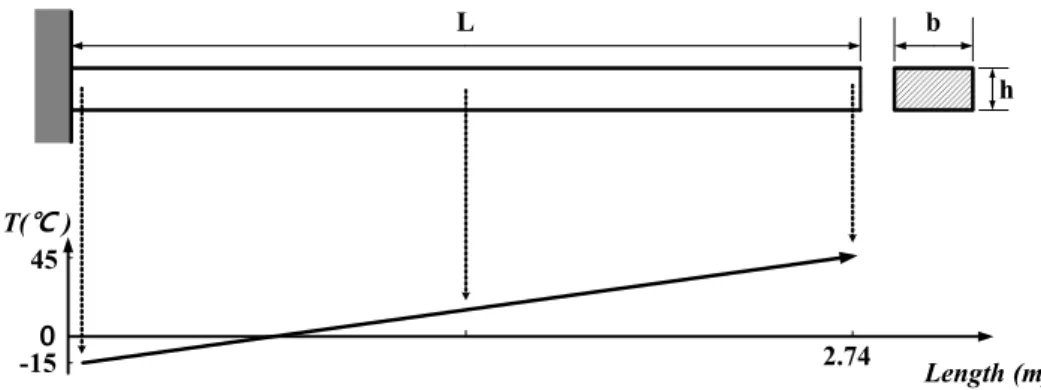
A numerical simulation is conducted to validate the damage detection performance using data classification techniques such as PCA and Isomap. For simplicity, it is assumed that damage occurs in the form of stiffness reduction at a specific location of finite elements. The schematic drawing of the cantilevered beam is shown in Fig 1.
L b h 0 -15 45 T(℃) Length (m) 2.74
Fig. 1 Schematics of a cantilevered beam applied to temperature gradient in each element.
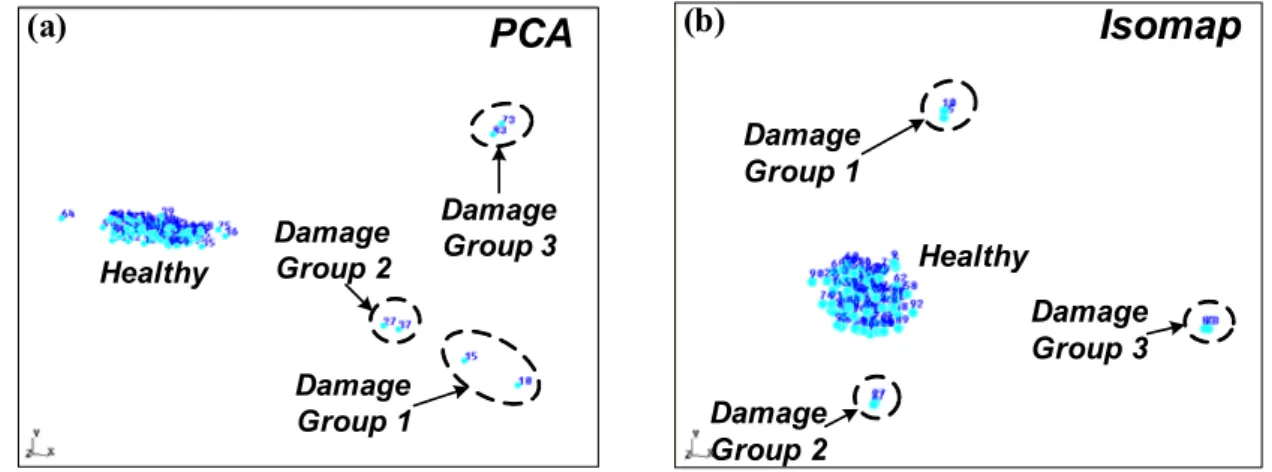
The variation of the first ten modal frequencies due to local reduction of stiffness value in specific damage locations is visually classified using PCA and Isomap, respectively. This attempt becomes significant as the quality of damage detection result using modal frequency change rapidly deteriorates due to unharmful environmental effects such as temperature gradient. The damage classification results using PCA and Isomap are illustrated in Fig. 2 and Fig. 3.
PCA
Healthy Damage Group 1 Damage Group 2 Damage Group 3(a)
Isomap
Healthy Damage Group 1 Damage Group 3 Damage Group 2(b)
Fig. 2 Classification results for the single damage group: (a) PCA result and (b) Isomap simulation.
PCA
Healthy Damage Group 1 Damage Group 2 Damage Group 3(a)
Isomap
Healthy Damage Group 3 Damage Group 1 Damage Group 2(b)
Fig. 3 Classification results for the dual damages group: (a) PCA result and (b) Isomap simulation.
Note that all the classification plots are projected on three-dimensional space. Although both PCA and Isomap successfully classified single-damage scenarios, it is obvious that Isomap outperformed the PCA in terms of level of separation and grouping toward homogenous data. And, the classification results of dual damages in the cantilevered beam are presented in Fig 3. Again, Isomap-based classification provides better separation result when it is compared to that of PCA. Speaking of PCA-based results, damage group 1 and 2 may not be distinctly separable without knowing the true group of damage locations.
4. Conclusions
PCA and Isomap-based data classification technique is applied to a structural damage localization problem using numerical simulations. The preliminary results show that
Isomap-based classification can be a powerful candidate for replacing PCA-based damage detection under the influence of environmental effects such as temperature gradient in a structure.
감사의 글
This research was supported by Basic Science Research Program through the National Research Foundation of Korea (NRF) funded by the Ministry of Education, Science and Technology (KRF-2010-0003173). The authors would like to thank their organization for its support.
참고문헌
Burges CJC (2005). Data Mining and Knowledge Discovery Handbook : A Complete Guide for Practitioners and Researchers, chapter Geometric Methods for Feature Selection and Dimensional Reduction : A Guided Tour. Kluwer Academic Publishers.
Ghodsi Ali (2006). Dimensionality reduction, a short tutorial. Department of Statistics and Actuarial Science, University of Waterloo.
Ha NV and Golinval JC (2010). Localization and Quantification of Damage in Beam-like Structures using Sensitivities of Principal Component Analysis Results. Mechanical Systems and Signal Processing. 24. pp. 1831-1843.
Kharal R (2006). Semidefinite Embedding for the Dimensionality Reduction of DNA Microarray Data. Master’s thesis, University of Waterloo.
Lee JA and Verleysen (2007). Nonlinear Dimensionality Reduction. Springer.
McClurkin JW et al. (1991). Concurrent Processing and Complexity of Temporally Encoded Neuronal Messages in Visual Perception. Science. 253. pp. 675-677.
Murase H and Nayar SK (1995). Visual Learning and Recognition of 3-D Objects from Appearance. International Journal of Computer Vision. 14(5). pp. 5-24.
van der Maaten LJP, Postma EO, and van den Herik HJ (2009). Dimensionality Reduction: A Comparative Review. Tilburg University Technical Report. TiCC-TR 2009-005.
Saul LK et al. (2006). Spectral Methods for Dimensionality Reduction. In Semisupervised Learning, MIT Press.
da Silva S et al. (2009). Structural Damage Detection by Fuzzy Clustering. Mechanical Systems and Signal Processing. 22. pp. 1636-1649.
Tenenbaum JB, de Silva V, and Langford JC (2000). A Global Geometric Framework for Nonlinear Dimensionality Reduction. Science 290. pp. 2319–2323.