N A N O E X P R E S S
Open Access
Efficient Performance of Electrostatic
Spray-Deposited TiO
2
Blocking Layers in Dye-Sensitized
Solar Cells after Swift Heavy Ion Beam Irradiation
P Sudhagar
1, K Asokan
2, June Hyuk Jung
1, Yong-Gun Lee
3, Suil Park
1, Yong Soo Kang
1*Abstract
A compact TiO2layer (~1.1 μm) prepared by electrostatic spray deposition (ESD) and swift heavy ion beam (SHI)
irradiation using oxygen ions onto a fluorinated tin oxide (FTO) conducting substrate showed enhancement of photovoltaic performance in dye-sensitized solar cells (DSSCs). The short circuit current density (Jsc= 12.2 mA cm
-2
) of DSSCs was found to increase significantly when an ESD technique was applied for fabrication of the TiO2
blocking layer, compared to a conventional spin-coated layer (Jsc= 8.9 mA cm-2). When SHI irradiation of oxygen
ions of fluence 1 × 10¹³ions/cm2 was carried out on the ESD TiO2, it was found that the energy conversion
efficiency improved mainly due to the increase in open circuit voltage of DSSCs. This increased energy conversion efficiency seems to be associated with improved electronic energy transfer by increasing the densification of the blocking layer and improving the adhesion between the blocking layer and the FTO substrate. The adhesion results from instantaneous local melting of the TiO2 particles. An increase in the electron transport from the
blocking layer may also retard the electron recombination process due to the oxidized species present in the electrolyte. These findings from novel treatments using ESD and SHI irradiation techniques may provide a new tool to improve the photovoltaic performance of DSSCs.
Introduction
Dye-sensitized solar cells (DSSCs) are a promising photovoltaic system for next generation solar cells that contain mesoporous nanocrystalline semiconductors like TiO2, ZnO and SnO2as photoanodes anchored with dye
molecules. These dye molecules serve as light harvesters [1-3]. It is believed that DSSCs are more cost effective than conventional solar cells due to their low produc-tion cost. Recently, intensive research activities have focused on enhancing the photoconversion efficiency of DSSCs by improving charge transport in the electronic interfaces such as (a) TiO2/transparent conducting oxide
(b) TiO2/electrolyte (c) dye/TiO2 (d) dye/electrolyte and
(e) electrolyte/counter electrode. For instance, electrons on either side of the TiO2 layer or in the transparent
conducting oxide (TCO) such as fluorinated tin oxide (FTO) may recombine with the oxidized redox couples
such as I3-. Electron recombination is one of the major
factors that determine the high energy conversion effi-ciency (2e-+I3- ® 3I-) [4,5]. Therefore, there have been
several different approaches to reduce or block the recombination of electrons on TCO and TiO2 layers to
improve the energy conversion efficiency. Among the interfaces described previously, the one between TiO2/
transparent conducting oxides faces severe recombina-tion problems, since the porous nature of photoanodes results in uncovered sites on the TCO layer, resulting in sites for electron recombination with I3-redox species
in the electrolyte.
Considerable attention has been focused on the meth-ods to reduce electron recombination at the interface between TCO substrate and electrolyte containing I3-.
In order to overcome this recombination problem, a compact oxide layer (pore-free and dense) is commonly introduced between the mesoporous TiO2 and the TCO
substrate, which blocks electron recombination with the electrolyte via a so-called blocking effect [6]. Further-more, the blocking layer should provide good adhesive properties between the TCO and the mesoporous TiO2 * Correspondence: [email protected]
1Center for Next Generation Dye-Sensitized Solar Cells, WCU Program, Department of Energy Engineering, Hanyang University, Seoul, 133-791, South Korea.
Full list of author information is available at the end of the article
© 2010 Sudhagar et al. This is an Open Access article distributed under the terms of the Creative Commons Attribution License (http://creativecommons.org/licenses/by/2.0), which permits unrestricted use, distribution, and reproduction in any medium, provided the original work is properly cited.
layers to facilitate electron transport from the mesopor-ous TiO2 to the TCO layers. From this perspective, a
variety of oxides have been investigated such as Nb2O5
[7], ZnO [8], MgO [9], Al2O3 [10] and SiO2 [11] in
addition to TiO2 [12]. Different preparation techniques
have been widely exploited to form blocking layers such as sol-gel [12], spin coating [13], sputtering [14,15] and spray-coating [16] techniques. Therefore, the formation of a blocking layer between mesoporous TiO2 and the
TCO substrate has been investigated, which not only blocks electron recombination but also facilitates elec-tron transport.
In this study, electrostatic spray deposition (ESD) was applied first for fabricating a TiO2 blocking layer, and
swift heavy ion beam irradiation (SHI) was subsequently performed as a post-treatment, since ESD allows particle size and shape to be controlled by varying processing parameters such as the polymer concentration in the spray solution and applied voltage. Furthermore, a conventional electrospinning setup, in which the con-ducting FTO electrode directly connected to the electric circuit (negative terminal) may produce an electro-hydrodynamic field between a collector (FTO) and a sol injector (syringe), may improve adhesion between the sprayed particles and the FTO substrate. Particle growth achieved via ESD is more effective than that obtained by conventional spray pyrolysis [17] or spin coating. Chen et al. [18] reported nanostructured TiO2 films fabricated
by ESD and studied their phase transformations by sin-tering. Zhang et al. [19] demonstrated the feasibility of ESD-derived uniform TiO2 particles in DSSCs and
sug-gested that the electrical contact between the conduct-ing substrate and TiO2 particle (electron transport layer)
plays a crucial role in power conversion efficiency, since the presence and the removal of the polymer molecules in the ESD layer during sintering may result in poor contact among TiO2 nanoparticles and poor adhesion to
conductive glass substrates. These will impose severe constraints on the electron transport from the mesopor-ous TiO2 layer to the FTO substrate. Therefore, an
alternative post-treatment may be necessary to obtain a compact, thin blocking layer with good contact among TiO2 nanoparticles and good adhesion to the conductive
glass substrates [20], resulting in rapid electron trans-port. SHI was employed as a post-treatment for improv-ing both adhesion and contact. Recently, Simprov-ingh et al. [21] reported that SHI irradiation improved the trans-mittance of conducting substrates (indium-doped tin oxide), and their performance was affected in DSSCs. The SHI method is based on the interactions of ions with solids, where the temperature around the trajectory of the ion increases remarkably. The shock waves, or so-called pressure waves, develop due to the temperature spike, which diffuses the heat radially in
the target [22]. This thermal spike can generate local heat along TiO2 nanoparticles. When the temperature is
greater than the melting temperature of TiO2
(~1,300°C), a liquid phase is formed in this specific region. This high temperature region cools down imme-diately due to very rapid heat transfer to the surround-ings, resulting in solidification of the surface, specifically melted TiO2 nanoparticles [23] that form a highly
adhe-sive TiO2 blocking layer with the FTO substrate. To
best of our knowledge, this is the first report of its kind to apply the SHI irradiation technique for obtaining an efficient blocking layer in DSSCs. The performance of the SHI-irradiated blocking layer was investigated in comparison with the unirradiated (pristine) and conven-tional spin-coated TiO2blocking layers.
Experimental
The following procedure was used for the preparation of a TiO2blocking layer on fluorinated tin oxide (FTO)
sub-strates: 15 wt% poly(vinyl acetate) (PVAc) (Mn ~ 5,000,000) solution was prepared by dissolving PVAc in dimethyl formamide (DMF) and dropping it into a mix-ture containing 1 g of titanium isopropoxide and 0.5 g of acetic acid while stirring. The as-prepared TiO2sol was
electrosprayed onto a grounded FTO substrate at 17 kV with a constant distance of about 10 cm between FTO and the electrospray syringe at a flow rate of 1.0 ml/h. The resultant ESD TiO2 blocking layer was ~1.1μm
thick and was sintered at 450°C for 30 min in air. In order to prepare SHI-irradiated films, the as-prepared ESD TiO2films were used without sintering.
SHI was conducted using 15 UD Pelletron tandem accelerator facilities available in the Materials Science Beamline at the Inter-University Accelerator Centre (IUAC), New Delhi, India. The vacuum of the experi-mental chamber was in the range of 10-6torr. The TiO2
films, which act as blocking layers, were subjected to 100 MeV O ion irradiation with fluence of 1 × 10¹³ ions/cm2. The electronic and nuclear energy loss values for 100 MeV O ions in TiO2, calculated using the SRIM
code simulation program (SRIM-2010) [24,25], were 1.284 × 10² and 6.739 × 10⁻² eV/Å, respectively. The range of O ions in this experiment is about 54.14 μm, indicating that the entire passage of ions in the film is dominated by electronic energy loss. Further experimen-tal details were published elsewhere [26].
In order to compare the effect of the blocking layer, two kinds of DSSCs were assembled: (a) a pristine cell fabricated from the ESD TiO2 blocking layer and (b) a
SHI cell using an irradiated ESD TiO2 blocking layer. In
addition, a reference cell was fabricated from the TiO2
blocking layer prepared by conventional spin coating (Ti (IV) bis (ethyl acetonato)-diisopropoxide solution in 2 wt% of 1-butanol) and was also tested under identical
experimental conditions. Further, TiO2 photoanodes
thickness about ~6 μm were prepared on the TiO2
blocking layer using TiO2 paste (Solaronix) by a doctor
blade technique [27] and subsequently sintered at 450°C for 30 min in air.
N719 dye (di-tetrabutylammonium cis-bis(isothiocya-nato)bis(2,2’-bipyridyl-4,4’-dicarboxylato)ruthenium(II)) was used to sensitize the TiO2 photo electrodes. The
TiO2 electrodes were immersed overnight in a 0.3 mM
dye solution containing a mixture of acetonitrile (ACN) and t-butyl alcohol (1:1 v/v) and dried at room tempera-ture. A sandwich-type configuration was employed to measure the performance of the dye-sensitized solar cells, using a Pt-coated F-doped SnO2 film as a counter
electrode and 0.5 M MPII (1-methyl-3-propylimidazo-lium iodide) with 0.05 M I2 in ACN as the electrolyte
solution. Current–voltage characteristics of DSSCs were performed under 1 sun illumination (AM 1.5G, 100 mW cm-2) with a Newport (USA) solar simulator (300 W Xe source) and a Keithley 2,400 source meter (device area is 0.16 cm2). The different stages of the cell fabrication are schematically shown in Figure 1. Electro-chemical impedance measurements were carried out using a potentiostat (IM6 ZAHNER) equipped with a fre-quency response analyzer (Thales) in the frefre-quency range of 0.1 Hz–1,000 kHz. The results were analyzed with an equivalent circuit model for interpreting the characteris-tics of the DSSCs. Incident photon-to-current conversion efficiency (IPCE) of DSSCs was measured using PV Mea-surements Inc. (Model QEX7) with bias illumination with reference to the calibrated silicon diode.
The surface morphologies of the TiO2 thin films
before and after SHI irradiation were studied by field-emission scanning electron microscopy (JEOL-JSM 6330F). The crystalline phases of the TiO2 films were
determined by X-ray diffraction (XRD) using a diffract-ometer (Rigagu Denki Japan) with CuKa radiation. The conductivity of the samples was studied via the two-probe method.
Results and Discussion
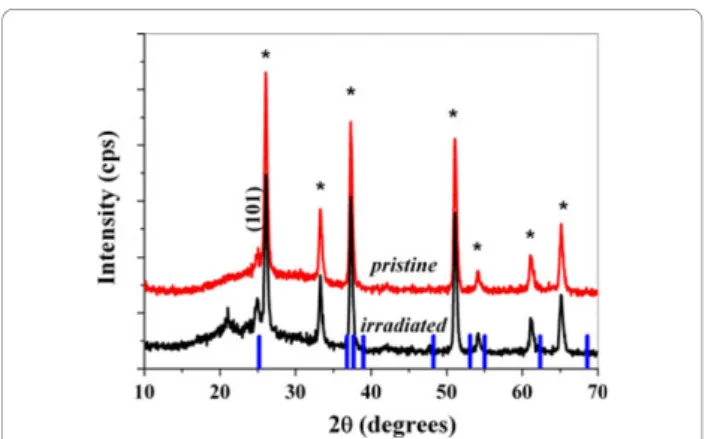
Figure 2 shows the X-ray diffraction spectra of the ESD pristine and the SHI-irradiated TiO2 layers. Hereafter,
the SHI-irradiated TiO2 layer is referred to as a layer
formed by the ESD first and subsequently SHI-irradiated techniques. The characteristic peak observed at ~25.3° in both the films indicated the presence of an anatase phase of TiO2 (JCPDS 21-1272). The increase in the
relative peak intensities observed in the SHI-irradiated sample shows that the SHI irradiation induced crystalli-zation when compared to the as-prepared pristine ESD TiO2 films. The average grain size of the SHI-irradiated
TiO2 films was found to be about 47 nm as estimated
from Scherrer’s equation. The significant additional peak exhibited in the SHI-irradiated sample is not clearly understood.
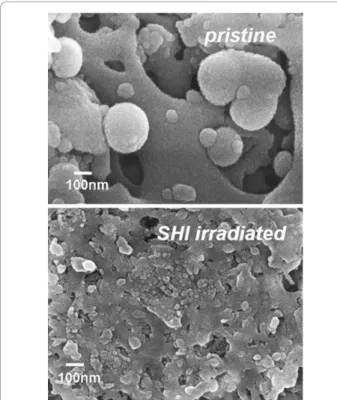
Surface morphologies of the pristine and the SHI-irradiated TiO2 films are presented in Figure 3. The
electrosprayed TiO2 films reveal an aggregation pattern,
and the spherical particles form an interconnected por-ous framework of nano-sized building blocks (Figure 3). The observed nano-aggregated particles may be ascribed to the existence of a Coulumbic force lower than the stretching force resulting from weak repulsion between adjacent spray droplets. Under SHI irradiation, these nano-aggregated TiO2 particles melted and solidified on
the FTO substrate and consequently formed a rather
Figure 1 Schematic of a electrostatic spray deposition of TiO2 compact layer, b SHI-irradiated TiO2compact layer and, c SHI-irradiated TiO2compact layer assisted DSSCs.
Figure 2 X-ray diffraction spectra. (Note that * indicated in the XRD spectra is indicated the crystalline contribution from FTO substrate.) Standard peak position (JCPDS 21-1272) of the TiO2 anatase phase is given in vertical lines.
flat, nonporous structure with the FTO layer (see Figure 3). This results in a compact interface at FTO/ TiO2 for both blocking electron recombination and
increasing electronic transport. The fragmentation of the aggregated particles into smaller grains under SHI irradiation can be explained by a thermal spike model. If a large amount of energy is deposited by the projectile ions to the electronic subsystem of the target material, this energy can be shared among electrons by electron– electron coupling and later transferred quickly to the surrounding lattice through electron–phonon coupling. Thus, a sudden temperature rise on the time scale of 10-12s along the ion track resulted in a molten state. The subsequent heat transfer to the surrounding lattice results in resolidification of this molten liquid phase. If this cooling rate slows to a critical value, nucleation of crystalline phases can be expected along the ion tra-jectory [28,29]. Therefore, we speculate that the surface of the TiO2 particles may undergo an ion-beam-induced
molten state in a short duration of time (10-12s). These molten state particles were attached with FTO substrate, enhancing the inter-particle connectivity (compact) to improve the conductivity of the film. The measured conductivity of the pristine and the SHI-irradiated TiO2
films found to be 2.31 × 10⁻²and 1.2 Scm-1, respectively, indicating large improvement in the electron conductiv-ity. Cross-sectional SEM images of the pristine and the SHI-irradiated TiO2 films are illustrated in Figure 4.
Figure 4b suggests that the pristine ESD TiO2 layer has
nano-aggregates and an inhomogeneous interface (con-tact) with the FTO layer, mostly due to the removal of polymer templates from ESD coating during sintering treatment. The observed inhomogeneous TiO2/FTO
interface in the pristine sample was further compressed by SHI irradiation using O2 ions. This interface
modifi-cation was confirmed by Figure 4c, showing that the TiO2 particles adhered well to the FTO layer. The
thickness of the pristine film, ~1.1 μm, was reduced to ~0.67μm after O ion irradiation. This is ascribed to the compact nature of TiO2 film formed by SHI irradiation.
It is noteworthy to mention that improving the compact nature of the TiO2 blocking layer upon SHI irradiation
can facilitate electron transport and also reduce electron recombination back to the electrolyte.
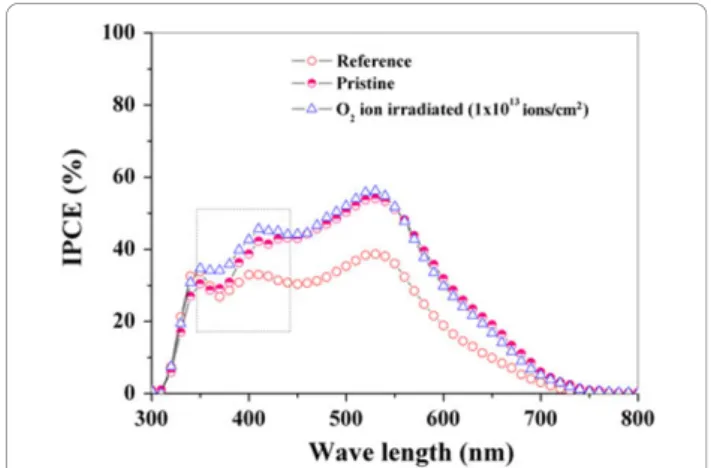
As shown in Figure 5, the ESD TiO2 blocking layer
DSSC (pristine cell) shows higher IPCE (maximum up to about ~53% at 530–540 nm) than the reference cell over the whole range of light wavelengths. This clearly demonstrates a ~16% improvement in external quantum efficiency from reducing the electron losses at
Figure 3 Scanning electron microscopy images of pristine and O2ion-irradiated TiO2compact layer.
Figure 4 Cross-sectional FE-SEM images of a bare FTO substrate, b pristine TiO2/FTO, and c O2ion-irradiated TiO2/ FTO. The thickness of the pristine and irradiated TiO2was about 1.1 and 0.67μm, respectively. (Inset: images in 100 nm scale.)
FTO/TiO2 interfaces. It appears that the ESD is more
efficient than the spin coating in terms of improving IPCE due to the formation of continuous films. Further, substantial improvement in IPCE was identified at lower wavelengths (380–420 nm), attributable to the SHI irra-diation on the TiO2 blocking layer. The IPCE can be
rationalized using the following relation [30],
IPCE
( )
= A inj coll (3)where A is the absorptivity indicating the fraction of incident light absorbed by the dye molecules,jinj is the
injection efficiency of dye molecules into the TiO2
con-duction band, andhcoll is the collection efficiency. The
parameters A andjinjare directly related to dye loading
on the TiO2 surface. In the present work, we have
con-trolled similar dye loading in the reference, the pristine and the SHI-irradiated electrodes, as verified with a dye removal test using 1 M aqueous NaOH solution. There-fore, A and jinj, of all these samples can be treated to
be equal, and the change in the IPCE is related to the improvement in hcoll. This improvement in hcollunder
SHI irradiation can be ascribed to (a) better adhesion of the TiO2blocking layer with the TCO substrate and (b)
enhanced contact among TiO2 particles. Hence, it is
expected that the SHI-irradiated blocking layer may result in higher photoconversion efficiency.
Figure 6 shows the photocurrent density–voltage (J-V) characteristics measured under 1 sun (100 mW cm-2 AM 1.5) and dark conditions. The photovoltaic para-meters were estimated from Figure 6 and are summar-ized in Table 1. The photocurrent density (Jsc) was
increased from 8.9 to 12.2 mA cm-2, and the overall effi-ciency (h) was markedly improved from 3.8 to 5.1% by replacing the ESD TiO2 compact layer, compared to the
conventionally spin-coated blocking layer. This might be attributed to the highly compact nature of the ESD
films, which provide more effective pathways for elec-trons. As a result, electrons can be collected faster at the TCO and transferred to the external circuit, result-ing in improvement in the photovoltaic performance. However, there is no appreciable change in the open circuit voltage (Voc) between these samples. When the
ESD cell was treated with SHI irradiation, the open cir-cuit voltage was further improved from 0.60 to 0.63 V, and consequently, the overall energy conversion effi-ciency improved from 5.1 to 5.5%. This may be because of the SHI irradiation, which melted TiO2 particles and
thereby improved electrical contact with the FTO sub-strate (denser and more compact) and among TiO2
par-ticles. This clearly demonstrates that the SHI irradiation enhances the blocking effect of electron recombination and creates a facilitating effect on electron transport.
A comparison of dark currents between the investi-gated cells provides qualitative information about the electron recombination process [31]. In DSSCs, prevent-ing the recapture of photoinjected electrons by I3- is
vital to obtain a high open circuit photovoltage. By inserting the blocking layer between the FTO substrate and the TiO2 mesoporous layer, the reaction possibilities
of I3-with the photoinjected electrons on the FTO
sub-strate are significantly hindered, as demonsub-strated by the reduced dark current [31]. Here, the dark current– voltage curves of the DSSCs using different blocking layers are presented in the lower part of Figure 6. The less dark current observed in the SHI-irradiated cell
Figure 5 IPCE spectra of DSSCs using different TiO2blocking layers.
Figure 6 J-V measurements under a light illumination (100 mW cm-2) along with b dark condition (lower part of the spectrum).
Table 1 Influence of TiO2blocking layer on photovoltaic
parameters of DSSCs Sample Voc(V) Jsc(mA cm -2 ) F.F (%) Efficiency (%) Reference 0.59 8.9 71.9 3.8 Pristine 0.60 12.2 69.3 5.1 O2ion irradiated (1 × 10¹³ions/cm2) 0.63 12.3 69.9 5.5
compared with the pristine cell may be attributed to the better electrical contact between the blocking layer and the FTO substrate, and the compact nature of the blocking layer as well. Furthermore, during SHI irradia-tion, it is expected that Sn4+ particles from the FTO layer may fuse with the TiO2 layer occupying the
oxy-gen vacancies in TiO2, thus lowering the Fermi level of
TiO2. For instance, the Fermi level position of the
Sn-doped TiO2 layer is lower than that of the TiO2
mesoporous layer, which is favorable for fast electron injection from mesoporous TiO2 particles to the
con-ducting substrate [32].
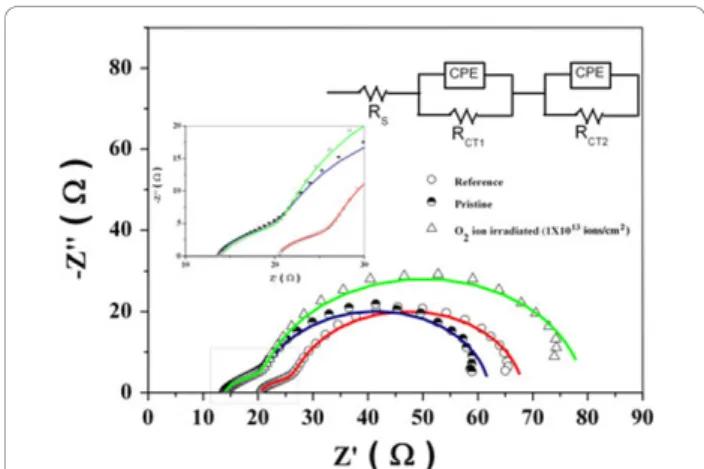
Electrochemical impedance spectroscopy (EIS) pro-vides valuable information on the kinetics of electron transport in the DSSCs with deeper understanding of the interfacial reactions at FTO/TiO2 [33] and
there-fore was employed to decipher the blocking layer effect in DSSCs. Figure 7 shows the Nyquist plots of the electrochemical impedance spectra. Their equivalent circuit is given as an inset in the figure. The charge transfer resistances RCT1and RCT2represent the
resis-tances at the Pt/FTO and TiO2/dye/electrolyte
inter-faces, respectively. The electrochemical parameters were estimated by fitting experimental data with the equivalent circuit (inset of Figure 7) [34] and are sum-marized in Table 2.
The series resistance, Rs, was decreased markedly in
the case of the pristine and O ion-irradiated electrodes, compared to the reference electrode. This is mostly associated with better electron transfer through the blocking layer due to better contact and better adhesion. The RCT2 value for SHI cells was increased markedly
compared to the reference and the pristine electrodes. The increased RCT2 value may be mostly due to the fast
electron transfer through the blocking layer. Hence, the increased electron transfer leads to lowering electron concentration of TiO2 mesoporous particles, which is
responsible for observed high RCT2 (57.3 Ω) values in
the O ion-irradiated sample.
The results described above suggest that contact among nanoparticles and the adhesion properties of a blocking layer with an FTO substrate may improve the performance of dye-sensitized solar cells. Further studies using different ion energies and fluence may further explain the role of electronic energy loss on these devices and allow development of precise control of the blocking layer.
Conclusions
An electrostatic spray deposition (ESD) technique fol-lowed by SHI irradiation using 100 MeV oxygen ions resulted in the formation of an efficient, dense TiO2
blocking layer between the TiO2 particle layer and the
TCO substrate. The blocking layer promotes charge transport from the TiO2 layer to the TCO substrate by
modifying the TCO/TiO2 interfaces and causes effective
electrical contact between the two layers. The formation of an effective, compact blocking layer was possible due to instantaneous surface melting of the ESD TiO2
nano-particles associated with a local temperature rise upon oxygen ion irradiation. Energy conversion efficiency was improved to a large extent (h = 5.5%), compared to that of the conventional blocking layer (h = 3.8%), mainly due to the increase in electron transport through the blocking layer, resulting from better contact among TiO2 nanoparticles and better adhesion with the TCO
substrate.
Acknowledgements
We thank Dr. A. Roy, Director, Inter-University Accelerator Centre, New Delhi, India for providing us beam time for SHI irradiation. This work was supported by the Engineering Research Center Program through a National Research Foundation of Korea (NRF) grant funded by the Ministry of Education, Science and Technology (MEST) (2010-0001842) and also by the World Class University (WCU) program (No. R31-2008-000-10092). Author details
1Center for Next Generation Dye-Sensitized Solar Cells, WCU Program, Department of Energy Engineering, Hanyang University, Seoul, 133-791, South Korea.2Inter-University Accelerator Centre, Aruna Asaf Ali Marg, New Delhi, 110 067, India.3School of Chemical and Biological Engineering, Seoul National University, Seoul, South Korea.
Figure 7 Nyquist spectra (measured under light illumination (100 mW cm-2)) of DSSCs. The inset represents the impedance spectra expanded in the high frequency ranges. The scattered points are experimental data, and the solid lines are the fitting curves.
Table 2 Influence of TiO2blocking layer on
electrochemical parameters of DSSCs
Sample Rs (Ω) RCT1(Ω) RCT2(Ω)
Reference 20.3 6.7 41.9
Pristine 13.6 8.6 39.8
Received: 24 June 2010 Accepted: 14 August 2010 Published: 16 September 2010
References
1. Gratzel M: Nature 2001, 414:338.
2. Quintana M, Edvinsson T, Hagfeldt A, Boschloo G: J Phys Chem C 2007, 111:1035.
3. Fukai Y, Kondo Y, Mori S, Suzukia E: Electrochem Comm 2007, 9:1439. 4. Cameron PJ, Peter LM: J Phys Chem B 2003, 107:14394.
5. Durrant JR, Haque SA, Palomares E: Coord Chem Rev 2004, 248:1247. 6. Cameron PJ, Peter LM: J Phys Chem 2005, 109:7392.
7. Xia J, Masaki N, Jiang K, Yanagida S: J Phys Chem C 2007, 111:8092. 8. Zhang Y, Wu L, Li Y, Xie E: J Phys D Appl Phys 2009, 42:085105. 9. Jung HS, Lee J-K, Nastasi M, Lee S-W, Kim JY, Park JS, Hong KS: Langmuir
2005, 21:10332.
10. Law M, Greene LE, Radenovic A, Kuykendall T, Liphardt J, Yang P: J Phys Chem B 2006, 110:22652.
11. Nguyen V, Lee H-C, Khan MA, Yang O-B: Sol Energy 2007, 81:529. 12. Hart JN, Menzies D, Cheng Y-B, Simon GP, Spiccia L, Chimie CR: 2006, 9:622. 13. Papageorgiou N, Maier WF, Grätzel M: J Electrochem Soc 1997, 144:876. 14. Hossain MF, Biswas S, Takahashi T: Thin Solid Films 2008, 517:1294. 15. Waita SM, Aduda BO, Mwabora JM, Niklasson GA, Granqvist CG, Boschloo G:
J Electroanal Chem 2009, 637:79.
16. Peng B, Jungmann G, Jager C, Haarer D, Schmidt H-W, Thelakkat M: Coord Chem Rev 2004, 248:1479.
17. Tachibana Y, Umekita K, Otsuka Y, Kuwabata S: J Phys D Appl Phys 2008, 41:102002.
18. Zhang Y, Wu L, Xie E, Duan H, Han W, Zhao J: J Power Sour 2009, 189:1256. 19. Chen CH, Kelder EM, Schoonman J: Thin Solid Films 1999, 342:35. 20. Fujihara K, Kumar A, Jose R, Ramakrishna S, Uchida S: Nanotechnology 2007,
18:365709.
21. Singh HK, Agarwal DC, Chavhan PM, Mehrad RM, Aggarwal S, Kulriya PK, Tripathi A, Avasthi DK: Nucl Instrum Methods Phys Res Sect B Beam Interact Materials Atoms .
22. Kumar V, Kumar R, Locha SP, Singh N: Nucl Instr Meth B 2007, 262:194. 23. Thakurdesai M, Kanjilal D, Bhattacharyya V: Semicond Sci Technol 2009,
24:085023.
24. Zeigler JF, Biersack JP, Littmark U: The Stopping and Range of Ions in Solids. Pergamon, New York; 19851.
25. [www.srim.org/].
26. Chandramohan S, Sathyamoorthy R, Sudhagar P, Kanjilal D, Kabiraj D, Asokan K, Ganesan V, Shripathi T, Deshpande UP: Appl Phys A 2009, 94:703. 27. Chena W, Suna X, Caia Q, Weng D, Lia H: Electrochem Commun 2007, 9:382. 28. Trinkaus H, Ryazanov AI: Phys Rev Lett 1995, 74:5072.
29. Szenes G: Phys Rev B 1995, 51:8026.
30. Nazeeruddin MK, Kay A, Rodicio I, Humphry-Baker R, Mueller E, Liska P, Vlachopoulos N, Graetzel M: J Am Chem Soc 1993, 115:6382. 31. Ito S, Liska P, Comte P, Charvet R, Pechy P, Bach U, Schmidt-Mende L,
Zakeeruddin SM, Kay A, Nazeeruddin MK, Grätzel M: Chem Commun 2005, 4351.
32. Cao Y, He T, Chen Y, Cao Y: J Phys Chem C 2010, 114:3627. 33. Fabregat-Santiago AF, Bisquert J, Palomares E, Otero L, Kuang D,
Zakeeruddin SM, Grätzel M: J Phys Chem C 2007, 111:6550. 34. Wang Q, Moser JE, Grätzel M: J Phys Chem B 2005, 109:14945.
doi:10.1007/s11671-010-9763-2
Cite this article as: Sudhagar et al.: Efficient Performance of Electrostatic Spray-Deposited TiO2Blocking Layers in Dye-Sensitized Solar Cells after
Swift Heavy Ion Beam Irradiation. Nanoscale Res Lett 2011 6:30.
Submit your manuscript to a
journal and benefi t from:
7 Convenient online submission 7 Rigorous peer review
7 Immediate publication on acceptance 7 Open access: articles freely available online 7 High visibility within the fi eld
7 Retaining the copyright to your article