서
론
방사선 및 방사성동위원소는 지질의 연대측정, 중금속 의 측정, 의료기술 등 다양한 분야에 걸쳐 이용되고 있 다. 특히, 방사선은 의료기술의 발달뿐만 아니라 식물체 에 돌연변이를 유발시켜 새로운 품종을 육성하는 돌연 변이 육종기술에도 많은 영향을 미쳤다. 방사선이 돌연 변이 육종기술에 이용되게 된 것은 1927년 Muller에 의 해 초파리에서 돌연변이가 일어난다는 사실을 토대로 1928년 Stadler가 방사선을 이용하여 보리에 돌연변이를 유도함으로써 시작되었다 (Muller 1927; Stadler 1928). 돌 연변이를 유도하기 위한 방사선은 이온빔, α선과 중성자 선 등인 고 LET (Linear Energy Transfer) 선원과 X선과 γ선 등인 저 LET 선원으로 구분된다 (Yang and Tobias ── 23 ──
단자엽 모델 식물의 방사선원 별 처리에 따른 유전적 다형성 분석
송미라∙김선희∙장덕수∙강시용∙김진백∙김상훈∙하보근∙김동섭*
한국원자력연구원 첨단방사선연구소
Genetic Relationship of Mono-cotyledonous Model Plant by
Ionizing Irradiation
Mira Song, Sun-Hee Kim, Duk-Soo Jang, Si-Yong Kang, Jin-Baek Kim,
Sang Hoon Kim, Bo-Keun Ha and Dong Sub Kim*
Advanced Radiation Technology Institute, Korea Atomic Energy Research Institute, 1266 Sinjeong, Jeongeup 580-185, Korea
Abstract -- In this study, we investigated the genetic variation in the general of monocot model plant (rice) in response to various ionizing irradiations including gamma-ray, ion beam and cosmic-ray. The non-irradiated and three irradiated (200 Gy of gamma-ray and 40 Gy of ion beam and cosmic-ray) plants were analyzed by AFLP technique using capillary electrophoresis with ABI3130xl genetic analyzer. The 29 primer combinations tested produced polymorphism results showing a total of 2,238 bands with fragments sizes ranged from 30 bp to 600 bp. The number of polymorphism generated by each primer combinations was varied significantly, ranging from 2 (M-CAC/E-ACG) to 158 (M-CAT/E-AGG) with an average of 77 bands. Polymorphic peaks were detected as 1,269 with an average of 44 per primer combinations. By UPGMA (Unweighted Pair Group Method using Arithmetic clustering) analysis method, the clusters were divided into non-irradiated sample and three non-irradiated samples at a similarity coefficient of 0.41 and three irradia-tion samples was subdivided into cosmic-ray and two irradiairradia-tion samples (200 Gy of gamma-ray and 40 Gy of ion beam) at similarity coefficient of 0.48. Similarity coefficient values ranged from 0.41 to 0.55.
Key words : Cosmic-ray, Gamma-ray, Genetic variation, Ion-beam, Monocot model plant
* Corresponding author: Dong Sub Kim, Tel. +82-63-570-3311, Fax. +82-63-570-3319, E-mail. [email protected]
1979; Tanaka et al. 1999). 현재까진 주로 저 LET에 의한 돌연변이 유도가 주를 이루었으나, 고 LET인 이온빔에 의해 돌연변이의 발생범위 (mutation spectrum)와 발생빈 도 (mutation frequency)가 높다는 보고가 있으면서 고
LET 선원을 이용한 연구도 많이 이루어지고 있다 (Yang
and Tobias 1979; Kaxama et al. 2008; Sugiyama et al. 2008). 최근 중국의 무인육종 우주선을 비롯한 미국과 러시아 의 우주정거장을 활용하여 우주 환경에 식물 종자 노출 시킨 우주 육종 연구 기법이 보고 되고 있다. 우주는 양 성자, 중이온, 감마선 등의 복합 방사선과 미소중력, 극 고∙저온 등 다양한 환경적 영향이 식물 유전자의 변이 를 유도하는 것으로 알려져 있다 (Bao et al. 2006; Li et al. 2007). 방사선에 의한 돌연변이 유도는 식물체에 방 사선을 조사하였을 때, DNA의 염기 또는 당의 결합을 절단하거나, DNA의 단일 가닥 또는 이중 가닥을 절단 하며, 염색체의 결실, 삽입, 복제, 전좌 및 세포벽의 손상 등을 일으키는 것으로 알려져 있다(Belli et al. 2002; Weibo
et al. 2009; Shi et al. 2010). 현재 국화, 벼, 콩, 옥수수, 밀 등 다양한 작물에서 형태적인 변화 또는 특정 스트레스 에 강하거나 영양 성분이 강화된 신품종이 돌연변이 육 종기술에 의해 개발되어 경제적인 효과를 보고 있다(Hara
et al. 2003; Lee et al. 2008; Kim et al. 2010).
돌연변이체의 유전적 변이를 평가하는 데 있어 DNA 표지를 이용한 분자생물학적인 방법이 사용되고 있다. 유연관계 분석, 유전적 다양성 파악, 유전분석 및 유전자 지도 작성 등 DNA 분자 표지를 이용한 방법에는 Res-triction Fragment Length Polymorphism (RFLP), Amplified Fragment Length Polymorphism (AFLP), Random Amplified Polymorphic DNA (RAPD), Single Nucleotide Polymorph-ism (SNP), Simple Sequence Repeat (SSR) 등의 방법이 이 용되고 있다 (Kim et al. 2010; Song et al. 2010). RFLP는 가장 널리 사용되는 hybridization 방법으로 재현성이 높 은 장점이 있으나, DNA의 양이 많이 필요하고 시간이 오래 걸리며 숙련된 기술이 필요한 단점이 있다. 또한, RAPD는 PCR을 이용한 방법으로 DNA의 양은 적게 사 용되지만 재현성이 낮은 단점이 있다. 반면 AFLP는 RFLP에 PCR 방법을 이용하여 재현성은 높이고 적은 DNA양으로도 실험이 가능한 장점을 갖고 있다. 또한, 1 bp의 작은 크기도 표시가 가능하며, 유전적으로 근연 종 간에도 고도의 유전적 변이 및 다형성 검출이 가능하다 (Zhu et al. 1998; Knorr et al. 1999; Heidi and Andrew 2007; Tatikonda et al. 2009). 이러한 장점 때문에 AFLP는 식물 분석에 있어 콩, 밀, 벼 등 다양한 작물의 유연관계 및 유 전적 다양성을 분석하는 데 이용되고 있다 (Maughan et
al. 1996; De Riek et al. 1999; Kwan et al. 2007).
벼 (Oriza sativa)는 국내는 물론 세계 각 지역에서 주 식으로 사용되는 중요한 식량작물 중에 하나이다. 벼는 염색체의 수가 12개인 이배체 식물로써, 게놈의 크기는 280~430 Mb로 비교적 작고 게놈지도 또한 완성 되었 으며, 다른 단자엽 식물과의 염색체상의 유전자 배열이 유 사하고 유전체 구성이 높은 상동성을 보여 단자엽 모델 식물로써 다양한 연구에 이용되고 있다 (Kim et al. 2004; Itoh et al. 2005; Jwa et al. 2006).
본 연구에서는 단자엽 모델 식물인 벼를 이용하여 감 마선 (저 LTE) 및 중이온빔 (고 LET)에 조사된 식물체, 우주선 (우주 환경)에 탑재된 식물체와 무처리된 식물체 들 간의 AFLP 분석을 실시하였다. 이를 통하여 각 방사 선원에 따른 돌연변이체의 유전적 차이 및 유연관계를 분석하고자 한다.
재료 및 방법
1.식물 소재
본 실험은 일품벼 종자를 대상으로 하여 실험을 수행 하였다. 감마선은 한국 원자력 연구원 첨단 방사선 연구 소의 저준위 조사시설 (60Co, 150 TBq of capacity)에서 200 Gy의 감마선을 조사하다. 그리고 중국의 무인 육종 우주선인 Shijian-8호에서 15일 동안 우주 환경에 노출 된 종자를 이용하였다. 또한, 일본의 다카사키 원자력연 구소의 이온빔 조사시설에서 220 MeV 탄소 이온 (LET 107 Kev μm-1)을 이용하여 40 Gy의 중이온빔을 조사하 여 실험에 사용하였다. 24�C (18 hr light, 8 hr dark)로 조절된 유리온실에서 수 도용 상토에 10개씩 10 반복으로 심어 1달간 재배하였 으며, 이후 초장과 뿌리 길이 및 발아율을 조사하였다. 2. Genomic DNA분리
대조구 및 방사선원 (감마선, 중이온빔, 우주환경노출) 조사된 식물체로부터 CTAB (Hexadecyl trimethyl-ammo-nium bromide) 방법을 사용하여 DNA를 추출하였다 (Xuet al. 2005). 각 식물체의 잎 0.1 g을 액체질소를 이용하
여 곱게 마쇄한 후 CTAB buffer (3% CTAB, 100 mM Tris-HCl (pH 8.0), 20 mM EDTA, 1.4 M NaCl) 5 ml와 1% PVP (polyvinyl pyrrolidone)를 넣고 한 번 더 갈아주었 다. 15 ml tube로 옮긴 후 60�C에서 15분에 한 번씩 섞 어 주며 1시간 동안 반응시켰다. 반응 시킨 샘플을 4�C 조건에서 9000 rpm으로 20분간 원심 분리하여 상층액을 새로운 튜브로 옮긴 후 동량의 PCI buffer (Phenol :
Chloroform : Isoamylalchol==25 : 24 : 1)를 넣고 15분간 흔 들어 반응시켰다. 4�C 조건에서 9000 rpm으로 20분간 원 심 분리하여 상층액을 새 tube에 옮긴 후 50μg의 RNAse를 넣어 37 �C에서 30분 동안 반응시켰다. 이후 동량의 CI buffer (Chloroform : Isoamylalchol==24 : 1)을 넣어 15분 동안 섞어 준 후 4�C 조건에서 9000 rpm으로 20분간 원심 분리 하였다. 상층액을 취하여 동일한 양의 isopropanol을 넣고 -20�C에서 2시간 동안 반응시켰다. 4�C 조건에서 9000 rpm으로 20분간 원심 분리하여 상층 액을 제거하고 2 ml의 70% 에탄올로 4�C 조건에서 9000 rpm으로 5분 동안 원심 분리하여 상층액을 버리고 한번 더 70% 에탄올로 4�C 조건에서 9000 rpm으로 5분 동안 원심 분리를 수행하였다. 이후 상층액을 버린 후 건조시 킨 후 100μl의 DW로 녹여주었다. 추출한 genomic DNA 는 흡광광도계 측정 (Jenway 6505, Essex, U.K.)과 0.8% agarose gel 전기영동을 통하여 DNA의 양과 질을 확인 한 후 실험에 이용하였다.
3. AFLP
분석
AFLP 분석은 AFLPTMAnalysis system I (InvirtogenTM California, USA)을 이용하여 실험하였다. 추출된 genomic DNA를 EcoRI과 MseI 제한효소를 이용하여 절단하였으 며, 절단된 샘플에 EcoRI/MseI adaptor로 37�C에서 2시 간 동안 ligation 반응을 실시하였다. Ligation 된 샘플을 TE buffer (10 mM Tris-HCl (pH 7.5), 1 mM EDTA)를 이 용하여 10배 희석한 후 AFLP Pre-Amp Primer Mix I Kit (Invitrogen)을 이용하여 pre-amplification을 수행하였다. Pre-amplification 조건은 94�C에서 2분 동안 변성시킨 후, 94�C에서 30초, 65�C에서 60초, 72�C에서 60초를 한 사이클로 하여, 30사이클을 PCR (polymerase chain reac-tion)한 후 60�C에서 10분 동안 중합반응을 실시하였다. 이후 1.5%의 agarose gel을 이용하여 PCR 산물을 확인
한 후, TE buffer를 이용하여 1/5로 희석한 후 5가지의 fluorescent dyes (HEX, FAM, NED, VIC, PET)로 라벨되 어진 29개의 EcoRI/MseI selective primer 조합을 사용하 여 selective PCR을 수행하였다. 조건은 94�C에서 30초, annealing temperature는 65�C에서 30초를 시작으로 0.7 �C씩 온도를 떨어뜨렸으며, 72�C에서 2분으로 하여 12 사이클을 수행한 후 94�C에서 30초 56�C에서 30초, 72 �C에서 2분 동안 30사이클로 수행하였다. 이후 PCR 산 물은 ABI3130xl genetic analyzer (Applied Biosystems, CA, USA)를 이용하여 capillary electrophoresis를 통해 AFLP 분석을 수행하였다.
4.
결과 분석
AFLP 결과는 Gene mapper software (Applied Biosys-tems)를 이용하여 30~600 bp에서 polymorphic peak의 유무에 따라 0 또는 1로 표시하여 matrix code를 작성하 였다. 이후, NTSYS pc version 2.0 프로그램을 사용하여, 각 개체간의 유사도 matrix를 UPGMA (Unweighted Pair Group Method using Arithmetic)로 분석하여, 덴드로그램 을 작성하고 유전적 유사도를 확인하였다.
결과 및 논의
1.생육조사
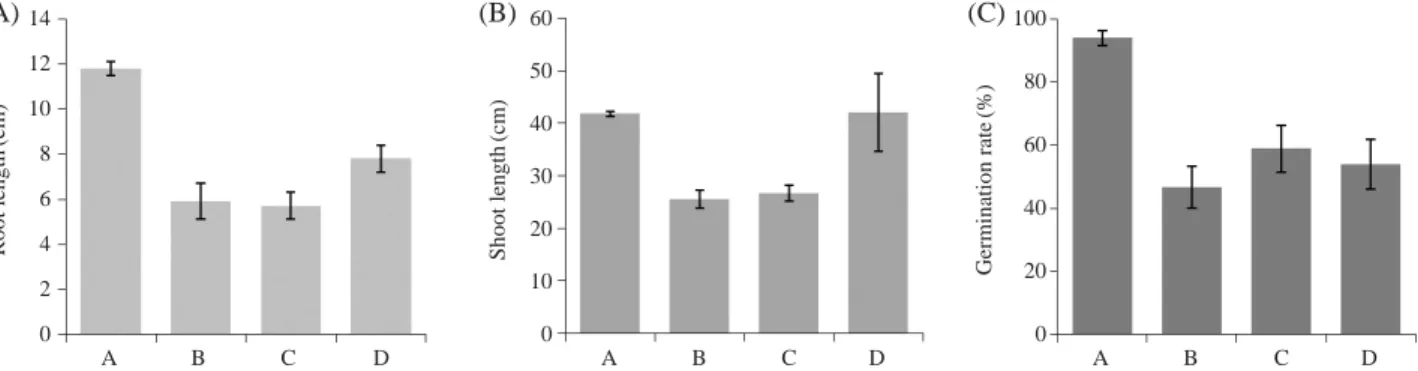
방사선원에 따른 각 식물체의 생육 결과를 비교하였 다 (Fig. 1). 그 결과 식물체의 길이가 대조구에 비하여 200 Gy 감마선과 40 Gy 중이온빔에서 30 cm 미만으로 낮 게 나타난 반면, 우주선에 탑재된 식물체에서는 40 cm 이상으로 대조구와 비슷하게 자란 것을 확인하였다. 뿌 리의 길이는 대조구에서 11 cm로 가장 길게 자랐으며, 조사된 식물체는 5~8 cm 내외로 대조구에 비하여 작은Fig. 1. Growth comparison of rice irradiated with gamma-ray, ion beam and cosmic-ray. The rice seeds were irradiated with 200 Gy of
gamma-ray, 40 Gy of ion beam and cosmic-ray. Seeds of control and irradiation samples were germinated and grown in soil tray for 1 month. (A) Non-irradiation, (B) 200 Gy of gamma-ray, (C) 40 Gy of Ion beam D. Cosmic-ray.
14 12 10 8 6 4 2 0 A B C D A B C D A B C D 60 50 40 30 20 10 0 100 80 60 40 20 0 Root length (cm) Shoot length (cm) Germination rate (%) (A) (B) (C)
것을 확인하였다. 발아율 역시 40~60% 내외로 90% 이 상의 발아율을 보인 대조구에 비하여 현저하게 낮아진 것을 확인하였다. 외부 스트레스 및 방사선 등 환경요인은 식물의 성장 및 발달에 많은 영향을 미친다고 알려져 있다 (Yu et al. 2007; Rakwal et al. 2008). 본 연구에서 방사선원에 따라 각 식물체의 성장에 영향을 미쳐 대조구 보다 더 작게 자라고, 발아가 잘 되지 않은 것으로 판단된다. 2. AFLP 분석 방사선원에 조사된 각 식물체들과 조사되지 않은 대조 구와의 유전적 다형성 분석을 하기 위하여, ABI 3130xl genetic analyzer의 capillary electrophoresis를 사용하였다. 본 실험에서는 기존의 acrylamide gel electrophoresis를 이용한 AFLP 분석보다 capillary를 이용하여 적은 양으 로 더 빠르고 정확하게 실험을 수행할 수 있었다.
방사선원에 조사된 식물체와 조사되지 않은 식물체간 총 29개의 selective primer 조합 중에서 M-CGA/E-AAC
primer 조합을 capillary를 통하여 polymorphism peak을 확인한 결과이다(Fig. 2). 30~600 bp에서의 polymorphism
peak의 유무에 따라 확인한 결과, 이온화 에너지원에 조
사된 각 식물체와 대조구 간의 primer 조합에서 전체 2,238개의 밴드로, primer 당 평균 밴드는 77개로 나타났 다 (Table 1). Polymorphic band는 총 1,269개로 평균 44 개의 특이적 밴드가 확인되었다. M-CAT/E-AGG 조합에 서 158개의 밴드와 130개의 polymorphic 밴드로 가장 높 게 나타났으며, 전체 밴드에서는 M-CAC/E-ACG 조합에 서 2개의 밴드로 가장 낮게 나타났다. Polymorphism은 M-CAC/E-ACG 조합이 100%로 최대값을, M-CTA/E-ACG에서 0%로 최소값을 나타냈으며 평균 57%의 유전 적 다양성을 보였다. 지금까지의 실험에서는 품종간 또 는 각각의 방사선원별로 처리된 식물체 간의 유연관계 분석만이 이루어졌다 (Bao et al. 2006; Li et al. 2007; Ra-shid et al. 2009). 우주환경에서 노출된 벼의 유연관계를 분석 하였을 때 polymorphism이 59.6%, 감마선에 조사 된 벼에서는 38%로 나타났으며, 품종간에서는 78.3%로 나타났다(Bao et al. 2006; Li et al. 2007; Rashid et al. 2009). Fig. 2. AFLP patterns of non irradiation plant and three irradiated plants on capillary electrophoresis using M-CGA/E-AAC primer
combina-tion. (A) Non-irradiation, (B) 200 Gy of gamma-ray, (C) 40 Gy of Ion beam, (D) Cosmic-ray. The red lines and red circles indicated thresholds and polymorphic bands, respectively.
180 220 260 300 340 380 420 460 600 400 200 30 600 400 200 30 Peak height 600 400 200 30 600 400 200 30 0 0 0 0 (A) (B) (C) (D)
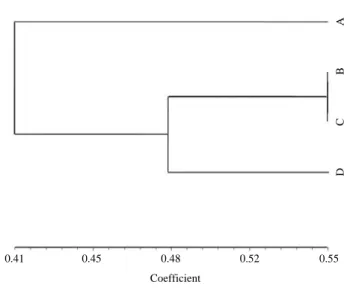
이러한 결과로 미루어 보아 AFLP에서 polymorphism은 제한효소와 selective primer의 조합과 각 개체간의 관계 에 의해서 많은 차이가 있는 것으로 보여진다 (Li et al. 2007; Yu et al. 2007; Rashid et al. 2009; Tatikonda et al. 2009). NTSYS-pc program을 이용한 유연관계분석에 있어 이 전 연구에서는 각 이온화 에너지원에 조사된 식물체로 부터 염에 내성이 있거나, 화색의 변이가 나타나는 등의 특이적인 성질에 따라서 선발된 개체로부터 유연 관계 를 분석하여 변이체들과 대조구와의 유전적 유사도를 확인하였다 (Song et al. 2010; Sung et al. 2010). 본 실험에 서는 감마선, 중이온빔, 우주선에 탑재된 식물체와 조사 하지 않은 식물체 간의 similarity coefficient를 확인한 결과, 전체적인 유사도는 0.41~0.55의 범위로 나타났으 며, 200 Gy 감마선과 40 Gy 중이온빔의 유연계수가 0.55 로 가장 가깝게 나타났으며, cosmic ray와는 0.48, 조사하 지 않은 대조구와는 0.41로 대조구와의 유연관계가 가 장 먼 것으로 나타났다 (Fig. 3). 이러한 결과로 보아 이 온화에너지원에 조사된 식물체간의 유연관계가 더 가깝 게 나타난 것은 방사선의 종류는 다르나 이온화에너지 원에 의해 변화되는 유전적 변이율이 비슷하기 때문이 라고 생각된다.
결
론
본 연구에서는 단자엽 모델 식물인 벼를 이용하여 각 방사선원인 감마선, 중이온빔, 우주선에 의해 조사된 식 물간의 유연관계를 분석하고자 수행하였다. 각 이온화 방사선에 조사된 식물체는 우주선에서 대조구와 비슷한 생장 속도를 보였으나, 200 Gy 감마선과 40 Gy 중이온빔 에서는 생장속도가 더딘 것을 확인할 수 있었다. 또한, 조사된 식물체에서의 발아율이 크게는 50% 이상 감소 하는 것을 확인하였다. AFLP를 통한 유연관계 분석에서 는 총 29개의 primer 조합에서 전체 2,238개의 밴드로 평균 77개의 밴드를 보였으며, polymorphic 밴드는 1,269 개로 평균 44개의 밴드가 확인되었다. 전체 57%의 poly-morphism을 나타내는 것을 확인할 수 있었다. NTSYS-pc program을 이용한 similarity coefficient는 전체 유사 도에서 0.41~0.55를 나타내었으며, 감마선과 중이온빔 에서는 0.55, 우주선은 0.48, 조사되지 않은 대조구와는0.41을 보였다. 이는 방사선에 조사된 식물체에서 돌연
변이가 일어나 유전적 변이율이 비슷하기 때문이라고 Table 1. Polymorphic patterns observed from 29 fluorescent
labeled AFLP primer combinations among non-irradia-tion and three irradianon-irradia-tion plants
No. of No. of Polymorphism Primer pair
total band polymorphic (%) band M-CAA/E-AAC 125 49 39 M-CAA/E-ACG 27 20 74 M-CAG/E-AAC 111 69 62 M-CAG/E-AGG 118 63 53 M-CAG/E-ACG 18 14 78 M-CAT/E-AAC 138 106 77 M-CAT/E-AGG 158 130 82 M-CAT/E-ACG 24 23 96 M-CAC/E-AGG 74 45 61 M-CAC/E-ACG 2 2 100 M-CCA/E-AAC 121 60 50 M-CCA/E-AGG 118 67 57 M-CCA/E-ACG 38 33 87 M-CGA/E-AAC 155 114 74 M-CGA/E-AGG 114 76 67 M-CGA/E-ACG 27 24 89 M-CTA/E-AGG 79 15 19 M-CTA/E-ACG 4 0 0 M-CAA/E-ACA 89 39 44 M-CAA/E-AGC 77 29 38 M-CAG/E-ACA 64 9 14 M-CAG/E-ACC 80 47 59 M-CAG/E-AGC 82 50 61 M-CAC/E-ACA 56 43 77 M-CAC/E-ACC 81 43 53 M-CAC/E-AGC 60 33 55 M-CCA/E-ACA 99 28 28 M-CCA/E-ACC 28 14 50 M-CCA/E-AGC 71 24 34 Total 2,238 1,269 -Mean 77 44 57
Fig. 3. Phylogenetic tree of the non-irradiation, and three irradiation
plants of rice from the UPGMA analysis based on the AFLP data. A. Non-irradiation B. 200 Gy of gamma-ray C. 40 Gy of Ion beam D. Cosmic-ray.
0.41 0.45 0.48 0.52 0.55
Coefficient
DC
B
생각된다. 향후 microarray, RT-PCR 등의 분석을 통하여 방사선원에 의해 반응되는 유전자의 분리 및 signal을 규명하는 연구가 필요한 것으로 판단된다.
사
사
본 연구는 교육과학기술부 지원 한국원자력연구원 기 본사업에 의해 수행되었으며 이에 감사드립니다.참 고 문 헌
Bao J, Corke H and Sun M. 2006. Analysis of genetic diversity and relationships in wasy rice (Oryza sativa L.) using AFLP and ISSR markers. Genet Resour Crop Evol. 35:353-330. Belli M, Sapora O and Tabocchini MA. 2002. Molecular targets
in cellular response to ionizing radiation and implications in space radiation protection. J. Radiat. Res. 43:13-S19. De RJ, Dendauw J, Mertens M, Loose M, Heursel J and van
Blockstaele E. 1999. Validation of criteria for the selection of AFLP markers to assess the genetic variation of a bree-ders’ collection of evergreen azaleas. Theor. Appl. Genet. 99:1155-1165.
Hara Y, Abe T, Sakmoto K, Miyazawa Y and Yoshida S. 2003. Effects of heavy-ion beam irradiation in rose (Rosa Hybrid cv ‘Bridal Fantasy’). RIKEN Accel. Rep. 36:135.
Heidi MM and Andrew CC. 2007. Almost forgotten or latest practice? AFLP applications, analysese and advances. Trends
in Plant Sci. 12(3):106-117.
Itoh J-I, Nonomura K-I, Ikeda K, Yamaki S, Inukai Y, Yamagi-shi H, kitano H and Nagato Y. 2005. Rice plant develop-ment: from zygote to spikelet. Plant Cell Physiol. 43(1):23-47.
Jwa NS, Agrawal GK, Tamogami S, Younkura M, Han O, Iwa-hashi J and Rakwal R. 2006. Defense/stress-relate marker genes, proteins and secondary metabolites in defining rice self-defense mechanisms. Plant Physiol. Biochem. 44:261-273.
Kaxama Y, Saito H, Yamamoto YY, Hayashi Y, Ichida H, Ryu-to H, Fukunishi N and Abe T. 2008. LET-dependent effects of heavy-ion beam irriaditon in Arabidopsis thaliana. Plant
Biol. 25:113-117.
Kim DS, Lee IS, Jang CS, Hyun DY, Seo YW and Lee YI. 2004. Selection of 5-methyltryptophan resistant rice mutants from irradiated calli derived from embryos. Euphytica. 135:9-19. Kim DS, Song JY, Chun J, Lee KJ, Kim J-B, Kim SH, Yun SJ
and Kang S-Y. 2010. Selection of gamma-ray induced salt tolerant rice mutants by in vitro mutagenesis. J. Radiat
Indus. 4(2):179-184.
Kim WJ, Kim DS, Kim SH, Kim J-B, Gho EJ and Kang S-Y. 2010. Analysis of genetic similarity detected by AFLP and PCoA among Genotypes of Kenaf (Hibiscus cannabinus L.)
J. Crop Sci. Biotech. 13(4):243-249.
Knorr C, Cheng HH and Dodgson JB. 1999. Application of AFLP markers to genome mapping in poultry. Animal
Genet-ics. 30:28-35.
Kwan SJ, Lim KB, Lim MH, Park JY, Kim JA, Kim JS, Lee SS, Park BS and Jin YM. 2007. Molecular genetics of Bra-ssicaceae based on AFLP display. Kor. J. Hort. Sci.
Tech-nol. 25:75-81.
Lee G-J, Chung SJ, Park IS, Lee JS, Kim J-B, Kim DS and Kang S-Y. 2008. Variation in the phenotypic features and transcripts of color mutants of chrysanthemum (Dendran-thema grandiflorum) derived from gamma ray mutagene-sis. J. Plant Biol. 51(6):418-423.
Li Y, Liu M, Cheng Z and Sun Y. 2007. Space environment induced mutations prefer to occur at polymorphic sites of rice genomes. Adv. Space Res. 40:523-527.
Maughan PJ, Saghai Maroof MA, Buss GR and Huestis GM. 1996. Amplified frgment length polymorphis (AFLP) in soybean: species diversit, inheritance and nerar-isogenic line analysis. Theor. Appl. Genet. 93:391-401.
Muller HJ. 1927. Artifical transmutation of the gene. Science 66:84-87.
Rashid M, Liu R, Jin W, Xu Y, Wang F, Tao Y, Wang J, Akbar AC, Chen J and He G. 2009. Genomic diversity among basmati rice (Oryza sativa L) mutants obtained through 60 Co gamma radiations using AFLP markers. African Jour.
Biotech. 8:6777-6783.
Rakwal R, Kimura S, Shibato J, Nojima K, Kim Y-K, Nahm BH, Jwa N-S, Endo S, Tanaka K and Iwahashi H. 2008. Growth retardation and death of rice plants irradiated with carbon ion beams is preceded by very early dose- and time-dependent gene expression changes. Mol. Cells. 25(2):272-278
Shi J-M, Guo J-G, Li W-J, Zhang M, Huang L and Sun Y-Q. 2010. Cytogenetic effects of low doses of energetic carbon ions on rice after exposures of dry seeds, wet seeds and seedlings. J. Radiat. Res. 51:235-242.
Song JY, Kim DS, Lee M-C, Lee KJ, Kim J-B, Kim SH, Yun SJ and Kang S-Y. 2010. Selection and genetic relationship of salt tolerant rice mutants by in vitro mutagenesis. J. Radiat
Indus. 4(4):307-312.
Stadler LJ. 1928. Mutation in barley induced by X-Rays and radium. Science 69:186-187.
Sugiyama M, Saito H, Ichida H, Hayashi Y, Ryuto H, Fukunishi N, Terakawa T and Abe T. 2008. Biological effects of heavy-ion beam irradiatheavy-ion on cyclamen. Plant Biol. 25:101-104.
Sung YS, Chung SJ, Kim SH, Kim W-J, Lee JY, Kim DS, Kim J-B, Kim HG and Kang S-Y. 2010. Analysis of genetic diversity among spary-type Chrysanthemum (Dedranthema grandiflorum) ‘Argus’ and its flower-colored mutants. J.
Radiat Indus. 4(2):171-177.
Tanaka A, Tano S, Chantes T, Yokota Y, Shikazono N and Watanabe H. 1991. A new Arabidopsis mutant induced by ion beams effects flavonoid synthesis with spotted pigmen-tation in testa. Genes Genet. Syst. 72:11-148.
Tatikonda L, Wani SP, Kannan S, Beerelli N, Sreedevi TK, Hoisington DA, Devi P and Varshney RK. 2009. AFLP-based molecular characterization of an elite germplasm col-lection of Jatropha curcas L., a biofuel plant. Plant Sci. 176: 505-513.
Weibo R, Bo D, Gyo HJ, Wei ZY, Zhu X and Zhaolan W. 2009. Characteristics of molecular changes in lespedeza plants after seeds been flown on satellite. Afr. J. Biotechnol. 8(18): 4353-4357.
Xu X, Kawasaki S, Fujimura T, Wang C. 2005. A protocol for high-throughput extraction of DNA from rice leaves. Plant Mol. Biol. Rep. 23:291-295.
Yang TC and Tobias CA. 1979. Potential use of heavy-ion ra-diation in crop improvement. Gamma Field Symposia. 18: 141-154.
Yu X, Wu H, Wei LF, Cheng ZL, Xin P, Huang CL, Zhang KP and Sun YQ. 2007. Characteristics of phenotype and gene-tic mutations in rice after spaceflight. Adv. Space Res. 40: 528-534.
Zhu J, Gale MD, Quarrie S, Jaskson MT and Bryan GJ. 1998. AFLP markers for the study of rice biodiversity. Theor.
Appl. Genet. 96:602-611.
Manuscript Received: January 13, 2012 Revised: January 27, 2012 Revision Accepted: February 20, 2012