Stroke can cause acute nerve injury, blockage of blood flow in the brain, or loss of brain function due to bleeding.1Stroke is one of the most common
caus-es of acquired disability and death.2,3Surviving stroke
patients have sequelae of dysfunction.4 Stroke
patients have multiple disorders, but most have problems with balance and gait.5,6
Post-stroke rehabilitation exercise has been shown to be very important for functional recovery.7Among
the various exercise methods, it has been reported that trunk exercise is effective for trunk control and balance.8 It has been reported that to improve the
gait of stroke patients, trunk exercises are performed on stable and unstable support surfaces.9 Unstable
support surface exercise has been reported to be effective in improving balance and gait.10,11
One of the methods of unstable support surface exercise is sling exercise (SE). A sling is used for trunk exercise by providing an unstable support sur-face from the ceiling.12,13 Previous studies have
reported that sling exercise is effective in improving the balance and gait of stroke patients.14,15 However,
in other previous studies, there was no difference from other exercises.16,17 Therefore, the effectiveness
of SE compared with other treatments remains unclear.
In order to analyze these unclear effects, there is a meta-analysis preceding study that analyzed the effects of SE in stroke patients.18This previous study
reported that SE has a large effect size on improving
Effects of Sling Exercise on Balance and Gait in Patients
with Stroke: Meta-Analysis of Studies in Korea
INTRODUCTION
Background: Stroke patients have multiple disorders, but most have problems with balance and gait. Post-stroke rehabilitation exercise has been shown to be very important for functional recovery.
Objectives: To systematically review and meta-analyze the effects of sling exercise (SE) on patients with stroke in studies published in Korea.
Design: Meta-analysis.
Methods: Five databases, namely, RISS, KISS, NDSL, DBpia and Earticle, were used to collect articles on vibration. Keywords such as “Stroke,” “Hemiplegia,” “Sling,” and “Sling Exercise” were used in the search for published articles. Interventions and comparisons were SE and other exercise (OE). Outcome measures were berg balance scale (BBS) and timed up and go (TUG). Consequently, eight studies were selected in the second screening using meta-analyses.
Results: Based on the results of the meta-analysis, SE was effective for BBS in the comparison of SE and OE [2.71, 95% CI (1.42, 4.01)]. It was effective for TUG in the comparison of SE and OE [-1.89, 95% CI (-3.01, -0.77)].
Conclusion: Based on eight limited studies, SE improved BBS and TUG over OE, suggesting improved stroke balance and gait. Therefore, more studies and large-scale sample randomized controlled trials are needed to confirm clinical application.
Keywords: Stroke; Sling exercise; Balance; Gait; Meta-analysis
Woonsu Cho, PT, Prof., PhDa,
Seongjin Lee, Prof., PhDb,
Byeonggeun Kim, PT, MSa
aDepartment of Physical Therapy, Nambu
University, Gwangju, Republic of Korea; bDepartment of Rehabilitation, Songwon University, Gwangju, Republic of Korea
Received : 20 June 2020 Revised : 29 July 2020 Accepted : 10 August 2020
Address for correspondence Byeonggeun Kim, PT, MS
Department of Physical Therapy, Nambu University, 23 Cheomdanjungang-ro, Gwangju, Republic of Korea
Tel: 82-10-4905-9286 E-mail: [email protected]
the balance of stroke patients. However, the effect size was not analyzed for gait. And Korea studies were not included.
Korean research is provided by the Korean Citation Index (KCI), which is the Korean version of the Science Citation Index (SCI). So, study published in Korea is not included in overseas meta-analysis study. Therefore, the purpose of this study is to meta-analyze the effect size on balance and gait by comparing SE and other exercise interventions in stroke patients published in Korea.
The following databases were searched from the earliest available date to June 2020: Research Information Sharing Service (RISS), Korean Studies Information Service System (KISS), National Digital Science Library (NDSL), DBpia and Earticle. We searched the search terms “Stroke,” “Hemiplegia,” “Sling,” and “Sling Exercise” in two languages (Korean and English) published at Korea. Re-search was conducted at the end of the study. However, additional studies were not search.
Types of studies
Randomized controlled trials (RCT) and non-ran-domized controlled trials (NRCT) investigating the use of SE as a treatment for patients with stroke were included.
Types of participants
The study samples included patients with stroke and hemiplegia. The diagnosis should have been con-firmed with head computerized tomography (CT) or magnetic resonance imaging (MRI) diagnosis. Patients should be able to understand instructions.
Types of interventions and comparisons
We included articles on intervention SE and other exercise (OE) in patients with stroke.
Types of outcome measures
The findings were analyzed in two primary outcome categories: balance and gait. Among the various measures, berg balance scale (BBS) and timed up and go (TUG), which were used in many studies, were selected.
Two reviewers (Cho and Kim) independently screened for potentially relevant titles and abstracts based on the pre-specified criteria, and full-text articles were retrieved whenever necessary. If a jour-nal article and thesis paper were duplicated, the journal article was adopted.
Two independent reviewers (Cho and Kim) abstracted and cross-checked the data obtained from the included trials. Any disagreements were resolved by co-author (Lee) to obtain a consensus.
As a tool for evaluating the quality of research methods, the RCT study used the Risk of Bias (RoB) tool developed by the Cochrane group, and the NRCT study used the Risk of Bias Assessment tool for Non-randomized Study (RoBANS). For each item of the RoB and RoBANS tools, there are three risks of skew: “high,” “low,” and “uncertain.” Assessed by two inde-pendent reviewers (Cho and Kim). Any disagreements were resolved by co-author (Lee) to obtain a consen-sus.
The meta-analysis procedure was performed with Revman 5.4. The random effects model and weighted mean difference (WMD) were used to calculate the mean effect size. A chi-square test was performed to detect statistically significant heterogeneity. We then estimated the amount of heterogeneity among studies by using the I2 statistic. Heterogeneity was further
investigated by checking data extracted from outlier studies and exploring the effects of study exclusion in sensitivity analyses. No funnel plots or assessments for publication bias were performed because of the small number of studies that were pooled in the com-parisons included in this literature. We then per-formed separate subgroup analyses for week time points.
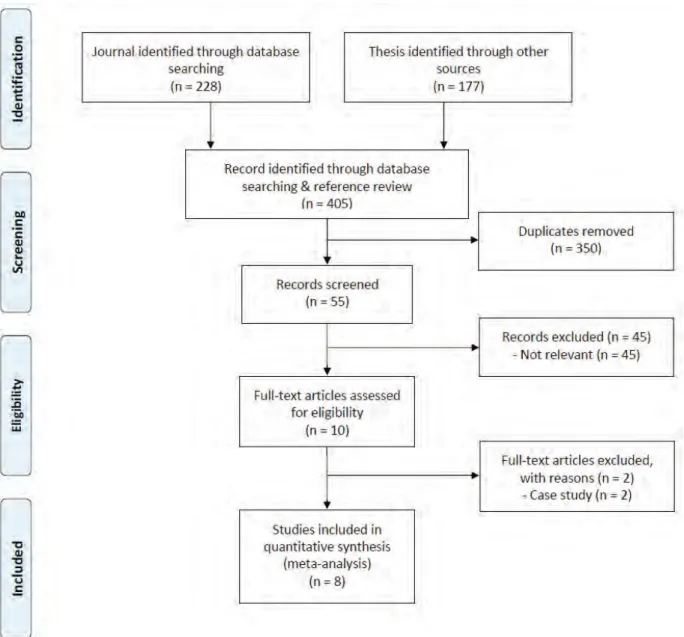
We initially retrieved 405 articles (Journal: 228,
METHODS
Literature Search Inclusion Criteria Selection of Studies Data Extraction Quality Assessment Statistical Analysis Literature SearchRESULTS
Thesis: 177) from the databases that were relevant to the search terms. Eight studies were finally included for analysis (Figure 1).14,19-25
Four RCT studies and four NRCT studies were included to investigate the SE effect on patients with stroke. These were three journal articles and five theses. They were published between 2011 and 2020. All studies were published in Korean. The
summa-rized characteristics of the studies included in our systematic review are presented in Table 1.
In this study, eight studies were conducted with methodological quality assessment using ROB (RCT: 5 studies) and RoBANS (NRCT: 3 studies) of the Cochrane library. The results are shown in Tables 2 and 3.
Study characteristics Methodological Quality of Included Studies
Publication type
Study design
Patient characteristics, Sample size
(G1: SE, G2: Control) Intervention
Authors (years) NRCT NRCT Park (2011) Duration of trial period Outcomes
40 patients diagnosed with stroke (G1: 20, male: 11, female: 9; G2: 20, male 13, female: 7), Mean age (SD): G1=51.15(3.31); G2=48.65(2.86) G1: SE G2: ME Once 30 minutes, 3 times a week, 8 weeks in total Biorescue, BBS, TUG, 10MWT, MMSE-K RCT Journal Jang and Kim
(2011)
20 patients diagnosed with stroke (G1: 10, male: unclear, female: unclear; G2: 10, male unclear, female: unclear), Mean age (SD): G1=56.60(4.74); G2=55.40(8.64) G1: SE G2: GE Once 40 minutes, 5 times a week, 4 weeks in total TIS, EMG, FMA, MTD-BS NRCT Journal
Park et al. (2012) 16 patients diagnosed with stroke (G1: 8, male: 3, female: 5; G2: 8, male 4, female: 4), Mean age (SD): G1=67.25(4.65); G2=68.13(7.49) G1: SE G2: GE Once 50 minutes, 5 times a week, 12 weeks in total BBS, PASS, MMAS, 10MWT, TUG, FIM NRCT Thesis
Lee (2012) 20 patients diagnosed with stroke (G1: 10, male: 6, female: 4; G2: 10, male 6, female: 4), Mean age (SD): G1=62.50(8.48); G2=63.40(4.94) G1: SE G2: ME Once 30 minutes, 3 times a week, 4 weeks in total EMG, BBS, FICSIT-4, TUG, Biorescue RCT Thesis
Park (2016) 30 patients diagnosed with stroke (G1: 15, male: 8, female: 7; G2: 15, male: 10, female: 5), Mean age (SD): G1=64.13(4.06); G2=63.53(3.37) G1: SE G2: SSWE Once 30 minutes, 5 times a week, 8 weeks in total MS, Will, BBS, TUG RCT Thesis
Choi (2018) 20 patients diagnosed with stroke (G1: 10, male: 10, female: 0; G2: 10, male: 7, female: 3), Mean age (SD): G1=50.20(17.1); G2=58.70(14.5) G1: SE G2: ME Once 30 minutes, 3 times a week, 6 weeks in total BBS, FRT, Gym plate, EMG RCT Journal
Jang et al. (2020) 16 patients diagnosed with stroke (G1: 8, male: 6, female: 2; G2: 8, male: 6, female: 2), Mean age (SD): G1=59.13(3.35); G2=54.88(4.05) G1: VSE G2: GE Once 35 minutes, 3 times a week, 6 weeks in total Biorescue, LEGsys RCT Thesis
Kwon (2016) 30 patients diagnosed with stroke (G1: 10, male: 6, female: 4; G2: 10, male: 5, female: 5; G3: 10, male: 6, female: 4), Mean age (SD): G1=53.00(6.89); G2=54.47(6.5); G3=56.57(7.13) G1: VSBE G2: SBE G3: BE Once 40 minutes, 3 times a week, 6 weeks in total EMG, BT Table 1. Characteristics of studies included in the analysis
G: group, NRCT: non-randomized controlled trials, SD: standard deviation, SE: sling exercise, ME: mat exercise, BBS: berg balance scale, TUG: timed up and go, 10MWT: 10 meter walk test, MMSE-K: mini mental state examination korea, RCT: randomized controlled trials, GE: general exercise, TIS: trunk impairment scale, EMG: Electromyography, FMA: fugl-meyer assessement, MTD-BS: measurement training and documentation-balance system, PASS: postural assessment scale for stroke patients, MMAS: modified motor assessment scale, FIM: functional independence measure, FICSIT-4: frailty and injuries cooperative studies of intervention technique-4, VSBE: vibration sling bridge exercise, SBE: sling bridge exercise, BE: bridge exercise, BT: balance trainer, SSWE: standing side wall exercise, MS: muscle strength, FRT: functional reaching test, VSE: vibration sling exercise
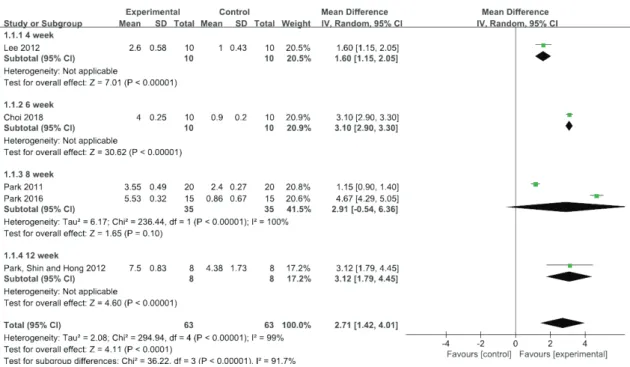
Five studies using BBS were performed to evaluate the effect of the treatment. The BBS score for the meta-analysis of SE was significantly improved (WMD=2.71, 95% CI [1.42, 4.45], P<0.00001)
com-pared with other exercise alone, as shown in Figure 2 (P≤0.1 and I2=75%); thus, the heterogeneity existed
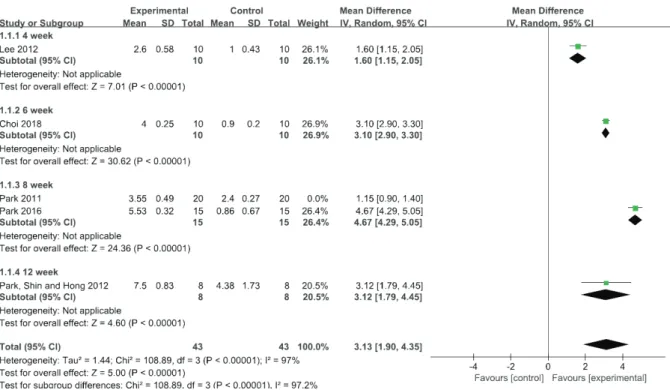
in every study. We further conducted sensitivity analysis, and the results were high, as shown in Figure 3. Random sequence generation Allocation concealment Blinding of participants Blinding of outcome assesment Incomplete outcome Study Unclear Unclear Unclear Unclear Low High High High High High Low High Low Low Low Selective reporting Unclear Unclear Unclear Unclear Unclear Other bias Unclear Unclear Unclear Unclear Unclear Unclear Unclear Unclear Unclear Unclear High High High High High Jang and Kim (2011)
Kwon (2016) Park (2016) Choi (2018) Jang et al. (2020)
Table 2. Methodological evaluation of RCT study using RoB tool
Selection of participants Confounding variables Measurement of intervention Blinding of outcome assessment Study Low Low Low High High High Incomplete outcome data Low High Low Selective reporting Unclear Unclear Unclear Low Low Low High High High Park (2011) Park et al. (2012) Lee (2012)
Table 3. Methodological evaluation of NRCT study using RoBANS tool
Figure 2. Forest plots for effect size comparison of SE and OE for BBS Comparison of SE and OE for BBS
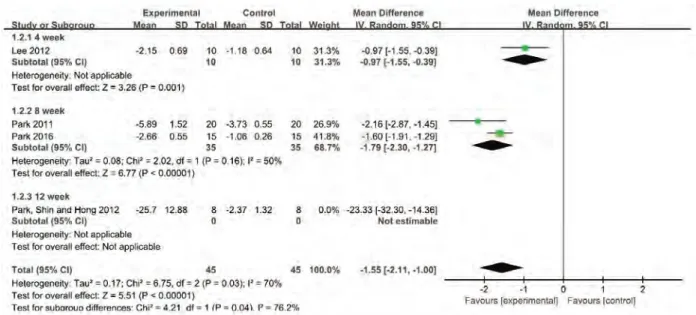
Four studies using TUG were performed to evaluate the effect of the treatment. The TUG for the meta-analysis of SE was significantly improved (WMD=-1.89, 95% CI [-3.01, -0.77], P=0.0009) compared
with other exercise alone, as shown in Figure 4(P≤0.1 and I2=75%); thus, the heterogeneity existed
in every study. We further conducted sensitivity analysis, and the results were decrease, as shown in Figure 5.
Figure 4. Forest plots for effect size comparison of SE and OE for TUG
Figure 3. Forest plots for sensitivity analysis after effect size comparison of SE and OE for BBS Comparison of SE and OE for TUG
Figure 5. Forest plots for sensitivity analysis after effect size comparison of SE and OE for TUG
A combined meta-analysis could not be performed because of the limited number of studies included and different evaluation methods employed. Park showed that Biorescue and 10MWT were significantly improved after SE.20Jang and Kim showed that FMA
and MTD-BS were significantly improved after SE.19
Park et al. showed that PASS, MMAS and 10MWT were significantly improved after SE.21 Lee showed
that FICSIT-4 and Biorescue were significantly improved after SE.22Kwon showed that BT was
sig-nificantly improved after SE.23Park showed that Will
was significantly improved after SE.24 Choi showed
that FRT and Gym-Plate were significantly improved after SE.25 Jang et al. showed that Biorescue and
LEGSys were significantly improved after SE.14
This study was conducted to investigate the effec-tiveness of SE through a meta-analysis of studies on SE therapy for patients with stroke that were pub-lished in South Korea. In this study, we analyzed balance and gait. In previous meta-analysis studies published abroad, only balance was studied. This suggests the necessity of analyzing the effect of SE on gait in stroke patients.
The effect size analyzed through meta-analysis in this study showed a high effect size of 2.71 for BBS and -1.89 for TUG. Balance had a larger effect size than gait. This result suggests that a sling provides an unstable support surface, which seems to have an effect on stabilizing the trunk of stroke patients by activating the trunk muscles more on the unstable support surface than on the stable support surface.17
Therefore, it is thought that trunk control primarily improves balance ability, and its influence secondarily improves gait ability.16,26
A prior meta-analysis study of balance after apply-ing SE to stroke patients also showed a high effect size. This was consistent with this study. For stroke patients, the effect of SE on gait came with a high effect size. However, there has been no study that determined the effect size by meta-analyzing gait after applying SE to stroke patients, so more studies need to be conducted.
Overall, heterogeneity in this study was high. The reason for the high heterogeneity is considered to be due to the difference of effect size according to the intervention period, as in the design of this study. Further analysis is needed to find the reasons for high heterogeneity in each period and on the whole. However, due to the lack of research, further analysis was not possible.
As a result of meta-analyzing a study published in Korea, SE was effective in improving balance and
DISCUSSION
gait. The results of this study could be used as evi-dence for the use of SE in the treatment of stroke patients in hospitals in Korea.
There are some limitations to this study. First, not only RCT, but also NRCT studies are included. Second, only studies with a small number of subjects are included. Third, unpublished article and hand search were not conducted in this study. Complementing these limitations will require future high-quality RCT and studies with larger sample sizes.
Based on eight limited studies, SE improved BBS and TUG over OE, suggesting improved stroke bal-ance and gait. It should be used with caution due to the limitations of the studies included, such as small sample size and risk of bias. Therefore, more studies and large-scale sample RCTs are needed to confirm clinical application.
No potential conflict of interest relevant to this arti-cle was reported.
This study was supported (in part) by research funds from Nambu University, 2020.
3. 4. 5. 6. 7. 8. 9. 10. 11. 12. 13. 14.
Sawacha Z, Carraro E, Contessa P, Guiotto A, Masiero S, Cobelli C. Relationship between clinical and instrumental balance assessments in chronic post-stroke hemiparesis subjects. J Neuroeng Rehabil. 2013;10(1):95.
Mansfield A, Inness EL, McIlroy WE. Stroke. Handb Clin Neurol. 2018;159:205-228.
Fishbein P, Hutzler Y, Ratmansky M, Treger I, Dunsky A. A Preliminary Study of Dual-Task Training Using Virtual Reality: Influence on Walking and Balance in Chronic Poststroke Survivors. J Stroke Cerebrovasc Dis. 2019;28 (11):104343.
Celestino ML, van Emmerik R, Barela JA, Gama GL, Barela AM. Intralimb gait coordination of individuals with stroke using vector coding. Hum Mov Sci. 2019;68:102522.
Ramos-Lima MJM, Brasileiro IC, Lima TL, Braga-Neto P. Quality of life after stroke: impact of clinical and sociodemographic factors. Clinics. 2018;73.
Souza DCB, de Sales Santos M, da Silva Ribeiro NM, Maldonado IL. Inpatient trunk exercises after recent stroke: An update meta-analysis of randomized controlled trials. NeuroRehabilitation. 2019;44(3):369-377.
Van Criekinge T, Saeys W, Hallemans A, et al. Effectiveness of additional trunk exercises on gait performance: study protocol for a randomized controlled trial. Trials. 2017;18(1):249.
Jung KS, Cho HY, In TS. Trunk exercises per-formed on an unstable surface improve trunk muscle activation, postural control, and gait speed in patients with stroke. J Phys Ther Sci. 2016;28(3):940-944.
Hwang HS, Kim JH, Choi BR. Comparison of the effects of visual feedback training and unstable surface training on static and dynamic balance in patients with stroke. J Phys Ther Sci. 2017;29 (10):1720-1722.
You YL, Su TK, Liaw LJ, Wu WL, Chu IH, Guo LY. The effect of six weeks of sling exercise training on trunk muscular strength and endurance for clients with low back pain. J Phys Ther Sci. 2015;27(8):2591-2596.
Yue YS, Wang XD, Xie B, et al. Sling exercise for chronic low back pain: a systematic review and meta-analysis. PLoS one. 2014;9(6):e99307. Jang HJ, Park CB, Kim BG. Effects of Passive Vibration Convergence Sling Exercise on the Balance and Gait of Patients with Stroke. Journal of the Korea Convergence Society. 2020;11(1):57-63.
REFERENCES
1.
2.
Lachance CC, Ford C. CADTH Rapid Response Reports. In: Portable Stroke Detection Devices for Patients with Stroke Symptoms: A Review of Diagnostic Accuracy and Cost-Effectiveness. Ottawa (ON): Canadian Agency for Drugs and Technologies in Health; 2019.
French B, Thomas L, Leathley M, et al. Does repetitive task training improve functional activi-ty after stroke? A Cochrane systematic review and meta-analysis. J Rehabil Med. 2010;42(1):9-15.
CONCLUSION
CONFLICT OF INTERESTS
Search strategy : RISS, KISS, NDSL, DBpia and Earticle Koeran #1 뇌졸중 AND 슬링 #2 뇌졸중 AND 슬링운동 #3 편마비 AND 슬링 #4 편마비 AND 슬링운동 English
#5 Stroke AND sling
#6 Stroke AND sling exercise #7 Hemiplegia AND sling
#8 Hemiplegia AND sling exercise 15. 16. 17. 18. 19. 20. 21.
Lee JY, Kim SY, Yu JS, Kim DG, Kang EK. Effects of sling exercise on postural sway in post-stroke patients. J Phys Ther Sci. 2017;29(8): 1368-1371.
Park JH, Hwangbo G. The effect of trunk stabi-lization exercises using a sling on the balance of patients with hemiplegia. J Phys Ther Sci. 2014;26(2):219-221.
Lee JS, Lee HG. Effects of sling exercise therapy on trunk muscle activation and balance in chronic hemiplegic patients. J Phys Ther Sci. 2014;26 (5):655-659.
Lianghua C, Junqi C, Qiyuan P, et al. Effect of Sling Exercise Training on Balance in Patients with Stroke: A Meta-Analysis. PLoS one. 2016;11(10):e0163351.
Jang KH, Kim KY. Effect of Intensive Trunk-Pelvic Stabilization Training Using Sling on Muscle Activity and Balance in Hemiplegia. Journal of Korea Academia-Industrial coopera-tion Society. 2011;12(3):1244-1252.
Park JH. Effect of Trunk Stabilization Exercises Using Sling on Balance and Gait in Patients with Hemiplegia [Master’s thesis]. Gyeongsan, Republic of Korea: Daegu University; 2011. Park SJ, Shin YA, Hong SM. Effects of Sling Exercise on Functional Balance, Walk Power and
22.
23.
24.
25.
26.
Independence in Chronic Stroke Patients. Journal of Sport and Leisure Studies. 2012;0(49):737-748. Lee JS. The effects of sling on trunk muscles activation and balance in chronic hemiplegic patient [Master’s thesis]. Naju, Republic of Korea: Dongshin university; 2012.
Kwon K. The effect of applying different bridge exercise after abdominal drawing-In maneuver on trunk muscles activation and balance for chronic stroke patients [Master’s thesis]. Yongin, Republic of Korea: Yongin University; 2016. Park JS. A Study on the Gluteus Medius Intensifying Exercise using the Sling's Effect on Chronic Stroke Patient's Muscle Strength and Balance Ability [Master’s thesis]. Gyeongsan, Republic of Korea: Daegu University; 2016. Choi SJ. The Effects of Closed Kinetic Chain Sling Exercise on the Balance and Back Muscle Activation Muscle of a Chronic Stroke Patients [Master’s thesis]. Gyeongsan, Republic of Korea: Daegu University; 2018.
Hwang BH, Kim TH. The effects of sand surface training on changes in the muscle activity of the paretic side lower limb and the improvement of dynamic stability and gait endurance in stroke patients. J Exerc Rehabil. 2019;15(3):439.