112
2019 ⦽ǎႊᔍᖒ⠱ʑྜྷ⦺⫭⇹ĥ⦺ᚁݡ⫭םྙ᧞ḲDevelopment of Si-Al-P Composites for Immobilization of Radioactive Waste Salt
Ki Rak Lee*, Hwan-Seo Park, Jung-Hoon Choi, Seung Youb Han, Hyun Woo Kang, Daegwon Eun, and Seona Jung
Korea Atomic Energy Research Institute, 111, Daedeok-daero 989beon-gil, Yuseong-gu, Daejeon, Republic of Korea
*
Pyroprocessing is of considerable technology for advanced recycling of spent fuel as no water is involved. Argonne National Laboratory (ANL) conducted the integral fast reactor (IFR) program and developed electrochemical and pyrometallurgical methods for the treatment of spent metallic fuel. At present, Korea Atomic Energy Research Institute (KAERI) is developing pyroprocessing to safely treat the nuclear spent fuel from pressurized water reactors (PWR). This technology has the advantage of proliferation resistance because the plutonium (Pu) is recovered with other minor actinides rather than as pure Pu. Several kinds of electrochemical processes such as electro-reduction, electro-refining, and electro-winning are included in pyroprocessing. Various kinds of salts such as LiCl, NaCl, KCl, and eutectic salts are used as electrolytes and hence waste salt, which is one of the more problematic wastes generated from pyroprocessing, is produced. At KAERI, LiCl and LiCl-KCl salt wastes are expected to be generated during pyroprocessing efforts. Therefore, it is very important to develop a proper method of waste salt treatment with disposal volume reduction as well as stable isolation from the biosphere.
The SAP (SiO2-Al2O3-P2O5) process has been
demonstrated to convert the metal chloride salt waste into manageable products at relatively low temperature to avoid evaporation of metal chlorides. The products can be fabricated as a monolithic waste form by adding a glassy material after the
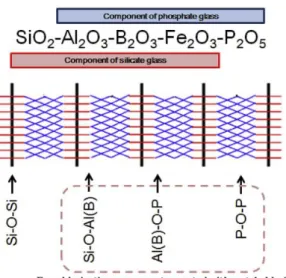
dechlorination process. Remarkable chemical durability and high waste loading for LiCl salt waste up to 40 mass% (prior to dechlorination) were achieved with the SAP waste form process. Compatibility between silicate and phosphate phase was generally very low because of immiscibility between the two phases. For the SAP waste form, silicate and phosphate phases were mixed with an intermediate micro-scale phase. Based on previous study, upgraded-SAP (U-SAP) was developed by controlling the composition of the glass phase, including the addition of B2O3, and then U-SAP
waste forms were consolidated after the dechlorination process without chemical binder such as glassy material. The microstructure of the U-SAP waste form was very different from that of the SAP waste form, where the micro-sized phases were not present in the SAP waste form. In this study, U-SAP waste forms were prepared with LiCl salt including simulant radionuclides (CsCl, BaCl2, SrCl2)
as a surrogate. Basic properties of dechlorinated products and waste forms were characterized with a variety of physical and chemical analyses. The structure of U-SAP waste form was investigated X-ray diffraction (XRD), transmission, scanning transmission, and scanning electron microscopies (i.e., TEM, STEM, and SEM, respectively), energy dispersive spectroscopy (EDS), secondary ion mass spectrometry (SIMS), and atom-probe tomography (APT).
2019 ⦽ǎႊᔍᖒ⠱ʑྜྷ⦺⫭ ⇹ĥ⦺ᚁݡ⫭ םྙ᧞Ḳ
113
Fig. 1. Conceptual description of U-SAP composite.Fig. 2. Schematic image for structural concept of U-SAP waste form.
REFERENCES
[1] H.-S. Park, I.-T. Kim, Y.-Z. Cho, H.-C. Eun, H.-S. Lee, Environ. Sci. Technol. 42 (2008) 9357-9362. [2] H.-S. Park, I.-H. Cho, H.-C. Eun, I.-T. Kim, Y.-Z.
Cho, H.-S. Lee, Environ. Sci. Technol. 45 (2011) 1932-1939.
[3] K.R. Lee, H.S. Park, I.H. Cho, J.H. Choi, H.C. Eun, T.K. Lee, S.Y. Han, D.H. Ahn, Kor. J.Chem. Eng. 34 (2017) 2390-2396.