© Korean Powder Metallurgy Institute 1203
-1. Introduction
Copper and copper-based alloys are widely used as electric and electrode materials due to their good conductivity. However, in the case of the precipitation- hardened copper alloys with high strength, there is a problem in that the mechanical properties deteriorate substantially due to the presence of a coarse precipitate phase at high temperature [1-2].
Copper metal matrix composites with reinforcing ceramic particles such as oxide, borides and carbides in the copper matrix were developed as electrode materials because the ceramic particles are stable at high temperatures [3-4]. TiB2 was also found to be a potential candidate for the reinforcement of the copper alloy because of its high melting point, hardness, thermal conductivity, and electrical conductivity [5].
Recently, great attention has been given to self- propagating high-temperature synthesis (SHS), which is one of the in situ processes for producing metal-matrix composites (MMCs) [6]. SHS is extremely attractive due to short synthesis time, low energy consumption and high purity of products. Spark-plasma sintering (SPS) is a newly developed process with which makes sintering of high quality materials can be produced in short periods through DC-pulse charging between powder particles with relatively high sintering pressure [7].
In the present study, in situ formation of TiB2 particles in the copper matrix through a combined process of mechanical treatment followed by SHS was investigated. Using the synthesized powder, the thermal stability and property after spark-plasma sintering was also studied.
2. Experimental and Results
Titanium (99.5%, < 10µm, irregular shape), amorphous boron (97%, < 1 µm, irregular shape) and copper (99.5%, < 45µm, dendritic shape) powders were used as starting materials. Powder mixtures with a stoichiometry of Cu-40%.wt(Ti+2B) were treated in a high-energy mill (AGO-2, planetary ball mill type) at 1000rpm(1st MM). Balls and vials are made of stainless steel, the diameter of the ball was 5mm and the powder to ball ratio was 1:20. The vials were evacuated and subsequently filled with argon up to 0.3 MPa.
Powder precursors obtained by mechanical treatment were subjected to SHS reaction which was ignited by heating a coil of spiral tungsten wire in argon atmosphere.
Cu-40wt.%TiB2 powders were produced by SHS reaction and then milled at 500rpm for 10min(2nd MM) by using the the same parameters as for 1st MM. The milled powder mixed with Cu powders by high-energy ball-milling to produce Cu-2.5wt.%TiB2 composites(3rd MM). The diameter of the balls was 2.77mm.
Spark-Plasma Sintering (SPS) was performed using a SPS apparatus (Sumitomo Coal Mining Co.Ltd, AUJ-1611) under vacuum. A graphite mold of 15 mm in inner diameter was used. The applied SPS-pressure and SPS-temperature were 50MPa and 650-750 , respectively. ℃ The final temperature was held for 5-30 min. After sintering, all samples were heat treated between 850 and 950 under Ar ℃ atmosphere for 2hours.
X-ray diffraction patterns (XRD, Cu Kα, Rigaku, RAD-3C) were taken for phases analysis. The morphology and qualitative analysis (EDS) of powders were observed 2006 POWDER METALLURGY
World Congress
PC11-W-04
Thermal Stability and Properties of Cu-TiB
2Nanocomposites Prepared by
Combustion Synthesis and Spark-plasma Sintering
Dae-Hwan Kwona, Thuy Dang Nguyenb, Dina Dudinac, Jong-Won Kumd, Pyuck-Pa Choie,Ji-Soon Kimf and Young-Soon Kwong
Research Center for Machine Parts and Materials, School of Materials Science & Engineering Processing, University of Ulsan, San 29 Mugeo-dong, Nam-gu, Ulsan 680-749, Korea
a
[email protected], [email protected], [email protected], [email protected] e
[email protected], [email protected], [email protected] Abstract
Cu-TiB2 nanocomposite powders were synthesized by combining high-energy ball-milling of Cu-Ti-B mixtures and subsequent self-propagating high temperature synthesis (SHS). Cu-40wt.%TiB2 powders were produced by SHS reaction and ball-milled. The milled SHS powder was mixed with Cu powders by ball milling to produce Cu-2.5wt.%TiB2 composites. TiB2 particles less than 250nm were formed in the copper matrix after SHS-reaction. The releative density, electrical conductivity and hardness of specimens sintered at 650-750℃ were nearly 98%, 83%IACS and 71HRB, respectively. After heat treatment at 850 to 950℃ for 2 hours under Ar atmosphere, hardness was descedned by 15%. Our Cu-TiB2 composite showed good thermal stability at eleveated temperature.
© Korean Powder Metallurgy Institute 1204 -by means of field emission-scanning electron microscopy (FE-SEM, JEOL, JSM-6500F). The relative density of samples was measured by the Archimedes method and hardness (HRB) values were measured by a Rockwell hardness tester. The electrical conductivity expressed in %IACS (International Annealed Copper Standard) was measured by a conductivity meter (Fischer, SIMASCOPE® SMP10).
Fig. 1. SEM images of (b) dark before and (c) bright area in (a) Cu-2.5wt.%TiB2 compacts spark- plasma sintered at 650 for 30min.℃
Table 1. Relative density and electrical conductivity after spark-plasma sintering
Sintering Sample name Temperature ( )℃ Time (min) Relative Density (%) Electrical conductiv ity (%IACS) Sample 1 650 5 98.16 82.99 Sample 2 650 15 98.29 83.49 Sample 3 650 30 98.19 83.12 Sample 4 700 5 98.35 83.25 Sample 5 750 5 98.61 82.33
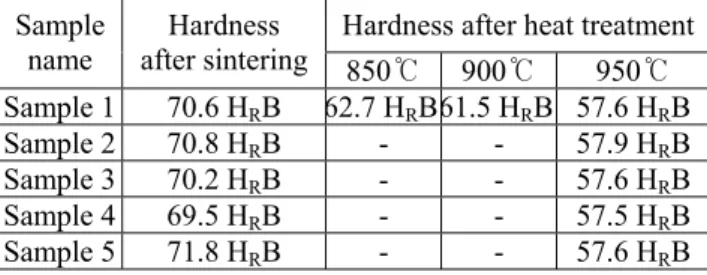
Table 2. Hardness after sintering and heat treatment Hardness after heat treatment Sample
name after sintering 850℃ 900℃ 950℃ Hardness Sample 1 70.6 HRB 62.7 HRB 61.5 HRB 57.6 HRB Sample 2 70.8 HRB - - 57.9 HRB Sample 3 70.2 HRB - - 57.6 HRB Sample 4 69.5 HRB - - 57.5 HRB Sample 5 71.8 HRB - - 57.6 HRB There are bright and dark areas in the microstructure (Fig. 1(a)). The dark area indicates the particles of SHS-products. In bright area, TiB2 particles sepreated from SHS-product were dispersed in the Cu matrix during milling (Fig. 1(c)). However, large particles of the SHS-product are still be seen in the microstructure (Fig. 1(a) and (b)). The size of TiB2 particles is smaller than 300nm (Fig 1(b) and (c)).
Table 1 and 2 show the relative density, electrical conductivy and hardness before and after heat treatment at elevated temperature. The relative density, electrical conductivity and hardness did not change even though sintering temperature and time increased. Hardness descreased sharply after heat treatment at 850 . However, ℃ after heat treatment at over 850 , hardness changed ℃ slightly.
3. Summary
Cu–40wt%TiB2 nanocomposite powders were success-fully synthesized by a combining mechanical milling and subsequent self-propagating high-temperature reaction. TiB2 particles were smaller than 300nm in size.
The relative density, electrical conductivity and hardness of all Cu-2.5wt.%TiB2 nanocomposites after spark-plasma sintering were approximately 98%, 83% IACS and 71 HRB, respectively. After heat treatment between 850 and 950 ℃ for 2hours, hardness decresed from 71 to 58 HRB by 15% compared to the values measuered at room temperature.
4. Acknowledgements
This work was supported by the Research Center for Machine Parts and Materials Processing (ReMM) located at the University of Ulsan which is funded by the Ministry of Commerce, Industry and Energy (MOCIE).
5. References
1. D.G. Morris and M.A. Morris, Mater. Sci. Eng. A, 104, 201 (1988).
2. J.B. Correia, H.A. Davies and C.M. Sellars, Acta Mater., 45, 177(1997).
3. A. Upadhyaya and G.S. Upadhyaya, Mater. Design, 16, 41(1995).
4. C. Biselli, D.G. Morris and N. Randall, Scripta Metall. Mater., 30, 1327(1994).
5. G.V. Samsonov and B.A. KovenskayaIn: V.I. Matkovich Editor, Boron and Refractory Borides Springer-Verlag, New York, p. 19, 1977.
6. Z.A. Munir, Ceram Bull, 67, 342(1988).