저작자표시-비영리-변경금지 2.0 대한민국 이용자는 아래의 조건을 따르는 경우에 한하여 자유롭게 l 이 저작물을 복제, 배포, 전송, 전시, 공연 및 방송할 수 있습니다. 다음과 같은 조건을 따라야 합니다: l 귀하는, 이 저작물의 재이용이나 배포의 경우, 이 저작물에 적용된 이용허락조건 을 명확하게 나타내어야 합니다. l 저작권자로부터 별도의 허가를 받으면 이러한 조건들은 적용되지 않습니다. 저작권법에 따른 이용자의 권리는 위의 내용에 의하여 영향을 받지 않습니다. 이것은 이용허락규약(Legal Code)을 이해하기 쉽게 요약한 것입니다. Disclaimer 저작자표시. 귀하는 원저작자를 표시하여야 합니다. 비영리. 귀하는 이 저작물을 영리 목적으로 이용할 수 없습니다. 변경금지. 귀하는 이 저작물을 개작, 변형 또는 가공할 수 없습니다.
Predictors of Institutionalization in Patients
with Alzheimer’s Disease
by
Dong Gyu Park
Major in Medicine
Department of Medical Sciences
The Graduate School, Ajou University
Predictors of Institutionalization in Patients
with Alzheimer’s Disease
by
Dong Gyu Park
A Dissertation Submitted to The Graduate School of
Ajou University in Partial Fulfillment of the Requirements
for the Degree of
Master of Medicine
Supervised by
So Young Moon, M.D., Ph.D.
Major in Medicine
Department of Medical Sciences
The Graduate School, Ajou University
This certifies that the dissertation
of Dong Gyu Park is approved.
SUPERVISORY COMMITTEE
In Soo Joo
So Young Moon
Jin Soo Lee
The Graduate School, Ajou University
December, 10th, 2015
- Abstract -
Predictors of Institutionalization in Patients with Alzheimer’s
Disease
Dementia is the most frequent reason for the institutionalization in the elderly. Knowing the estimated time until institutionalization can give important information to clinicians and caregivers in making decisions. Many studies have reported predictors of institutionalization in patients with dementia, but only few studies have included the factors that measured long-term change. Moreover, studies with Asian population are scarce. In this study, we first evaluated baseline factors that may predict institutionalization of the patient with Alzheimer’s disease, and then we evaluated predictors that measured longitudinal change.
Among the patients with Alzheimer’s disease enrolled in CREDOS study, we selected the patients who were enrolled between July 2008 and December 2013, to utilize data from public long-term care insurance, which has been implemented in South Korea since July 2008. We excluded the patients who have already been institutionalized at the time of enrollment. By retrospectively reviewing the data from the long-term care insurance program, we identified the patients who were institutionalized between July 2008 and January 2014. We compared the measures of dementia severity, cognition, neuropsychiatric symptoms, and medication use between the institutionalized patients and not-institutionalized patients.
On mean 3.19 years of follow-up, 421 (17%) of patients were institutionalized. Institutionalized patients were less educated, had longer duration after onset of the symptoms, and had lower cognitive ability, higher dementia severity, and more severe neuropsychiatric symptoms at baseline. They had more rapid decline of cognitive ability and aggravation of dementia severity. The institutionalized patients also used the antipsychotics more frequently. Finally, lower cognitive at baseline, higher dementia severity at baseline, more severe neuropsychiatric symptoms at baseline, more rapid aggravation of dementia severity, and more frequent use of antipsychotics were independent predictors of institutionalization.
Keyword: Institutionalization, Predictors, Alzheimer’s disease, Dementia
TABLE OF CONTENTS
ABSTRACT ··· ⅰ
TABLE OF CONTENTS ··· iii
LIST OF TABLES ··· iv
. Ⅰ INTRODUCTION ··· 1
. Ⅱ SUBJECTS AND METHODS ··· 4
A. SUBJECTS ··· 4
B. METHODS ··· 6
1. Cognitive Assessment ··· 6
2. Public Long-Term Care Insurance for the Elderly in South Korea ··· 7
3. Institutionalization ··· 8
. Ⅲ RESULTS ··· 11
A. BASELINE FACTORS ··· 11
B. FACTORS THAT MEASURED LONGITUDINAL CHANGE ··· 17
. Ⅳ DISCUSSION ··· 22 . Ⅴ CONCLUSION··· 26 REFERENCES ··· 27 국문요약 ··· 34
LIST OF TABLES
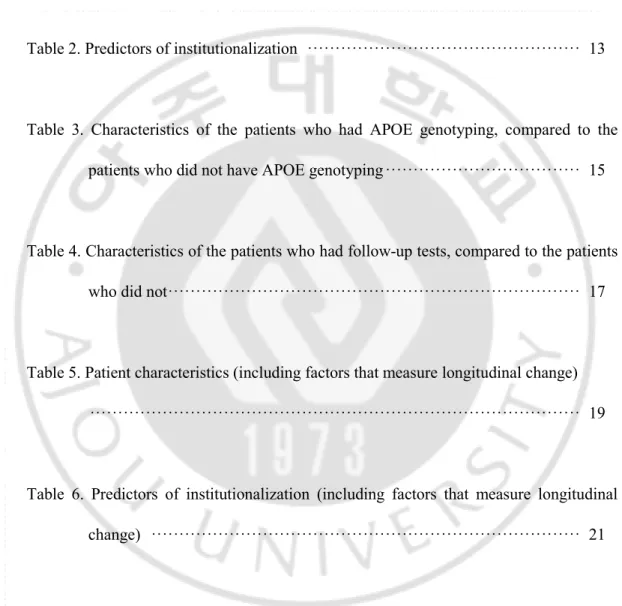
Table 1. Patient characteristics at baseline ··· 11
Table 2. Predictors of institutionalization ··· 13
Table 3. Characteristics of the patients who had APOE genotyping, compared to the patients who did not have APOE genotyping ··· 15
Table 4. Characteristics of the patients who had follow-up tests, compared to the patients who did not ··· 17
Table 5. Patient characteristics (including factors that measure longitudinal change) ··· 19
Table 6. Predictors of institutionalization (including factors that measure longitudinal change) ··· 21
Ⅰ. INTRODUCTION
Dementia, of which Alzheimer’s disease is the most prevalent type, is the most frequent reason for the institutionalization of the elderly (Agüero-Torres et al., 1998; Aguero-Torres et al., 2001). Approximately 20% of patients are institutionalized in the first year after a diagnosis of dementia. This increases to 50% after 5 years and approaches 90% after 8 years (Luppa et al., 2008). Most patients prefer to remain in their homes (Luppa et al., 2008), but as the disease progresses the patients often require institutionalization when they and their caregivers are no longer able to cope with the demands that this places on them (Gallagher et al., 2011).
Although the patients vary in their course of the Alzheimer’s disease, knowing the estimated time until institutionalization at the time of the diagnosis can have some important role in decision making. For example, with the reliable estimate, the patients and their caregivers can make necessary preparations, and clinicians can recommend appropriate care (Brodaty et al., 2014). With this information, policy makers could also estimate social demand for aged care services, as institutionalization of the patients has an impact on social economic burden.
Many studies have reported predictors of institutionalization in patients with Alzheimer’s disease or dementia (Hebert et al., 2001; Kim et al., 2002; Yaffe et al., 2002; Gaugler et al., 2003; Gaugler et al., 2007; Luppa et al., 2008; Gaugler et al., 2009; Luppa et al., 2010; Wattmo et al., 2011; Brodaty et al., 2014). Patients who are not married tend to be
institutionalized earlier (Luppa et al., 2008; Gaugler et al., 2009), but other sociodemographic variable such as older age, male or female, living alone were inconclusive (Luppa et al., 2008; Gaugler et al., 2009; Wattmo et al., 2011; Brodaty et al., 2014). Patients with the diagnosis of Alzheimer’s disease are more easily institutionalized compared to the patients with dementia of other cause (Luppa et al., 2008; Gaugler et al., 2009). Regarding patient characteristics, severity of cognitive impairment, functional impairment, and behavioral symptoms such as depression or hallucination are persistent predictors of institutionalization at baseline (Luppa et al., 2008; Gaugler et al., 2009; Wattmo et al., 2011; Brodaty et al., 2014). A Few studies have evaluated predictors that measured long-term change. A recent study found greater decline in cognitive or functional ability, and neuropsychiatric symptoms were predictors of institutionalization (Brodaty et al., 2014), while other study showed rate of change in instrumental activities of daily living (IADL) decline but not in cognitive deterioration was an important predictor (Wattmo et al., 2011). Antipsychotics use was also associated with earlier institutionalization (Brodaty et al., 2014). Studies showed an earlier institutionalization when the caregiver was a child or another relative, compared to the spouse (Luppa et al., 2008).
Most of these studies have been conducted in western countries, and studies in Asian population are scarce (Kim et al., 2002), and to our knowledge, this is the first study with large sample size in Asian population. Cultural difference between Asian and western countries could affect patients and caregivers in making decisions regarding institutionalization. In this study, we first evaluated baseline factors that may predict institutionalization of the patient with Alzheimer’s disease, and then we evaluated predictors
Ⅱ. SUBJECTS AND METHODS
A. SUBJECTS
In the present study, 3752 patients with Alzheimer’s disease were selected from the participants of the Clinical Research Center for Dementia of South Korea (CREDOS) study, in which patients were enrolled from November 2005 to December 2013. Because current study utilizes nationwide data from public long term care insurance (LTCI) program to decide whether the patient is admitted to nursing home, 1105 patients who were enrolled in CREDOS study before July 1st, 2008, when LTCI program started in South Korea, were excluded. Among remaining 2647 patients, 134 patients who have been already institutionalized at the time they were enrolled in CREDOS study were excluded. Another 43 patients who lacked enough information were excluded, and finally remaining 2470 patients were studied. In evaluating APOE genotype as a predictor of institutionalization, 1456 patients who agreed to have genetic tests were studied. And for measures with longitudinal change, only 816 patients who had follow-up tests were included.
CREDOS is a clinical research group consisting of neurologists and psychiatrists specializing in dementia, which has been funded by the Ministry of Health, Welfare, and Family Affairs since 2005. The centers included in the CREDOS have started a longitudinal registry study (CREDOS study) to build up a hospital-based registry of dementia patients (Park et al., 2011). The CREDOS cohort is dynamic and hospital-based. Participants can leave or be added over time. Participants are continually added when they are diagnosed
with subjective memory impairment, mild cognitive impairment, mild cognitive impairment of subcortical vascular type, Alzheimer’s disease, and subcortical vascular dementia, and agree to be registered to cohort. Subjects can also leave the cohort by stopping to visit hospital or when they die (Lee et al., 2014). The patients with Alzheimer’s disease were diagnosed when they met criteria of probable Alzheimer’s disease according to the criteria of the National Institute of Neurological and Communicative Disorders and Stroke and the Alzheimer’s disease and related Disorders Association (NINCDS-ADRDA) (McKhann et al., 1984; Kang et al., 1997).
This study uses the Dementia Evaluation Package developed by the CREDOS composed of the Clinical Evaluation Form and the Caregiver Questionnaire form. The Clinical Evaluation Form at baseline included; 1) history of cognitive decline from the caregiver (the onset time was based on the time stated by the caregiver), 2) Korean version of Mini-Mental State Examination (K-MMSE) (Kang et al., 1997), 3) Clinical Dementia Rating scale (CDR) (Morris, 1993), 4) Global Deterioration Scale (Reisberg et al., 1982), 5) Hachinski ischemia scale, 6) neurological examinations, and 7) Geriatric depression scale. The Caregiver Questionnaire Form included; 1) basic demographic data of the patient and caregiver, 2) lifestyle and family history, 3) past medical history including vascular risk factors such as hypertension, diabetes, heart disease, hyperlipidemia, previous stroke history, alcohol, and smoking. Vascular risk factors were regarded as positive either if the patient had previously been diagnosed with associated disease or if he or she was currently under medical treatment for the disease. Smoking history was considered to be positive for both past and current smokers. However, current smokers were only included in statistical
analysis. The Caregiver Questionnaire Form also included; 4) Korean Dementia Screening Questionnaire (KDSQ) (Yang et al., 2002), 5) Barthel activities of daily living (ADL) index, 6) Seoul instrumental ADL (S-IADL) (Ku et al., 2004) and 7) Korean version of Neuropsychiatric Inventory (K-NPI) (Choi et al., 2000). All the patients underwent laboratory tests including complete blood counts (CBC), chemistry and electrolytes, lipid profile, urinalysis, venereal disease research laboratory (VDRL), thyroid function test, vitamin B12/folate, fibrinogen, and homocysteine. MRI was also performed in all patients. APOE genotypes were analyzed, using the standard polymerase chain reaction method (Yoon et al., 2013). The DNAs of the subjects who agreed having gene tests were extracted from their peripheral blood samples using the phenol-chloroform procedure and APOE genes were amplified in the polymorphic region. Frequencies of E2, E3, and E4 alleles were estimated by gene counting. We classified all patients who have done the test into 2 groups; APOE E4 carrier and non-carrier group. For the patients who are staying in the cohort and available, follow-up study was performed once a year until March 2015. Follow-up studies included K-MMSE, CDR, and caregiver questionnaire including K-NPI. At the beginning of this registry, the symposium was held in order to standardize diagnostic assessment and to ascertain inter-center and intra-center reliability. In the middle of the registry, neurologists, psychiatrists, research nurses, and psychologists had a regular meeting in order to check the quality of data every 3rd Saturday.
B. METHODS
We examined a standardized neuropsychological battery, the Seoul Neuropsychological Screening Battery (SNSB) in all patients. The SNSB contains tests for verbal and visual memory, visuoconstructive function, frontal/executive function, attention, language, praxis, and four elements of Gerstmann syndrome. Age-, sex-, and education-specific norms for each test based on 447 normal subjects were available. The scores of scorable cognitive tests were classified as abnormal when they were below the 16th percentiles of the norms. If any task in the descriptive items was found to be abnormal by a neuropsychologist, the domain was categorized as “abnormal”.
2. Public Long-Term Care Insurance for the Elderly in South
Korea
This study utilizes nationwide data from public LTCI in South Korea. Korea is one of the fast-aging societies in the world, and LTCI has been implemented since July 2008. The LTCI scheme covers the population aged 65 and older regardless of their income levels as well as the population younger than 65 selected with relatively higher levels of severity based on the standardized evaluation of senile functional disorders (dementia, cerebrovascular disease, and Parkinson disease).
Korea’s LTCI recognizes in-kind benefits in principle. In-kind benefits consist of home care benefits and residential care benefits. Home care benefit include home help, home bathing, home nursing, day/night care, and short-term care, while residential care benefits consist of elderly care facilities and group homes. Selection between residential care benefits and home care benefits is not limited in principle (Park and Kim, 2008; Kwon, 2009; Seok,
2010; Kang et al., 2012).
Institutionalized patients with Alzheimer’s disease must be qualified in LTCI to receive residential care benefits. When the patients are admitted, long-term care facilities report the patients’ information to National Health Insurance Corporation for financial support. Thus since July 2008 when the LTCI program was introduced, lists of dementia patients admitted in long-term care facilities could be made using data from National Health Insurance Corporation.
3. Institutionalization
Institutionalization is defined as admission to long term care facilities. In South Korea, there are two kinds of long term care facilities, where elderly people in need for nursing care are mostly admitted: long-term care hospital and nursing home. Nursing homes are licensed nursing facility with 24-hour care, and benefit from public LTCI program. Direct medical services are not available in nursing homes, but these facilities maintain connections with community hospitals. On the other hand, long-term care hospitals are community hospitals where long-term admission is available. Mostly, elderly people with chronic illness such as dementia or stroke are admitted for several years. Long-term care hospitals benefit from national health insurance, not from public LTCI program.
The date of the nursing home placement was obtained from public LTCI program data, but data from LTCI program lacks the patients who are admitted to long-term care hospital. For those who are admitted to long-term care hospital, we utilized the data from national health insurance. Because the data from national health insurance do not differentiate
acute-care hospital with long-term acute-care hospital, we regarded the patient as institutionalized when he or she was admitted in the same hospital for at least 6 months.
4. Statistical Analysis
Categorical variable are reported as frequencies and percentages, while continuous variables are reported as the mean with standard deviation. Discrete variables were compared using Chi-square tests. Independent Student’s t-tests were used to compare characteristics of not-institutionalized and institutionalized groups. The incidence rate of institutionalization was calculated for the subjects at the end of follow-up. We used Kaplan-Meier survival curves to plot the survival curve for incident institutionalization. Cox proportional hazard models were created to estimate the hazard ratios and 95% confidence intervals of incident institutionalization among Alzheimer’s disease. Following variables were included as baseline factors: age, sex, education years, follow-up duration (months), duration after first recognition of the symptoms to diagnosis of Alzheimer’s disease and enrollment (months), baseline dementia severity (CDR), baseline cognitive ability (MMSE), geriatric depression scale, baseline neuropsychiatric symptoms (total NPI), co-morbidities such as hypertension, diabetes mellitus, cardiovascular disease, or stroke, alcohol use, smoking, relationship with main caregiver (spouse, son/daughter-in-law, daughter/son-in-law, others), APOE genotypes, and medication types (choline-esterase inhibitors/memantine, antipsychotics, benzodiazepines). We also included following variables that measured longitudinal change, for those who had follow-up test: change of MMSE score per year, change of CDR sum-of-boxes (CDR-SB) per year, change of total NPI per year, and
medication possession ratio (MPR) of antipsychotics and choline-esterase inhibitors or memantine. MPR is calculated by dividing total days of prescription of the medication with total follow-up days of the patient. For example, MPR is “1” for antipsychotics, if the patient had prescription for antipsychotics for whole period of the follow-up duration. MPR is “0.5”, if the patient had 6 month-prescription of antipsychotics while the patient’s follow-up duration is 1 year. We use MPR for evaluating medication effect on institutionalization, because the time in which each patient was on the medication could vary between the patients. All statistical analyses were performed using Statistical Analysis System (SAS) version 9.3 (SAS Institute Inc., Cary, NC).
Ⅲ. RESULTS
A. BASELINE FACTORS
Of the 2470 patients, 421 patients (17.0%) were institutionalized either in nursing home (49.2%), long term care hospital (44.7%), or both (6.2%) at a mean time of 38.3 months (SD=16.53). Baseline demographic features and clinical measures are described in Table 1. Patients in this sample were representative of patients with Alzheimer’s disease diagnosed in memory clinics in South Korea.
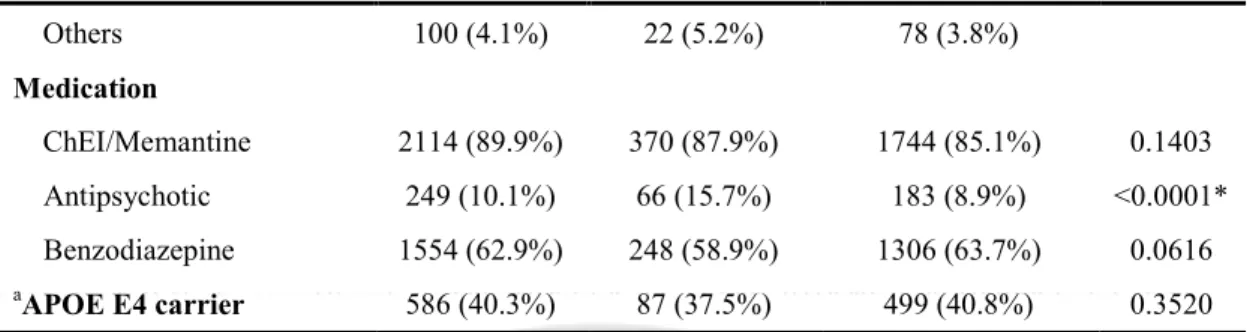
Patients who were institutionalized were significantly older (75.4 vs 74.3, p=.0057) at baseline, and had shorter years of education (5.7 vs 6.2, p=0.0279) than those who were not institutionalized. Institutionalized patients had more severe dementia according to Clinical Dementia Rating scale (CDR) and Mini-Mental State Examination (MMSE) and more severe neuropsychiatric symptom (NPI) at baseline than the patients who were not institutionalized. These two groups did not differ in comorbidities at baseline, such as hypertension, diabetes, and stroke. Regarding the medication, those who were institutionalized had more antipsychotics at baseline, but choline esterase inhibitors, memantine, and benzodiazepine intake did not show difference between two groups.
Table 1. Patient characteristics at baseline
Overall (N=2470) Institutionalized (N=421, 17.0%) Not institutionalized (N=2049, 83.0%) p
Age 74.5 (7.83) 75.4 (7.77) 74.3 (7.83) 0.0057* Sex 0.1313 Male 1683 (68.1%) 300 (71.3%) 1383 (67.5%) Female 787 (31.9%) 121 (28.7%) 666 (32.5%) Education years 6.3 (5.17) 5.7 (4.91) 6.4 (5.21) 0.0074* Follow-up duration, months 38.3 (16.53) 25.9 (15.39) 41.0 (15.52) <0.0001* Duration after onset,
months
31.6 (29.05) 34.5 (30.95) 30.9 (28.62) 0.0279* Dementia severity and clinical features
MMSE 18.2 (5.12) 16.2 (5.14) 18.6 (5.02) <0.0001*
CDR-SB 5.3 (3.09) 6.6 (3.50) 5.1 (2.94) <0.0001*
NPI 15.2 (18.15) 20.4 (21.87) 14.1 (17.10) <0.0001* Geriatric Depression Scale 7.1 (4.44) 6.9 (4.46) 7.1 (4.43) 0.5372 Co-morbidities Hypertension 1245 (50.4%) 197 (46.8%) 1048 (51.2%) 0.1037 Diabetes mellitus 615 (24.9%) 109 (25.9%) 506 (24.7%) 0.6053 Cardiovascular disease 392 (15.9%) 62 (14.7%) 330 (16.1%) 0.4808 Stroke 200 (8.1%) 34 (8.1%) 166 (8.1%) 0.9861 Alcohol 0.0522 Current 1310 (78.9%) 286 (82.7%) 1024 (77.9%) Never 351 (21.1%) 60 (17.3%) 291 (22.1%) Smoking 0.7987 Current smoker 134 (8.1%) 26 (7.5.%) 108 (8.2%) Ex-smoker 336 (20.2%) 67 (19.4%) 269 (20.5%) Never smoker 1191 (71.7%) 253 (73.1%) 938 (71.3%) Living together with main
caregiver 1452 (59.1%) 235 (56.0%) 1217 (59.7%) 0.1532 Main caregiver 0.0105* Spouse 715 (29.2%) 95 (22.6%) 620 (30.5%) Son/Daughter-in-law 927 (37.8%) 183 (43.6%) 744 (36.6%) Daughter/Son-in-law 709 (28.9%) 120 (28.6%) 589 (29.0%)
Others 100 (4.1%) 22 (5.2%) 78 (3.8%) Medication ChEI/Memantine 2114 (89.9%) 370 (87.9%) 1744 (85.1%) 0.1403 Antipsychotic 249 (10.1%) 66 (15.7%) 183 (8.9%) <0.0001* Benzodiazepine 1554 (62.9%) 248 (58.9%) 1306 (63.7%) 0.0616 aAPOE E4 carrier 586 (40.3%) 87 (37.5%) 499 (40.8%) 0.3520 a
APOE genotyping was only performed in 1456 patients out of 2470 patients, who agreed on genetic testing. Standard deviations or percentages are in brackets. Asterisks indicate difference between patients who were institutionalized and not institutionalized is significant; *p<0.05. APOE, Apolipoprotein E; ChEI, cholinesterase inhibitor; CDR-SB, Clinical Dementia Rating scale Sum-of-Boxes; MMSE, Mini-Mental State Examination; NPI, Neuropsychiatric Inventory.
In Cox proportional hazard model, we found that lower cognitive ability (lower MMSE), higher dementia severity (higher CDR), and more severe neuropsychiatric symptom (higher NPI) at baseline were independent risk factor for institutionalization. Other baseline variables, such as age, education years, comorbidities, alcohol, smoking, relationship with the main caregiver, did not show significant relationship with the institutionalization of the patients. Whether the patient was taking the medication at baseline, such as choline esterase inhibitor, memantine, antipsychotics, or benzodiazepines, also did not have significant influence in the patient’s institutionalization. (Table 2)
Table 2. Predictors of institutionalization
Hazard ratio p 95% CI for Hazard ratio
Age 1.01 0.2181 0.994 1.025
Sex (Male) 0.83 0.2818 0.585 1.169
Education, years 1.01 0.3189 0.987 1.042
Duration after onset, months 1.00 0.9659 0.996 1.004
MMSE 0.95 0.0003* 0.924 0.976 CDR 0.5 1.00 1 1.76 <0.0001* 1.335 2.332 2 1.68 0.0123* 1.120 2.533 NPI 1.01 0.0014* 1.004 1.015
Geriatric Depression Scale 0.98 0.0806 0.954 1.003
Co-morbidities
Hypertension 0.84 0.1221 0.666 1.049
Diabetes mellitus 1.15 0.2985 0.886 1.484
Cardiovascular disease 0.83 0.2564 0.595 1.148
Stroke 0.78 0.2340 0.519 1.174
Alcohol (current drinker) 1.20 0.2311 0.892 1.604
Smoking
Current smoker 1.14 0.5723 0.727 1.480
Ex-smoker 1.23 0.2187 0.884 1.712
Never smoker 1.00
Living together with main caregiver 0.90 0.4041 0.700 1.154 Main caregiver Spouse 1.00 Son/daughter-in-law 1.08 0.6555 0.774 1.501 Daughter/daugher-in-law 0.87 0.4458 0.604 1.248 others 1.67 0.0714 0.956 2.914 Medication ChEI/Memantine 1.21 0.2640 0.868 1.677 Antipsychotic 1.26 0.1605 0.913 1.732 Benzodiazepine 0.97 0.8167 0.778 1.218 aAPOE E4 carrier 0.95 0.7237 0.698 1.284 a
APOE genotyping was only performed in 1456 patients out of 2470 patients, who agreed on genetic testing. Asterisks indicate risk of institutionalization is significant; *p<0.05. APOE, Apolipoprotein E; ChEI, cholinesterase inhibitor; CDR-SB, Clinical Dementia Rating scale Sum-of-Boxes; MMSE, Mini-Mental State Examination; NPI, Neuropsychiatric Inventory.
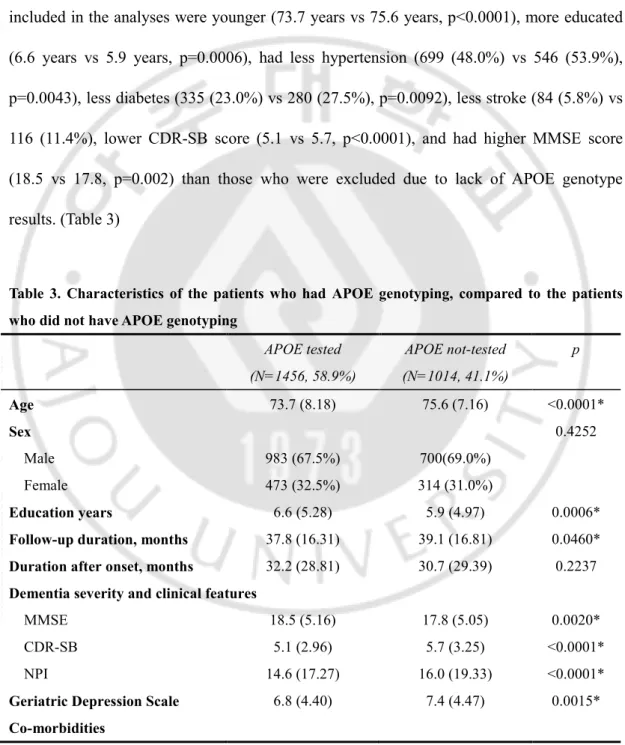
Of 2470 patients, 1456 patients who agreed on genetic testing had APOE genotyping and were studied for the association of APOE genotype and institutionalization. Participants included in the analyses were younger (73.7 years vs 75.6 years, p<0.0001), more educated (6.6 years vs 5.9 years, p=0.0006), had less hypertension (699 (48.0%) vs 546 (53.9%), p=0.0043), less diabetes (335 (23.0%) vs 280 (27.5%), p=0.0092), less stroke (84 (5.8%) vs 116 (11.4%), lower CDR-SB score (5.1 vs 5.7, p<0.0001), and had higher MMSE score (18.5 vs 17.8, p=0.002) than those who were excluded due to lack of APOE genotype results. (Table 3)
Table 3. Characteristics of the patients who had APOE genotyping, compared to the patients who did not have APOE genotyping
APOE tested (N=1456, 58.9%) APOE not-tested (N=1014, 41.1%) p Age 73.7 (8.18) 75.6 (7.16) <0.0001* Sex 0.4252 Male 983 (67.5%) 700(69.0%) Female 473 (32.5%) 314 (31.0%) Education years 6.6 (5.28) 5.9 (4.97) 0.0006*
Follow-up duration, months 37.8 (16.31) 39.1 (16.81) 0.0460* Duration after onset, months 32.2 (28.81) 30.7 (29.39) 0.2237 Dementia severity and clinical features
MMSE 18.5 (5.16) 17.8 (5.05) 0.0020*
CDR-SB 5.1 (2.96) 5.7 (3.25) <0.0001*
NPI 14.6 (17.27) 16.0 (19.33) <0.0001*
Geriatric Depression Scale 6.8 (4.40) 7.4 (4.47) 0.0015*
Hypertension 699 (48.0%) 546 (53.9%) 0.0043* Diabetes mellitus 335 (23.0%) 280 (27.6%) 0.0092* Cardiovascular disease 218 (15.0%) 174 (17.2%) 0.1433 Stroke 84 (5.8%) 116 (11.4%) <0.0001* Alcohol 0.1054 Current 713 (80.4%) 597 (77.1%) Never 174 (19.6%) 177 (22.9%) Smoking 0.8385 Current smoker 69 (7.8%) 65 (8.4%) Ex-smoker 183 (20.6%) 153 (19.8%) Never smoker 635 (71.6%) 556 (71.8%)
Living together with main caregiver 851 (58.9%) 601 (59.3%) 0.8673 Medication ChEI/Memantine 1263 (86.7%) 851 (83.9%) 0.0497* Antipsychotic 134 (9.2%) 115 (11.3%) 0.0826 Benzodiazepine 923 (63.4%) 631 (62.2%) 0.5557
Standard deviations or percentages are in brackets. Asterisks indicate difference between patients who were institutionalized and not institutionalized is significant; *p<0.05. ChEI, cholinesterase inhibitor; CDR-SB, Clinical Dementia Rating scale Sum-of-Boxes; MMSE, Mini-Mental State Examination; NPI, Neuropsychiatric Inventory.
Of 1456 patients, 586 patients (40.2%) had at least one E4 allele while 870 patients (59.8%) did not. E4 allele carriers was younger (age 72.7 vs 74.4, p=0.001), had more education (7.0 years vs 6.3 years, p=0.0113), had fewer cardiovascular disease (12.5% vs 16.7%, p=0.0273), and were more on choline-esterase inhibitor or memantine at baseline (90.8 % vs 84.0%, p=0.0002). However, there was no difference in prevalence of E4 allele in the institutionalized group (37.5%) and not-institutionalized group (40.8%) (p=0.3520). In Cox proportional hazard model also, presence of E4 allele did not predict early
institutionalization (p=0.7237)
B. FACTORS THAT MEASURED LONGITUDINAL CHANGE
Among 2470 patients, 816 patients who had follow-up tests (MMSE, CDR) and caregiver questionnaire at least once were examined for evaluation of factors that measured longitudinal change: yearly change in CDR-SB, MMSE, and NPI. Subjects included in the analyses were younger (73.3 vs 75.1, p<0.0001), had longer duration of total follow-up (45.3 months vs 34.9 months, p<0.0001), were more educated (6.7 years vs 6.1 years, p=0.0004), had lower CDR-SB score at baseline (5.0 vs 5.5, p<0.0001), lower NPI score (13.6 vs 15.9, p<0.0012), lower geriatric depression score (6.7 vs 7.2, p=0.0091), higher MMSE score (18.5 vs 18.0, p=0.0204), and had more use of cholinesterase inhibitors or memantine (720 (88.2%) vs 1394 (84.3%), p=0.0085), but less use of benzodiazepines (478 (58.6%) vs 1076 (65.1%), p=0.0017) than those who were excluded. (Table 4) For each patient, difference between the initial and the last scores of these variables were divided by interval periods (years) to calculate yearly change in CDR-SB, MMSE, and NPI. Medications during follow-up periods, such as choline-esterase inhibitors, memantine, and antipsychotics, were included in the analysis as MPR of each drug, as stated earlier.Table 4. Characteristics of the patients who had follow-up tests, compared to the patients who did not
Follow-up tested (N=816, 33.0%)
Follow-up tests not done (N=1654, 67.0%)
Age 73.3 (7.97) 75.1 (7.69) <0.0001*
Sex 0.0810
Male 537 (65.8%) 1146 (69.3%)
Female 279 (34.2%) 508 (30.7%)
Education years 6.7 (5.26) 6.1 (5.11) 0.0040*
Follow-up duration, months 45.3 (13.06) 34.9 (16.97) <0.0001* Duration after onset, months 33.0 (30.85) 30.8 (28.11) 0.0901 Dementia severity and clinical features
MMSE 18.5 (4.98) 18.0 (5.18) 0.0204*
CDR-SB 5.0 (2.82) 5.5 (3.21) <0.0001*
NPI 13.6 (16.00) 15.9 (19.08) 0.0012*
Geriatric Depression Scale 6.7 (4.35) 7.2 (4.47) 0.0091*
Co-morbidities Hypertension 411 (50.4%) 834 (50.04%) 0.9793 Diabetes mellitus 187 (22.9%) 428 (25.9%) 0.1096 Cardiovascular disease 121 (14.8%) 271 (16.4%) 0.3195 Stroke 62 (7.6%) 138 (8.3%) 0.5230 Alcohol 0.4968 Current 515 (79.7%) 795 (78.3%) Never 131 (20.3%) 220 (21.7%) Smoking 0.5318 Current smoker 56 (8.7%) 78 (7.7%) Ex-smoker 123 (19.0%) 213 (21.0%) Never smoker 467 (72.3%) 724 (71.3%)
Living together with main caregiver 490 (60.2%) 962 (58.5%) 0.4251 Medication ChEI/Memantine 720 (88.2%) 1394 (84.3%) 0.0085* Antipsychotic 70 (8.6%) 179 (10.8%) 0.0815 Benzodiazepine 478 (58.6%) 1076 (65.1%) 0.0017*
Standard deviations or percentages are in brackets. Asterisks indicate difference between patients who were institutionalized and not institutionalized is significant; *p<0.05. ChEI, cholinesterase inhibitor; CDR-SB, Clinical Dementia Rating scale Sum-of-Boxes; MMSE, Mini-Mental State Examination;
NPI, Neuropsychiatric Inventory.
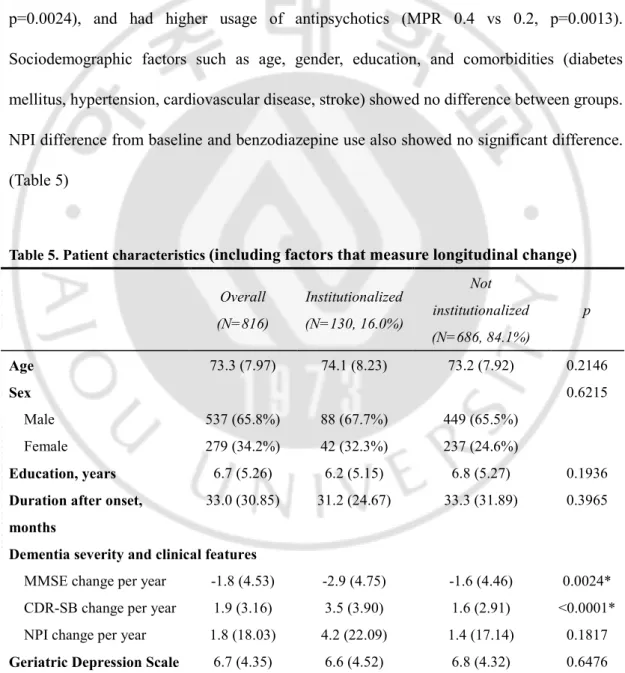
Of 816 patients studied, 130 patients (16.0%) were institutionalized in a mean time of 45.3months (SD=13.06). Patients who were institutionalized had significantly higher yearly CDR-SB difference (1.9 vs 1.6, p<0.0001), higher yearly K-MMSE difference (-1.8 vs -1.6, p=0.0024), and had higher usage of antipsychotics (MPR 0.4 vs 0.2, p=0.0013). Sociodemographic factors such as age, gender, education, and comorbidities (diabetes mellitus, hypertension, cardiovascular disease, stroke) showed no difference between groups. NPI difference from baseline and benzodiazepine use also showed no significant difference. (Table 5)
Table 5. Patient characteristics (including factors that measure longitudinal change) Overall (N=816) Institutionalized (N=130, 16.0%) Not institutionalized (N=686, 84.1%) p Age 73.3 (7.97) 74.1 (8.23) 73.2 (7.92) 0.2146 Sex 0.6215 Male 537 (65.8%) 88 (67.7%) 449 (65.5%) Female 279 (34.2%) 42 (32.3%) 237 (24.6%) Education, years 6.7 (5.26) 6.2 (5.15) 6.8 (5.27) 0.1936
Duration after onset, months
33.0 (30.85) 31.2 (24.67) 33.3 (31.89) 0.3965
Dementia severity and clinical features
MMSE change per year -1.8 (4.53) -2.9 (4.75) -1.6 (4.46) 0.0024* CDR-SB change per year 1.9 (3.16) 3.5 (3.90) 1.6 (2.91) <0.0001* NPI change per year 1.8 (18.03) 4.2 (22.09) 1.4 (17.14) 0.1817 Geriatric Depression Scale 6.7 (4.35) 6.6 (4.52) 6.8 (4.32) 0.6476
Co-morbidities Hypertension 411 (50.4%) 61 (46.9%) 350 (51.0%) 0.3916 Diabetes mellitus 187 (22.9%) 34 (26.2%) 153 (22.3%) 0.3382 Cardiovascular disease 121 (14.8%) 18 (13.9%) 103 (15.0%) 0.7311 Stroke 62 (7.6%) 10 (7.7%) 52 (7.6%) 0.9647 Alcohol 0.0514 Current 515 (79.7%) 96 (86.5%) 419 (78.3%) Never 131 (20.3%) 15 (13.5%) 116 (21.7%) Smoking 0.5630 Current smoker 56 (8.7%) 7 (6.3%) 49 (9.2%) Ex-smoker 123 (19.0%) 20 (18.0%) 103 (19.3%) Never smoker 467 (72.3%) 84 (75.7%) 383 (71.6%) Living together with main
caregiver 490 (60.2%) 72 (55.8%) 418 (61.0%) 0.2676 Medication (MPR) Antipsychotics 0.2 (0.40) 0.4 (0.45) 0.2 (0.39) 0.0013* Benzodiazepines 0.3 (0.41) 0.3 (0.41) 0.3 (0.41) 0.8050 Galantamine 0.3 (0.43) 0.3 (0.41) 0.3 (0.43) 0.7767 Rivastigmine 0.4 (0.45) 0.4 (0.45) 0.4 (0.45) 0.9275 Donepezil 0.6 (0.45) 0.6 (0.45) 0.6 (0.45) 0.4822 Memantine 0.2 (0.39) 0.3 (0.42) 0.2 (0.39) 0.0519
Standard deviations or percentages are in brackets. Asterisks indicate difference between patients who were institutionalized and not institutionalized is significant; *p<0.05. CDR-SB, Clinical Dementia Rating scale Sum-of-Boxes; MMSE, Mini-Mental State Examination; MPR, Medication Possession Ratio; NPI, Neuropsychiatric Inventory.
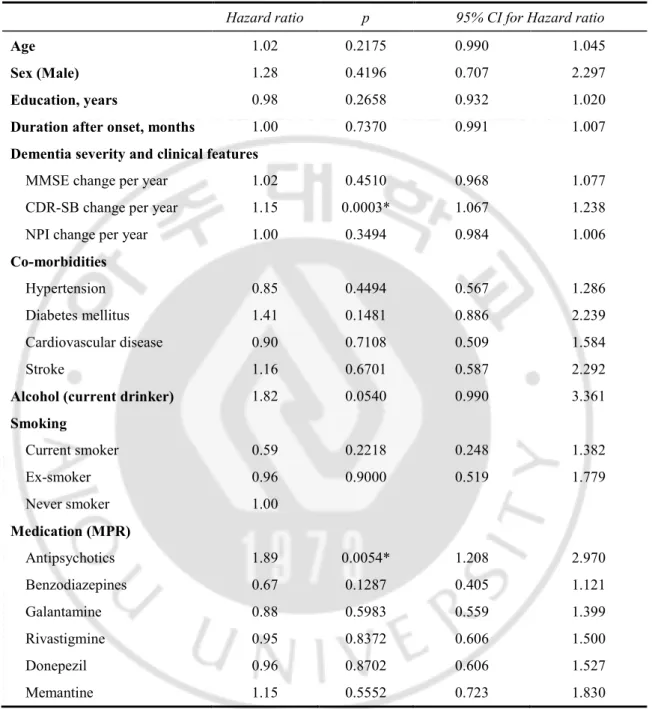
In Cox proportional hazard model, higher yearly CDR-SB difference (HR 1.15, p=0.0003) and higher MPR of antipsychotics (HR 1.89, p=0.0054) predicted a shorter time until institutionalization. (Table 6)
Table 6. Predictors of institutionalization (including factors that measure longitudinal change)
Hazard ratio p 95% CI for Hazard ratio
Age 1.02 0.2175 0.990 1.045
Sex (Male) 1.28 0.4196 0.707 2.297
Education, years 0.98 0.2658 0.932 1.020
Duration after onset, months 1.00 0.7370 0.991 1.007
Dementia severity and clinical features
MMSE change per year 1.02 0.4510 0.968 1.077
CDR-SB change per year 1.15 0.0003* 1.067 1.238
NPI change per year 1.00 0.3494 0.984 1.006
Co-morbidities
Hypertension 0.85 0.4494 0.567 1.286
Diabetes mellitus 1.41 0.1481 0.886 2.239
Cardiovascular disease 0.90 0.7108 0.509 1.584
Stroke 1.16 0.6701 0.587 2.292
Alcohol (current drinker) 1.82 0.0540 0.990 3.361
Smoking Current smoker 0.59 0.2218 0.248 1.382 Ex-smoker 0.96 0.9000 0.519 1.779 Never smoker 1.00 Medication (MPR) Antipsychotics 1.89 0.0054* 1.208 2.970 Benzodiazepines 0.67 0.1287 0.405 1.121 Galantamine 0.88 0.5983 0.559 1.399 Rivastigmine 0.95 0.8372 0.606 1.500 Donepezil 0.96 0.8702 0.606 1.527 Memantine 1.15 0.5552 0.723 1.830
Asterisks indicate risk of institutionalization is significant; *p<0.05. CDR-SB, Clinical Dementia Rating scale Sum-of-Boxes; MMSE, Mini-Mental State Examination; MPR, Medication Possession Ratio; NPI, Neuropsychiatric Inventory.
Ⅳ. DISCUSSION
In this study we found that older age at baseline, shorter years of education, lower cognitive ability (lower MMSE) and higher dementia severity (higher CDR) at baseline, antipsychotics use at baseline, more rapid decline in cognitive ability (higher yearly MMSE difference) and dementia severity (higher yearly CDR-SB difference), and more frequent use of antipsychotics are associated with earlier institutionalization. In Cox proportional hazard model, lower MMSE at baseline, higher CDR at baseline, higher NPI at baseline, higher yearly difference in CDR, and more frequent use in antipsychotics were independent predictors of earlier institutionalization. APOE genotype could not predict institutionalization in this study.
17.0% of patients were institutionalized either in nursing home or long term care hospital in mean 3.19 years of follow up in our study. This is relatively small proportion compared to previous reports. In previous systemic review by Luppa et al. (Luppa et al., 2008), approximately 20% of patients are institutionalized in the first year after a diagnosis of dementia. Although subjects of this study is confined to Alzheimer’s disease, excluding other types of dementia, since patients with the diagnosis of Alzheimer’s disease are more easily institutionalized compared to the patients with dementia of other cause (Luppa et al., 2008; Gaugler et al., 2009), larger proportion of the subjects was expected to be institutionalized. In study in which subjects were confined to patients with Alzheimer’s disease, 23% was institutionalized in 3 years of follow up (Wattmo et al., 2011). This may be
due to cultural difference between Asia, especially South Korea, and western countries. Korean caregivers show higher level of “famiism” than does White American caregivers (Youn et al., 1999). Due to Confucian attitude of respecting elders, some caregivers feel guilty in institutionalizing their spouse or parents, so that they co-reside with dementia patients, even if the patients have severe dysfunction in activities of daily living (ADL) (Kim et al., 2009). To our knowledge, this is the first longitudinal study with Asian population evaluating predictors of institutionalization in patients with dementia.
Among baseline characteristics at the time of diagnosis, lower MMSE, higher CDR, and higher NPI at baseline were independent predictors of early institutionalization. These findings were consistent with previous studies (Luppa et al., 2008; Gaugler et al., 2009; Wattmo et al., 2011; Brodaty et al., 2014). However, unlike previous study stating that female gender precipitate admission to nursing homes (Wattmo et al., 2011), in current study male nor female gender was associated with institutionalization, which is consistent finding with recent study held in Australia (Brodaty et al., 2014).
Presence of APOE e4 allele did not predict institutionalization in this study, which is consistent with the result of previous study (Wattmo et al., 2011). APOE e4 allele is a well-known risk factor for the development of Alzheimer’s disease (Farrer et al., 1997), however, the effect of APOE e4 genotype on the disease progression is unsettled. A few studies have found a deleterious effect of APOE e4 genotype on disease progression (Dal Forno et al., 1996; Craft et al., 1998; Kanai et al., 1999), but most studies could not find correlation between APOE genotype and the progression of the disease (Basun et al., 1995; Dal Forno et al., 1996; Growdon et al., 1996; Jonker et al., 1998; Slooter et al., 1999). One study even
reported more aggressive progression in the patients without APOE e4 allele (Stern et al., 1997). In this view, findings of current study agree with previous reports that APOE e4 allele is associated with earlier development of Alzheiemer’s disease, but not with the disease progression.
Of predictors that measured longitudinal change, more rapid decline in dementia severity (CDR) and more frequent use of antipsychotics were independent risk factors of earlier institutionalization. In recent study in which study population included various types of dementia, greater decline in cognitive (MMSE) and functional abilities (SMAF, Functional Autonomy Measurement System) indicated earlier institutionalization (Brodaty et al., 2014). However, in other study whose study population was confined to the patients with Alzheimer’s disease, rate of change in IADL decline, but not in cognitive deterioration (MMSE) was independent predictor of earlier institutionalization, although rapid decline in MMSE was significant predictor of institutionalization in univariate analysis (Wattmo et al., 2011). Current study agrees more with the latter study, in that institutionalized patients had higher decline in MMSE, but decline in overall dementia severity (CDR) was more important predictor. These findings may be due to difference between various types of dementia. When examining a functional measure of severity (CDR) in patients with Alzheimer’s disease and frontotemporal dementia who were matched for age and MMSE score, total CDR scores were significantly worse in those with FTD compared to the patients with Alzheimer’s disease (Rosen et al., 2004). This means that when study population is homogeneous, MMSE scores may show more correlation with CDR, making decline in MMSE score not an independent predictor. Subgroup analysis within the same type of
dementia or further study in more homogeneous group of patients with other type of dementia could add more insights regarding the issue.
This study has many limitations. As mentioned earlier, because the CREDOS cohort is a dynamic, open cohort, subjects may be registered or leave anytime during the study. This makes follow up periods to be different in each patient, thus it is impossible to know proportion of the institutionalized subjects in specific given period. This study mainly utilizes data from LTCI program in South Korea, but to include patient admitted in long term care hospital we also had to use data from national health insurance. Because the data from national health insurance do not differentiate acute-care hospital with long-term care hospital, we regarded the patient as admitted to the long term care hospital when he or she stayed in the same hospital for at least 6 months. This cut-off value of 6 month is arbitrary, and there might be some patients who were discharged after staying in the same hospital for more than 6 months. In previous studies, caregiver factors such as caregiver age, caregiver burden, health, or stress predicted earlier institutionalization. However, due to lack of enough information caregiver questionnaires, various caregiver factors could not be included in this study. Finally, there was relatively small number of patients who had follow up tests (816 out of 2470 patients, 33.0%), so separate analysis was needed for the variables regarding longitudinal change.
Ⅴ. CONCLUSION
This study shows that among patients with Alzheimer’s disease, those with lower cognitive ability, higher dementia severity, and severe behavioral symptom at baseline are more likely to be institutionalized earlier in their course of the disease. During follow up, more rapid decline in dementia severity and more frequent use of antipsychotics are independent predictors of earlier institutionalization. With this information, clinicians could guide the patient and their caregivers in the appropriate management at more appropriate stage of the disease.
REFERENCES
1. Agüero-Torres H, Fratiglioni L, Guo Z, Viitanen M, von Strauss E, Winblad B: Dementia is the major cause of functional dependence in the elderly: 3-year follow-up data from a population-based study. American Journal of Public Health 88: 1452-1456, 1998
2. Aguero-Torres H, von Strauss E, Viitanen M, Winblad B, Fratiglioni L: Institutionalization in the elderly: the role of chronic diseases and dementia. Cross-sectional and longitudinal data from a population-based study. J Clin Epidemiol 54: 795-801, 2001
3. Basun H, Grut M, Winblad B, Lannfelt L: Apolipoprotein ϵ4 allele and disease progression in patients with late-onset Alzheimer's disease. Neuroscience letters 183: 32-34, 1995
4. Brodaty H, Connors MH, Xu J, Woodward M, Ames D: Predictors of institutionalization in dementia: a three year longitudinal study. J Alzheimers Dis 40: 221-226, 2014
5. Choi SH, Na DL, Kwon HM, Yoon SJ, Jeong JH, Ha CK: The Korean version of the neuropsychiatric inventory: a scoring tool for neuropsychiatric disturbance in dementia patients. Journal of Korean medical science 15: 609-615, 2000
6. Craft S, Teri L, Edland SD, Kukull WA, Schellenberg G, McCormick WC, Bowen JD, Larson EB: Accelerated decline in apolipoprotein E-epsilon4 homozygotes with Alzheimer's disease. Neurology 51: 149-153, 1998
7. Dal Forno G, Rasmusson DX, Brandt J, Carson KA, Brookmeyer R, Troncoso J, Kawas CH: Apolipoprotein E genotype and rate of decline in probable Alzheimer's disease. Archives of neurology 53: 345-350, 1996
8. Farrer L, Cupples L, Haines J, Hyman B, Kukull W, Mayeux R, Myers R, Pericak-Vance M, Risch N, Van Duijn C: APOE and Alzheimer Disease Meta Analysis Consortium: Effects of age, sex, and ethnicity on the association between apolipoprotein E genotype and Alzheimer disease: a meta-analysis. Jama 278: 1349-1356, 1997
9. Gallagher D, Mhaolain AN, Crosby L, Ryan D, Lacey L, Coen RF, Walsh C, Coakley D, Walsh JB, Cunningham C: Determinants of the desire to institutionalize in Alzheimer’s caregivers. American journal of Alzheimer's disease and other
dementias 26: 205-211, 2011
10. Gaugler JE, Duval S, Anderson KA, Kane RL: Predicting nursing home admission in the U.S: a meta-analysis. BMC Geriatr 7: 13, 2007
institutionalization of cognitively impaired older people: utilizing dynamic predictors of change. Gerontologist 43: 219-229, 2003
12. Gaugler JE, Yu F, Krichbaum K, Wyman JF: Predictors of nursing home admission for persons with dementia. Med Care 47: 191-198, 2009
13. Growdon J, Locascio J, Corkin S, Gomez-Isla T, Hyman B: Apolipoprotein E genotype does not influence rates of cognitive decline in Alzheimer's disease.
Neurology 47: 444-448, 1996
14. Hebert R, Dubois MF, Wolfson C, Chambers L, Cohen C: Factors associated with long-term institutionalization of older people with dementia: data from the Canadian Study of Health and Aging. J Gerontol A Biol Sci Med Sci 56: M693-699, 2001
15. Jonker C, Schmand B, Lindeboom J, Havekes LM, Launer LJ: Association Between Apolipoprotein Eϵ4 and the Rate of Cognitive Decline in Community-Dwelling Elderly Individuals With and Without Dementia. Archives of Neurology 55: 1065-1069, 1998
16. Kanai M, Shizuka M, Urakami K, Matsubara E, Harigaya Y, Okamoto K, Shoji M: Apolipoprotein E4 accelerates dementia and increases cerebrospinal fluid tau levels in Alzheimer's disease. Neuroscience letters 267: 65-68, 1999
Korean Med Sci 27 Suppl: S41-46, 2012
18. Kang Y, Na DL, Hahn S: A validity study on the Korean Mini-Mental State Examination (K-MMSE) in dementia patients. Journal of the Korean Neurological
Association 15: 300-308, 1997
19. Kim JM, Shin IS, Jeong SJ, Gormley N, Yoon JS: Predictors of institutionalization in patients with dementia in Korea. Int J Geriatr Psychiatry 17: 101-106, 2002
20. Kim M-D, Hong S-C, Lee C-I, Kim S-Y, Kang I-O, Lee S-Y: Caregiver Burden among Caregivers of Koreans with Dementia. Gerontology 55: 106-113, 2009
21. Ku HM, Kim JH, Kwon EJ, Kim SH, Lee HS, Ko HJ, Jo S, Kim DK: A study on the reliability and validity of Seoul-Instrumental Activities of Daily Living (S-IADL).
Journal of Korean Neuropsychiatric Association 43: 189-199, 2004
22. Kwon S: The introduction of long-term care insurance in South Korea. Eurohealth 15: 28, 2009
23. Lee M, Lim TS, Lee HY, Moon SY: Profile of memory impairment as a prognostic marker in amnestic mild cognitive impairment. J Neurol Sci 347: 124-128, 2014
24. Luppa M, Luck T, Brahler E, Konig HH, Riedel-Heller SG: Prediction of institutionalisation in dementia. A systematic review. Dement Geriatr Cogn Disord
26: 65-78, 2008
25. Luppa M, Luck T, Weyerer S, Konig HH, Brahler E, Riedel-Heller SG: Prediction of institutionalization in the elderly. A systematic review. Age Ageing 39: 31-38, 2010
26. McKhann G, Drachman D, Folstein M, Katzman R, Price D, Stadlan EM: Clinical diagnosis of Alzheimer's disease: report of the NINCDS-ADRDA Work Group under the auspices of Department of Health and Human Services Task Force on Alzheimer's Disease. Neurology 34: 939-944, 1984
27. Morris JC: The Clinical Dementia Rating (CDR): current version and scoring rules.
Neurology, 1993
28. Park HK, Na DL, Han SH, Kim JY, Cheong HK, Kim SY, Kim SY, Hong CH, Kim DK, Ku BD, Moon SY, Lee JY, Shim YS, Youn YC, Kim EJ, Kim BC, Park KH, Cha KR, Seo SW, Lee JH: Clinical characteristics of a nationwide hospital-based registry of mild-to-moderate Alzheimer's disease patients in Korea: a CREDOS (Clinical Research Center for Dementia of South Korea) study. J Korean Med Sci 26: 1219-1226, 2011
29. Park IS, Kim SK: Korean elderly long-term care insurance system and long-term care hospital. Journal of the Korean Geriatrics Society 12: 68-73, 2008
assessment of primary degenerative dementia. The American journal of psychiatry, 1982
31. Rosen HJ, Narvaez JM, Hallam B, Kramer JH, Wyss-Coray C, Gearhart R, Johnson JK, Miller BL: Neuropsychological and functional measures of severity in Alzheimer disease, frontotemporal dementia, and semantic dementia. Alzheimer
Disease & Associated Disorders 18: 202-207, 2004
32. Seok JE: Public long-term care insurance for the elderly in Korea: design, characteristics, and tasks. Social work in public health 25: 185-209, 2010
33. Slooter A, Houwing-Duistermaat JJ, van Harskamp F, Cruts M, Van Broeckhoven C, Breteler MM, Hofman A, Stijnen T, van Duijn CM: Apolipoprotein E genotype and progression of Alzheimer’s disease: the Rotterdam Study. Journal of neurology 246: 304-308, 1999
34. Stern Y, Brandt J, Albert M, Jacobs DM, Liu X, Bell K, Marder K, Sano M, Albert S, Castenada CDC: The absence of an apolipoprotein ϵ4 allele is associated with a more aggressive form of Alzheimer's disease. Annals of neurology 41: 615-620, 1997
35. Wattmo C, Wallin AK, Londos E, Minthon L: Risk factors for nursing home placement in Alzheimer's disease: a longitudinal study of cognition, ADL, service
utilization, and cholinesterase inhibitor treatment. Gerontologist 51: 17-27, 2011
36. Yaffe K, Fox P, Newcomer R, Sands L, Lindquist K, Dane K, Covinsky KE: Patient and caregiver characteristics and nursing home placement in patients with dementia.
Jama 287: 2090-2097, 2002
37. Yang DW, Chey JY, Kim SY, Kim BS: The development and validation of Korean dementia Screening questionnaire (KDSQ). Journal of the Korean Neurological
Association 20: 135-141, 2002
38. Yoon B, Shim YS, Cheong HK, Kim YD, Lee KO, Hong YJ, Oh YS, Na HR, Kim BC, Choi SH, Yang DW: Interaction of white matter hyperintensities (WMHs) and apolipoprotein E (APOE) genotypes on cognition in patients with amnestic mild cognitive impairment (aMCI). Arch Gerontol Geriatr 57: 292-297, 2013
39. Youn G, Knight BG, Jeong H-S, Benton D: Differences in familism values and caregiving outcomes among Korean, Korean American, and White American dementia caregivers. Psychology and Aging 14: 355-364, 1999
- 국문요약 -
알츠하이머병 환자에서의 요양원 입소와 관련된 요인 분석
아주대학교 대학원 의학과 박 동 규 (지도교수: 문 소 영) 치매는 노인들이 요양원에 입소하게 되는 가장 큰 원인 질환으로 알려져 있다. 알츠하이머병 환자들을 진료하는데 있어 요양원 입소의 시기를 예측하는 것은 의사는 물론 보호자들에게도 향후 계획을 세우는데 있어 큰 도움일 될 것이다. 현재까지 치매 환자들의 요양원 입소와 관련된 요인들에 관하여는 여러 연구가 있어왔으나, 아시아 인종을 대상으로 한 연구는 드문 실정이며 또한 종적인 변화에 대한 변수들을 포함한 연구도 드물다. 이에 본 연구에서는 기저 요인 뿐만 아니라, 추적 관찰을 통하여 얻어지는 증상 변화에 관한 변수들을 포함하여 알츠하이머병 환자들의 요양원 입소와 관련된 예측인자들을 알아보고자 하였다. 본 연구에서는 2008 년 7 월부터 대한민국에 전국적으로 시행된 노인장기요양보험의 자료를 이용하기 위해, CREDOS 연구에 등록된 알츠하이머병 환자들 중 2008 년 7 월부터 2013 년 12 월까지 등록된 사람들만을 대상으로 하였다. 2008 년 7 월에 이미 요양원에 입소하여 있는 환자들은제외하였으며, 노인장기요양보험 자료를 이용하여 대상 환자들 중 2008 년 7 월부터 2011 년 1 월 사이에 요양원에 입소한 환자들을 후향적으로 구분하였다. 이후 요양원에 입소한 환자들과 입소하지 않은 환자들 간의 인지기능척도, 치매 진행 척도, 정신신경학적 증상 척도와 약물 사용을 비교하였다. 평균 3.19 년의 추적관찰 기간 동안, 총 421 명 (17%) 의 환자들이 요양원에 입소하였다. 입소한 환자들은 입소하지 않은 환자들에 비하여 교육 수준이 낮았으며, 등록 당시 인지기능이 더 낮았고, 치매 정도가 심하였으며, 정신신경학적 증상 또한 심하였다. 종적 변수를 비교하였을 때, 입소한 환자들은 입소하지 않은 환자들에 비하여 인지기능이 더 빨리 감소하였고, 치매 정도가 더욱 빨리 악화되었으며, 항정신병약물을 더욱 자주 사용하였다. 이들 중 독립적인 예측인자들로서, 기저 인지기능이 낮을수록, 기저 치매 정도가 심할수록, 기저 정신신경학적 증상이 심할수록, 더 빨리 치매 정도가 악화될수록, 그리고 항정신병약물을 더 자주 사용할수록 요양원 입소를 더 잘 하는 것으로 나타났다. 핵심어: 요양원 입소, 알츠하이머병, 치매