J Korean Acad Community Health Nurs (지역사회간호학회지) http://dx.doi.org/10.12799/jkachn.2014.25.3.217
The Influence of Health Literacy and Diabetes Knowledge on Diabetes
Self-care Activities in Korean Low-income Elders with Diabetes
Jeong, Jihye · Park, Namhee · Shin, So Young
Department of Nursing, College of Medicine, Inje University, Busan, Korea
Purpose: This study aimed to assess the levels of and relationships among health literacy, knowledge about dia-betes, and self-care activities in the Korean low-income elderly with diabetes and to identify factors influencing the self-care activities of this vulnerable population. Methods: This study surveyed a total of 151 low-income elderly patients with diabetes registered at 16 Visiting Health Care Services in B City, Korea. Health literacy was measured with the Newest Vital Sign. Diabetes knowledge was measured with the Diabetes Knowledge Test. The Summary of Diabetes Self-care Activities Questionnaire was used to assess diabetes self-care activities. A stepwise multiple regression analysis was conducted to identify significant factors influencing diabetes self-care activities in these patients. Results: In the regression model, diabetes knowledge (β=.322, p<.001), exercise (β=.337, p<.001), and experiences of diabetes education (β=.241, p=.001) were significantly associated with increased diabetes self-care activities in low-income elderly patients with diabetes when gender, education, health literacy, and sub-jective health state were controlled. Conclusion: To improve diabetes self-care activities in the low-income elderly with diabetes, it is important to develop a customized program considering their knowledge, exercise, and diabetes education experience.
Key Words: Health literacy, Knowledge, Self care, Diabetes mellitus, Aged
Corresponding author: Park, Nam hee
Department of Nursing, College of Medicine, Inje University, 633-165 Kaegum-dong, Busanjin-gu, Busan 614-735, Korea. Tel: +82-51-890-6832, Fax: +82-51-891-6832, E-mail: [email protected]
- This article is a revision of the first author's master's thesis from Inje University.
Received: Jun 5, 2014 | Revised: Sep 25, 2014 | Accepted: Sep 29, 2014
This is an open access article distributed under the terms of the Creative Commons Attribution Non-Commercial License (http://creativecommons.org/licenses/ by-nc/3.0), which permits unrestricted non-commercial use, distribution, and reproduction in any medium, provided the original work is properly cited.
INTRODUCTION
As the increase in the elderly population has led to an accumulative increase in the morbidity of chronic dis-ease, the importance of chronic disease management is becoming evident to prevent its complications. Among such chronic diseases, the morbidity of diabetes has persistently increased in Korea. The prevalence rate of diabetes has increased from 8.6% in 2001 to 10.1% in 2010[1]. In particular, the morbidity of diabetes has in-creased with the aging population, representing up to 23.6% in the population aged over 70, which corre-sponds to 1 out of 4 older adults having diabetes[1]. Underserved classes such as the low-income class have a higher morbidity in diabetes and have a lower practic-ing rate in decreaspractic-ing health risk behavior factors than
the class with an income level in the upper high 25%[2]. Therefore, more active management strategy is required to improve health equity[2].
The recognition and treatment rates of diabetes has increased in these days and reached up to 73.2% and 61.0%, respectively. However, the management rate of diabetes is only 28.5% which is below half of those rec-ognition and treatment rates[1]. The diabetes manage-ment rate and follow-up test rate for detecting dia-betes-related complications are lower in patients in the low-income population than those in the general pop-ulation[3]. According to the American Diabetes Associa-tion[4], considering that the population with a low man-agement rate of diabetes showed a 2~4 fold higher in-cidence of cardiovascular diseases and spent 2.3 fold more on medical expenses due to diabetes-related
com-plications such as hypertension (67%), neuropathy (60~ 70%), non-traumatic amputation (60%), renal failure (44 %), and blindness (28.5%) than the population without diabetes, it has been suggested that diabetes manage-ment is an important and urgent social problem.
Diabetes knowledge about diabetes diet, regular ex-ercise, blood glucose test, medication therapy, symptom management, complication prevention, and foot hygiene is required for successful diabetes self care. Exercise is important in reducing blood glucose levels especially in elderly patients with diabetes[5-7]. Diabetes knowledge should be undertaken in advance for effective diabetes management. It has been reported that low-income dia-betes patients have low levels of diadia-betes knowledge and the levels of diabetes knowledge are directly related to glucose control capabilities in this population. There-fore, developing effective strategies to provide health in-formation and improve knowledge levels in this vulner-able population of low-income elderly patients with dia-betes is necessary[5,8,9].
However, it may be hard to understand such health information due to difficult medical terms or lack of knowledge[10].
It was reported that the literacy level of diabetes pa-tients on health information could influence diabetes knowledge, self-care activities, and blood glucose con-trol[11,12]. It is reported that high health literacy levels are significantly related to high diabetes knowledge lev-els and the maintenance of low HbA1c levlev-els. While, low health literacy levels are associated with difficulty in maintaining low HbA1c levels and incidence of compli-cations such as diabetic retinopathy[11,12].
In particular, the elderly population with low health literacy may have limited interpretative ability of blood pressure or blood glucose levels which is basic knowl-edge required for self-care. Inappropriate understand-ing of the methods and time schedules for medication administration could result in serious health problems. The health literacy levels of older adults directly affect disease-related knowledge levels and relate to medi-cation administration and self-care activities[11,13] In-creased age and low-income level were verified as im-portant factors impairing the understanding of health in-formation and its utilization in daily lives[14,15]. The re-sults of these previous studies imply the necessity of as-sessing diabetes self-care activities status in low-income elderly diabetes patients.
Developing education programs which take into ac-count the level of health literacy in advance may be more effective in the improvement of diabetes
know-ledge and diabetes self-care activities in the elderly dia-betes patients. Therefore, this study aimed to assess the relationship between health literacy and diabetes know-ledge, and to identify the factors that should be consid-ered to improve self-care activities in low-income eld-erly with diabetes
METHODS
1. Design
This was a cross-sectional, descriptive survey study. 1) Sample and setting
The subjects of this study were 151 low-income eld-erly diabetes patients aged 65 years and older, regis-tered at Visiting Health Care Services in B City, Korea fromJuly 2nd, 2012 to August 31st, 2012. The number of estimated subjects was calculated by using G-power analysis 3.0. At least 118 subjects were needed to per-form a multiple regression analysis including 10 varia-bles, with an effect size of 0.15, a power of 0.8, and a two-tailed ? of 0.05. A sample size of 151 was sufficient for this study. Using a convenient sampling method, persons aged 65 and older among diabetes patients reg-istered at 16 Visiting Health Care Services in B City were first chosen. Among them, persons in the low-income population conforming to the selection criteria of this study were chosen. A minimum of 2 persons to a max-imum of 22 persons per each Visiting Health Care Ser-vice participated in the study. Detailed selection criteria for subjects included the followings: a) low-income eld-erly patients diagnosed as diabetes by a physician, b) having at least one month period of diabetes medica-tion administramedica-tion, c) having communicative skills to understand and judge the content of questionnaires, and d) agreeing to participate in the study after listening to the detailed explanation of the study process. Sub-jects were provided the full explanations regarding the aims and needs of the study. We explained that there would be no harm for study participation. We also ex-plained that collected data would be used for the study purpose only and subjects might stop participating at any time during the study. Visiting nurses were trained via one face-to-face interview and feedback discussion regarding study aims, survey contents, and assessment methods.
2) Ethical considerations
Review Board (PIRB12-010-05). 2. Measures
1) Health Literacy
Health literacy was measured with the Newest Vital Sign which was published by Weiss et al.,[16] in “Quick assessment of literacy in primary care the newest vital sign” and translated and validated by Kim[14]. It com-prises 6 questions with a total score of 6 (where 0~1= limited literacy class, 2~3=potentially limited literacy class, and 4~6=appropriate literacy class). The reliability of the tool from the study by Kim[14] was Cronbach's ⍺ =.76 while that of this study was Cronbach's ⍺=.73. 2) Diabetes Knowledge
Diabetes knowledge was measured with the Michi-gan Diabetes Research and Training Center developed by Fitzgerald et al.[6] and modified and translated into Korean by Choi[17]. It comprises a total of 18 issues (19 questions) consisting of one issue about causes, 1 issue about symptoms, 3 issues (4 questions) about the prop-er level of blood glucose control, 4 issues about diet, 1 issue about exercise, 4 issues about general manage-ment, and 5 issues about medication. Scores of 1 for a right answer and 0 for a wrong answer yield a minimum score of 0 to a maximum score of 19 (where high scores =higher levels of diabetes knowledge). Since the division into the group treated with oral hypoglycemic agents only and the group treated with both oral hypoglycemic agents and insulin injections was considered insignif-icant in this study, 4 issues related to insulin admin-istration were excluded from the original tool with an approval of the author[17]. Fourteen issues (15 ques-tions) were used in the final analysis with a score range from 0 to 15. The reliability of the tool from the study by Choi[17] was Cronbach's ⍺=.75 while that of this study was Cronbach's ⍺=.70.
3) Diabetes Self-care Activities
Diabetes self-care activities were measured with the 25-questionnaire Summary of Diabetes Self-Care Activi-ties Questionnaire (SDSCA) developed by Toobert & Glasgow[18], modified by Toobert et al.[19], and trans-lated into Korean by Chang & Song[20]. When exclud-ing questions that could not be scored, a total of 17 questions assessed the domains of diet, exercise, medi-cation, blood glucose test, and foot management. Sub-jects were asked to answer such questions as ‘how many days did you conduct a blood glucose test within
the last 7 days?’ and select the number of days an activi-ty was conducted from 0 to 7. One question was asking ‘the number of days to administer insulin injection’ which the subject for insulin administration only could answer. Therefore, we calculated an average score of this question with the question asking ‘the number of days to administer diabetes medication’ with an appro-val by the author[20]. The total score ranged from 0 to 112 (where higher scores=high levels of self-care activ-ities). The reliability of the tool from the study by Chang & Song[20] was Cronbach's ⍺=.77 while that of this study was Cronbach's ⍺=.74.
4) Data Analysis
General characteristics were analyzed with frequen-cies, percentages, and descriptive statistics (means and standard deviations). The levels of health literacy, dia-betes knowledge, and diadia-betes self-care activities were calculated by frequencies, percentages, and descriptive statistics (means and standard deviations). The differ-ences in health literacy, diabetes knowledge, and dia-betes self-care activities according to the general char-acteristics of subjects were analyzed by independent t-test, one-way ANOVA and post verification tests and were confirmed by Scheffe? test. The relationships among health literacy, diabetes knowledge, and dia-betes self-care activities were assessed with Pearson’s correlation coefficients.
A stepwise multiple regression analysis was con-ducted to assess the influencing factors of diabetes self care activities in low-income elderly diabetes patients. Diabetes knowledge, health literacy, and general char-acteristics including gender, educational level, exercise, diabetes education experience, subjective health state were included in the analysis. Durbin-Watson value of 1.81 showed no autocorrelation problem. A tolerance limit of .934~.975 and variation inflation factor of 1.026 ~1.071 showed that there was no problem of multicol-lineality. All analyses were conducted using the IBM SPSS Statistics, version 19.0.
RESULTS
1. General Characteristics and the Levels of Health Literacy, Diabetes Knowledge, and Diabetes Self- care Activities
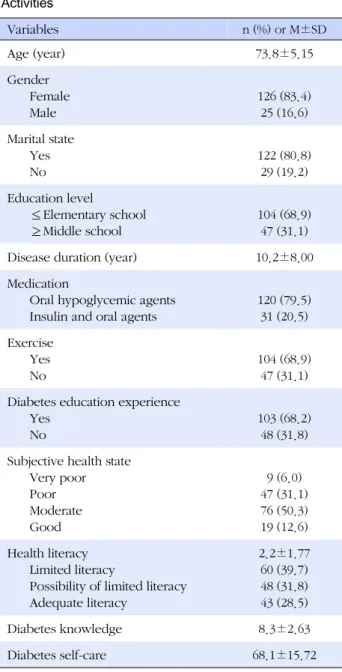
General characteristics and the levels of health liter-acy, diabetes knowledge, and diabetes self-care activ-ities are shown in Table 1. The M±SD of health literacy
Table 1. General Characteristics and the Levels of Health
Literacy, Diabetes Knowledge, and Diabetes Self-care Activities Variables n (%) or M±SD Age (year) 73.8±5.15 Gender Female Male 126 (83.4) 25 (16.6) Marital state Yes No 122 (80.8) 29 (19.2) Education level ≤Elementary school ≥Middle school 104 (68.9) 47 (31.1)
Disease duration (year) 10.2±8.00
Medication
Oral hypoglycemic agents Insulin and oral agents
120 (79.5) 31 (20.5) Exercise Yes No 104 (68.9) 47 (31.1) Diabetes education experience
Yes No
103 (68.2) 48 (31.8) Subjective health state
Very poor Poor Moderate Good 9 (6.0) 47 (31.1) 76 (50.3) 19 (12.6) Health literacy Limited literacy
Possibility of limited literacy Adequate literacy 2.2±1.77 60 (39.7) 48 (31.8) 43 (28.5) Diabetes knowledge 8.3±2.63 Diabetes self-care 68.1±15.72
score was 2.2±1.77, and ranged from 0~6.
The proportions of subjects with limited literacy, pos-sibility of limited literacy, and adequate literacy were 39.7% (n=60), 31.8% (n=48), and 28.5% (n=43), respecti-vely. The M±SD of diabetes knowledge score was 8.3± 2.63, and ranged from 0~15. The M±SD of diabetes self- care activities score was 68.1±15.72, and ranged from 0~112 with an average score of 68.1±15.72(Table 1). 2. Differences in Health Literacy, Diabetes Knowledge,
and Diabetes Self-care Activities according to GeNeRal Characteristics
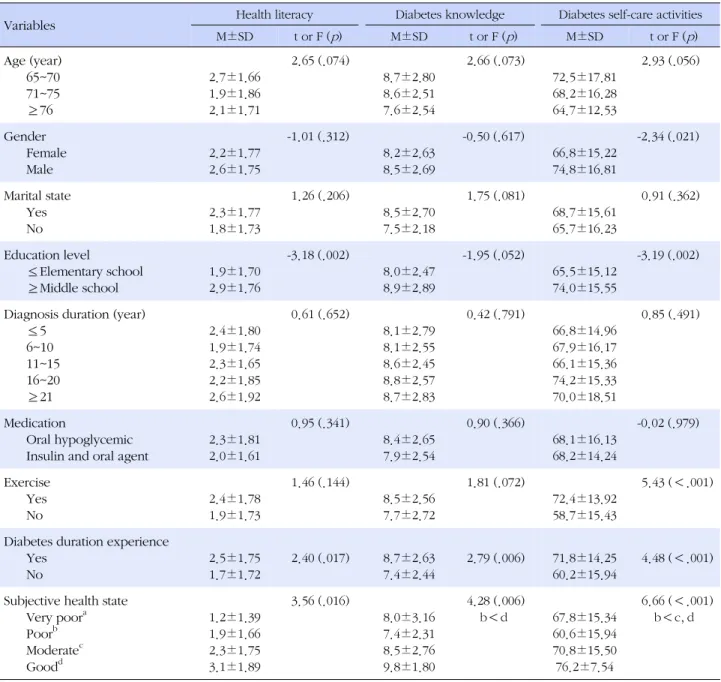
The differences in health literacy according to general characteristics were statistically significant in education level (t=-3.18, p =.002), diabetes education experience (t=2.40, p =.017), and subjective health state (F=3.56, p =.016). The difference in diabetes knowledge accord-ing to general characteristics was statistically significant in diabetes education experience (t=2.69, p =.006) and subjective health state (F=4.28, p =.006). The difference in diabetes self-care activities according to general char-acteristics was statistically significant in gender (t=-2.34, p =.021), education level (t=-3.19, p =.002), exercise (t= 5.43, p <.001), diabetes education experience (t=4.48, p <.001), and subjective health state (F=6.66, p <.001) (Table 2).
3. Correlations among Health Literacy, Diabetes Knowledge and Diabetes Self-care Activities The correlations among health literacy, diabetes knowledge, and diabetes self-care activities are shown in Table 3. Diabetes self-care activities had a statistically significant positive correlation with health literacy (r= .31, p <.001), and diabetes knowledge (r=.42, p <.001). Furthermore, health literacy and diabetes knowledge had a statistically significant positive correlation (r=.42, p <.001). The higher the health literacy level, the higher the diabetes knowledge level was; and the higher the health literacy level and diabetes knowledge level, the higher the diabetes self-care activities level was. 4. Influencing Factors of Diabetes Self-care Activities
The results of a stepwise regression analysis to identi-fy influencing factors of diabetes self-care activities are shown in Table 4. In addition to health literacy and dia-betes knowledge, gender, education level, exercise, diabetes education experience, and subjective health
state which showed significant differences in diabetes self-care activities, were analyzed in the regression mo-del. Durbin-Watson value of 1.81 verified that there was no auto-correlation problem in this regression model. The tolerance limit of .934~.975 and variation inflation factor of 1.026~1.071 showed no multi-collinearity pro-blem. Influencing factors of diabetes self-care activities in low-income elderly diabetes patients were found to be diabetes knowledge (β=.32, p <.001), exercise (β= .33, p <.001), and diabetes education experience (β= .24, p =.001), and three variables in the regression mo-del accounted for 34.4% of the variance in diabetes
Table 2. Differences in Health Literacy, Diabetes Knowledge, Diabetes Self-care Activities according to General Characteristics
Variables Health literacy Diabetes knowledge Diabetes self-care activities
M±SD t or F (p) M±SD t or F (p) M±SD t or F (p) Age (year) 65~70 71~75 ≥76 2.7±1.66 1.9±1.86 2.1±1.71 2.65 (.074) 8.7±2.80 8.6±2.51 7.6±2.54 2.66 (.073) 72.5±17.81 68.2±16.28 64.7±12.53 2.93 (.056) Gender Female Male 2.2±1.77 2.6±1.75 -1.01 (.312) 8.2±2.63 8.5±2.69 -0.50 (.617) 66.8±15.22 74.8±16.81 -2.34 (.021) Marital state Yes No 2.3±1.77 1.8±1.73 1.26 (.206) 8.5±2.70 7.5±2.18 1.75 (.081) 68.7±15.61 65.7±16.23 0.91 (.362) Education level ≤Elementary school ≥Middle school 1.9±1.70 2.9±1.76 -3.18 (.002) 8.0±2.47 8.9±2.89 -1.95 (.052) 65.5±15.12 74.0±15.55 -3.19 (.002)
Diagnosis duration (year) ≤5 6~10 11~15 16~20 ≥21 2.4±1.80 1.9±1.74 2.3±1.65 2.2±1.85 2.6±1.92 0.61 (.652) 8.1±2.79 8.1±2.55 8.6±2.45 8.8±2.57 8.7±2.83 0.42 (.791) 66.8±14.96 67.9±16.17 66.1±15.36 74.2±15.33 70.0±18.51 0.85 (.491) Medication Oral hypoglycemic Insulin and oral agent
2.3±1.81 2.0±1.61 0.95 (.341) 8.4±2.65 7.9±2.54 0.90 (.366) 68.1±16.13 68.2±14.24 -0.02 (.979) Exercise Yes No 2.4±1.78 1.9±1.73 1.46 (.144) 8.5±2.56 7.7±2.72 1.81 (.072) 72.4±13.92 58.7±15.43 5.43 (<.001)
Diabetes duration experience Yes No 2.5±1.75 1.7±1.72 2.40 (.017) 8.7±2.63 7.4±2.44 2.79 (.006) 71.8±14.25 60.2±15.94 4.48 (<.001) Subjective health state
Very poora Poorb Moderatec Goodd 1.2±1.39 1.9±1.66 2.3±1.75 3.1±1.89 3.56 (.016) 8.0±3.16 7.4±2.31 8.5±2.76 9.8±1.80 4.28 (.006) b<d 67.8±15.34 60.6±15.94 70.8±15.50 76.2±7.54 6.66 (<.001) b<c, d
self-care activities (F=27.20, p <.001)(Table 4).
DISCUSSION
This study assessed the relationships between health literacy, diabetes knowledge, and diabetes self-care ac-tivities in low-income elderly with diabetes and identi-fied the influencing factors of diabetes self-care activi-ties. The findings of this study showed that diabetes knowledge, exercise, and diabetes education experi-ence have a significant influexperi-ence on diabetes self-care activities.
Diabetes self care activities in low-income elderly dia-betes patients had statistically significant differences in gender, education level, exercise, diabetes education experience, and subjective health state. Although our study showed higher levels of diabetes self care activ-ities in men than women, the study by Park et al.[21] re-ported conflicting results with women having higher levels of diabetes self care activities than men. More re-search is needed to identify the influence of gender on diabetes self care activities.
The finding that subjects with increased educational levels had increased diabetes self care activities is
analo-Table 3. Correlations among Health Literacy, Diabetes Knowledge, and Diabetes Self-care Activities
Variables Health literacy Diabetes knowledge Diabetes self-care activities
r (p) r (p) r (p)
Health literacy 1
Diabetes knowledge .42 (.<001) 1
Diabetes self-care activities .31 (<.001) .42 (<.001) 1
Table 4. Influencing Factors of Diabetes Self-care Activities
Variables B SE β t (p) R2 Adj. R2 F (p)
Constant 38.82 3.68 10.54 (<.001)
Diabetes knowledge 1.92 0.40 .32 4.70 (<.001) .18 0.17
Exercise 11.39 2.26 .33 5.02 (<.001) .30 0.29
Diabetes education experience 8.11 2.28 .24 3.54 (.001) .35 0.34 27.20 (<.001)
gous with the study result by Park & Kim[22]. There was a significant difference in diabetes self care activities by diabetes education experience. Therefore, diabetes ed-ucation may be an effective intervention even for sub-jects with low education levels to improve diabetes self care activities. Exercise was a significant difference dia-betes self care activities in this study. Exercise such as walking is effective in reducing blood glucose levels in older patients. Therefore, regular exercise should be in care plans to improve diabetes self care activities in low-income elderly diabetes patients[7].
According to Park[23], type II diabetes patients with better subjective health states had lower levels of HbA1c and higher levels of diabetes self care activities than their counterparts. This finding shows that a patient’s subjective health evaluation is related to actual his/her health status. Only 12.6% of subjects reported good subjective health states in this study. Assessing and im-proving subjective health states in low-income elderly diabetes patients are important for increasing diabetes self care activities.
From the correlation analysis among health literacy, diabetes knowledge, and diabetes self-care activities, diabetes self-care activities had statistically significant positive correlations with health literacy and diabetes knowledge while health literacy and diabetes knowl-edge had a statistically significant positive correlation. These findings are parallel with the study by McCleary [24]. These findings indicate that increased health liter-acy is associated with increased diabetes knowledge, and increased diabetes knowledge is related to
increa-sed diabetes self care activities. Therefore, assessing how low-income elderly patients with diabetes under-stand and utilize diabetes related information is a sig-nificant step to improve diabetes self care activities in this population.
In the stepwise regression analysis to identify influ-encing factors of the diabetes self-care activities in study subjects, diabetes knowledge, exercise, and diabetes education experience were found to be statistically sig-nificant variables with an explanation power of 34.4%. Diabetes knowledge has been reported as an influenc-ing factor of diabetes self-care activities in many pre-vious studies[11,25]. According to Yang[25], older pa-tients with high levels of foot care knowledge have high levels of self-care activities. Acquisition of diabetes knowledge should be ahead of performing diabetes self-care activities and it is possible through effective education. According to Zhang & Kim[26], individuals who engaged in exercise had high levels of diabetes self-care activities compared to those who did not en-gage in exercise. Mun[27] reported that exercise might reduce depression and improve self efficacy which might motivate self-care activities. Therefore, a strategy to encourage physical activities and exercise not only for low-income diabetes patients who have abilities to independently perform daily activities but also for those who have insufficient abilities to independently per-form daily activities is required. Diabetes education ex-perience was also related to self-care activities and this result was similar to the study findings of Yoo[28]. Indi-viduals with diabetes education experience may have
more opportunities to have disease-related knowledge and repetitive educations can help accumulating dia-betes knowledge. This accumulated knowledge may af-fect glucose control capabilities and self-care activities in diabetes patients[11,12]. In this regard, improving diabetes knowledge though education is important to prevent diabetes-related complications and improve self-care activities. Considering cognitive impairment in older adults related to aging process, repetitive educa-tion and feedback should be provided.
In this study, health literacy had a statistically signifi-cant positive correlation with diabetes self-care activi-ties, but it was excluded from the final stepwise regres-sion analysis. Some studies found that health literacy was a significant influencing factor of diabetes self-care activities[29,30], but some other studies reported that it had no direct influence on diabetes self-care activities [24]. Since there were conflicting results in these studies regarding the relationship between health literacy and diabetes self-care activities, further studies should be performed repetitively. These conflicting results may be due to the use of various tools in assessing health literacy. Attention should be paid to selecting instru-ments, and the development of standardized assess-ment tools is important to effectively assess health liter-acy considering the characteristics of the elderly dia-betes patients.
This study has significance in that it provides im-portant information about the relationship between health literacy, diabetes knowledge, and diabetes self- care activities and influencing factors of diabetes self- care activities in low-income elderly diabetes patients in Korea for developing a differentiated strategy to im-prove diabetes self-care activities in this vulnerable po-pulation.
CONCLUSION
The results of this study suggest that, in addition to enhancing diabetes knowledge and encouraging ex-ercise, providing continuous health education is critical for low-income elderly with diabetes to improve dia-betes self-care activities. Especially for low-income eld-erly with diabetes, repetitive education to change rec-ognition in diabetes self-care and various community- based resources and support are necessary.
Unexpectedly, health literacy is excluded in the final stepwise regression analysis because it was not statisti-cally significant. Therefore, further studies exploring the relationships among the variables that may affect
dia-betes self-care activities and those developing stand-ardized instruments that can assess health literacy are suggested. In addition, by performing further studies that compare the levels of health literacy between gen-eral elderly population and low-income elderly, devel-oping effective strategies to improve health literacy is needed. Furthermore, more studies are recommended that investigate the effects of diabetes self-care activities on managing blood sugar levels, preventing diabetes- related complications, and improving quality of life in low-income older adults with diabetes.
REFERENCES
1. Korea Centers for Disease Control & Prevention. Korea health statistics 2011: The 5th Korea national health and nutrition examination survey. Policy Report. Seoul: Korea Centers for Disease Control & Prevention; 2012 December. Report No.: 11-1351159-000027-10.
2. Ministry of Health and Welfare. The 3rd national health pro-motion strategy 2011-2020 (HP2020). Policy Report. Seoul: Ministry of Health and Welfare; 2011 June. Report No.:11- 1352000-000285-13.
3. Kim HY, Yun WJ, Shin MH, Kweon SS, Ahn HR, Choi SW, et al. Management of diabetic mellitus in low-income rural pa-tients. Korean Journal of Preventive Medicine and Public Health. 2009;42(2):315-322.
http://dx.doi.org/10.3961/jpmph.2009.42.5.315
4. American Diabetes Association. Statistics about diabetes [In-ternet]. Alexandria VA: American Diabetes Association. 2011 [cited 2012 February 18]. Available from:
http://www.diabetes.org/diabetes-basics/diabetes-statistics/? loc=DropDownDB-stats.
5. American Diabetes Association. Standards of medical care in diabetes-2009. Diabetes Care. 2009;32(1):13-61.
http://dx.doi.org/10.2337/dc09-S013
6. FitzgeraldJT, Anderson RM, Funnell MM, Hiss RG, Hess GE, Barr PA, et al. The reliability and validity of a brief diabetes knowledge test. Diabetes Care. 1998;21(5):706-710. http://dx.doi.org/10.2337/diacare.21.5.706
7. Lee HJ, Park KY, Park HS, Kim IJ. The effect of problem solv-ing nurssolv-ing counselsolv-ing and intensified walksolv-ing exercise on diabetes self-care, coping strategies, and glycemic control among clients with DM type 2. Journal of Korean Academic Nursing. 2005;35(7):1314-1324.
8. Fenwick EK, XieJ, Ress G, Finger RP, Lamoureux EL. Factors associated with knowledge of diabetes in patients with type 2 diabetes using the diabetes knowledge test validated with rasch analysis. Public Library of Science. 2013;8(12):1-12. http://dx.doi.org/10.1371/journal.pone.0080593
9. Bains SS, Eqede LE. Associations between health literacy, dia-betes knowledge, self-care behaviors and glycemic control in a low income population with type 2 diabetes. Diabetes Tech-nology & Therapeutics. 2001;13(3):335-341.
http://dx.doi.org/10.1089/dia.2010.0160
10. Chi-Lum B. Friend or Foe? Consumers using the internet for medical information. TheJournal of Medical Practice Manage-ment. 1999;14(4):196-198.
11. Benzel LindleyJA. Exploration of factors impacting the self- care of elders with diabetes. [dissertation]. [Arizona]: Arizona University; 2005. 237 p.
12. Schillinger D, Grumbach K, Piette J, Wang F, Osmond D, Daher C, et al. Association of health literacy with diabetes out-comes.Journal of the American Medical Association. 2002; 288(4):475-482. http://dx.doi.org/10.1001/jama.288.4.475 13. Kim SH, Lee EJ. The influence of functional literacy on
per-ceived health status in Korean older adults.Journal of Kore-an Academic Nursing. 2008;38(2):195-203.
http://dx.doi.org/10.4040/jkan.2008.38.2.195
14. KimJE. Measuring the level of health literacy and influence factors: Targeting the visitors of a university hospital's out-patient clinic. Journal of Korean Clinical Nursing Research. 2011;17(1):27-34.
15. Lee TW, Kang SJ. Health literacy in the Korean elderly and in-fluencing factors.Journal of the Korean Gerontological Soci-ety. 2008;28(4):847-863.
16. Weiss BD, Mays MZ, Martz W, Castro KM, DeWalt DA, Pig-none MP, et al. Quick assessment of literacy in primary care: The Newest Vital sign. Annals of Family Medicine. 2005;3(6): 514-522. http://dx.doi.org/10.1370/afm.405
17. Choi EJ. Factors related to glycemic control in patients with type 2 diabetes mellitus. [Dissertation]. [Seoul]: Yonsei Uni-versity; 2007. 131 p.
18. Toobert DJ, Glasgow RE. Assessing diabetes self-manage-ment: The summary of diabetes self-care activities question-naire. In: Bradley C, editor. Handbook of psychology and diabetes. Switzerland: Harwood Academic; 1994. p. 351-375. 19. Toobert DJ, Hampson SE, Glasgow RE. The summary of dia-betes self-care activities measure: Results from 7 studies and a revised scale. Diabetes Care. 2000;23(7):943-950.
http://dx.doi.org/10.2337/diacare.23.7.943
20. Chang SJ, Song MS. The validity and reliability of a Korean version of the summary of diabetes self-care activities
ques-tionnaire for older patients with type 2 diabetes.Journal of Korean Adult Nursing. 2009;21(2):235-244.
21. ParkJY, Lee TY,Jang KS, Oh HY. A study on blood glucose level and self management among community dwelling type II diabetes patients. Journal of Korean Adult Nursing. 2010; 22(3):271-280.
22. Park MY, Kim KH. The study related to perceived stress, stress coping method, self-care behavior and hemoglobin A1c of elderly diabetic mellitus patients. Journal of Korean Academy Fundamental Nursing. 2008;15(2):186-194. 23. Park JY. A study on self management, hemoglobin A1c
(HbA1c), and perceived health status for the type II diabetes patients.Journal of Korean Biological Nursing Science. 2010; 12(2):106-113.
24. McClearyJV. Health literacy and its association with diabetes knowledge, self-efficacy and disease self-management among African Americans with diabetes mellitus. Association of Black Nursing FacultyJournal. 2011;22(2):25-32.
25. Yang NY. Knowledge, self efficacy and self care behavior re-garding foot care among elderly diabetes mellitus patients. Journal of Korean Adult Nursing. 2009;21(4):413-422. 26. Zhang HL, Kim HL. Compliance and barriers to self-care
be-haviors in patients with type 2 diabetes. Journal of Korean Clinical Nursing Research. 2010;16(1):155-166.
27. Mun YH. The effects of an exercise program on the physical, physiological and emotional status of the aged. Journal of Korean Academy of Community Health Nursing. 2006;17(4): 451-460.
28. YooJH. A study on the relationship of self-care behavioral compliance and perceived self-efficacy in type II diabetic patient.Journal of Korean Academy Fundamental Nursing. 2000;7(3):453-465.
29. Karter AJ, Subramanian U, Saha C, CrossonJC, Parker MM, Swain BE, et al. Barriers to insulin initiation: The translating research into action for diabetes insulin starts project. Diabe-tes Care. 2010;33(4):733-735.
http://dx.doi.org/10.2337/dc09-1184
30. Mbaezue N, Mayberry R, GazmararianJ, Quarshie A, Ivonye C, Heisler M. The impact of health literacy on self-monitoring of blood glucose in patients with diabetes receiving care in an inner-city hospital.Journal of the National Medical Asso-ciation. 2010;102(1):5-9.