A Conceptual Core Design of a High Temperature Reactor Cooled by Super Critical Water
Kang-Mok Bae, Hyung-Kook Joo, Hyun-Chul Lee, Jae-Man-Noh, Yoon-Yong Bae Korea Atomic Energy Research Institute, Yuseong Post Office 105, Daejeon, Korea
1. Introduction
A feasibility study on the core design for a super critical water cooled reactor (SCWR) system is being performed. A cruciform solid moderator was proposed for the rectangular fuel assembly design for a SCWR with a thermal neutron spectrum.[1,2] A conceptual core design for the 1700 MWe SCWR was investigated and presented at the last KNS spring meeting.[3] A couple of the core design features including the excess reactivity control by control rods design, the coolant outlet temperature control by using an orifice and lowering the rated system power to 1400MWe are changed in order to enhance the safety of the SCWR core. In this paper, the design features of the conceptual core of a 1400 MWe SCWR are presented.
2. Methods and Results 2.1 Assembly Design Parameters
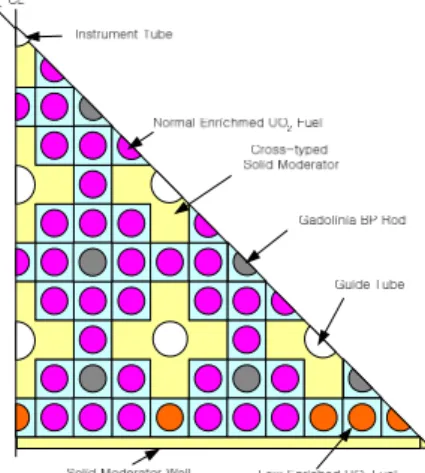
The fuel enrichment and burnable poison rod design are slightly changed in a fuel assembly when compared to those of a previous design.[2] Figure 1 shows the assembly design with the cruciform solid moderator.
Figure 1. A Conceptual Assembly Design
Since a high coolant density variation along the axial direction in a SCWR core induces a distortion of the axial power shape towards the core bottom, the axial zoning of a fuel enrichment, 6.5, 7.2, and 8.0 w/o from the bottom to the top, are introduced to flatten the axial power shape. The height of three regions is 115.8, 100.8, and 149.4 cm from bottom to top, respectively. In order to reduce the radial pin peaking in an assembly, a lower enrichment is also used for the fuel rods near the corner of the assembly and the peripheral fuel rods facing the ZrH2 solid moderators. The radial power peaking in a
single assembly calculation is reduced to 1.26 at the beginning-of-cycle (BOC). Gadolinia is used as a burnable poison to reduce the excess reactivity of the core. Fresh fuel assembly contains 36 gadolinia burnable poison rods in the bottom and the middle region of the core and 32 gadolinia rods in the top region of the core. The content of Gd2O3 in a gadolinia
rod is 10 w/o.
2.2 Core Design Concept
The power level of the SCWR system is reduced from 1700 MWe to 1400 MWe in order to reduce the linear heat generation rate. The conceptual SCWR core contains 193 fuel assemblies. The design limit for the maximum linear heat generation rate is assumed to be 39 kW/m the same as that of a light water reactor. Therefore, the power peaking factor limit associated with the maximum linear power is determined to be 2.76. A typical fuel loading pattern for the equilibrium core with a four-batch reload scheme is shown in Figure 2.
Figure 2. Loading Pattern of a Equilibrium Core with Control Banks Position and Orifice Flow Rate
2.3 Orifice Design for Flow Distribution
Maximum cladding temperature is limited to be less
than 620 oC to prevent a corrosion and stress corrosion
cracking (SCC) in a super critical condition for a fast system.[4] In Japan, the maximum cladding temperature
limit of 650 oC is recommended by Oka et al. in a super
critical thermal system for nickel alloy.[5] However, no Transactions of the Korean Nuclear Society Autumn Meeting
material and clad temperature criteria has been confirmed for either the cladding or the structure material in thermal or fast spectrum of a SCWR so far. In our previous study[3], the outlet coolant temperature of each assembly at the top of the core was calculated instead of the cladding surface temperature. The
maximum coolant temperature was calculated by 730 oC
at BOC. In order to reduce the coolant outlet temperature, an orifice concept to allow a different flow rate for each assembly is introduced in this study. The coolant flow rate distribution is determined by considering the assembly power distribution and the radial coolant temperature distribution. The optimized flow rates are presented in Figure 2.
2.4 Control Banks Design
The excess reactivity is controlled by control rods in the conceptual SCWR core. Since the control rods are inserted from the top of the core, the axial power shape is shifted to the bottom of the core with a control rod insertion. The control rod insertion from the top makes an axial power shape control more difficult in conjunction with the axial variation in a moderator density. Therefore, the control rod insertion strategy is developed with the consideration of both the axial power shape and the reactivity control simultaneously. Moreover, a control rod insertion makes the assembly power distribution rebalanced which will effect on the coolant temperature distribution of all the assemblies. Namely, the coolant temperature of each assembly should also be considered in the determination of the critical control banks position. Control bank positions in the conceptual SCWR core are also displayed in Figure 2. Six types of control banks are considered in this study. At BOC, F bank is fully inserted in the core region and E bank position is in the middle of the core region. The other banks are located at the top region of the core at BOC. All of the control banks are assumed to move individually without any systematic overlap mechanism. 2.5 Core Calculation Results
The core characteristics in this section are obtained from the core calculation for an equilibrium cycle. The
average discharged fuel burnup of UO2 is 36 GWd/tHM
which is shorter than the values proposed by Gen-IV. There is a need of using a high fuel enrichment or an assembly design modification like that accommodating more moderators at the top of the core or increasing the moderator to fuel volume ratio. The peak assembly-wise relative power during a burnup period occurs in the middle region of the core where the fresh fuel assembly is located and that is 1.354 at an EOC. By using the enrichment zoning of the fuel in three axial regions in a fresh fuel assembly, the axial power peaking factor can be managed to be less than 1.4 for a whole burnup period. Maximum axial power ratio of BOC, MOC, and EOC is 1.42, 1.33, and 1.38, respectively. The power
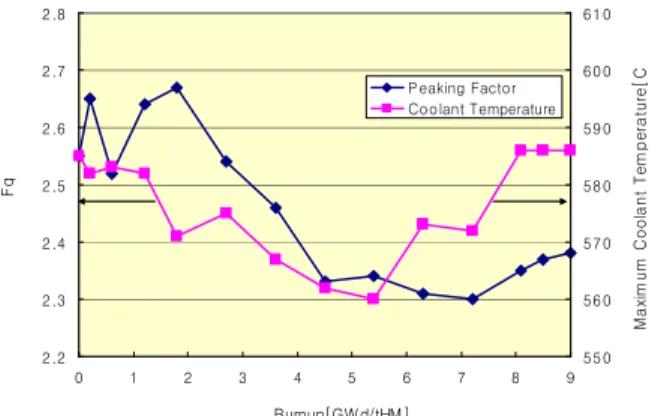
peaking factor was kept at less than the design limit during a burnup period and the maximum value is 2.67 at the burnup point of 1.8 GWd/tHM. The maximum
coolant temperature was calculated by 586 oC at a BOC
during a normal operation and it is slightly decreased with a burnup. Figure 3 shows the maximum coolant termperature and peaking factor with a burnup period.
2.2 2.3 2.4 2.5 2.6 2.7 2.8 0 1 2 3 4 5 6 7 8 9 55 0 56 0 57 0 58 0 59 0 60 0 61 0 P eaking Factor Coolant Temperature M a xi m u m C o o la n t T e m p er a tu re[ C ] F q Burnup[GW d/tHM]
Figure 3. Fq and Max. Coolant Temperature vs. Burnup
3. Conclusion
A conceptual core of a 1400 MWe SCWR core design is investigated. The reactivity control by a control rod manipulation and a coolant outlet temperature control by using an orifice are applied to enhance the safety of the SCWR core. Orifice concept to manipulate the flow distribution can decrease the maximum coolant temperature of the core to be less than 586 oC and reactivity control by the control rods could be performed within the power peaking criteria.
REFERENCES
[1] H.K.Joo, J.W.Yoo and J.M.Noh, “A Conceptual Design for a Rectangular Fuel Assembly for the Thermal SCWR System,” Proceeding of the GLOBAL2003, New Orleans, LA, USA 2003.
[2] H.K.Joo, K.M.Bae, H.C.Lee, J.M.Noh, and Y.Y.Bae, “A Conceptual Core Design with a Rectangular Fuel Assembly for a Thermal SCWR System,” Proceeding of the International Congress on Advances in Nuclear Power Plants(ICAPP2005), Seoul, Korea 2005.
[3] K.M.Bae, H.K.Joo, H.C.Lee, J.M.Noh, and Y.Y.Bae, “A SCWR Core Design with a Conceptual Fuel Assembly Using a Cruciform Moderator,” Proceedings of the Korean Nuclear Society Spring Meeting, Jeju, Korea 2005.
[4] A Technology Roadmap for Generation IV Nuclear Energy Systems, GIF-002-00, USDOE Nuclear Energy Advisory Committee and the Generation IV International Forum, December 2002.
[5] K.Kamei, A.Yamaji, Y.Ishiwatari, L.Jie, Y.Oka, “Fuel and Core Design of Super LWR with Stainless Steel Cladding,” Proceeding of the International Congress on Advances in Nuclear Power Plants(ICAPP2005), Seoul, Korea 2005.