Korean Journal of Microbiology (2019) Vol. 55, No. 3, pp. 303-305 pISSN 0440-2413
DOI https://doi.org/10.7845/kjm.2019.9093 eISSN 2383-9902
Copyright ⓒ 2019, The Microbiological Society of Korea
Complete genome sequence of Gordonia sp. MMS17-SY073, a soil
actinobacterium
Yeong Seok Kim and Seung Bum Kim*
Department of Microbiology and Molecular Biology, College of Bioscience and Biotechnology, Chungnam National University, Daejeon 34134, Republic of Korea
토양 방선균인 Gordonia sp. MMS17-SY073 균주의 유전체 분석
김영석 ・ 김승범*충남대학교 생명시스템과학대학 미생물 ․ 분자생명과학과
(Received August 14, 2019; Revised September 10, 2019; Accepted September 11, 2019)
*For correspondence. E-mail: [email protected]; Tel.: +82-42-821-6412; Fax: +82-42-822-7367
An actinobacterial strain designated Gordonia sp. MMS17- SY073 (=KCTC 49257) was isolated from a coastal soil of an island, and its complete genome was analyzed. A single contig consisting of 5,962,176 bp with the G + C content of 67.4% was obtained, and the annotation resulted in 5,201 protein-coding genes, 6 rRNA genes and 45 tRNA genes. Strain MMS17- SY073 was closest to the type strain of Gordonia soli based on the 16S rRNA gene sequence comparison, sharing 98.5% sequence similarity. A number of biosynthetic gene clusters for secondary metabolites, non-ribosomal peptide synthetase types in particular, could be identified from the genome.
Keywords: Gordonia, biosynthetic gene cluster, complete genome, soil actinobacterium
The genus Gordonia belongs to the family Gordoniaceae of the phylum Actinobacteria, and was firstly proposed by Tsukamura et al. (1971). Gordonia is Gram-positive, rich in DNA G + C content, nonmotile, and slightly acid-fast. Strains of Gordonia are able to degrade various pollutants such as ruber, hydrocarbons, and phenol compounds (Linos et al., 1999; Xue et al., 2003; Kim et al., 2009), and may also play important roles in bioremediation and biodegradation of pollutants (Arenskotter et al., 2004;
Franzetti et al., 2009). With the fast accumulation of the genome data, the genome analysis of Gordonia is expected to provide information on the genetic background of such properties, and also potential for the production of secondary metabolites.
In this study, an actinobacterial strain designated Gordonia sp. MMS17-SY073 was isolated from a coastal soil in Seonyu Island, Jeonbuk, Korea (35°48'46''N, 126°24'36''E). The strain was isolated on tryptic soy agar (TSA, BD) supplemented with antifungal antibiotics cycloheximide and nystatin (each at 50 µg/ml). The strain was deposited in the Korean Collection for Type Cultures (KCTC) under the accession number KCTC 49257.
The genomic DNA for the whole genomic shotgun sequencing of strain MMS17-SY073 was extracted by using commercial genomic DNA extraction kit (Solgent). The library construction including enzymatic fragmentation and tagmentation was per-formed using the SMRT Cell 8Pac V3. The genome library was subjected to the single molecule realtime sequencing (SMRT) using a PacBio RS II system (Pacific Biosciences). Sequences were assembled to construct contigs using RS Assembly 3.0 (Pacific Biosciences), and annotation using Prokka 1.12b (Torsten, 2014).
The whole genome sequencing using the PacBio RS II platform produced a total of 98,032 reads with an average length of 16,851 bp and genome coverage depth of 154×. A single contig
304
∙ Kim and Kim미생물학회지 제55권 제3호
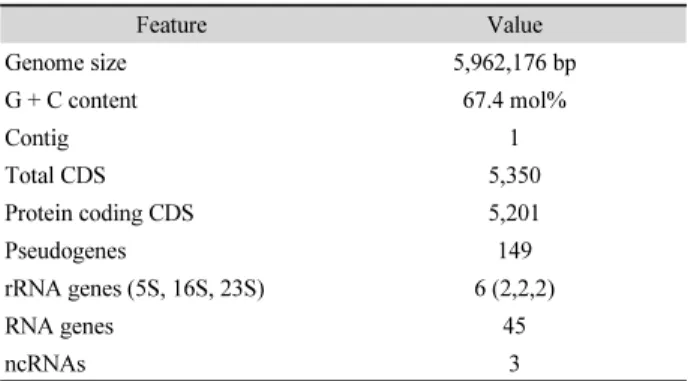
Table 1. The features of MMS17-SY073 genome Feature Value Genome size 5,962,176 bp G + C content 67.4 mol% Contig 1 Total CDS 5,350 Protein coding CDS 5,201 Pseudogenes 149 rRNA genes (5S, 16S, 23S) 6 (2,2,2) RNA genes 45 ncRNAs 3
was obtained from the assembly, and the complete genome sequence consisted of 5,962,176 bp with the DNA G + C content of 67.4%. No functional plasmid was detected. The annotation of the completed genome identified a total of 5,350 coding sequences (CDS) of which 5,201 were protein-coding genes and 149 were pseudogenes, and also 6 rRNA genes, 45 tRNA genes and 3 ncRNAs (Table 1).
Based on the phylogenetic analysis using 16S rRNA gene sequences, strain MMS17-SY073 was mostly related to the species of the genus Gordonia, and the closest species were Gordonia soli NBRC 108243T (Shen et al., 2006) with 98.5% sequence similarity, Gordonia polyisoprenivorans NBRC 16320T (Linos et al., 1999) with 98.1% similarity, and Gordonia hankookensis ON-33T (Park et al., 2009) with 97.8% similarity. The genome- based comparisons clearly distinguished strain MMS17-SY073 from the two neighboring species, G. soli and G. polyisoprenivorans, as the average nucleotide identities (ANI) with those two were 75.8% and 76.3% respectively, thus indicating that the strain merits recognition as a new species of Gordonia.
The genome of strain MMS17-SY073 contained various types of biosynthetic gene clusters for secondary metabolites, in particular those for non-ribosomal peptide synthetases (NRPS), and also multiple clusters for terpenes. Other gene clusters included those for bacteriocin, betalactone, ectoin, and type I polyketide synthase (PKS).
Nucleotide sequence accession number
The Bioproject number for Gordonia sp. MMS16-SY073 is PRJNA494249, and the sequence accession number for the genome is CP033972.
적 요
섬 해안가 토양에서 방선균주 Gordonia sp. MMS17-SY073 를 분리하여 유전체 분석을 실시하였고, 그 결과 5,962,176 염 기쌍 및 67.4%의 G + C 함량으로 이루어진 유전체 정보를 확보 하였다. 유전정보 분석 결과 총 5,201개 단백질 지정 유전자, 6 개 rRNA 유전자 및 45개 tRNA 유전자를 확인하였다. MMS17- SY073 균주는 16S rRNA 유전자를 이용한 분석 결과 분류학적 으로 Gordonia soli의 표준균주와 가장 가까웠으며 그 유사도 는 98.5%로 나타났다. MMS17-SY073 균주는 non-ribosomal peptide synthetase 유형을 비롯한 다수의 이차대사산물 생합 성 유전자를 보유하고 있는 것으로 나타났다.Acknowledgements
This work was supported by the 2017 CNU Research Grant of Chungnam National University (grant no. 2017-2015-01).
References
Arenskotter M, Daniel B, and Alexander S. 2004. Biology of the metabolically diverse genus Gordonia. Appl. Environ. Microbiol. 70, 3195–3204.
Franzetti A, Caredda P, Ruggeri C, Colla PL, Tamburini E, Papacchini M, and Bestetti G. 2009. Potential applications of surface active compounds by Gordonia sp. strain BS29 in soil remediation technologies. Chemosphere 75, 801–807.
Kim KK, Lee KC, Klenk HP, Oh HM, and Lee JS. 2009. Gordonia kroppenstedtii sp. nov., a phenol-degrading actinomycete isolated from a polluted stream. Int. J. Syst. Evol. Microbiol. 59, 1992– 1996.
Linos A, Steinbuchel A, Sproer C, and Kroppenstedt RM. 1999. Gordonia polyisoprenivorans sp. nov., a rubber-degrading actino-mycete isolated from an automobile tyre. Int. J. Syst. Bacteriol. 49, 1785–1791.
Park S, Kang SJ, Kim W, and Yoon JH. 2009. Gordonia hankookensis sp. nov., isolated from soil. Int. J. Syst. Evol. Microbiol. 59, 3172– 3175.
Shen FT, Goodfellow M, Jones AL, Chen YP, Arun AB, Lai WA, and Young CC. 2006. Gordonia soli sp. nov., a novel actino-mycete isolated from soil. Int. J. Syst. Evol. Microbiol. 56, 2597– 2601.
Torsten S. 2014. Prokka: rapid prokaryotic genome annotation, Bioinformatics 30, 2068–2069.
Genome sequence of Gordonia sp. MMS17-SY073∙
305
Korean Journal of Microbiology, Vol. 55, No. 3 acid-fast organisms occurring in sputa of patients with pulmonary
disease and in soil. J. Gen. Microbiol. 68, 15–26.
Xue Y, Sun X, Zhou P, Liu R, Liang F, and Ma Y. 2003. Gordonia
paraffinivorans sp. nov., a hydrocarbon-degrading actinomycete isolated from an oil-producing well. Int. J. Syst. Evol. Microbiol. 53, 1643–1646.