Session Ⅰ-A : IT기반기술/정보통신시스템기술 7
1. Introduction
Blockchain has become the buzzword in recent years, its application and fame for cryptocurrencies and financial systems have become its alluring characteristics that entice users to utilize and employ the technology. Blockchain is also becoming celebrated to be used in the energy sector, specifically in Microgrids because of the decentralized nature of both technologies. Functions like energy trading and access control and management are among the most common application of Blockchain in Microgrid.
In Microgrid, devices often perform a critical function and if attacked can cause serious and catastrophic damages to the whole system. Authors in [1] described several cyber-security requirements for microgrid including Identity Management (IdM). However, most IdMs are designed for user identity management and the applicability of these solutions for devices have not yet fully examined in the literature. Unlike users that have unique attributes, the selection of identifiers, efficient management of identity credentials have been a critical issue for identity management of devices. Thus, this work presents a hybrid Blockchain-based Identity Management framework that utilizes Blockchain technology as an Identity Provider, rather than relying on a third-party. Moreover, these Blockchain platforms together with several modules in the proposed framework give several added authentication layer compared to the
existing solutions in literature. In addition, recently, Physically unclonable functions (PUFs) ability to generate unique, unclonable bits for the identification and authentication of ICs have received significant attention in the hardware security community and PUF is also employed as a means to strengthen the verification of devices.
2. Proposed Work
In this work, the notion that authentication is a shared responsibility between a device manufacturer and consumer is emphasized. In general, the initial work of authentication of a device should start from the creation of the device at the manufacturer side. With this, the proposed work, employ this as the first layer of authentication work and assumes that manufacturers of devices are able to register each device in a Public Blockchain platform (PuBP) before releasing them to the market like the work in [2]. However, since these records in the Blockchain are transparent to any user (node), a public ID and a cryptographically hashed private ID [3] is ideal to be stored. Moreover, device vendors can also utilize the Blockchain records to verify the authenticity of the devices avoiding selling counterfeits to consumers. The proposed work emphasizes the creation of the PuBP since Microgrid operators will also utilize and benefit from this entity.
마이크로그리드에서 장치들을 위한 하이브리드 블록 체인 기반
식별 관리 프레임워크
A Hybrid Blockchain-based Identity Management Framework for
Devices in Microgrid
레진 카바카스, 나인호 군산대학교
Regin A. Cabacas, In-Ho Ra
School of Computer, Information and Communication Engineering, Kunsan National University
요약
This paper presents a hybrid blockchain-based Identity Management Framework for devices in Microgrid. It incorporates the use of a Public and Private Blockchain platform to store and authenticate Microgrid device identities. It also emphasizes the shared responsibility of the manufacturers to provide the first layer of authentication for the devices they produce. Identities of each device are stored in the private and public Blockchain and authenticated using physically unclonable functions (PUF) and cryptographic functions.
한국콘텐츠학회 2019 춘계종합학술대회 8
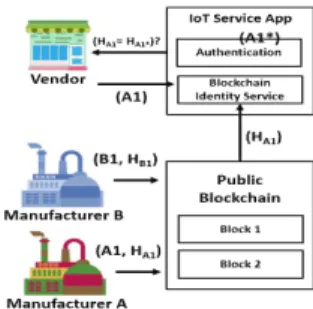
Figure 1. First layer of authentication. Manufacturer creates a record of the Device (A1, B1) and store it in the Blockchain.
Figure 1 depicts the registration of device in the PuBP and the scenario when a device Vendor also authenticates a particular device. The process within this is as follows:
1. The Vendor queries the PuBP using an IoT Service application that contains a Blockchain Identity Service using the device's public ID (A1) to retrieve the hashed private ID (HA1).
2. The authentication module then provides a challenge to the PUF of the device and waits for the response, which is a secret private ID (e.g., A1*).
3. The verification passes if the received hash from BG, and computed hash of PUF response matches for the device.
Similar to the process used by the Vendor, the microgrid operator through its Administrator can perform the devices authentication from the PubP. After which, the Administrator will now register the device to a local Private Blockchain platform (PriBP). The local Private (Permissioned) Blockchain platform is employed to hold records of each device in Microgrid to easily facilitate access management and avoid delay in data processing and communication problems. Furthermore, this is employed to counter internal threats like cloning, counterfeiting and adding of malicious devices by internal entities. Figure 2 shows an instance of registration of new devices and authentication of existing devices. The process assumes that an Administrator who has access to authenticated devices or gateway is able to add devices which will undergo three (3) phases namely; Key Generation, Registration and Authentication.
Figure 2. Second layer of authentication. Administrator adds the device in the Microgrid infrastructure and publishes the record in the private Blockchain platform.
Key Generation Phase
1. The admin first verifies whether the device is already registered in the PriBP.
2. A random secret key is generated (e.g., KA1 for device A1).
3. It sends the key (KA1) to the gateway and the gateway returns the encrypted key (EKA1) by using its own encrypted key (KG1).
Registration Phase
1 The admin uploads the public ID, the hash of the secret ID and the encrypted key {A1, HA1, EKA1} into the PriBP. The device is now associated with the gateway and the gateway is now responsible for the authentication of the device.
Authentication Phase
1. To be able to secure the authenticity of the device a regular preiodic authentication of each device should be undergone. The gateway queries the PriBP with the device (A1) public ID and check that the device has not been tampered, removed and replaced.
2. PriBP returns the hash of the private ID (HA1) and encrypted key (EKA1).
3. The gateway can now recover the secret key (KA1) using its own secret key (KG1) and verify if it matches with the device.
3. Conclusion
This paper presented a blockchain-based Identity Management framework for Microgrid Devices that utilized private and public Blockchain platform as an Identity provider instead of a third-party. The proposed work exploits the ideal characteristics of Blockchain in order to perform, fast, secure and reliable device authentication. In the future, implementation and testing of the proposed approach is needed and the inclusion of access control management is also taken into consideration.
4. Acknowledgment
This work was supported by Institute for Information & communications Technology Promotion (IITP) grant funded by the Korea government (MSIT) (No. 2018-0-00508, Development of blockchain-based embedded devices and platform for MG security and operational efficiency).
References
[1] Mohan, A. and Khurana, H. Cyber, “Implementing Cyber Security Requirements and Mechanisms in Microgrids HAL Id : hal-01431004,” 2017.
[2] Rao V. and K. V. Prema, “Light-weight hashing method for user authentication in Internet-of-Things,” Ad Hoc Networks, vol. 89, pp. 97–106, 2019. [3] Islam, M. N. Patii, V. C. and Kundu, S. “On IC
traceability via blockchain,” 2018 Int. Symp. VLSI Des. Autom. Test, VLSI-DAT 2018, pp. 1–4, 2018.