Genetic Polymorphism and
Haplotype Analysis of 4 Tightly
Linked X-STR Duos in Koreans
Eun Jin Lim
1*, Hwan Young
Lee
1,2*, Jeong Eun Sim
1,
Woo Ick Yang
1, Kyoung-Jin
Shin
1,21Department of Forensic Medicine
and Brain Korea 21 Project for Medical Science, Yonsei University College of Medicine, Seoul, Korea
2Human Identification Research
Center, Yonsei University, Seoul, Korea
*The first two authors equally contributed to this work Aim To investigate genetic polymorphism and haplotypes
of tightly linked X-chromosomal short tandem repeat (X-STR) clusters in Koreans.
Methods Four X-STR duos in the linkage group
1-4 (DXS10135-DXS8378, DXS7132-DXS10071-4, HPRTB-DXS10101, and DXS10134-DXS7423) were investigated in 450 unrelated Koreans (300 men and 150 women) using the Mentype Argus X-8 Polymerase Chain Reaction Amplification Kit.
Results No significant deviation from Hardy-Weinberg
equilibrium was observed in any of the 8 loci. DXS10135 was the most polymorphic X-STRs, with 25 alleles and DXS7423 was the least informative, with 5 alleles. Eleven off-ladder alleles and a triallelic pattern were observed, and these alleles were characterized by cloning and sequenc-ing analysis. In 300 Korean men, 38 to 59 haplotypes were observed for each linkage duo with 91.6-96.6% of haplo-type diversities. However, due to the low genetic diversity of DXS7423, the X-STR duo in linkage group 4 (DXS10134-DXS7423), in comparison with other linkage duos, had considerably lower haplotype diversity values (91.6%) with 3 common haplotypes (35-15, 36-15, and 37-15) observed in 44.3% of Koreans.
Conclusion Four X-STR duos in the linkage group 1-4 will
be able to provide a powerful tool for solving complex kin-ship cases in Koreans. However, to increase the haplotype diversity in the linkage group 4, it will be useful to discov-er a new markdiscov-er for Asians that can sdiscov-erve as an adequate substitute for DXS7423 or at least complement the existing linkage duo of DXS10134-DXS7423.
Received: October 27, 2008. Accepted: February 10, 2009.
Correspondence to:
Kyoung-Jin Shin
Department of Forensic Medicine Yonsei University College of Medicine
250 Seongsanno, Seodaemun-Gu Seoul 120-752, Korea
Gonosomal markers have been efficiently used for solv-ing deficiency cases (1,2). Due to hemizygosity in men and high mean exclusion chances, X-chromosomal short tandem repeats (X-STR) are particularly helpful in pater-nity testing and kinship analyses, such as father-daugh-ter, mother-son, and grandmother-granddaughter kinship testing, or the kinship testing of putative sisters (1). How-ever, when second and third degree kinships are investi-gated, extremely polymorphic STRs might be required (3). As the degree of polymorphism is limited in most STRs and highly polymorphic STRs like DXS10011 are prone to muta-tions (4,5), it has recently been suggested that stable hap-lotypes of closely linked loci are used in kinship testing in-stead of a single STR (2).
This approach of substituting single STRs with haplo-types consisting of clustered STRs resulted in the division of the chromosome X into the linkage groups 1-4 locat-ed at Xp22, Xq12, Xq26, and Xq28, each of which yields independent genotype information (2,6). Especially, 4 X-STR duos in the linkage groups 1-4 (DXS10135-DXS8378, DXS7132-DXS10074, HPRTB-DXS10101, and DXS10134-DXS7423) have been widely investigated in various popu-lation groups (6-12). Since each of the 4 STR clusters spans less than 0.5 cM, the clusters represent stable haplotypes, thereby providing highly informative tools for kinship test-ing (2,6).
In the present study, we investigated the polymorphisms and haplotypes of the 4 tightly linked X-STR duos in Kore-ans and evaluated their efficiency in forensic practice. In addition, we provided relevant information about popula-tion differences with respect to allele distribupopula-tion patterns and haplotype diversities.
MatErIaLS and MEtHodS dna samples
Blood or buccal samples from 450 unrelated Koreans living in Seoul (300 men and 150 women), including 150 men and 150 women already typed for 9 X-STRs (13,14), were analyzed. Genomic DNA was extracted using a QIAamp DNA Mini Kit (Qiagen, Hilden, Germany) according to the manufacturer’s instructions, and the DNA was quantitated using NanoDrop 1000 spectrophotometer (Thermo Fisher Scientific, Wilmington, DE, USA), following the
manufturer’s recommendation. The study was performed in ac-cordance with the ethical standards of the Declaration
of Helsinki.
Polymerase chain reaction (PCr) amplification and genotyping
The genomic DNA was amplified using the Mentype Ar-gus X-8 PCR Amplification Kit (Biotype AG, Dresden, Ger-many) and the PCR products were analyzed by capillary electrophoresis using an ABI PRISM 310 Genetic Analyzer (Applied Biosystems, Foster City, CA, USA) according to the Mentype Argus X-8 PCR Amplification Kit manual (15). The fragment sizes were determined using the GeneScan 3.7 software (Applied Biosystems) and the allele designations were carried out using Genotyper 3.7 software (Applied Bi-osystems) with the Argus X-8_v1.gta macro (Biotype AG). Sequence analysis of off-ladder alleles
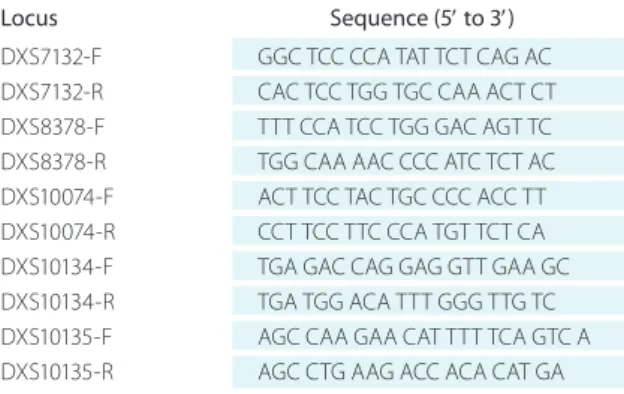
Sequence analyses were performed on samples which contained alleles that could not be designated using the allelic ladder of the Mentype Argus X-8 PCR Amplification Kit. Primers for PCR amplification of off-ladder alleles were
designed using the Primer 3 software (http://frodo.wi.mit.
edu/primer3/input.htm) (Table 1). Each PCR product was cloned using the TOPO TA Cloning Kit (Invitrogen, Carlsbad, CA, USA) following the manufacturer’s recommendation. Then, at least two clones were chosen and sequenced on an ABI 3730 Genetic Analyzer using a BigDye Terminator Cycle Sequencing Ready Reaction Kit (Applied Biosystems) according to the manufacturer’s instruction. The allele no-menclature followed the guidelines of the DNA commis-sion of the International Society for Forensic Genetics (16).
Statistical analysis
Polymorphism information content, heterozygosity, mean exclusion chances for trio and duo cases, and power of
dis-tabLE 1. Polymerase chain reaction and sequencing primers for sequence analysis of the observed off-ladder alleles from the Mentype argus X-8 kit
Locus Sequence (5′ to 3′)
DXS7132-F GGC TCC CCA TAT TCT CAG AC DXS7132-R CAC TCC TGG TGC CAA ACT CT DXS8378-F TTT CCA TCC TGG GAC AGT TC DXS8378-R TGG CAA AAC CCC ATC TCT AC DXS10074-F ACT TCC TAC TGC CCC ACC TT DXS10074-R CCT TCC TTC CCA TGT TCT CA DXS10134-F TGA GAC CAG GAG GTT GAA GC DXS10134-R TGA TGG ACA TTT GGG TTG TC DXS10135-F AGC CAA GAA CAT TTT TCA GTC A DXS10135-R AGC CTG AAG ACC ACA CAT GA
tabLE 2. allele frequencies of 8 X-chromosomal short tandem repeat loci in 450 Koreans (300 men and 150 women) allele dXS7132 dXS7423 dXS8378 HPrtb dXS10074 dXS10101 dXS10134 dXS10135 7 0.0017 9 0.0050 10 0.0017 0.5767 0.0033 11 0.0067 0.3000 0.0400 12 0.0833 0.1117 0.3183 0.0033 13 0.2017 0.0017 0.0050 0.4067 0.0017 14 0.3133 0.2833 0.1917 0.0117 15 0.2983 0.6583 0.0300 0.0617 16 0.0717 0.0533 0.0100 0.1833 0.0100 17 0.0183 0.0033 0.3067 0.0100 17.3 0.0033 18 0.0050 0.2750 0.0666 19 0.1267 0.0882 20 0.0250 0.1032 21 0.0017 0.1314 21.3 0.0033 22 0.1265 22.2 0.0017 23 0.0799 24 0.0765 25 0.0599 26 0.0333 26.2 0.0017 27 0.0117 0.0499 28 0.0167 0.0516 28.2 0.0167 29 0.0317 0.0349 29.2 0.0450 0.0017 30 0.1017 0.0017 0.0150 30.2 0.0917 31 0.1767 0.0017 0.0166 31.1 0.0017 31.2 0.1467 32 0.1633 0.0250 0.0183 32.2 0.0783 33 0.0683 0.0317 0.0100 33.2 0.0300 34 0.0150 0.0717 0.0033 34.2 0.0033 0.0017 35 0.1567 0.0033 35.3 0.0033 36 0.2217 0.0033 37 0.2183 0.0017 37.1 0.0017 37.3 0.0117 38 0.1250 38.3 0.0267 39 0.0650 39.3 0.0083 40 0.0150 41 0.0017 41.3 0.0050 42.3 0.0017 43.3 0.0050
crimination for men and women were calculated at the
ChrX research homepage (http://www.chrx-str.org). Exact
tests of the Hardy-Weinberg equilibrium and the popula-tion differentiapopula-tion were carried out using the Arlequin 2.0
software (http://lgb.unige.ch/arlequin). Data from German
(6), Ghanaian (11), and Japanese (12) populations were used for the exact test of population differentiation. Hap-lotypes of 4 closely linked STR duos were obtained from male genotypes and haplotype diversity was calculated using Arlequin 2.0 software.
rESuLtS
Genetic polymorphism of 8 X-Str loci
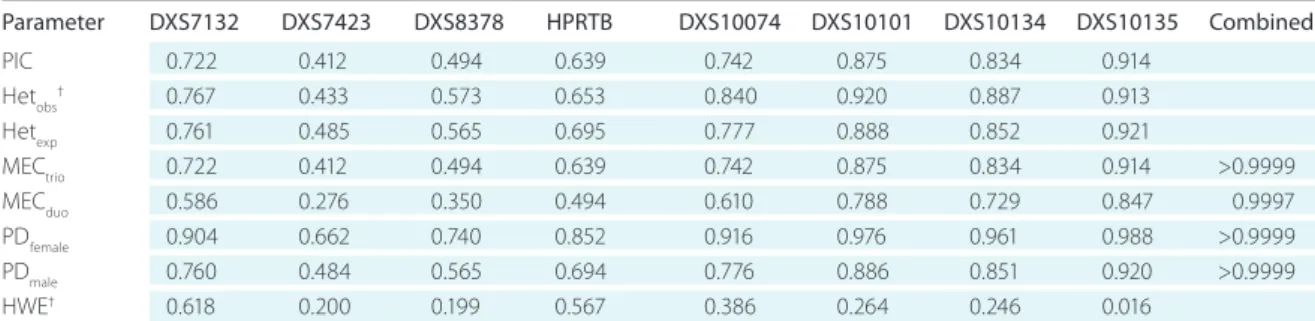
Allele frequencies of 8 X-STR loci (DXS7132, DXS7423, DXS8378, HPRTB, DXS10074, DXS10101, DXS10134, and DXS10135) are shown in Table 2, and the values for poly-morphism information content, heterozygosity, mean ex-clusion chance, and power of discrimination are shown in Table 3. DXS10135 was the most polymorphic X-STR, with 25 alleles, and DXS7423 was the least polymorphic one, with 5 alleles. In particular, the most frequently observed alleles of the DXS7423 and DXS8378 loci had 65.8% and 57.7% oc-currences, respectively. Forensic efficiency parameters also demonstrated that the DXS7423 and DXS8378 loci were much less informative in Koreans than in Germans (6). No significant deviations from the Hardy-Weinberg equilibri-um were observed in these 8 markers (Table 3).
The allele frequencies of the 8 X-STR loci in the Korean, Ger-man, Ghanaian, and Japanese populations were compared with the exact test of population differentiation (6,11,12). We found no significant differences between Korean and Japanese populations in all 8 loci; P-values of population comparison were 0.292 for DXS7132, 0.270 for DXS7423,
0.128 for DXS8378, 0.040 for HPRTB, 0.957 for DXS10074, 0.468 for DXS10101, 0.030 for DXS10134 and 0.019 for DXS10135. However, the German and Ghanaian popula-tions showed significant differences from the Korean pop-ulation (P < 0.001) in almost all loci. For the locus DXS7132, a significant difference could not be detected between the Korean and Ghanaian populations (P = 0.026).
Sequence structure of off-ladder alleles
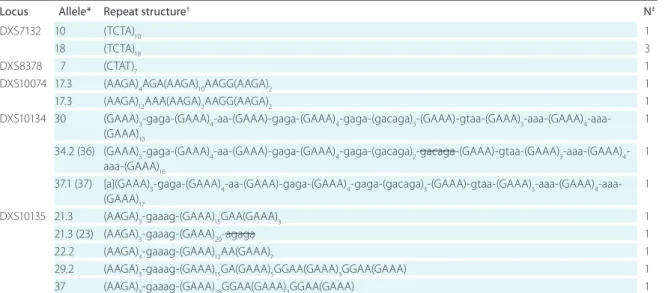
At 5 X-STR loci, 11 off-ladder alleles were observed in 15 samples: in 4 samples at DXS7132 (allele 10 and 18), in 1 sample at DXS8378 (allele 7), in 2 samples at DXS10074 (allele 17.3), in 3 samples at DXS10134 (allele 30, 34.2, and 37.1), and in 5 samples at DXS10135 (allele 21.3, 22.2, 29.2, and 37). All these off-ladder alleles were confirmed by clon-ing and sequencclon-ing analysis and their repeat structures were described in Table 4. Alleles 10 and 18 at DXS7132, allele 7 at DXS8378, allele 30 at DXS10134, and allele 37 at DXS10135 were found to have a regular repeat motif, but the other apparent microvariant alleles contained an insertion/deletion of nucleotides within or beyond repeat motifs. Two microvariant alleles at DXS10074 (17.3 with different sequence structure) and 3 microvariant alleles at DXS10135 (21.3, 22.2, and 29.2) contained variations in core repeat units, while 2 microvariant alleles at DXS10134 (34.2 and 37.1) and 1 microvariant allele at DXS10135 (21.3) had variations in the non-core repeat units within or ad-jacent to the repeat motifs. The allele 34.2 at DXS10134 contained a 6 bp (gacaga) of non-core repeat unit dele-tion within the repeat motif (genuine allele of 36). The al-lele 37.1 at DXS10134 and the alal-lele 21.3 at DXS10135 had a 1 bp insertion within the upstream flanking region and a 5 bp (agaga) deletion at the downstream flanking region, respectively (genuine alleles 37 and 23, respectively). In ad-dition, at DXS10135, a triallelic pattern (24-26-28) was
ob-tabLE 3. Forensic statistical parameters of 8 X-chromosomal short tandem repeat loci calculated in a Korean population*
Parameter dXS7132 dXS7423 dXS8378 HPrtb dXS10074 dXS10101 dXS10134 dXS10135 Combined PIC 0.722 0.412 0.494 0.639 0.742 0.875 0.834 0.914 Hetobs† 0.767 0.433 0.573 0.653 0.840 0.920 0.887 0.913 Hetexp 0.761 0.485 0.565 0.695 0.777 0.888 0.852 0.921 MECtrio 0.722 0.412 0.494 0.639 0.742 0.875 0.834 0.914 >0.9999 MECduo 0.586 0.276 0.350 0.494 0.610 0.788 0.729 0.847 0.9997 PDfemale 0.904 0.662 0.740 0.852 0.916 0.976 0.961 0.988 >0.9999 PDmale 0.760 0.484 0.565 0.694 0.776 0.886 0.851 0.920 >0.9999 HWE† 0.618 0.200 0.199 0.567 0.386 0.264 0.246 0.016
*abbreviations: PIC – polymorphic information content; Hetobs – observed heterozygosity; Hetexp – expected heterozygosity; MECtrio – mean
exclu-sion chance in trios involving daughters; MECduo – mean exclusion chance in father/daughter or mother/son duos; Pdfemale – power of discrimination
in women; Pdmale – power of discrimination in men; HWE – Hardy-Weinberg equilibrium. †P value calculated using the female data.
served in the female sample, and this characterization was confirmed by cloning and sequencing.
Haplotype analysis
Table 5 shows the haplotype frequencies of the 4 link-age groups in 300 Korean men. The 4 linklink-age duos of DXS10135-DXS8378, DXS7132-DXS10074, HPRTB-DXS10101, and DXS10134-DXS7423 revealed 56, 41, 59, and 38 haplotypes, respectively, and their haplotype diversity values were all higher than 0.9. Of all the ob-served haplotypes, 68% showed frequencies <0.02, and some haplotypes (35-15, 36-15, and 37-15 of DXS10134-DXS7423) showed very high frequencies >0.10 (0.12, 0.18, and 0.14, respectively).
dISCuSSIon
Forensic efficiency parameters indicated that the 8 X-STRs in the present study were suitable for forensic applications in Koreans. These values were still generally lower than in Ger-mans (6); moreover, the values for DXS7423 and DXS8378 in Koreans were particularly low. The test for population dif-ferentiation also indicated a significant difference between Korean and German populations (6). However, Korean and Japanese populations showed similar allele distribution patterns across all 8 loci, implying genetic similarity accord-ing to the geographic location (12).
Sequencing analysis of 11 off-ladder alleles indicated that most off-ladder alleles in the present study had simi-lar sequence structure to those reported in the Mentype Argus X-8 kit manual and those studied in a previous re-port (6,7,15). However, alleles 34.2 and 37.1 at DXS10134 and allele 21.3 (genuine allele of 23) at DXS10135 were first observed here, and the microvariant alleles at DXS10134 and DXS10135 showed somewhat different sequence structures in Koreans. Particularly, 3 microvariant alleles at DXS10135 (21.3, 22.2, and 29.2) in Koreans were caused by the addition or deletion of partial core repeat units, but most microvariant alleles observed in Germans and Hun-garians were caused by variation at the 3’ flanking region (6,7). In addition, the triallelic pattern (24-26-28) observed at DXS10135 was assumed to be a type 1 triallelic pattern (17), which might have originated from a somatic muta-tion of one allele during an individual’s development, since this pattern showed an imbalance in amounts between the 3 alleles.
Since stable haplotypes of closely linked X-STR loci were recently suggested for use in kinship testing instead of a single STR, the haplotype analysis of 4 linked X-STR duos was carried out in 300 Korean men. A total of 38 to 59 hap-lotypes for each linkage duo and 91.6 to 96.6% of haplo-type diversities were observed, which are slightly lower values than those found in Germans (96.0 – 97.6%) (6). Although each linkage duo was proved to be
high-tabLE 4. off-ladder alleles of 8 X-chromosomal short tandem repeat loci in a Korean population
Locus allele* repeat structure† n‡
DXS7132 10 (TCTA)10 1
18 (TCTA)18 3
DXS8378 7 (CTAT)7 1
DXS10074 17.3 (AAGA)4AGA(AAGA)10AAGG(AAGA)2 1
17.3 (AAGA)12AAA(AAGA)2AAGG(AAGA)2 1
DXS10134 30 (GAAA)3-gaga-(GAAA)4-aa-(GAAA)-gaga-(GAAA)4-gaga-(gacaga)3-(GAAA)-gtaa-(GAAA)3-aaa-(GAAA)4 -aaa-(GAAA)10
1 34.2 (36) (GAAA)3-gaga-(GAAA)4-aa-(GAAA)-gaga-(GAAA)4-gaga-(gacaga)2-gacaga-(GAAA)-gtaa-(GAAA)3-aaa-(GAAA)4
-aaa-(GAAA)16
1 37.1 (37) [a](GAAA)3-gaga-(GAAA)4-aa-(GAAA)-gaga-(GAAA)4-gaga-(gacaga)3-(GAAA)-gtaa-(GAAA)3-aaa-(GAAA)4
-aaa-(GAAA)17
1
DXS10135 21.3 (AAGA)3-gaaag-(GAAA)15GAA(GAAA)3 1
21.3 (23) (AAGA)3-gaaag-(GAAA)20-agaga 1
22.2 (AAGA)3-gaaag-(GAAA)12AA(GAAA)7 1
29.2 (AAGA)3-gaaag-(GAAA)15GA(GAAA)5GGAA(GAAA)3GGAA(GAAA) 1
37 (AAGA)3-gaaag-(GAAA)28GGAA(GAAA)3GGAA(GAAA) 1
*the numbers in parentheses are genuine alleles identified by sequence analysis. the allele nomenclature follows the guidelines of the dna com-mission of the International Society for Forensic Genetics (16).
†deletion and insertion are indicated with strikethrough and in square brackets, respectively. ‡the number of samples showing off-ladder allele.
tabLE 5. Haplotype frequencies (F) of 4 linked X-chromosomal short tandem repeat duos in 300 Korean men no dXS10135 dXS8378 F dXS7132 dXS10074 F HPrtb dXS10101 F dXS10134 dXS7423 F 1 16 10 0.0067 10 17 0.0033 10 30 0.0033 32 14 0.0067 2 16 12 0.0033 11 17 0.0033 10 32 0.0033 32 15 0.0100 3 17 10 0.0067 11 18 0.0067 11 29 0.0033 33 14 0.0067 4 17 11 0.0067 12 15 0.0067 11 30.2 0.0133 33 15 0.0133 5 18 10 0.0367 12 16 0.0233 11 31 0.0233 33 16 0.0033 6 18 11 0.0167 12 17 0.0433 11 31.2 0.0033 34 14 0.0267 7 18 12 0.0033 12 18 0.0133 11 33 0.0033 34 15 0.0300 8 19 9 0.0033 12 19 0.0100 12 26.2 0.0033 34 16 0.0033 9 19 10 0.0533 12 20 0.0067 12 28 0.0067 35 14 0.0400 10 19 11 0.0467 13 14 0.0033 12 28.2 0.0033 35 15 0.1200 11 19 12 0.0167 13 15 0.0167 12 29.2 0.0100 35 16 0.0033 12 20 10 0.0533 13 16 0.0133 12 30 0.0233 35 17 0.0033 13 20 11 0.0333 13 17 0.0867 12 30.2 0.0267 35.3 14 0.0033 14 20 12 0.0100 13 18 0.0533 12 31 0.0400 36 13 0.0033 15 21 10 0.0633 13 19 0.0267 12 31.1 0.0033 36 14 0.0533 16 21 11 0.0333 13 20 0.0033 12 31.2 0.0533 36 15 0.1800 17 21 12 0.0100 14 14 0.0033 12 32 0.0600 36 16 0.0067 18 21.3 10 0.0033 14 15 0.0233 12 32.2 0.0267 36 17 0.0033 19 22 10 0.0767 14 16 0.0533 12 33 0.0433 37 14 0.0533 20 22 11 0.0567 14 17 0.1067 12 33.2 0.0033 37 15 0.1433 21 22 12 0.0067 14 18 0.0733 12 34 0.0067 37 16 0.0333 22 22 13 0.0067 14 19 0.0600 13 27 0.0033 37.1 16 0.0033 23 22.2 10 0.0033 14 20 0.0100 13 28 0.0100 37.3 15 0.0067 24 23 10 0.0767 14 21 0.0033 13 28.2 0.0133 38 14 0.0333 25 23 11 0.0033 15 12 0.0067 13 29 0.0167 38 15 0.0700 26 23 12 0.0100 15 13 0.0033 13 29.2 0.0133 38 16 0.0067 27 24 10 0.0333 15 15 0.0200 13 30 0.0433 38.3 14 0.0067 28 24 11 0.0133 15 16 0.0700 13 30.2 0.0267 38.3 15 0.0133 29 24 12 0.0100 15 17 0.0467 13 31 0.0700 39 14 0.0167 30 25 10 0.0467 15 18 0.0900 13 31.2 0.0833 39 15 0.0500 31 25 11 0.0100 15 19 0.0333 13 32 0.0567 39 16 0.0033 32 25 12 0.0067 15 20 0.0033 13 32.2 0.0367 39.3 14 0.0067 33 26 10 0.0167 16 15 0.0067 13 33 0.0100 39.3 15 0.0033 34 26 11 0.0133 16 16 0.0100 13 33.2 0.0067 40 14 0.0033 35 26 12 0.0033 16 17 0.0133 13 34 0.0033 40 15 0.0133 36 27 10 0.0333 16 18 0.0200 14 27 0.0033 41.3 15 0.0067 37 27 11 0.0167 16 19 0.0067 14 28 0.0033 42.3 15 0.0033 38 28 9 0.0033 17 17 0.0033 14 28.2 0.0033 43.3 15 0.0067 39 28 10 0.0233 17 18 0.0067 14 29 0.0033 40 28 11 0.0233 18 18 0.0033 14 29.2 0.0167 41 28 12 0.0133 18 19 0.0033 14 30 0.0200 42 29 9 0.0033 14 30.2 0.0133 43 29 10 0.0100 14 31 0.0267 44 29 11 0.0200 14 31.2 0.0233 45 29.2 11 0.0033 14 32 0.0167 46 30 10 0.0033 14 32.2 0.0100 47 30 11 0.0067 14 33 0.0333 48 30 12 0.0033 14 33.2 0.0133 49 31 10 0.0033 15 29.2 0.0033 50 31 11 0.0033 15 30 0.0133 51 32 10 0.0100 15 31 0.0067 52 33 10 0.0067 15 31.2 0.0033 53 34 10 0.0033 15 32 0.0100 54 35 10 0.0033 15 33 0.0033 55 36 10 0.0033 15 34 0.0033 56 37 11 0.0033 16 29 0.0033 57 16 31 0.0033 58 16 33 0.0033 59 16 33.2 0.0033 h* 0.9640 ± 0.0029 0.9473 ± 0.0038 0.9662 ± 0.0029 0.9157 ± 0.0073
ly informative for forensic applications, the linkage group 4 (DXS10134-DXS7423), in comparison with other link-age duos, had considerably lower haplotype diversity val-ues (91.6%) with 3 common haplotypes (35-15, 36-15, and 37-15) observed in 44.3% of Koreans. This finding may be explained by the very low genetic diversity of DXS7423 in Koreans; these haplotype distribution patterns were also observed in a Japanese population (6). Since Germans (6), Hungarians (7), and Ghanaians (6), however, showed high haplotype diversity values and relatively even haplotype distribution patterns across all 4 X-STR duos, there will be a need for discovering a new marker for Asians that can serve as an adequate substitute for DXS7423 or at least comple-ment the existing linkage duo of DXS10134-DXS7423. A re-cent report has suggested that DXS10146 and DXS10147 are two additional candidates that could be included into this linkage group to increase discrimination capacity (18). However, two recombination events have been observed between DXS10146 and DXS10134, and DXS10147 has been shown to have only a fairly low degree of polymor-phism (18). Therefore, to evaluate the efficiency of certain markers for use in haplotype complexes along with oth-er markoth-ers, and to quantify the genetic distance between markers with greater precision, the investigation of a much greater number of checked meiosis should be conducted with regard to ethnic background.
To summarize, the 4 X-STR duos in the linkage group 1-4 can provide a powerful tool for solving complex kinship cases in Koreans. To verify the usefulness of these haplotypes in family tree reconstruction, however, linkage analysis, deter-mination of mutation rates, and the accurate recombina-tion frequency between these linked markers should be performed before introducing them into forensic practice. acknowledgments
This work was supported by the Korea Science and En-gineering Foundation (KOSEF) grant funded by the Ko-rean government (MEST) (No. M10740030002-07N4003-00210).
references
1 Szibor r, Krawczak M, Hering S, Edelmann J, Kuhlisch E, Krause d. use of X-linked markers for forensic purposes. Int J Legal Med. 2003;117:67-74. Medline:12690502
2 Szibor r. X-chromosomal markers: past, present and future. Forensic Sci Int; Genet. 2007;1:93-9. Medline:19083736 doi:10.1016/j.fsigen.2007.03.003
3 Hering S, augustin C, Edelmann J, Heidel M, dressler J, rodig H, et al. dXS10079, dXS10074 and dXS10075 are Strs located within
a 280-kb region of Xq12 and provide stable haplotypes useful for complex kinship cases. Int J Legal Med. 2006;120:337-45.
Medline:16344967doi:10.1007/s00414-005-0061-y
4 brinkmann b, Klintschar M, neuhuber F, Huhne J, rolf b. Mutation rate in human microsatellites: influence of the structure and length of the tandem repeat. am J Hum Genet. 1998;62:1408-15.
Medline:9585597doi:10.1086/301869
5 Hering S, brundirs n, Kuhlisch E, Edelmann J, Plate I, benecke M, et al. dXS10011: studies on structure, allele distribution in three populations and genetic linkage to further q-telomeric chromosome X markers. Int J Legal Med. 2004;118:313-9.
Medline:15248074doi:10.1007/s00414-004-0467-y
6 becker d, rodig H, augustin C, Edelmann J, Gotz F, Hering S, et al. Population genetic evaluation of eight X-chromosomal short tandem repeat loci using Mentype argus X-8 PCr amplification kit. Forensic Sci Int; Genet. 2008;2:69-74. Medline:19083792 doi:10.1016/j.fsigen.2007.08.013
7 Zalan a, Volgyi a, brabetz W, Schleinitz d, Pamjav H. Hungarian population data of eight X-linked markers in four linkage groups. Forensic Sci Int. 2008;175:73-8. Medline:17590298doi:10.1016/ j.forsciint.2007.05.012
8 barbaro a, Cormaci P, Votano S, barbaro a. Population data of 8 X-Strs in South Italy (Calabria) using the Mentype® argus X-8 PCr amplification Kit (biotype). Forensic Science International: Genetics Supplement Series. 2008;1:135-9. doi:10.1016/j.fsigss.2007.10.109
9 ruivo d, ribeiro t, Espinheira r, Geada H. use of eight X-chromosomal Strs in paternity investigation. Forensic Science International: Genetics Supplement Series. 2008;1:522-4.
doi:10.1016/j.fsigss.2007.10.001
10 branicki W, Wolanska-nowak P, Parys-Proszek a, Kupiec t. application of the Mentype argus X-8 Kit to forensic casework. Problems of Forensic Sciences. 2008;73:53-64.
11 thiele K, Loffler S, Loffler J, Gunthner F, nitschke K, Edelmann J, et al. Population data of eight X-chromosomal Str markers in Ewe individuals from Ghana. Forensic Science International: Genetics Supplement Series. 2008;1:167-9. doi:10.1016/j.fsigss.2007.10.059
12 Hashiyada M, Itakura Y, Funayama M. Polymorphism of eight X-chromosomal Strs in a Japanese population. Forensic Science International: Genetics Supplement Series. 2008;1:150-2.
doi:10.1016/j.fsigss.2007.10.020
13 Shin KJ, Kwon bK, Lee SS, Yoo JE, Park MJ, Chung u, et al. Five highly informative X-chromosomal Strs in Koreans. Int J Legal Med. 2004;118:37-40. Medline:14634833 doi:10.1007/s00414-003-0415-2
14 Lee HY, Park MJ, Jeong CK, Lee SY, Yoo JE, Chung u, et al. Genetic characteristics and population study of 4 X-chromosomal Strs in Koreans: evidence for a null allele at dXS9898. Int J Legal Med. 2004;118:355-60. Medline:15185093 doi:10.1007/s00414-004-0456-1
dresden (Germany): biotype aG; 2007.
16 bar W, brinkmann b, budowle b, Carracedo a, Gill P, Lincoln P, et al. dna recommendations. Further report of the dna Commission of the ISFH regarding the use of short tandem repeat systems. International Society for Forensic Haemogenetics. Int J Legal Med. 1997;110:175-6. Medline:9274938doi:10.1007/s004140050061
17 Clayton tM, Guest JL, urquhart aJ, Gill Pd. a genetic basis for
anomalous band patterns encountered during dna Str profiling. J Forensic Sci. 2004;49:1207-14. Medline:15568691doi:10.1520/ JFS2003145
18 Edelmann J, Hering S, augustin C, Szibor r. Characterisation of the Str markers dXS10146, dXS10134 and dXS10147 located within a 79.1 kb region at Xq28. Forensic Sci Int; Genet. 2008;2:41-6.