This content has been downloaded from IOPscience. Please scroll down to see the full text.
Download details:
IP Address: 203.255.172.21
This content was downloaded on 29/12/2016 at 06:35 Please note that terms and conditions apply.
Energy-efficient vertical transportation with sensor information in smart green buildings
View the table of contents for this issue, or go to the journal homepage for more 2016 IOP Conf. Ser.: Earth Environ. Sci. 40 012079
(http://iopscience.iop.org/1755-1315/40/1/012079)
You may also be interested in:
Signalling information from embedded sensors to promote lifetime extension in electrical and electronic equipment
S Hickey and C Fitzpatrick
A Fusion of Sensors Information for Autonomous Driving Control of an Electric Vehicle (EV) Hasri Haris, Khairunizam Wan, D Hazry et al.
Modeling of a new 2D Acceleration Sensor Array using SystemC-AMS Erik Markert, Marco Dienel, Goeran Herrmann et al.
Experiments on distributed active vibration control of a simply supported beam Tao Tao and Kenneth D Frampton
Sensor validation using principal component analysis
Gaetan Kerschen, Pascal De Boe, Jean-Claude Golinval et al.
Distributed group-based vibration control with a networked embedded system Kenneth D Frampton
Experimental study on active vibration control of a flexible cantilever using an artificial neural-network state predictor
Woo Chun Choi and Nam Woong Kim
Analysis of using EMG and mechanical sensors to enhance intent recognition in powered lower limb prostheses
Energy-efficient vertical transportation with sensor
information in smart green buildings
H Bahn1
Department of Computer Science & Engineering, Ewha Womans University, Seoul, 120-750, South Korea
E-mail:[email protected]
Abstract. In modern smart green buildings, sensors can detect various physical status of a building such as temperature, humidity, motion, and light, which can be used for smart living services. This paper presents an energy-efficient vertical transportation by making use of indoor sensor technologies. Specifically, sensors detect elevator users before they push the call button, and then inform to the elevator control system through building networks. By using this information, our system generates a reservation call and controls the moving time and direction of each elevator efficiently. Simulation experiments with a variety of traffic situations show that our elevator control system exhibits significantly better performance than the conventional system that does not use sensor information with respect to passengers’ waiting time and energy consumption.
1. Introduction
Due to the recent advances in indoor sensor technologies, various smart living services in a modern green building are being realized. For example, indoor sensors can collect temperature, humidity, motion, light, and sound, which might be used for energy saving, comfort, healthcare, and security [1]. HVAC (Heating, Ventilating, and Air Conditioning) is a representative system that can utilize indoor sensor technologies. HVAC controls the air condition and the temperature of a building according to the weather and the existence of human beings, thereby leading to an energy-efficient building infrastructure.
Vertical transportation is another important service that can be involved in indoor sensor technologies in a smart green building. There is a report that HVAC and vertical transportation are the two major complaints of building tenants [2]. To alleviate this situation, this paper presents a novel elevator control system that utilizes indoor sensor technologies. As human behaviors and movements can be detected precisely with current sensor technologies such as video, audio, optical, and floor sensors [1], [3], [4], [5], an elevator control system can recognize the arrival of users before they push the actual call buttons. Thus, our system exploits this information for enhancing the efficiency of elevator control, leading to reduced waiting time and energy consumption. Although a lot of studies on vertical transportation have been performed, utilizing indoor sensor technologies for elevator control is in its infancy.
1 Address for correspondence: H Bahn, Department of Computer Science & Engineering, Ewha Womans
University, Seoul, 120-750, South Korea. E-mail:[email protected].
Content from this work may be used under the terms of theCreative Commons Attribution 3.0 licence. Any further distribution of this work must maintain attribution to the author(s) and the title of the work, journal citation and DOI.
The goal of elevator control systems is usually mentioned as the minimization of waiting time, riding time, and the energy consumption of the systems. Previous works have mostly focused on the minimization of the average waiting time as passenger’s dissatisfaction grows significantly as the waiting time becomes long [7]. This paper focuses on the minimization of both energy consumption and passenger’s waiting time.
Elevator control is a complex optimization problem due to the complicated elevator dynamics, uncertainty of traffic patterns, and multiple goals to be considered concurrently. Due to this reason, previous works utilize well-known optimization techniques like fuzzy logics and genetic algorithms [8], [9], [10], [11], [21]. Also, some facilities such as cameras and additional buttons are adopted to collect more information on waiting passengers [10]. Some research predicts traffic patterns using peak time distribution analysis [9]. However, prediction and adaptation used in existing research is limited as elevator control systems recognize passengers’ arrival only after they push the elevator call buttons. Unlike previous works, the proposed elevator control system collects passenger information by sensor technologies before they actually arrive, which will be utilized in efficient elevator control. Specifically, our system generates a reservation call for candidate passengers detected by sensors and controls the moving direction and the moving time of elevators efficiently. To validate the efficiency of the proposed elevator control system, we perform simulations with a variety of traffic conditions. Our experimental results depict that the proposed elevator control system performs significantly better than the legacy system that does not use sensor information with respect to the average waiting time, the worst case waiting time, and the energy consumption. In particular, the improvement of the average waiting time and the energy consumption is in the range of 15-30% and 28-31%, respectively.
The remainder of this paper is organized as follows. Section 2 discusses previous studies on sensor technologies for smart green building environments. Section 3 describes the proposed elevator control system in detail. Section 4 validates the proposed system through simulation experiments. Finally, Section 5 concludes this paper.
2. Sensor technologies for smart green buildings
Recently, smart green building prototypes are developed that contain various indoor sensors such as video sensors, floor sensors, and battery-backed wireless sensors. We can collect a lot of context information from these sensors, which might be exploited for smart green building services. Kidd et al. present a context-aware home prototype [3]. It consists of several living spaces such as bedroom, bathroom, living room, dining room, and office, and video sensors are installed in each space for tracing human movements. With this information, human behaviors can be analyzed and predicted. Figure 1.(a) shows a person tracked by the video sensor in this prototype building.
Orr and Abowd present a smart floor for tracking human movements and identities [4]. They created a system for identifying users by making use of their footstep force profile. This also allows
Figure 1. (a) Video sensors Figure 1. (b) Floor sensors Figure 1. User tracking systems with various sensor technologies [3, 4, 5].
the tracking and the prediction of tenants in a smart building. Addlesee et al. present an active floor, which is similar to the smart floor [5]. The active floor is the square grid of conventional tiles that is supported at the corners by cylindrical load cells, which send weight changes of about 50 grams to the location system. With this information, the system can predict the future locations of people. Similarly, Steinhage and Lauterbach present capacitive sensor arrays which are embedded in floor carpets in order to track the movement across a large area [14]. Figure 1. (b) shows these floor sensors. Want et
al. present the active badge system for tracking people in an office building [13]. In their system,
people wear an active badge, and it periodically delivers signals, which are used to trace the location of people.
Sensor networks have also been widely studied for smart green building infrastructure. Gao et al. propose an intelligent light control system based on wireless sensor networks [19]. Their system reduces the energy consumption of a smart green building significantly. Eliades et al. present the sensor placement problem in smart buildings in order to monitor and protect indoor air quality against contaminations [20]. They formulate the problem as a multi-objective optimization problem to save the sensor cost as well as the impact of contamination events. Sreedharan et al. design a real-time sensor system that combines information from multiple sensors to accurately detect a sudden release of toxic contaminants in a smart building [21].
Smart parking providers also make use of sensor technologies to monitor the real-time availability of parking spaces [15]. Finding the best path to an exit with sensor networks is also attempted [16]. Brunette et al. develop wireless sensor nodes that can provide contextual information including human activity, environment, and RFID tags, which can be used in ubiquitous computing applications to automatically adjust their behavior according to the situation [18].
Sensor information in a smart green building can also be used efficiently in vertical transportation systems. Strang and Bauer use RFID tags to inform the destination floor before passengers enter the elevator car [17]. Kwon et al. also use context information by using floor sensors, but their scheduling is not applicable to group elevator systems [6]. Mitsubishi Electric Corporation developed an RFID-enabled elevator system [12]. The RFID tag informs the arrival of passengers and their destination, which are used for the elevator control and security. By combining RFID and cameras, their system discerns if a person wants to use an elevator or is just walking near an elevator [12].
3. Energy-efficient elevator control with sensors
Legacy elevator control systems cannot recognize passengers before they actually push the elevator request buttons. Thus, waiting time and energy consumption are increased significantly. Take, for example, a typical situation where a passenger pushes a request button at the 1st floor right after the elevator goes from the 1st up to the highest floor. Then, the passenger should wait during a full round trip time of the elevator, and the energy consumption of the elevator is also increased because of the long moving distance.
To address this issue, we present a novel elevator control system called ESG (Elevator control for Smart Green buildings). ESG obtains passengers’ arrival information in advance from multiple sensors and exploits the information to control elevator systems. As mentioned in Section 2, with the rapid advances in sensor and wireless network technologies, there is no difficulty in detecting and transferring the passenger information in advance. Given information on subsequent passengers beforehand, ESG controls elevators more efficiently with respect to the waiting time and energy consumption.
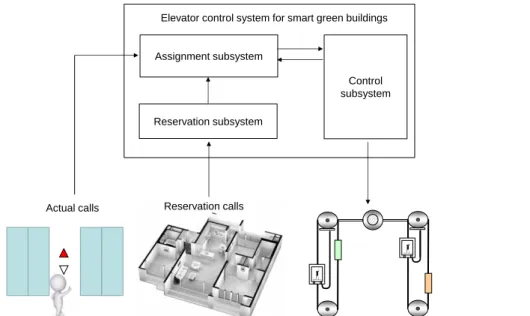
Now, let us see the details of ESG. Figure 2 shows the overall architecture of ESG; it is composed of three subsystems, namely the Control Subsystem (CS), the Reservation Subsystem (RS), and the Assignment Subsystem (AS). CS controls the moving or stopping of the elevator. RS collects and processes passengers’ arrival information detected by sensors. When a passenger approaches the elevator, multiple sensors detect the passenger’s location in advance, and then inform this information to the elevator control system through building networks. RS calculates the time when the passenger will arrive at the elevator and then generates a reservation call accordingly. AS receives the
reservation call from RS, and decides two parameters; DT (delay time) and MD (moving direction). DT is the time interval that should be delayed before the elevator begins its movement for the reservation call, and MD is the moving direction, i.e., upward or downward, of the elevator. If a reservation call arrives during the idle time of the elevator car, the car does not move immediately at right, but delays its movement as long as it can reach the requested location before the passenger arrives there. Determining DT is important to reduce the moving distance of the car, potentially related to the energy consumption, since other requests towards the same direction during the delayed time can arrive. We define DT as the time difference between the passenger’s moving time to the elevator door (denoted by PT) and the elevator car’s moving time to the reserved floor. In particular, the elevator car’s moving time depends on the distance of the movement. If the distance is longer than a certain threshold (denoted by MIN), a uniform motion interval exists in the middle of the moving. Otherwise, the car moves only as acceleration and deceleration motions. Equation (1) represents how
DT is calculated. ASC DIST PT 2 if DIST < MIN DT = (1) USC MIN DIST ASC MIN PT 2 otherwise PT = AHT – RCT DIST = CE – PFi FH
where CE is the current floor of the elevator, PFi is the current floor of the passenger i, FH is the
height of a floor, DIST is the distance between the elevator’s and the passenger i’s floors, MIN is the minimum distance for uniform motion, ASC is the uniform acceleration of the car, USC is the uniform velocity of the car, AHT is the actual call time, and RCT is the reservation call time. By expression (1), delay time of an elevator car before starting its movement can be calculated.
Figure 2. Basic architecture of the proposed elevator control system. Reservation subsystem
Assignment subsystem
Control subsystem Elevator control system for smart green buildings
Reservation calls Actual calls
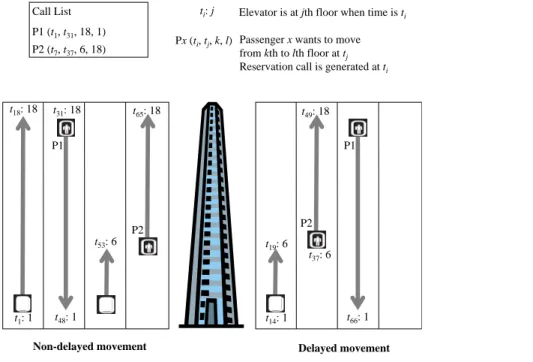
Now, we will explain our scheduling system by describing the workings of the algorithm with appropriate examples. Figure 3 depicts a simple situation to show the effectiveness of delayed movement. Suppose that two passengers P1 and P2 want to ride the elevator. P1 is at the 18th floor and aims at going down to the 1st floor. P2 is at the 6th floor and aims at going up to the 18th floor. In this simple example, we suppose the logical time that is increased by one whenever an elevator goes up or down for a floor and ignore all other time components like boarding time. We suppose that sensors detect passengers 30 time units before they arrive at the elevator door. Thus, P1 and P2 make actual calls at t31 and t37, but their reservation calls are generated at t1 and t7, respectively. When we do not apply the delayed movement, the car starts moving at t1 towards the 18th floor to pick up P1. Although P2 makes a reservation at t7, the car already passed by the 6th floor at that time. As a result, the wait time of P2 becomes longer, and also the elevator consumes additional energy because of the increased moving distance. In contrast, if we adopt delayed movement, the elevator delays its movement for 13 time units, and then starts moving at t14; thus, P2 can take the elevator at this turn. Accordingly, the total execution time of the elevator system is reduced, which also leads to significant energy-savings.
MD (moving direction) is another critical parameter for the waiting time and the energy consumption. Figure 4 shows an example situation of MD’s effects. Suppose that reservation calls for passengers P1 and P2 are issued at t1 and t6, from the 12th and 6th floors, respectively, and the passengers will actually arrive in front of the elevator door 30 time units later; the elevator car initially stops at the 8th floor and the destination of P1 and P2 are the 15th and 18th floors, respectively. Then, in the legacy elevator control system, the car first goes up to the 12th floor at t31 to pick up P1. P1 rides the car at t35, and arrives at the destination floor at t38. Then, the car goes down to the 6th floor to pick up P2. In this way, the waiting time of P2 becomes 11 time units. In contrast, in our system, the car first goes down to the 6th floor to pick up P2, and then goes up to the 12th floor to pick up P1. Accordingly, the waiting time of the passengers and the moving distance of the elevator are significantly reduced.
Now, we will describe how the aforementioned algorithm can be applied in group elevator control systems. The operation of ESG for group elevator systems is composed of two phases: the allocation phase and the processing phase. When a reservation call is issued, the elevator control system first decides which elevator should be allocated to that request. For efficient allocation, ESG calculates the passengers’ expected waiting time for each car. Then ESG allocates the car incurring the minimum expected waiting time to that request. The expected waiting time (PWT) of elevator car x from the i-th
to the j-th floor is calculated as
PWT (x, i, j) = TMOVE + TADDITIONAL
ASC
DIST
2
if DIST < MIN TMOVE = (2)USC
MIN
DIST
ASC
MIN
2
otherwiseTADDITIONAL = TOPEN + TBOARDING + TCLOSE
where DIST is the distance between the passenger and the car, MIN is the minimum distance for uniform motion, ASC is the uniform acceleration of the car, and USC is the uniform velocity of the car.
TOPEN, TBOARDING, and TCLOSE are the time to open the elevator door, the time to board the elevator, and
the time to close the elevator door, respectively. If the car needs to visit some additional floor during the movement from i to j, multiple TMOVE and TADDITIONAL are added to PWT.
After the allocation phase is completed, ESG inserts the passenger’s reservation call into the request queue of the selected car. ESG, then, processes the passenger’s reservation call based on the original ESG algorithm.
Figure 3. A simple situation that contrasts non-delayed and delayed movements.
Figure 4. A simple situation of adopting Moving Direction (MD) in the proposed system.
Call List P1 (t1, t31, 18, 1) P2 (t7, t37, 6, 18) t1: 1 t18: 18 t31: 18 t65: 18 P2
ti: j Elevator is at jth floor when time is ti
Px (ti, tj, k, l) Passenger x wants to move
from kth to lth floor at tj Reservation call is generated at ti
t48: 1 t53: 6 P1 t14: 1 t19: 6 t37: 6 t49: 18 P2 t66: 1 P1
Non-delayed movement Delayed movement
Call List P1 (t1, t31, 12, 15) P2 (t6, t36, 6, 18) t31: 8 t35: 12 t38: 15 P1
ti: j Elevator is at jth floor when time is ti Px (ti, tj, k, l) Passenger x wants to move
from kth to lth floor at tj Reservation call is generated at ti
t36: 6 t34: 8 t42: 12 P2 Conventional elevator system
The proposed elevator control system t47: 6 t59: 18 P2 t45: 15 P1 t48: 18
4. Experimental results
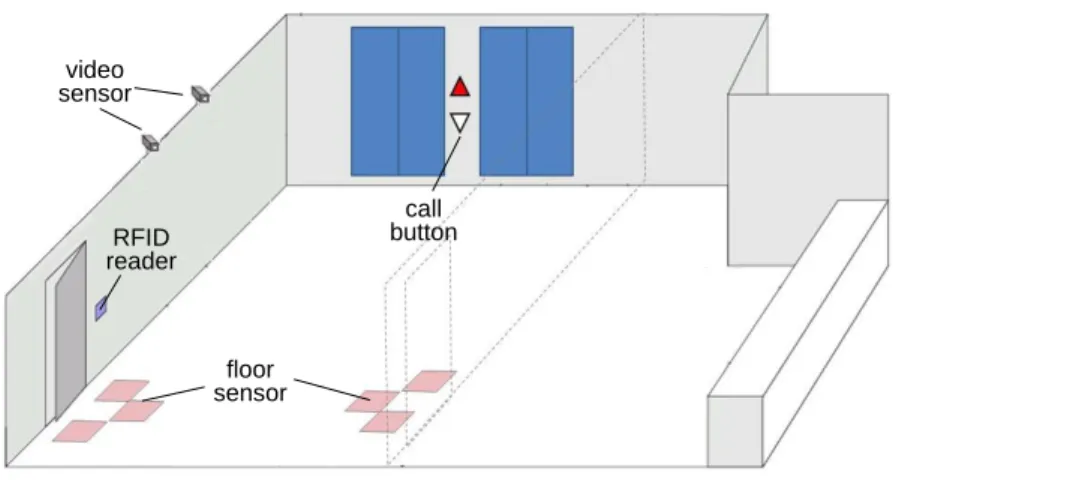
To validate the effectiveness of multiple sensor devices in detecting passenger information, we equipped RFID, video, and floor sensors in a twenty-story building for residence, and collected sensed data for enrolled users. The building authenticates the enrolled users at the gate of the underground parking area or the main entrance of the ground floor using an RFID tag or a password. We first collect sensor data at this time to make a reservation call. Less than 120 seconds are needed for a candidate passenger to move from this location to the elevator door. Along the hallway towards the elevator, floor sensors are located, and they can detect the moving direction of people through the path of the step. This information is collected about 60 seconds prior to the actual call at the elevator. Video sensors are also located at the ceiling of the hallway, and they can also recognize the movement of people. The distance from this location to the elevator is about 30 seconds or less. We set the default moving direction of reservation calls to “up” at the parking area and the ground floor. Note that a reservation call is dropped from the request queue when it is not continued to appear in the subsequent sensors. For example, when a reservation call is generated 120 seconds prior to the actual call through RFID tags but there is no corresponding reservation call through video or floor sensor, the request is dropped from the scheduling queue.
In the residence area ranging from the 2nd to 20th floors, each home has its front door and there are floor sensors along the hallway. 60 seconds or so are needed to move from the front door to the elevator including the locking time of the door. Video sensors are also located at the ceiling of the hallway, and the distance to the elevator is about 30 seconds or less. We set the default moving direction of reservation calls to “down” at residence floors. Figure 5 depicts our experimental environments of sensing systems.
We perform simulation experiments to evaluate the efficiency of ESG. We use similar conditions with previous works [8], [10]. The number of floors and elevators is set to 20 and 6, respectively, and each elevator car can accommodate 20 people. The passengers’ traffic is generated by Poisson process with the average arrival rate ranging from 5 to 35 passengers/min as usual [8], [10]. To reflect the peak-time traffic in real situations, we also generate passengers’ traffic by a non-homogeneous Poisson process where the arrival rate itself changes according to another Poisson process. We compare ESG with CS (current system) that does not use reservation calls. We use three criteria: waiting time (average case), waiting time (worst case), and energy consumption.
According to the aforementioned prototype sensor settings, we perform three ESG configurations: ESG-30, ESG-60, and ESG-120. In ESG-30, the reservation call is generated 30 seconds prior to the passenger’s actual call. Similarly, ESG-60 and ESG-120 generate reservation calls 60 and 120 seconds
Figure 5. Prototype configurations to collect sensor data.
floor sensor video sensor call button RFID reader 7
prior to actual calls, respectively. In reality, the optimum time period for the reservation call should be defined empirically depending on passengers’ and elevators’ moving time and the location of sensors. An elevator’s moving time can be estimated precisely by the law of motion as in Equation (1), but a passenger’s moving time varies depending on the location of sensors and each passenger’s step. If we overestimate the passenger’s moving time, the passenger should wait long for the elevator car. If we underestimate the passenger’s moving time, the elevator car may arrive before the passenger arrives. As a closer sensor estimates the moving time of the candidate passenger more precisely, in our empirical study, a reservation call from a distant sensor is dropped from the request queue when it appears from a closer sensor.
Location of sensors is also important to determine the time period for reservation calls. A distant sensor provides the control system with passengers’ information earlier and thus using this information allows the elevator car to pick up many passengers at a time. This eventually leads to the reduction of energy consumption. In contrast, a close sensor provides more accurate information, and thus the waiting time of passengers can be minimized. For now, we show the results for a spectrum of policies by utilizing multiple sensors and do not provide the tuning issue of the optimal time period.
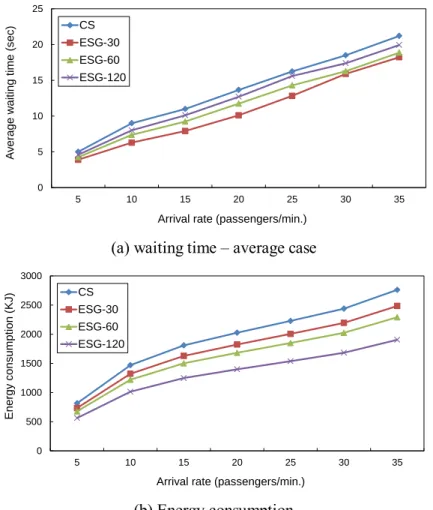
Figure 6. (a) shows the average waiting time of CS and ESG as the arrival rate is varied. As depicted in the figure, ESG exhibits consistently better performance than CS irrespective of the arrival rate. Specifically, the average waiting time of ESG-30 is better than CS by 22% on average and up to
(a) waiting time – average case
(b) Energy consumption
Figure 6. Comparison of the current system (CS) and the elevator control for smart green buildings (ESG). 0 5 10 15 20 25 5 10 15 20 25 30 35 A v erage w ait ing tim e (s ec )
Arrival rate (passengers/min.) CS ESG-30 ESG-60 ESG-120 0 500 1000 1500 2000 2500 3000 5 10 15 20 25 30 35 Energy c ons um pt ion (KJ )
Arrival rate (passengers/min.) CS
ESG-30 ESG-60 ESG-120
30%. The performance enhancement of ESG-120 is relatively small as many passengers ride the elevator at a time. Figure 6(b) depicts the amount of energy consumed while operating the elevator system. ESG again exhibits better performance than CS. Among the three configurations, ESG-120 performs the best as more people can ride the car at a single round trip time compared to other elevator control systems. The gain of ESG-120 over CS is 28.6% on average and up to 31.2% with respect to the energy consumption.
Figure 7 depicts the results for non-homogeneous traffic patterns. Again, ESG performs better than CS for all performance measures. As shown in Figure 7(a), ESG-30 exhibits 16.1% better performance than CS with respect to the waiting time of average case. Similar to the results in Figure 6, the performance enhancement of ESG-120 is not large with respect to the waiting time of average case. However, this is not the case for the waiting time of the worst case as shown in Figure 7(b). Irrespective of ESG configurations, the improvement of the worst case waiting time is in the range of 6.5-6.8%. Figure 7(c) depicts the energy consumption of the elevator system. Similar to the homogeneous traffic cases, ESG-120 performs the best; the improvement is 30.7% compared to CS in terms of the energy consumption.
5. Conclusion
This paper presented a novel elevator control system, called ESG, for smart green buildings. ESG uses multiple sensor devices to collect passengers’ arrival information before they arrive at the elevator. Specifically, three types of sensor devices, RFID, video, and floor sensors are used to estimate passenger information precisely. By utilizing this prior information, ESG controls the elevator system more efficiently than legacy elevator control systems. We generate a reservation call for candidate passengers detected by sensors and control the moving direction and the moving time of elevator cars for the reservation calls. Experimental results with various traffic conditions showed that ESG reduces the average waiting time and the energy consumption by 15-30% and 28-31%, respectively, compared to legacy elevator systems. As a future work, we plan to extend ESG to collect the destination floor of passengers in advance by using a variety of sensors including smartphone sensors. We expect that more complete information can be used for efficient scheduling.
Acknowledgment
This research has been supported by the National Research Foundation of Korea (NRF) grant funded by the Korea government (MSIP) (No.2011-0028825).
(a) waiting time – average case (b) waiting time – worst case (c) Energy consumption Figure 7. Comparison of the current system (CS) and the elevator control for smart green buildings (ESG) as the traffic is non-homogeneous.
10 11 12 13 14 15 16 17 18 19 20 CS E S G-3 0 E S G-6 0 ES G-1 20 A v erage w ait ing time (s ec ) 30 32 34 36 38 40 42 44 CS E S G-3 0 E S G-6 0 E S G -1 2 0 Max imum w ait ing t ime (s ec ) 0 500 1000 1500 2000 2500 3000 CS E S G-3 0 E S G-6 0 E S G -1 2 0 Energy c ons um pt ion (KJ ) 9
References
[1] Essa I 2000 Ubiquitous sensing for smart and aware environments IEEE Personal
Communications 7 47–9
[2] So AT and Liu SK 1996 An overall review of advanced elevator technologies Elevator World 44 96–103
[3] Kidd C D, Orr R J, Abowd G D, Atkeson C G, Essa I A, MacIntyre B, Mynatt E, Starner T E and Newstetter W 1999 The aware home: a living laboratory for ubiquitous computing research Lecture Notes in Computer Science 1670 191–8
[4] Orr R J and Abowd G D 2000 The smart floor: a mechanism for natural user identification and tracking Pro. Int. Conf. Human Factors in Computing Systems (The Hague, Netherlands) 275–6
[5] Addlesee M, Jones A, Livesey F and Samaria F 1997 The ORL active floor IEEE Personal
Communications 4 35–41
[6] Kwon O, Bahn H and Koh K 2006 A context-aware elevator scheduling system for smart apartment buildings Proc. Int. Conf. Advances in Hybrid Information Technology (Jeju Island, Korea) 362–72
[7] Brand M E and Nikovski D N 2004 Risk-averse group elevator scheduling Proc. Int. Congress
Vertical Transportation Technologies (Istanbul, Turkey) 1–8
[8] Lee S and Bahn H 2005 An energy-aware elevator group control system Proc. IEEE Int. Conf.
Industrial Informatics (Perth, Australia) 639–43
[9] Brand M E and Nikovski D N 2004 Optimal parking in group elevator control Proc. IEEE Int.
Conf. Robotics & Automation (New Orleans, LA) 1002–8
[10] Kim J H and Moon B R 2001 Adaptive elevator group control with camera IEEE Trans.
Industrial Electronics 48 377–82
[11] Eguchi T, Hirasawa K, Hu J and Markon S 2004 Elevator group supervisory control systems using genetic network programming Congress on Evolutionary Computation 2 1661–7 [12] Shimbun N S 2004 Elevators get smart RFID in Japan
[13] Want R, Hopper A, Falcão V and Gibbons J 1992 The active badge location system ACM Trans.
Information Systems 10 91–102
[14] Steinhage A and Lauterbach C 2008 Monitoring movement behavior by means of a large area proximity sensor array in the floor Proc Workshop Behavior Monitoring and Interpretation 15–27
[15] Doherty L, Simon J and Watteyne T 2012 Wireless sensor network challenges and solutions
Microwave J. 55 22–34
[16] Christakos C 2006 Sensor networks applied to the problem of building evacuation: an evaluation in simulation Proc. IST Mobile and Wireless Summit (Mykonos, Greece) 134–8 [17] Strang T and Bauer C 2007 Context-aware elevator scheduling Proc. Int. Conf. Advanced
Information Networking and Applications Workshops (Niagara Falls, Ont.) 276–81
[18] Brunette W, Lester J, Rea A and Borriello G 2005 Some sensor network elements for ubiquitous computing Proc. IEEE/ACM Int. Conf. Information Processing in Sensor Networks (Los Angeles, CA) 388–92
[19] Gao Y, Lin Y and Sun Y 2013 A wireless sensor network based on the novel concept of an I-matrix to achieve high-precision lighting control Building and Environment 70 223–31 [20] Eliades D, Michaelides M, Panayiotou C and Polycarpou M 2013 Security-oriented sensor
placement in intelligent buildings Building and Environment 63 114–21
[21] Sreedharan P, Sohn M, Nazaroff W and Gadgil A 2011 Towards improved characterization of high-risk releases using heterogeneous indoor sensor systems Building and Environment 46 438–47