ICCAS2005 June 2-5, KINTEX, Gyeonggi-Do, Korea
A New Control Method for an Adaptive Noise Canceller Using Stochastic difference
between Voice and Noise Signals Power Change
H. Nishi∗ and T. Kakinoki∗
∗Department of Engineering, SOJO University, 860-0844, Kumamoto, Japan
(Tel: +81-96-326-3659; Fax: +81-96-326-3000; Email:[email protected])
Abstract: This paper reports a technique for discriminating double talk and echo path change using the stochastic charac-teristics of power change for an adaptive noise canceller. The causes of rapid error increasing are double talk and echo path change. When the echo path is changed, the system corrects the impulse response in order to reduce the error. However, in the case of double talk, the system has to suspend the updating impulse response in order to maintain the quality of the voice signal. In the conventional system, it was difficult to discriminate between the two situations. In this research, the stochastic characteristics of the voice power change in the double talk period were experimentally verified to be different from the power change during echo path changing. Based on the results, a new double talk detection method is proposed.
Keywords: control, adaptive noise canceller, power change, adaptive filter 1. Introduction
In order to extract a voice signal buried in noise, or to sepa-rate sound signals from two kinds of sound sources, adaptive noise cancellers have been studied[1][2][3]. In speech recog-nition, attention is focused on the pre-processing in order to improve the recognition accuracy.
Adaptive noise cancellers use the technology of adaptive fil-ters with input from two microphones. One is for a reference noise input and the other is for a voice signal where the noise overlaps[4][5].
During the period when there is no voice signal, the noise signal into the voice signal microphone is approximately es-timated as the reference noise influenced by the echo path between two microphones using the adaptive filter theory. After the completion of the echo path presumption, it is sup-posed that the input of a voice signal microphone deducted by the estimated noise signal, which is the convolution be-tween the echo path and the reference noise microphone in-put, is the voice signal without noise. However, if the same processing as described above is used for a voice signal (dou-ble talk period), an incorrect echo path will be estimated and the distortion of the voice signal will increase. For this reason, a method that discriminates whether a voice signal exists or not and suspends the echo path correction during the double talk period was studied.
2. Principle of an adaptive noise canceller and double talk problems
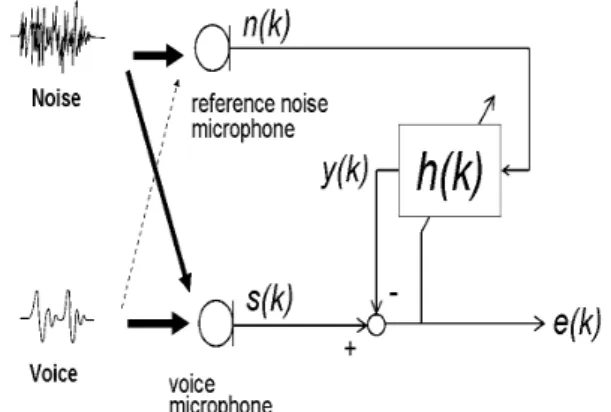
Fig.1 shows the system structure of an adaptive noise can-celler. Noise is mainly inputted into a reference noise micro-phone. It is assumed that the level of the voice signal that is input to the reference noise microphone can be ignored. Therefore, a time series signal of reference noise is expressed with n(k).
On the other hand, the voice signal and noise after being influenced by acoustic space is inputted into the voice mi-crophone. s(k)is a mixed time series signal of voice and noise.
h(k) is the impulse response of the acoustic space between
Fig. 1. System structure of an adaptive noise canceller
the reference noise microphone and the voice microphone. Therefore, the estimated value of the noise inputted into the voice microphone is obtained as y(k) which is the convolution of n(k) and h(k). y(k) = p−1 X i=0 n(k− i)h(i) (1) p is the tap length, which means the length of the impulse response. e(k) is the error signal of the noise canceller, which is obtained by subtracting y(k) from s(k). After h(k)’s con-verging, e(k) becomes small enough. Each coefficient of h(k) is updated in order to make the error value e(k) smaller.
e(k) = s(k)−
p−1
X
i=0
n(k− i)h(i) (2) Many different methods for correcting h(k) have been stud-ied[6][7]. In this paper, an LMS(Least Mean Square) algo-rithm is adopted because the amount of calculation is small and it is used in many systems. The correction formula of the coefficients is described as follows,
hk+1(i) = hk(i) + 2ce(k)n(k− i) (3)
c is the step gain. In order to avoid confusing the time and the order number of coefficients, k is used for time and i for
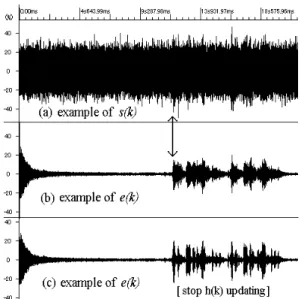
the order number. Fig.2 shows the waveform examples of s(k) and e(k). Waveform (a) is an example of s(k). n(k)
Fig. 2. Waveform examples of s(k) and e(k)
is white noise and the S/N ratio of s(k) is approximately 3dB-0dB. Waveform (b) shows e(k). The arrow in (a) and (b) indicates the beginning point of the double talk period. The S/N ratio of e(k) is secured more than 20dB and noise is sufficiently eliminated. However, several unnatural en-velopes are observed after power peaks in the waveform (b). Consequently, an excessive echo is added.
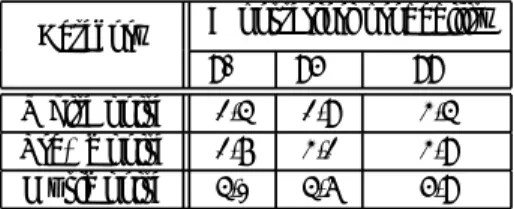
Voice is a desirable signal for users, but it is an error signal for the system. The noise canceller feedbacks wrong data to h(k) in order to reduce the error(voice signal). e(k) waveform in which the double talk period is given manually and updating is stopped in the double talk period is shown in (c) of Fig.2. In waveform (c), the natural start and stop of the voice signal can be observed. Moreover, the echo is limited and a natural voice can be obtained. The results obtained from a survey regarding the voice quality for both data in which echo path updating is suspended while double talk like(c) and data without double talk detection like(b) is shown in Fig.3.
Fig. 3. Opinion test result for voice quality
Regardless of the noise category, the evaluation results show that the data obtained with suspending echo path updating during double talk is better than the data obtained without
double talk detection. In terms of a practical system, the double talk must be detected automatically not manually. Although many double talk detection methods have been studied, no perfect system has been reported. Most methods aim at the power or correlation of n(k), s(k) or e(k) and detect the double talk when the value exceeds the threshold. On the other hand, the waveform of s(k) and e(k) when the echo path changes shown by Fig.4 are similar to that of the double talk period. Then it is difficult to distinguish the double talk and the change of the echo path.
Fig. 4. Waveform of s(k) and e(k) when echo path changes(echo path changes four times-indicated by ar-rows)
3. Conventional researches
Adaptive noise cancellers and acoustic echo cancellers have been studied on the same theoretical basis - adaptive filter theory. Many conventional researches for double talk detec-tion have been applied for acoustic echo cancellers. In the case of acoustic echo cancellers, n(k) in Fig.1 is the voice sig-nal of tele-conference users. However, n(k) is the reference noise input in adaptive noise cancellers.
The conventional researches are classified into time domain processing[8] and frequency domain processing[9]. Time do-main processing uses duration or power level. Frequency domain processing observes correlation coefficients in order to detect double talk. In the case of the duration, by using the stochastic characteristic of human voice duration, the system can detect the double talk when extraordinary dura-tion is observed. In the case of correladura-tion, it is possible by observing smaller correlation coefficients between n(k) and s(k) than the threshold value. However, those techniques are not successfully for adaptive noise cancellers because n(k) is high level noise especially continuous noise. Apparently du-ration is not useful and correlation is not effective when the power level of n(k) is very high.
Such situation means other parameters should be studied. In this research, the power change of the voice signal in the dou-ble talk period is experimentally verified to be different from the power change during echo path changing. In addition, a method of discriminating the double talk and the echo path change is proposed. First of all, a voice signal and the re-maining error signals are collected, and the histograms of the power change value between frames are obtained. Using the histograms, the voice signal probability (a posteriori
proba-bility) of the data whose category is unknown and the given power change value are studied. The voice signal probability means the double talk probability. The double talk detec-tion method is proposed in this case because it judges the data and determines that the beginning frame of the voice is where a posteriori probability exceeds the fixed threshold. The accuracy of this double talk detection method is evalu-ated compared with the conventional method, which detects the double talk by using only the power level.
4. Power change in the double talk and echo path changing period
Discriminating the double talk period and the echo path changing period was shown to be important in the previous section. In this section, the following conditions are studied in order to attain the goal.
(1) Power level of e(k) is small enough while double talk does not exit after the converging of h(k).
(2) Causes of echo path change are the moving of the noise source, microphone and speaking persons. Then the changing rate is low(100ms-1s).
(3) Power change of the voice signal depends on the speech speed(20ms-100ms), then it is faster than the case of echo path change.
Therefore, the period where only a reference noise exists can be detected using the power level threshold under condition (1), and it is expected that echo path changing and double talk are discriminated using the threshold for power change under condition (2) and (3). This section studies the stochas-tic characterisstochas-tics of power change while changing the period of the echo path and the double talk period, then verifies the possibility of discrimination between them[10].
4.1. Experimental conditions for training data col-lection
The measurement conditions of power change in the double talk period and the echo path changing period are shown in Table 1. Power data was measured in a room under Table 1. Measurement conditions of power change
Items Contents
Noise type ·White noise: 32.5s and data length ·Traffic noise: 43.0s (n(k)) ·Music noise: 37.6s Double talk data Voice and white noise
Data length: 79.1s Method of echo path Moving a shield screen
changing near voice microphone Sampling frequency 11.025kHz
Quantization 16bit Frame length 18.14ms(200samples) Measured data Power and Power change
(dB) of 3 kinds of noise and voice data in the
error signal e(k) Calculation method LMS algorithm
Fig. 5. Experiment environment
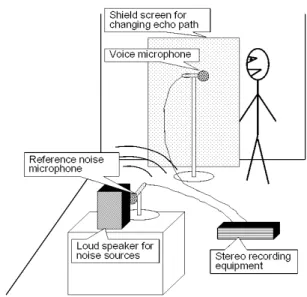
the conditions described in Fig. 5. Two audio signals from a reference noise microphone and a voice microphone were recorded simultaneously using stereo recording equipment. When the echo path must be changed, the shield screen is moved.
4.2. Results of the experiment
Fig.6 shows the histogram of power change of the noise and voice data. Each data represents a difference in the power value between two bounded frames. The average and the
Fig. 6. Histogram of power change
standard deviation are shown in Table 2. The average of Table 2. Average and standard deviation of each category
Category Average Standard deviation White noise -0.00973 0.8968 Traffic noise -0.01350 1.0167 Music noise -0.01064 1.3697 Voice 0.00114 2.1702
each category is close to 0. However, the standard deviation is different for each category. The standard deviation of voice is the largest. This means the power change of the beginning
point and the ending point of voice is larger than that of any other category. In three kinds of noise data, the standard deviation of music noise is larger than that of the other two categories. White noise is the smallest. The S/N ratio for any category is close, therefore the stochastic characteristics of each category differs as shown.
4.3. Analysis of the power change data
In this section, when the category is unknown and the power change is given, a posteriori probability that the category is voice(means double talk) is introduced. The following con-ditions are supposed.
(a) Echo path(h(k)) is converged already. (b) Error noise is small.
(c) In this situation, the double talk or echo path change is detected using the power level.
(d) The a priori probabilities of double talk and echo path change are the same.
According to item(c), the system should judge whether a double talk or echo path change has begun. Here, several variables are defined.
Edt Event where double talk appears.
Eep Event where an echo path change appears.
Opc pc is power change data which means the power
dif-ference between the frame and the previous frame. Opc
is the event where the power change data is pc. Simultaneous probability of event Edt and Opcis expressed
as the formula,
P r(Edt∩ Opc) = P r(Opc|Edt)P r(Edt)
= P r(Edt|Opc)P r(Opc) (4)
Using the Bayesian rule, P r(Edt|Opc) =
P r(Opc|Edt)P r(Edt)
P r(Opc)
(5) The denominator is rewritten as following,
P r(Edt|Opc) =
P r(Opc|Edt)P r(Edt)
P r(Opc|Edt)P r(Edt) + P r(Opc|Eep)P r(Eep)
(6) A priori probabilities are the same under condition (d),
P r(Edt|Opc) =
P r(Opc|Edt)
P r(Opc|Edt) + P r(Opc|Eep)
(7) P r(Opc|Edt) and P r(Opc|Eep) can be obtained by Fig.6.
Therefore, P r(Edt|Opc) is calculated using the formula(6)
and Fig.6. The result of the calculation is shown in Fig.7. The calculated threshold values of the power change using Fig.7 are shown as Table.3. At the same accuracy(a posteri-ori probability), for example 99%, the beginning point of the double talk can be detected by observing the 3.4dB power change in the case of voice with white noise. However, in the case of music noise, it is necessary to detect 5.9dB power change. As a result of the difference, misdetection increases for voice with music noise. In the case of voice with traffic noise, double talk detection accuracy is the middle between white noise and music noise.
Fig. 7. A posteriori probability of double talk
Table 3. Threshold of power change value for detecting the beginning point of double talk(dB)
Category A posteriori probability 90% 95% 99% White noise 2.4 2.9 3.4 Traffic noise 2.7 3.2 3.9 Music noise 4.1 4.6 5.9
5. Double talk detection method
In the previous section, the stochastic basis in order to ob-tain the double talk detection method is described. In this section, the specific method is introduced.
Double talk detection is composed of two modules. One is to detect the beginning point of the double talk and the other is to detect the end point of the double talk. The theoreti-cal ground behind detecting the beginning point has already been discussed. In the case of detecting the beginning point, before beginning double talk, the power level is low enough, therefore, the threshold value of the power change can be set according to the method described in the previous discus-sion.
On the other hand, while searching the ending point, the state is in a double talk period itself, then, the power level is high and unstable. In such a situation the power change information is not useful.
In order to solve the problem, a method that uses differ-ent data between the detection of the beginning point and the ending point of the double talk is proposed. For the beginning point, the power change is used according to the discussed method, and for the ending point, the threshold power level is obtained using the data before the beginning point is introduced.
The threshold for the ending point is set as 3dB plus the low-est value among the 50 frames before the beginning point. A common value is used as the threshold for detecting the beginning point. It is set using a desirable a posteriori prob-ability and the Fig.7. On the other hand, the ending point is established dynamically. Furthermore, the threshold for ending point detection is determined using voice data before
the beginning point. This is done to avoid setting an abnor-mally large value when an unexpectedly long voice exists. However, after stop the updating the adaptive filter by tecting the beginning point, if the end point cannot be de-tected, the situation produces the problem that system can-not restart the updating the adaptive filter. In order to avoid the problem, when the end point was not detected within the fixed time, the new method restarts the updating automati-cally.
6. Evaluation of the new double talk detection method
In this section, the new double talk detection method pro-posed in the previous section is evaluated. The evaluation experiment consists of two items.
(i) Accuracy of double talk detection Probability that the double talk is detected correctly when double talk oc-curs.
(ii) Accuracy of echo path change detection Probability that the echo path change is detected correctly when an echo path change occurs.
The experiment environment is the same as that of the train-ing data collection shown in Fig.5.
6.1. Accuracy of double talk detection
In this section, the accuracy of double talk detection is eval-uated in the case where the evaluation data does not contain an echo path change. The evaluation result is shown in Ta-ble 4 and Fig.8. The evaluation data is open and different from the training data collected in section4..
The detection accuracy in Fig.8 is obtained using the ob-served data and the following calculation.
DetectionAccuracy = CorrectlyDetectedF ramesN umber T otalF ramesN umber This evaluation data has no echo path change. It has a noise period and a double talk period. Then this evaluation rep-resents the detection accuracy when the double talk occurs. Table 4. Result of double talk detection accuracy ( Frame length is 18.14ms)
Items Noise Category
White noise Traffic noise Music Data length(s) 54.50 48.10 48.09 Frame number 3005 2652 2651
Correct 2809 2332 2258
frame number
Accuracy(%) 93.5 88.0 85.2
The accuracy obtained in white noise is the best, in traffic noise is the next best and in music noise is the worst. This result is also expected using the data of Fig.7. However, this accuracy is almost the same as that of the conventional method (using the power level) because the updating of the echo path is converged and the background noise is small enough. This means that the next experiment, which detects the echo path change, has become more important.
Fig. 8. Accuracy of double talk detection
6.2. Accuracy of echo path change detection
This section describes the detection accuracy when the echo path changes. The evaluation result is shown in Table 5 and Fig.9. The evaluation data is also open and different from the training data collected in section4.. The detection error Table 5. Result of echo path change detection accuracy
Items Noise Category
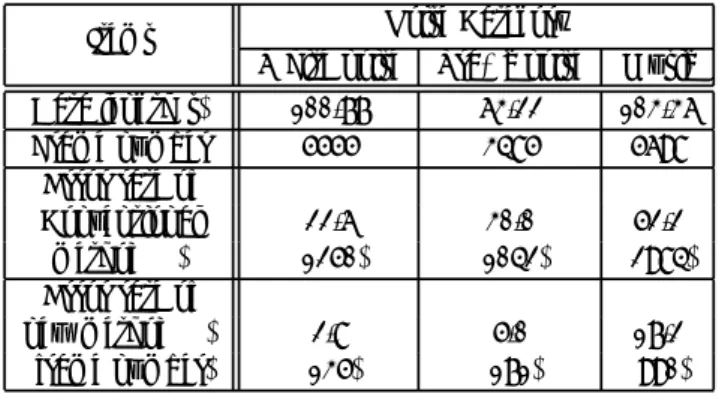
White noise Traffic noise Music Data length(s) 100.77 63.22 103.36 Frame number 5555 3485 5698 Error rate of Conventional 22.6 30.0 52.2 method(%) (1250) (1042) (2984) Error rate of new method(%) 2.8 5.0 17.2 (frame number) (135) (171) (990)
Fig. 9. Detection error of echo path change
rate in Fig.9 is obtained using the observed data and the following calculation.
DetectionErrorRate =ErrorF ramesN umber T otalF ramesN umber This evaluation data has no double talk. It has a noise period and an echo path changing period. Therefore this evaluation indicates the error rate when the echo path change occurs.
Among the three noise categories, the new method is better than the conventional method, which uses only the power level. It was proven that the idea of using the stochastic characteristics of power change is useful and robust. How-ever, the detection ability is not stable. It depends on the noise category. In the case of white noise and the traffic noise, the detection error of echo path changing, is small. However, in the case of music noise, the difference between the new method and the conventional method is not suffi-ciently large. The reason is that the power change in music is large compared to that of the other two kinds of noise. It is a future subject to be investigated in order to improve the double talk detection ability in music noise.
7. Conclusion
This paper proposes a new double talk detection method of distinguishing from an echo path change using the power change between two adjacent frames. The method is evalu-ated using mixed signals, which include voice and three kinds of noise; white noise, traffic noise and music noise. The eval-uated items are the accuracy of double talk detection and the detection error of the echo path change. The new method was confirmed to be better than the conventional method in the three noise categories.
References
[1] B. Widrow, J. R. Glover, “Adaptive noise canceling: principles and applications,” Proc. IEEE, 63, 12, pp.1692-1716, 1975.
[2] W. A. Harrison, S. J. Lim, E. Singer,“A new application of adaptive noise cancellation,” IEEE Trans. on Acoustics, Speech and Signal Processing, ASSP-34, pp. 21-27, 1986. [3] Liem M, Manck O,“Architecture of a Single Chip
Acous-tic Echo and Noise Canceller Using Cross Spectral Esti-mation,” Proc ICASSP, Vol.2003, No.Vol.2, PageII.637-II.640, 2003
[4] B. Widrow, S. Sterns,“Adaptive Signal Processing,” Prentice-Hall, 1985.
[5] Simon Haykin,“Adaptive Filter Theory Third Edition,” Prentice Hall, 1996.
[6] J. Nagumo, A. Noda,“A learning method for system identification,” IEEE Trans. on Automat. Control, Vol. AC-12, no. 3, pp.282-287, June 1967.
[7] T. Usagawa, H. Matsuo, Y. Morita, M. Ebita,“A New Adaptive Algorithm Focused on the Convergence Char-acteristics by Colored Input Signal: Variable Tap Length LMS,” IEICE Trans. Fundamentals, Vol. E75-A, 11, 1992. [8] S. Ninami and T. Kawasaki,“A Double Talk Detection Method for an Echo Canceller”, ICC’85 REC., pp.1492-1497, 1985.
[9] T. Gaensler and J. Benesty, “A Frequency-Domain Double-Talk Detector Based on a Normalized Cross-Correlation Vector”, Signal Process, Vol.81, No.8, pp.1783-1787, 2001.
[10] H. Nishi and M. Kitai,“Analysis and Detection of Dou-ble Talk in Telephone Dialogs,” Proc. ICSLP94, S27-11.1, 1623-1626, 1994.