P1-78 / M.-R. Choi
IMID 2009 DIGEST •
Abstract
We achieved high efficiency and long lifetime in small-molecule organic light-emitting diodes using a blend of polyaniline-based conducting polymer and a perfluorinated ionomer as a hole injection layer (HIL). The HIL formed by single spin coating greatly enhanced the surface work function and thus the hole injection from the anode, which resulted in great improvement in device luminous efficiency. We find that the solution processed HIL outperforms the conventional vacuum-deposited small molecule HIL in terms of the device performance.
1. Introduction
As a front runner for the next generation of display, organic light-emitting diodes (OLEDs) have plenty of potential for ultra-thin and flat panel display. Achieving high-efficiency and long-lifetime devices is still one of the most crucial issues for realizing high performance OLEDs. Since the conventional anode of indium-tin-oxide (ITO) possesses relatively low work-function (WF) (~4.9 eV), the new hole-injection layer (HIL) with higher work-function is required for efficient hole injection. Conventionally, small molecules such as CuPc (Ionization potential (IP)= 5.0 eV), MTDATA (IP=5.1eV) and 2TNATA (IP=5.1eV) and conducting polymers such as PEDOT:PSS (WF=5.2eV) were employed as HILs. However, there is still a high hole-injection barrier. Here we used
blends of polyaniline (PANI)-based conducting polymer (PANI/PSS and PSS-g-PANI) with a perfluorinated ionomer (PFI) as HILs in small molecule OLEDs. Our devices using the new HILs achieved higher efficiency and longer lifetime in small molecule OLEDs compared with the devices with the conventional HILs.
2. Experimental
The hole-injection layers (PEDOT/PSS, PANI/PSS, PANI/PSS/PFI, PSS-g-PANI, PSS-g-PANI/PFI) were spin-coated on top of indium-tin-oxide (ITO)/glass in 40~60nm thickness. PEDOT/PSS, g-PANI, PSS-g-PANI/PFI baked on the hotplate in air at 200℃ for 10min and in N2 glove box at 200℃ for 10min in
sequence. PANI/PSS, PANI/PSS/PFI baked at 150℃ in the same way. Then NPB, Bebq2:C545T, Bebq2, Liq, Al were sequentially deposited on the hole-injection layers under vacuum below 5X10⁻⁷Torr. The devices were encapsulated with a glass lid by using a UV-curable epoxy resin.
The current-voltage-luminescence (I-V-L) charac-teristics were obtained with a Keithley 236 source measurement unit and a Minolta CS2000 Spectroradiometer. The device lifetime was recorded by using a McScience Polaronix OLED Lifetime Test System.
Polymeric hole-injection layer for high-efficiency and
long-lifetime in organic light-emitting diodes
Mi-Ri Choi
1*, Tae-Hee Han
1, Seong-Hoon Woo
1, Kyung-Geun Lim
1, Won
Min Yun
2, Oh Kwan Kwon
2, Chan Eon Park
2, Hoon-Kyu Shin
3, Dal Ho
Hur
4, Kyoung-Hwan Shin
5, Jyongsik Jang
5, Tae-Woo Lee
11Dept. of Materials Science and Engineering, Pohang University of Science and
Technology (POSTECH), San 31 Hyoja-Dong, Nam-Gu, Pohang, Gyeongbuk 790-784, Korea
Phone: +82-10-8781-2354 , E-mail: [email protected]
2Dept. of Chemical Engineering, Pohang University of Science and Technology
(POSTECH), San 31 Hyoja-Dong, Nam-Gu, Pohang, Gyeongbuk 790-784, Korea
3National Center for Nanomaterials Technology, Pohang, Gyeongbuk, Korea 4Research Institute of Chemical & Electronic Materials, Cheil Industries INC, 332-2,
Gocheon-dong, Uiwang-si, Gyeonggi-do 437-711, Korea
5School of Chemical and Biological Engineering, Seoul National University, Seoul
151-742, Korea
Keywords : Organic Light-Emitting Diode(OLED), Conducting Polymer, Hole-Injection layer
P1-78 / M.-R. Choi
• IMID 2009 DIGEST
3. Results and discussion
Figure 1 shows our schematic device structure of ITO/HIL/NPB/Bebq2:C545T/Bebq2/Liq/Al. We newly formulated the conducting polymer compositions composed of PANI:PSS(1:6) and PFI, and novel self-doped conducting polymer compositions composed of PSS-g-PANI and PFI. We employed the composition as the HIL. And we compared polymeric HILs with a conventional small molecule HIL (2TNATA) in small molecule OLEDs.
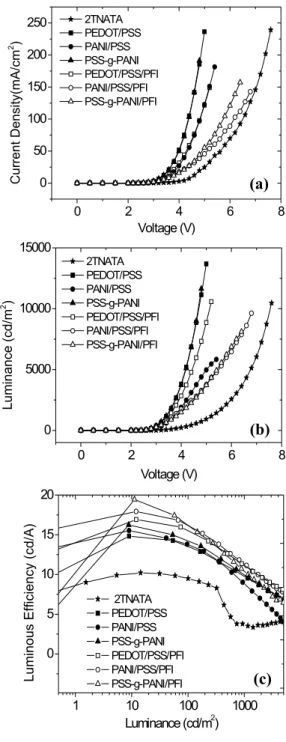
Figure 2(a) shows the current density versus voltage characteristics with varying the HILs in the green OLEDs. The device with polymeric HILs showed higher current density compared with that with a small molecule HIL (2TNATA). When the polymeric HILs are blended with large amount of PFI, the current density tends to be lowered which can be attributed to the efficient electron-blocking capability of the PFI surface layer. The luminance versus voltage characteristics shown in Figure 2(b) also showed the same trend as the current density versus voltage characteristics.
Devices using conducting polymers (PEDOT/PSS, PANI/PSS) and polymers/PFI (PEDOT/PSS/PFI, PANI/PSS/PFI, PSS-g-PANI/PFI) blends produced much higher luminous efficiency than that using the small molecule HIL in Figure 2(c). The device using the small molecule HIL (2TNATA) showed ~10 cd/A. However, when using conducting polymers as the HIL, higher efficiencies (PEDOT/PSS:~15cd/A, PANI:PSS:~15.5cd/A) were obtained and in the case of PSS-g-PANI, a little higher maximum luminous efficiency was obtained (~16cd/A). When devices were fabricated by using conducting polymer/PFI blends, much higher luminous efficiencies were achieved. By spin coating of the blend of conducting polymer and PFI, preferentially resides at the surface by self-organization. The PFI surface layer increases the work function and thus facilitates the hole
injection and efficiently blocks the electrons. The efficient hole injection and electron-blocking by the HILs with PFI can improve the charge carrier balance in devices. As a result, we achieved very high luminance efficiency (~ 20 cd/A) from the device using PSS-g-PANI/PFI.
In addition, we observed the device lifetime which is very crucial for commercialization of OLEDs for
Figure 1. Schematic device structure
0 2 4 6 8 0 50 100 150 200 250 C u rr ent Densi ty(mA/ cm 2 ) Voltage (V) 2TNATA PEDOT/PSS PANI/PSS PSS-g-PANI PEDOT/PSS/PFI PANI/PSS/PFI PSS-g-PANI/PFI 0 2 4 6 8 0 5000 10000 15000 Lumi nanc e (cd/ m 2 ) Voltage (V) 2TNATA PEDOT/PSS PANI/PSS PSS-g-PANI PEDOT/PSS/PFI PANI/PSS/PFI PSS-g-PANI/PFI 1 10 100 1000 0 5 10 15 20 Lu mi no us Ef fic ie nc y (c d/A) Luminance (cd/m2) 2TNATA PEDOT/PSS PANI/PSS PSS-g-PANI PEDOT/PSS/PFI PANI/PSS/PFI PSS-g-PANI/PFI
Fig. 2. (a) current density, (b) luminance, and (b) luminous efficiency of OLED devices according to hole injection layers.
(b) (a)
P1-78 / M.-R. Choi
IMID 2009 DIGEST • light-emitting panel displays and solid-state lighting.
In terms of the device lifetime, the devices using the newly reformulated composition with PFI outperform the device using the small molecule HIL. The half- lifetime of the device using conducting polymers was improved compared with the half-lifetime of the device using 2TNATA. At 2000cd/m2, the half-lifetime of PEDOT/PSS is 12h, PANI/PSS is 5h, PSS-g-PANI is 56h and 2TNATA is 2h. The half-lifetime of the device using the blends of conducting polymer and PFI was dramatically improved. At 2000cd/m2, the half-lifetime of PEDOT/PSS/PFI is 300h, PANI/PSS/PFI is 94h and PSS-g-PANI/PFI is 84h.
This improved device lifetime can be attributed to the improved charge balance and the efficient blocking of In and Sn migration from the ITO into the emitting layer by the PFI.
4. Summary
We used the conducting polymers (PEDOT/PSS, PANI/PSS and PSS-g-PANI) and the blends of conducting polymer and PFI as a hole-injection layer instead of a small molecule HIL in OLED devices. Comparing to a small molecule OLED using small molecule HIL, polymeric HILs improved the luminous efficiency and lifetime because of the charge balance and efficient prevention of atomic migration from the ITO to the emitting layer. Finally, we can conclude that these kinds of conducting polymer compositions can be a very good candidate to replace the conventional small molecule HIL for better device performance despite the low cost and the simple process.
5. References
1. G. W. Scherer, J. Am. Ceram. Soc., 73[11], 3 (1990). 2. H. J. Kim and J. S. Im, SID’05 Technical Digest,
Vol. 1, p.401 (2005).
1. T.-W.Lee, et al., Adv. Funct. Mater., 17, (2007), 390
2. T.-W.Lee, et al., Adv. Funct. Mater. 18, (2008), 2246
3. Jyongsik Jang, et al. Thin Solid Film 516 (2008) 3152
4. Kaushik Roy Choudhury, et al., Adv. Funct. Mater., 19, (2009), 49