J Korean Acad Community Health Nurs (지역사회간호학회지) http://dx.doi.org/10.12799/jkachn.2015.26.3.303
Factors associated with Patient Activation for Self-management
among Community Residents with Osteoarthritis in Korea
Ahn, Yang Heui1 · Kim, Bong Jeong2 · Ham, Ok Kyung3 · Kim, Seong Hoon4 1Department of Nursing, Yonsei University Wonju College of Medicine, Wonju
2Department of Nursing, Cheongju University, Cheongju 3Department of Nursing, Inha University, Incheon
4Department of Rehabilitation, Yonsei University Wonju College of Medicine, Wonju, Korea
Purpose: The purpose of this study was to survey patient activation for self-management and to identify factors
associated with patient activation for self- management among community residents with osteoarthritis in Korea.
Methods: Cross-sectional study design was used. Survey data were collected from 270 community residents with
osteoarthritis through direct interviews. Studied factors included patient activation, joint pain, physical function, depression, and general characteristics. Data were analyzed using chi-squared test, t-test and multivariate logistic regression analysis. Results: The participants’ mean score of patient activation was 56.0±16.61. The mean score of each factor was 10.6±5.89 for joint pain, 5.5±3.56 for physical function, and 19.3±10.01 for depression. The patient activation level was significantly associated with depression and general characteristics such as educa-tion, religion, comorbid hypertension, and use of medical clinics (p<.05). Conclusion: The findings suggest that depression, education, religion, comorbid hypertension, and use of medical clinics may be important factors to be considered when developing programs of patient activation for self-management. This is the first study that measured patient activation, and further studies are suggested to find factors associated with patient activation for self-management among community residents with other chronic diseases.
Key Words: Self-management, Osteoarthritis, Patient
Corresponding author: Ahn, Yang Heui
Department of Nursing, YonseiUniversity Wonju College of Medicine, 20 Ilsan-ro, Wonju 26426, Korea. Tel: +82-33-741-0383, Fax: +82-33-743-9490, E-mail: [email protected]
- This work was supported by Basic Science Research Program through the National Research Foundation of Korea(NRF) under Grant by the Ministry of Education, Science and Technology(2012-8-5261).
Received: Aug 29, 2015 | Revised: Sep 21, 2015 | Accepted: Sep 23, 2015
This is an open access article distributed under the terms of the Creative Commons Attribution Non-Commercial License (http://creativecommons.org/licenses/ by-nc/3.0), which permits unrestricted non-commercial use, distribution, and reproduction in any medium, provided the original work is properly cited.
INTRODUCTION
Worldwide, the prevalence of symptomatic osteo-arthritis is 9.6 % in men and 18.0 % in women aged 60 years or over and 80 % of those people with osteo-arthritis (OA) have mobility limitations and 25 % cannot perform major activities of daily life[1]. In Korea, the prevalence of OA was 5.1 % in men and 18.9 % in wom-en aged 50 years or over in the 2010~2013 Korea Natio-nal Health and Nutrition Examination Survey (KNHANES VI-1)[2].
OA is the most common form of arthritis and is a potentially debilitating disorder that can result in
func-tional impairment and reduced independence in older adults, and in enormous societal and financial burdens in terms of lost earnings, health care costs, and reduced quality of life[3]. However it is often overlooked be-cause the disease characteristics accompany the aging process. For the management of OA, the American Academy of Orthopedic Surgeons strongly recommend-ed patient participation in self-management (SM) pro-grams based on evidence[4]. SM refers to disease related tasks and skills with self-efficacy for managing their chronic conditions. OA patients have to become effec-tive managers of their own health to control of modifi-able risk factors such as sedentary lifestyle and
unheal-thy diet, so that they need to be activated to take re-sponsibility for their own health care. Therefore patient activation for SM is considered as an increasingly im-portant component of strategies to improve chronic ill-ness care[5]. Patient activation for SM is defined as a construct that describes skills, beliefs, motivation, and behaviors that enable an individual to actively partic-ipate in his/her own health care[6]. More highly acti-vated patients believe that their role in managing their health is important, have knowledge and confidence to act appropriately and will act to maintain or improve their health. Empirical studies indicate that people who are more activated are significantly morelikely to en-gage in self-management compared with people who score lower on activation scales[7,8]. Also patient activa-tion is related to health status or health outcomes in chronic diseases such as better physical and mental functioning[8], glucose control[9], blood pressure con-trol[7,10], and less depression[11]. People with multiple chronic conditions tend to have lower activation scores compared to people with only a single chronic dition[12], which indicates that having multiple con-ditions may necessitate greater self-management and more careful monitoring of one’s health. Activation lev-els were especially higher for people at a younger age, men, people with higher education and incomes[13]. In nursing, only one research was found, in which patient activation was evaluated as a self-management elements [14].
Patient activation for SM has been studied in patients with chronic diseases in USA and other countries, but it has not yet been studied in Korean patients. Although nursing research on self-management of Korean pati-ents with arthritis have been studied since 1990s includ-ing exercise or self-help education program[15,16], how-ever nhow-ever approached in aspect of patient activation. As described above, prior studies have shown that patient activation is related to self-management behaviors, health status/health related outcomes and socio-demographics [7-13]. Understanding patient activation for SM enables nurses to coach patients for enhancing their healthcare and health outcomes. Therefore, identifying factors asso-ciated with patient activation will be helpful evidence in designing intervention strategies to stimulate increases in activation among patients with chronic conditions. The purpose of this study was to describe patient activation for SM and to identify factors associated with patient ac-tivation for SM among community residents with osteo-arthritis.
METHODS
1. Design and SampleA cross-sectional survey design was employed. A convenience sample of 270 osteoarthritis patients was recruited from the three Community Health Posts lo-cated in W city, Korea. Using G*Power 3.1.2 program, a sample size of 265 cases was calculated to have a .90 ef-ficacy in detecting small effect size at the 5% level of sig-nificance in two-tailed t-test analysis, indicating that the number of participants in this study was sufficient. The sampling inclusion criteria were (a) 40 years or older,(b) able to communicate using Korean,(c) doctor-diagnos-ed osteoarthritis, and (d) willingness to participate in this study. Exclusion criteria were (a) other severe phys-ical pain besidejoint pain,(b) a cognitive impairment or psychiatric disease, and (c) artificialjoint implants.
This study was approved by the Institutional Review Board of the Yonsei university (YWNR-12-0-003). Pati-ents were asked if they were willing to participate in the survey study. Benefits and risks of participation were discussed; patients agreeing to participate were pro-vided informed written consents that included con-fidentiality and authorization to use and release health information. Data were collected by research assistants in January and February 2013, using face-to-face inter-views during home visits.
2. Measures
p atient activation was measured using the Korean version of the 13-item Patient Activation Measure (PAM 13-K) which is a scale assessing patients’ knowledge, skills, and confidence for self-management of a chronic disease[6]. PAM is a unidimensional Guttman-like meas-ure with a 4-point scale, structmeas-ured developmentally in a hierarchic order with four stages. PAM has strong psy-chometric properties and has been shown to be a valid and reliable measure[12]. In Korea, translation and psy-chometric properties of the Korean version of PAM-13 have been validated using Rasch analysis, however the ranking according to the difficulty of items differed slightly from that in the original version[17]. Four pos-sible responses on PAM13-K range from strongly dis-agree to strongly dis-agree. Items with a response of ‘not applicable’ or with no response were scored as "mis-sing". Based on responses to the 13-item measure, each participant was assigned an activation score that could be converted to a score ranging from 0 to 100[12].
Pre-vious studies reported the PAM 13 items as having a Cronbach’s ⍺ of .87[13]. The ⍺ coefficient of the PAM 13-K in the current study was .88. PAM was used after permission from Insignia Health Inc.
Joint pain was measured using the Korean Western Ontario and McMaster Universities Osteoarthritis Index (K-WOMAC), a specific measure assessing pain, stiffness, and physical function in patient with osteoarthritis in the hip or knee[18]. In the current study, the 7 items of the K-WOMAC were selected to measure self-reportedjoint pain and stiffness. Each item is scored on a 5-point Likert scale (0=none, 1=slight, 2=moderate, 3= severe, 4=ex-treme) with total scores ranging from 0 to 28, and a high-er score indicating greathigh-er pain. A previous study re-ported the K-WOMAC 7 items as having a Cronbach’s ⍺ of .81[19]. The Cronbach's ⍺ for this study was .89.
p hysical function was measured using the Korean version of 8-item Stanford Health Assessment Question-naire Disability Scale (HAQDS) to assess arthritis health outcomes[20]. It was translated into Korean and a blind back-translation was performed by independent bilin-gual nurse scholars. This is a short version of the 22- item disability scale in the Stanford Health Assessment Questionnaire, in which items have been chosen to rep-resent use of every major joint in the body. There are 4 possible responses for each question: 0=without any difficulty; 1=with some difficulty; 2=with much diffi-culty; and 3=unable to do. Possible scores range from 0 to 24 with higher scores on the HAQDS representing more severe disability in physical function. The Cron-bach's ⍺ for the original instrument was .85[20], and for the current study, .85.
Dep ression was measured using the Korean Center for Epidemiologic Studies Depression Scale (K-CES-D), which was translated and tested for reliability and val-idity by Cho and Kim[21]. The 20 items are rated on a 4-point Likert scale (0=almost none, 1=1 to 2 days per week, 2=3 to 4 days per week, and 3=5 to 7 days per week) as a measure of frequency of symptoms experi-enced during the past week. Three items with negative meanings were reverse coded for statistical analysis. Possible scores ranged from 0 to 60 with higher scores representing more symptoms of depression. The Cron-bach’s ⍺ for Seo et al’s study[22] was .85 and for the current study, .85.
General characteristics included gender, age, educa-tion, religion, occupaeduca-tion, marital status, living with family, type of health insurance, comorbidities, and use of medical clinics. Comorbid diseases were limited to the most prevalent diseases including hypertension,
diabetes, cardio-vascular disease, and use of medical clinics was measured whether or had been seen by a doctor once or more during the past 6 months.
3. Analytic Strategy
Data were analyzed using PASW Statistics 20.0 for Windows (SPSS Inc, Chicago, IL, USA). Descriptive sta-tistics were used to describe the distribution of the study variables. x2
test or t-test was used to analyze the associ-ation or differences between general characteristics or health status (joint pain, physical function and depres-sion) and patient activation level. Multivariate logistic regression analyses were conducted to analyze factors associated with patient activation level. Patient activa-tion level was divided into two categories (low & high) using the PAM mean score (56.0) as the cut-off point be-cause of inconsistencies with the original hierarchic order. Dummy variables were created for categorical covariate variables. Statistical significance was deter-mined at the .05 probability level.
RESULTS
1. Descriptive Statistics of Study Variables
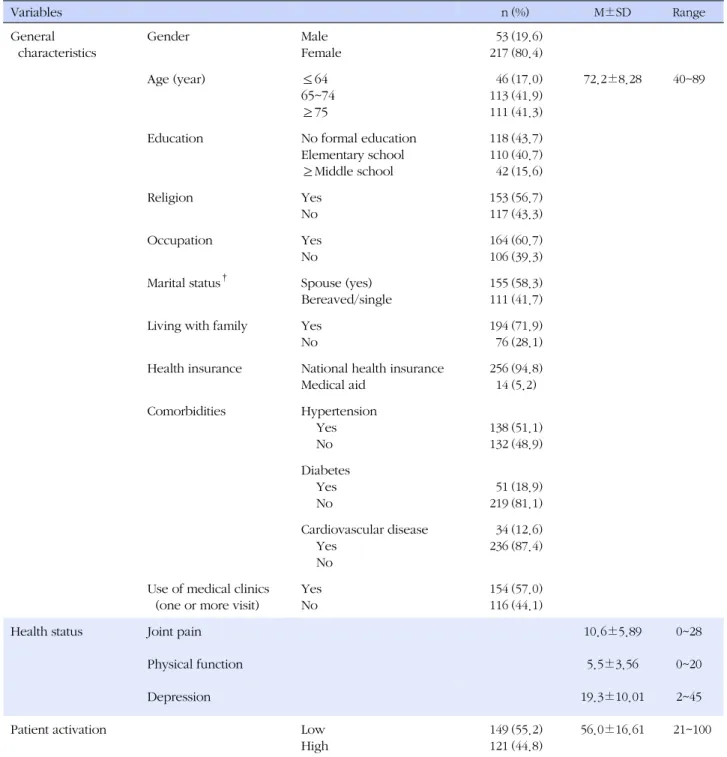
The majority of the participants were women (80.4%), and the mean age of the participants was 72.2±8.28 years old, with those aged 65 or older constituting 83.2%. Of the participants, 43.7% had no formal education, 56.7% were religious and 60.7 % were employed. 58.3% of the participants were married (had spouses) and 71.9% were living with their family members such as spouse or children. Most respondents (94.8%) were en-rolled in the National Health Insurance. Comorbid chron-ic diseases included hypertension (51.1%), diabetes (18.9%), and cardiovascular disease (12.6%). Fifty seven percent visited medical clinics for symptomatic osteo-arthritis once or more during the past 6 months (Table1).
Regarding health status, the mean scores were; joint pain, 10.6±5.89, physical function, 5.5±3.56, depres-sion, 19.3±10.01. The mean score of patient activation was 56.0±16.61 and 55.2% of the participants were at a low level of patient activation, while 44.8% were at a high level of activation (Table 1).
2. Differences in Patient Activation Level by General Characteristics and Health Status
pa-Table 1. Descriptive Statistics of Study Variables (N=270) Variables n (%) M±SD Range General characteristics Gender Male Female 53 217 (19.6) (80.4) Age (year) ≤64 65~74 ≥75 46 113 111 (17.0) (41.9) (41.3) 72.2±8.28 40~89
Education No formal education
Elementary school ≥Middle school 118 110 42 (43.7) (40.7) (15.6) Religion Yes No 153 117 (56.7) (43.3) Occupation Yes No 164 106 (60.7) (39.3) Marital status† Spouse (yes)
Bereaved/single
155 111
(58.3) (41.7)
Living with family Yes
No
194 76
(71.9) (28.1) Health insurance National health insurance
Medical aid 256 14 (94.8) (5.2) Comorbidities Hypertension Yes No 138 132 (51.1) (48.9) Diabetes Yes No 51 219 (18.9) (81.1) Cardiovascular disease Yes No 34 236 (12.6) (87.4) Use of medical clinics
(one or more visit)
Yes No 154 116 (57.0) (44.1)
Health status Joint pain 10.6±5.89 0~28
Physical function 5.5±3.56 0~20
Depression 19.3±10.01 2~45
Patient activation Low
High 149 121 (55.2) (44.8) 56.0±16.61 21~100 †
Excluded missing data.
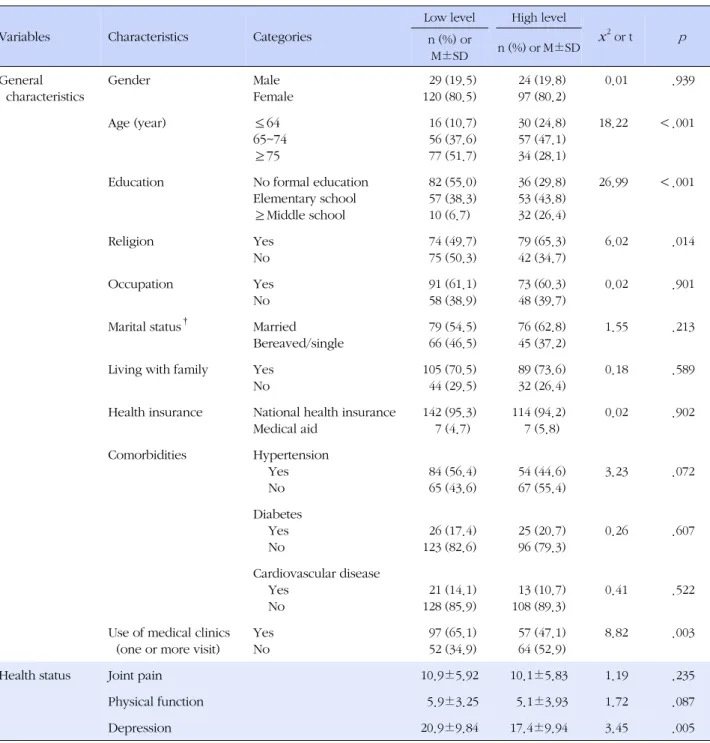
tient activation level by age, education, religion, use of medical clinics, and depression (Table 2). Patients aged under 64 years of age were more likely to have a high level of activation compared with patients aged 65 to 74 years and 75 years or older (x2=18.22, p <.001). For
ed-ucation, patients with middle school graduation or over were more likely to have a high level of patient activa-tion compared to patients with no formal educaactiva-tion or
only elementary graduates (x2=26.99, p <.001). Patients
with religious beliefs were more likely to have a high level of activation compared to patients with no religious beliefs (x2
=6.02, p =.014). Patients who had not been seen in medical clinics at least once or more during the past 6 months were more likely tohave a high level of ac-tivation compared with patients who had been seen in medical clinics in the past 6 months (x2
Table 2. Differences in Patient Activation Level by General Characteristics and Health Status (N=270)
Variables Characteristics Categories
Low level High level x2 or t p n (%) or M±SD n (%) or M±SD General characteristics Gender Male Female 29 (19.5) 120 (80.5) 24 (19.8) 97 (80.2) 0.01 .939 Age (year) ≤64 65~74 ≥75 16 (10.7) 56 (37.6) 77 (51.7) 30 (24.8) 57 (47.1) 34 (28.1) 18.22 <.001
Education No formal education
Elementary school ≥Middle school 82 (55.0) 57 (38.3) 10 (6.7) 36 (29.8) 53 (43.8) 32 (26.4) 26.99 <.001 Religion Yes No 74 (49.7) 75 (50.3) 79 (65.3) 42 (34.7) 6.02 .014 Occupation Yes No 91 (61.1) 58 (38.9) 73 (60.3) 48 (39.7) 0.02 .901
Marital status† Married
Bereaved/single 79 (54.5) 66 (46.5) 76 (62.8) 45 (37.2) 1.55 .213
Living with family Yes No 105 (70.5) 44 (29.5) 89 (73.6) 32 (26.4) 0.18 .589
Health insurance National health insurance Medical aid 142 (95.3) 7 (4.7) 114 (94.2) 7 (5.8) 0.02 .902 Comorbidities Hypertension Yes No 84 (56.4) 65 (43.6) 54 (44.6) 67 (55.4) 3.23 .072 Diabetes Yes No 26 (17.4) 123 (82.6) 25 (20.7) 96 (79.3) 0.26 .607 Cardiovascular disease Yes No 21 (14.1) 128 (85.9) 13 (10.7) 108 (89.3) 0.41 .522
Use of medical clinics (one or more visit)
Yes No 97 (65.1) 52 (34.9) 57 (47.1) 64 (52.9) 8.82 .003
Health status Joint pain 10.9±5.92 10.1±5.83 1.19 .235
Physical function 5.9±3.25 5.1±3.93 1.72 .087
Depression 20.9±9.84 17.4±9.94 3.45 .005
†Excluded missing data.
OA patients who had higher score of depression tended to be the least activated (t=3.45, p =.005). 3. Factors associated with Patient Activation Level
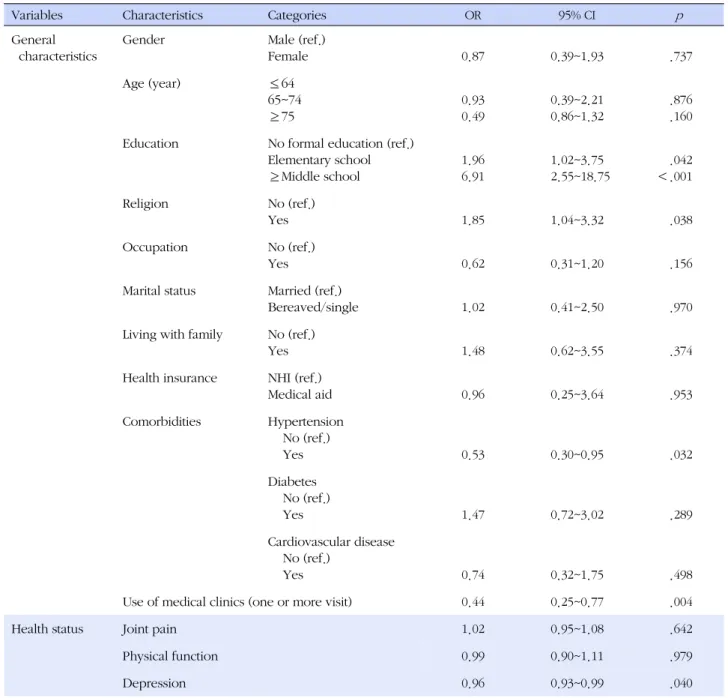
Multivariate logistic regression analysis including all independent variables was conducted to determine which variables were predictors of patient activation level (Table 3). In the model, the significant predictors
of patient activation level were education, religion, co-morbid hypertension, use of medical clinics, and depres-sion. Elementary school graduates and middle school graduates were 1.96 times (95% CI=1.02~3.75) and 6.91 times (95%, CI=2.55~18.75) respectively more likely to belong to the high level of activation group than those with no formal education. OA patients with a religious beliefs were 1.85 times (95% CI=1.04~3.32) more likely to belong to the high level of activation group than
Table 3. Factors associated with Patient Activation Level (N=270)
Variables Characteristics Categories OR 95% CI p
General characteristics
Gender Male (ref.)
Female 0.87 0.39~1.93 .737 Age (year) ≤64 65~74 ≥75 0.93 0.49 0.39~2.21 0.86~1.32 .876 .160
Education No formal education (ref.)
Elementary school ≥Middle school 1.96 6.91 1.02~3.75 2.55~18.75 .042 <.001 Religion No (ref.) Yes 1.85 1.04~3.32 .038 Occupation No (ref.) Yes 0.62 0.31~1.20 .156
Marital status Married (ref.)
Bereaved/single 1.02 0.41~2.50 .970
Living with family No (ref.)
Yes 1.48 0.62~3.55 .374
Health insurance NHI (ref.)
Medical aid 0.96 0.25~3.64 .953 Comorbidities Hypertension No (ref.) Yes 0.53 0.30~0.95 .032 Diabetes No (ref.) Yes 1.47 0.72~3.02 .289 Cardiovascular disease No (ref.) Yes 0.74 0.32~1.75 .498
Use of medical clinics (one or more visit) 0.44 0.25~0.77 .004
Health status Joint pain 1.02 0.95~1.08 .642
Physical function 0.99 0.90~1.11 .979
Depression 0.96 0.93~0.99 .040
Model fit -2Log likelihood=305.62, x2=60.97 (p<.001), Cox & Snell R2=.205, Nagelkerke R2=.274
ref.=reference; OR=Odds ratio; CI=Confidence interval.
those with no religious beliefs. OA patients with no co-morbid hypertension were 1.88 times (95% CI=0.30~ 0.95) more likely to belong to thehigh level of activation group than those with comorbid hypertension. OA pa-tients with no medical clinic use were 2.27 times (95% CI=0.25~0.77) more likely to belong to the high level of activation group than OA patients using medical clinics once or more during the past 6 months.
OA patients with a lower score for depression were 1.04 times (95% CI=0.93~0.99) more likely to belong to
the high level of activation group than those with a higher score for depression. Joint pain and physical function among variables of health status were not sig-nificantly associated with patient activation level. The Nagelkerke R2 value was 0.274 suggesting that the mod-el has predictive ability for patient activation levmod-el. There was no multicollinearity among independent vari-ables (tolerance, .304~.971; variance inflation factor, 1.030~3.267).
DISCUSSION
The results show that the mean score for patient acti-vation was 56.0±16.61, which is similar to that of pa-tients (average age of 61.9 years) with chronic con-ditions (56.8±10.00)[8], but lower than that of patients with diabetes (mean=62.7)[23] (average age of 62 years) and chronic conditions (mean=64.2) (age of 18 years over)[12]. The possible reasons for the difference of pa-tient activation in the current study may due to the age of the participants, older compared to those of previous studies or due to cultural differences or differences in the healthcare system.
Current study results indicate that patient activation is significantly associated with depression among varia-bles of health status and general characteristics such as education, religion, comorbid hypertension, and use of medical clinics. Regarding general characteristics, pa-tients with higher educational attainment were much more likely to have a higher level of patient activation for SM than counterparts, a finding consistent with a pre-vious study[7]. Patients’ educational background may be an important factor for nurses to assess and design for the strategies to enhance patient activation for SM. In the current study, patients with religious beliefs were more likely to have a high level of activation compared to patients with no religious beliefs. No research was found to support this result. Previous studies showed religious beliefs promote positive health behaviors or health care utilization[24,25], and patient activation is related to health behaviors or health outcomes[7-11]. So it could be guessed indirectly that religious beliefs may promote positive health behaviors or health care uti-lization through patient activation. Further studies need to confirm associations between patient activation and religious beliefs. The presence of comorbid hyperten-sion in the current study was associated with a lower level of patient activation, whereas diabetes and car-diovascular diseases were unrelated. Previous studies have reported that people with multiple chronic dis-eases tended to have lower activation scores compared to adults with a single chronic condition or without co-morbidity[12,26]. As the presence of comorbidities with-in the osteoarthritis patient population negatively im-pacts both physical functioning and pain, more aggres-sive teaching of self-management skills is needed for os-teoarthritis patients with comorbidities[12]. Further study is required to ascertain the relationship between patient activation for SM and comorbidities in this population. And the results of this study show that people using
medical clinics at least once or more for treatment of their symptomatic OA during past 6 months, had lower patient activation. This finding may be due to patients’ dependency on doctors or preference to get a prescrip-tion from a clinic rather than self-manage their disease. A similar finding from previous study was that patients with higher activation levels made fewer emergency de-partment visits[23]. Age and gender were also not re-lated to patient activation, which is inconsistent with previous studies reporting differences in patient activa-tion level by age and gender[8,13]. A skewed distribu-tion of gender and age in the current sample: 85.2% of the participants were 65 years or older adults and 80.4% of the participants were women may explain the differ-ences.
Among variables of health status, depression was as-sociated with patient activation level among patients with OA, consistent with findings for chronic conditions such as diabetes and hypertension[11,27]. PAM modi-fied for use in patients with mental health conditions (PAM-MH) has shown that higher activation was asso-ciated with greater recovery from mental health prob-lems[28]. Depression is common among people with painful osteoarthritis and concomitant depression is as-sociated with greater pain and disability among people with painful osteoarthritis[29]. Depressed patients with OA may be less likely to enhance activation and to par-ticipate in their self-management behaviors. Nurses should develop strategies to reduce depressive symp-toms in patients with OA, which in turn could increase patient activation levels. Unexpectedly, patient activa-tion level was unrelated to joint pain and physical function in the multivariate logistic analyses. This re-sult may indicate that patient activation level may not directly influence joint pain and physical function, but influence them indirectly through health behaviors[30]. Further research is needed to understand the relation-ship between patient activation level and health sta-tus such as joint pain and physical function for these patients.
Some limitations of this study should be noted. First, the study was cross-sectional., thus causal relationship between variables is not clear indicating a need for ex-perimental or longitudinal studies to examine changes in relationships among variables over time. This type of study would help to more clearly define directionality. There is also a limitation in generalizing the findings as the sample was not representative of all patients with OA, but only participants living in the community.
CONCLUSION
The current study investigated factors associated with patient activation for SM among community residents with OA using survey data. The study results revealed that depression and general characteristics such as edu-cation, religion, comorbid hypertension, and use of me-dical clinics were significantly associated with patient activation for SM. These findings provide insights and valuable information in assessing and designing effec-tive intervention programs, and these significant varia-bles could be employed in targeting population inter-vention, and in developing messages tailored to the characteristics of the clients with OA. To our knowl-edge, this is the first study on patient activation in Kore-an patients with OA. Therefore repetitive studies to con-firm factors associated with patient activation for SM are suggested and evidence about patient activation from populations living with other chronic diseases need to extend. Further studies to improve health status or heal-th outcomes heal-through enhanced patient activation for SM among patients with osteoarthritis are needed.
REFERENCES
1. World Health Organization . Chronic rheumatic conditions [In-ternet]. Geneva: WHO. 2013 [cited 2015 August 1] Available from: http://www.who.int/chp/topics/rheumatic/en/ 2. Ministry of Health and Welfare·Korean Center for Disease
Control and Prevention. Korea health statistics 2013: Korea National Health and Nutrition Examination Survey (KNHANES Ⅵ-1). Seoul: Korea Centers for Disease control and Prevention Korea 2014 December. Report No:11-1351159-000027-10. 3. Robbins L, Kulesa MG. The state of the science in the
pre-vention and management of osteoarthritis. AmericanJournal of Nursing. 2012;112(3):25-33.
http://dx.doi.org/10.1097/01.NAJ.0000412636.55398.06 4. American Academy of Orthopedic Surgeons. Treatment of
osteoarthritis of the knee: Evidence-based guideline 2nd ed. Rosemont IL: American Academy of Orthopedic Surgeons 2013. 1200 p.
5. Donald M, Ware RS, Ozolins IZ, Begum N, Crowther R, Bain C. The role of patient activation in frequent attendance at primary care: Apopulation-based study of people with chronic disease. Patient Education and Counseling. 2011;83(2):217-221. 6. Hibbard JH, Mahoney ER, Stockard J, Tusler M.
Develop-ment and testing of a short form of the patient activation mea-sure. Health Services Research. 2005;40(6 p1):1918-1930. http://dx.doi.org/10.1111/j.1475-6773.2005.00438.x 7. Hendriks M, RademakersJ. Relationships between patient
activation, disease-specific knowledge and health outcomes among people with diabetes: A survey study. BioMedCentral Health Services Research. 2014;14(1):393-401.
http://dx.doi.org/10.1186/1472-6963-14-393
8. Mosen DM, SchmittdielJ, HibbardJ, SobelD, Remmers C, Bel-lowsJ. Is patient activation associated with outcomes of care for adults with chronic conditions?Journal of Ambulatory Care Management. 200730(1):21-29.
9. Remmers C, HibbardJ, Mosen DM, Wagenfield M, Hoye RE, Jones C. Is patient activation associated with future health outcomes and healthcare utilization among patients with di-abetes? Journal of Ambulatory Care Management. 2009;32 (4):320-327. http://dx.doi.org/10.1097/JAC.0b013e3181ba6e77 10. Greene J, HibbardJH. Why does patient activation matter?
An examination of therelationships between patient activa-tion and health-related outcomes.Journal of General Internal Medicine. 2012;27(5):520-526.
http://dx.doi.org/10.1007/s11606-011-1931-2
11. Gerber LM, Barron Y, MongovenJ, McDonald M, Henriquez E, Andreopoulos E, et al. Activation among chronically ill older adults with complex medical needs: Challenges to sup-porting effective self-management.Journal of Ambulatory Care Management. 2011;34(3):292-303.
http://dx.doi.org/10.1097/JAC.0b013e31821c63b1
12. HibbardJH, Cunningham PJ. How engaged are consumers in their health and health care, and why does it matter? Research Briefs. 2008;8:1-10.
13. Lubetkin EI, Lu W, Gold MR. Levels and correlates of patient activation in health center settings: Building strategies for im-proving health outcomes.Journal of Health Care for the Poor and Underserved. 2010;21(3):796-808.
http://dx.doi.org/10.1353/hpu.0.0350
14. Kawi J. Self-management and self-management support on functional ablement in chronic low back pain. Pain Manage-ment Nursing. 2014;15(1):41-50.
http://dx.doi.org/10.1016/j.pmn.2012.05.001
15. Cheon EY. The effects of a self-management program on physical function and quality of life of patients with knee os-teoarthritis.Journal of Korean Academy of Nursing. 2005;35 (3):514-525.
16. Jeong YH, KimJI. Effects of a 9-week self-help management . aquaticexercise program on pain, flexibility, balance, fati-gue and self-efficacy in the patients with osteoarthritis. Jour-nal of Muscle andJoint Health. 2010;17(1):47-57.
17. Ahn YH, Yi CH, Ham OK, Kim BJ. Psychometric properties of the Korean version of the "Patient Activation Measure 13" (PAM13-K) in patients with osteoarthritis. Evaluation & the Health Professions. 2015;38(2):255-264.
http://dx.doi.org/10.1177/0163278714540915
cultural adaptation and validation of Korean Western Ontario and McMaster Universities (WOMAC) and Lequesne osteo-arthritis indices for clinical research. Osteoosteo-arthritis Cartilage. 2001;9(8):746-750. http://dx.doi.org/10.1053/joca.2001.0471 19. Song R, Lee EO, Lam P, Bae SC. Effects of tai chi exercise on
pain, balance, muscle strength, and perceived difficulties in physical functioning in older women with osteoarthritis: A randomized clinical trial. TheJournal of Rheumatology. 2003; 30(9):2039-2044.
20. Lorig KR, Sobel DS, Ritter PL, Laurent D, Hobbs M. Effect of a self-management program on patients with chronic disease. Effective Clinical Practice. 2001;4(6):256-262.
21. Cho MJ, Kim GH. Diagnostic validity of the CES-D (Korean Version) in the assessment of DSM-III-R major depression. Journal of the Korean Neuropsychiatric. 1993;32(3):381-399. 22. Seo BN, Ham YL, Ahn YH . A study on the relationship bet-ween level of pain and depression in middle-aged women with chronic low back pain. Journal of Muscle and Joint Health. 2007;14(2):118-126.
23. Begum N, Donald M, Ozolins IZ, Dower J. Hospital admis-sions, emergency department utilization and patient activa-tion for self-management among people with diabetes. Dia-betes Research and Clinical Practice. 2011;93(2):260-267. http://dx.doi.org/10.1016/j.diabres.2011.05.031
24. AllenJD, Leyva B, Torres MI, Ospino H, Tom L, Rustan S, et al. Religious beliefs and cancer screening behaviors among Catholic Latinos: Implications for faith-based interventions. Journal of Health Care for the Poor and Underserved. 2014;
25(2):503-526. http://dx.doi.org/10.1353/hpu.2014.0080 25. Holt CL, Clark EM, Roth DL. Positive and negative religious
beliefs explaining the religion-health connection among Afri-can AmeriAfri-cans. The InternationalJournal for the Psychology of Religion. 2014;24(4):311-331.
http://dx.doi.org/10.1080/10508619.2013.828993
26. Smith SG, Pandit A, Rush SR, Wolf MS, Simon C. The associa-tion between patient activaassocia-tion and accessing online health information: Results from a national survey of US adults. Health Expectations. 2014. Forthcoming.
http://dx.doi.org/10.1111/hex.12316
27. Magnezi R, Glasser S, Shalev H, Sheiber A,Reuveni H. Patient activation, depression and quality of life. Patient Education and Counseling. 2014;94(3):432-437.
http://dx.doi.org/10.1016/j.pec.2013.10.015
28. Green CA, Perrin NA, Polen MR, Leo MC, HibbardJH, Tusle, M. Development of the patient activation measure for mental health. Adminstration and Policy in Mental Health. 2010;37 (4):327-333. http://dx.doi.org/10.1007/s10488-009-0239-6 29. Gleicher Y, Croxford R, HochmanJ, Hawker G. A prospective
study of mental health care for comorbid depressed mood in older adults with painful osteoarthritis. BMC Psychiatry. 2011; 11:147-156. http://dx.doi.org/ 10.1186/1471-244X-11-147 30. HibbardJH, GreeneJ, Becker ER, Roblin DW, Painter MW,
Perez DJ, et al. Racial/ethnic disparities and consumer activa-tion in health. Health Affairs. 2008;27(5):1442-1453. http://dx.doi.org/10.1377/hlthaff.27.5.1442