3532 Bull. Korean Chem. Soc. 2014, Vol. 35, No. 12 Guiqing Zhang and Shijie Xie http://dx.doi.org/10.5012/bkcs.2014.35.12.3532
Temperature and Electric Field Effect on Proton Transfer in Adenine-thymine
Guiqing Zhang†,‡,§,* and Shijie Xie††School of Physics, Shandong University, Jinan 250100, P.R. China
‡School of Physical Science and Information Engineering, Liaocheng University, Liaocheng 252000, P.R. China §Shandong Provincial Key Laboratory of Optical Communication Science and Technology, Liaocheng 252000, P.R. China
*E-mail: [email protected] Received April 12, 2014, Accepted August 17, 2014
In theoretical simulations of proton transfer in DNA, environmental factors nearly have not been considered. In our calculations, using QM/MM method on the basis of CP2K, proton transfer on adenine-thymine base pair is studied in water, at wide scope temperature, and under the external electric field. Our results indicate that the external electric field induces the proton transfer at room temperature, and its intensity and temperature have some effect on hole localization and proton transfer.
Key Words : Proton transfer, Adenine-thymine, Temperature, External electric field
Introduction
Proton transfer in complementary bases of DNA plays an important role in genetic mutation,1,2 radiation-induced DNA damage,3,4 and charge migration along the double helix in DNA.5-7 On the basis of pKa measurements, it was
predicted that proton transfer occurs on guanine-cytosine (GC) base pair charged positively or negatively.8-11 Mean-while it was pointed out that proton transfer would not take place on the radical cation of adenine-thymine (AT) base pair for its weak acid in the last decade.8,10 Therefore, studies of proton transfer in GC base pair have been paid more attention for both experimental and theoretical research. On the other hand, our understanding on proton transfer in AT and GC base pairs mainly comes from the data of single base or base pair, and the environmental factors were omitted in the most former simulations.12-15 Related studies pointed out that DNA is sensitive to environmental factors, such as solute, temperature et al. Recently Conwell group pointed out that proton transfer appears on radical cation of AT base pair at low temperature in water.16 At higher temperature, what would happen? In this paper, we investigate whether proton transfer could be found at higher temperature in water, then the proton behaviors under the external electric field are discussed.
Computational Method
In our calculations, to reduce scale effect, considering the computational cost, a B-DNA stack composed of 10 AT base pairs, (AT)10, will be constructed with Amber 12 and
AmberTools 13 Suite.17 18 Na+ ions are added as counter-ions to be neutral. Usually this method works by construct-ing a Columbic potential on a 1.0 angstrom grid and then placing counter-ions one at a time at the points of lowest/ highest electrostatic potential. In this paper, they will be placed in major and minor grooves. Then the sodium
mole-cules are moved 2.88 angstroms from the backbone to decrease its effect on charge distribution. (AT)10 including
the counter-ions will be solvated with a truncated octahedral box model, 2985 water molecules are placed in it. Before commencing molecular dynamics, it is necessary to mini-mize the above structure to remove bad contacts and reach closet local minima. The following QM/MM dynamics are carried with CP2K code, which provides a general frame-work for DFT using a mixed Guassian and plane waves approach and classical pair and many-body potentials.16,18-20 Especially, CP2K is advantageous to calculate an odd elec-tron system because it incorporates a correction for the incomplete cancelation of the electron self-interaction, which is found to be a serious shortcoming of DFT.21,22 5 com-plementary bases from No.4 to 8 of the (AT)10 are defined as
quantum box, which will be simulated with quantum mechanics (QM), and the others with molecular mechanics (MM). It should be pointed out that water and Na+ are excluded out of the QM region.
Results and Discussion
Removing an electron, a hole is induced into (AT)10. The
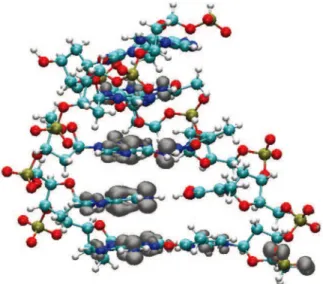
hole spreads on the whole QM region at the beginning of the simulations showed in Figure 1. And then it localizes on one adenine gradually, which has lower on-site energy of a hole compared with a thymine base.23,24 Conwell et al. demon-strated that the water hydration induces hole localization on one base, instead of several bases.16 In our calculations, if the waters are dealt with quantum mechanics, which the distance with the helix less than 8 angstroms, the hole would localize on waters.25,26 Next we study the temperature, and then the external electric field influences on charge locali-zation and proton transfer.
Temperature Effect on Charge Localization and Proton Transfer. Usually, the experiments on proton transfer and charge transport in DNA are under the room temperature.27-31
Temperature and Electric Field Effect on Proton Transfer in Adenine-thymine Bull. Korean Chem. Soc. 2014, Vol. 35, No. 12 3533
However temperature influences are omitted in theoretical simulations. In our simulations with CP2K, the temperature is adjusted from 20 k to 300 K.
To observe the temperature effect on the charge locali-zation time, we define the whole hole localilocali-zation on a adenine as localization time at the spin density m(r) = 0.001. From 20 K to 300 K, the hole localization time changes from 20fs to 38fs showed in Figure 2. We deduce that higher temperature cause stronger vibration and rotation of waters, and this induces the polarization of waters more disorderly. So when temperature arises, the hole localization becomes more difficult. In Figure 3, hydrogen bond stretches are plotted from 20 K to 300 K. Obviously, at 20 K, the H-O hydrogen bond vibrates and becomes shorter until 85fs. The length of H-O is about 1.0 angstrom after stability, which shows us that proton transfers form N6 to O4. Temperature arises, proton transfer will be more difficult.
When an external electric field applied, the hole will occupy an adenine base once we begin the simulations.
Conwell et al. pointed out proton transfer could be found on AT base pair below the room temperature from N6 to O4 as the Figure 4.
External Electric Field Effect on Proton Transfer. Followed Denis et al. calculations applied external electric field, we also induce the electric field parrel with the O-H hydrogen bond between complementary bases which the hole localized in DNA. The direction of external electric field showed in Figure 4. The scope of the Eext is from 0 to
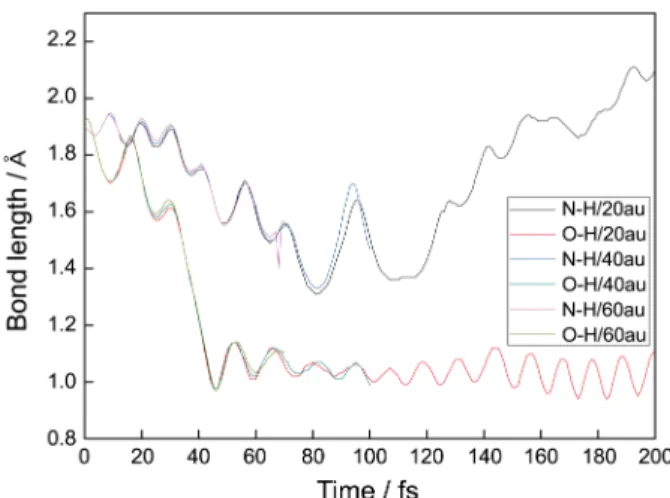
100 au (1 au = 5.14 × 10¹¹ V m−1).32,33 Firstly we observe the proton transfer at 20 K as Figure 5. The phenomenon appears at 45fs however the electric intensity. It is obvious that the electric field will accelerate proton transfer on AT.
Figure 1. Charge distribution on AT at the beginning of the simulations.
Figure 2. Relationship between temperature and localization time of the hole in AT base pair.
Figure 3. H-O and N-H hydrogen bond stretches of AT base pair the hole localized at different temperature. H-O and N-H represent the hydrogen bond between hydrogen-oxygen, nitrogen-hydrogen.
Figure 4. Scheme of proton transfer on AT, where the dotted arrow represents the direction of the electric field.
Figure 5. At 20 K, the intensity of the external electric field effect on proton transfer in AT.
3534 Bull. Korean Chem. Soc. 2014, Vol. 35, No. 12 Guiqing Zhang and Shijie Xie
In order to study the intensity of the external electric field, we plot the hydrogen bond length between O-H, N-H of AT base pair at the step of 20 au. Some of our simulations are short because we terminate to avoid higher temperature and induce strange changes. It’s interesting that the proton transfer occurs at different electric field intensity from 20 au to 100 au at 20 K. The intensity of electric field influences are clear on the distance of N-H than that of H-O. At 300 K, the cases have the same tendency in Figure 6.The difference between at low temperature and high temperature is that the electric field intensity will not obvious effect in the latter case. It shows us the molecular will be more active at high temperature and its effect will be more important.
Conclusion
Temperature and external electric field effect on charge distribution and proton transfer have been investigated by DFT calculations with CP2K code. The following conclu-sions emerge from our calculations: (1) Temperature is one of the most dominant factors on charge distribution and proton transfer in AT base pair. Temperature higher, the hole will be more difficult to localize. It is speculated that higher temperature causes stronger polarization disorder of waters, and this disorder makes charge distribution slower.
As to proton transfer, it is agree with Conwell’s conclusion that it could be found at low temperature. (2) Suitable ex-ternal electric field induces proton transfer occur at room temperature. Under the electric field, no matter how low and higher temperature, proton transfer all could be found.
Acknowledgments. The material in this paper is based upon work supported in part by the National Science Foundation of China (Grant No. 11047113) and Taishan Professor Foundation of Shandong Province.
References
1. Lowdin, P.-O. Rev. Mod. Phys. 1963, 35, 724-732.
2. Lwdin, P.-O. Adv. Quantum Chem. 1966, 2, 213-360.
3. Gu, J.; Wang, J.; Rak, J.; Leszczynski, J. Angew. Chem. Int. Ed. 2007, 46(19), 3479-3481.
4. Dabkowska, I.; Rak, J.; Gutowski, M. Eur. Phys. J.D 2005, 35(2), 429-435.
5. Wagenknecht, H.-A. Angew. Chem. Int. Ed. 2003, 42(22), 2454-2460.
6. Ito, T.; Rokita, S. E. Angew. Chem. Int. Ed. 2004, 43(14), 1839-1842.
7. Ghosh, A. K.; Schuster, G. B. J. Am. Chem. Soc. 2006, 128(13), 4172-4173.
8. Steenken, S.; Telo, J. P.; Novais, H. M.; Candeias, L. P. J. Am. Chem. Soc. 1992, 114(12), 4701-4709.
9. Candeias, L. P.; Steenken, S. J. Am. Chem. Soc. 1989, 111(3), 1094-1099.
10. Steenken, S. Chem. Rev. 1989, 89(3), 503-520.
11. Szyperska, A.; Rak, J.; Leszczynski, J.; Li, X.; Ko, Y. J.; Wang, H.; Bowen, K. H. J. Am. Chem. Soc. 2009, 131(7), 2663-2669. 12. Florian, J.; Hrouda, V.; Hobza, P. J. Am. Chem. Soc. 1994, 116(4),
1457-1460.
13. Gu, J.; Leszczynski, J. J. Phys. Chem. A 1999, 103(15), 2744-2750.
14. Noguera, M.; Bertran, J.; Sodupe, M. J. Phys. Chem. B 2008, 112(15), 4817-4825.
15. Ceron-Carrasco, J. P.; P.n-Carrasco, J.; Requena, A.; Michaux, C.; Perpote, E. A.; Jacquemin, D. J. Phys. Chem. A 2009, 113(27), 7892-7898.
16. Kinz-Thompson, C.; Conwell, E. J. Phys. Chem. Lett. 2010, 1(9), 1403-1407.
17. Cheatham, T. E., III; Simmerling, C. L.; Wang, J.; Duke, R. E.; Luo, R.; Walker, R. C.; Zhang, W.; Merz, K. M.; Roberts, B.; Hayik, S.; Roitberg, A.; Seabra, G.; Swails, J.; Goetz, A. W.; Kolossvry, I.; Wong, K. F.; Paesani, F.; Vanicek, J.; Wolf, R. M.; Liu, J.; Wu, X.; Brozell, S. R.; Steinbrecher, T.; Gohlke, H.; Cai, Q.; Ye, X.; Wang, J.; Hsieh, M.-J.; Cui, G.; Roe, D. R.; Mathews, D. H.; Seetin, M. G.; Salomon-Ferrer, R.; Sagui, C.; Babin, V.; Luchko, T.; Gusarov, S.; Kovalenko, A.; Case, D. A.; Darden, T. A.; Kollman, P. A. AMBER 12. University of California, San Francisco, 2012.
18. Becke, A. D. Phys. Rev. A 1988, 38, 3098-3100.
19. Lee, C.; Yang, W.; Parr, R. G. Phys. Rev. B 1988, 37, 785-789. 20. Mantz, Y. A.; Gervasio, F. L.; Laino, T.; Parrinello, M. Phys. Rev.
Lett. 2007, 99, 058104.
21. Perdew, J. P.; Zunger, A. Phys. Rev. B 1981, 23, 5048-5079. 22. Mantz, Y. A.; Gervasio, F. L.; Laino, T.; Parrinello, M. J. Phys.
Chem. A 2007, 111(1), 105-112.
23. Rakhmanova, S. V.; Conwell, E. M. J. Phys. Chem. B 2001, 105(10), 2056-2061.
24. Sugiyama, H.; Saito, I. J. Am. Chem. Soc. 1996, 118(30), 7063-7068.
25. Giese, B.; Spichty, M. ChemPhysChem 2000, 1(4), 195-198. 26. Giese, B.; Wessely, S. Chem. Commun. 2001, 2108-2109. 27. Delaney, S.; Barton, J. K. J. Org. Chem. 2003, 68(17), 6475-6483. 28. Genereux, J. C.; Barton, J. K. Chem. Rev. 2010, 110(3),
1642-1662.
29. Vura-Weis, J.; Wasielewski, M. R.; Thazhathveetil, A. K.; Lewis, F. D. J. Am. Chem. Soc. 2009, 131(28), 9722-9727.
30. Sontz, P. A.; Muren, N. B.; Barton, J. K. Acc. Chem. Res. 2012, 45(10), 1792-1800.
31. Williams, T. T.; Odom, D. T.; Barton, J. K. J. Am. Chem. Soc. 2000, 122(37), 9048-9049.
32. Ceron-Carrasco, J. P.; Jacquemin, D. Phys. Chem. Chem. Phys. 2013, 15, 4548-4553.
33. Ceron-Carrasco, J. P.; Jacquemin, D. Chem. Commun. 2013, 7578-7580.
Figure 6. At 300 K, the intensity of the external electric field effect on proton transfer in AT.