© Korean Powder Metallurgy Institute 1301
-Effect of Post Deformation on the Structure
and Properties of Sintered Al-Cu-SiC Composites
Hyungsik Chung1,a, Ryun-Min Heo2,b, Moontae Kim1,c, Jae-Hwan Ahn1,d 1School of Chemical and Materials Engineering
San 5, Wonchon-dong, Youngtong-gu, Suwon, Kyonggi, 443-749, Korea
2Changsung Corporation, 11B-9LT, Namdong Industrial Area, Namdong-Ku, Incheon, 403-100, Korea a[email protected], b[email protected], c[email protected], d [email protected]
Abstract
Sintered composites of Al-8wt%Cu-10vol%SiCp were deformed by repressing or equal channel angular pressing(ECAP) at room temperature, 500℃ and 600℃. Repressing produced more densification than ECAP but resulted in much lower transverse rupture strengths. In both cases, deformation at room temperature and 500℃, resulted in much lower strengths than deformation at 600℃, and also caused the fracturing of some SiC particles. The higher bend strengths and less SiC fracturing at 600℃ are attributable to the presence of an Al-Cu liquid phase during deformation. The employment of copper coated SiC instead of bare SiC particles for preparing the composites was found not improving the properties. Keywords : Al-Cu-SiC sintered composites, Repressing, Hot Pressing, ECAP
1. Introduction
Aluminum matrix composites such as Al-SiC, can render improved mechanical and wear properties than monolithic aluminum alloys [1,2]. Particulate-reinforced Al-SiCp composites are most attractive for low cost applications from an economical view [3]. The conventional powder metallurgy process is very economical by simply mixing elemental aluminum and alloying powders with SiC particles, but generally yields very poor properties. In the present work, the effects of a post deformation on the structure and properties of sintered Al/SiCp composites are investigated.
2. Experiment and Results
A commercial aluminum powder(<75µm) and copper powder (<45µm) were mixed with either pure SiC particles or copper-coated SiC particles (average size, 44 µm) to make Al-8 wt.% Cu-10 vol.% SiC. The latter particles are covered with continuous copper layers of 1-2µm thickness and contain about 40wt.% of copper. Rectangular specimens were compacted to the relative density of 85%, and sintered in nitrogen at 600 for 1 hour. The sintered ℃ composites were either repressed at room temperature in air, hot pressed at 500 and 600 in vacuum for 60minutes or ℃ ℃ ECAPed with the channel angle of 90degree at the same temperatures. Three point bending test was conducted in accordance with ASTM B312-96, and microstructures were examined with optical microscope or SEM.
Microstructures of deformed Composites: The maximum density by cold repressing of Al-Cu-SiC sintered compacts was about 98-99% relative density even at or over 550MPa, whereas near full density products could be obtained by hot pressing at either 500 , 145MPa or℃ 600 , 65MPa. In Fig℃ . 1, some fractured SiC particles along with voids were observed after repressing at room temperature, but none at 600 . The high repressing pressure at room temperature ℃ and the voids around SiC particles can cause the fracturing of the particles. The lower pressure and softer matrix at higher temperatures allow easier flow of matrix to fill the voids around the SiC particles and lessen the particle fracturing. In addition, remelted solidified liquid phase at 600 can act as a hydrostati℃ c buffer around the SiC particles. The copper coating of SiC particles was found not effective for lessening the particle fracturing or improving the properties. ECAP at room temperature produced a severely deformed matrix along with some fractured or de-bonded SiC particles, Fig. 2. ECAP was reported to accumulate a shear strain of about 0.97 by one pass for a solid bar [4]. After ECAP at 600 , the matrix was fully ℃ recrystallized to extremely fine grains and few fracturing or de-bonding of SiC particles could be observed.
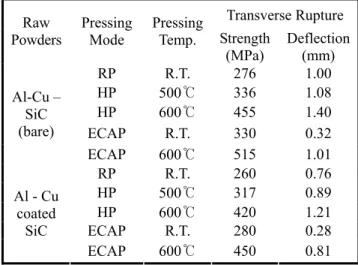
Transverse Rupture Properties: The transverse rupture properties of the deformed composites are compared in Table 1. ECAP yielded higher strengths but yielded lower ductility than repressing or hot pressing. The very low ductility after ECAP at room temperature reflects the effect of severe deformation but the much higher strength and ductility after ECAP at 600℃ is due to the fully recrystallized fine grain structure. The large improvements
2006 POWDER METALLURGY World Congress
C03-03-1 *Invited
© Korean Powder Metallurgy Institute 1302 -in both strength and ductility by rais-ing the press-ing temperature from 500 to 600 clearly show the bene℃ ℃ -ficial effect of the re-melted liquid phase. The composites mixed bare SiC particles yielded higher strengths and ductility than those mixed with copper coated SiC particles. This is due to the thicker liquid phase around the SiC particles, which contains a large portion of brittle CuAl2 phase [5].
Fig. 1 Microstructures of (a)(b)Al-Cu-SiC(bare) repre ssed at R.T.., hot pressed at 600℃, respectively (c)A l-copper coated SiC hot pressed at 600℃
.
Fig. 2 Al-Cu-SiC composites ECAPed at (a)RT (b) 6 00℃
Table 1. Transverse Rupture Properties of deformed Composites
Transverse Rupture Raw
Powders Pressing Mode Pressing Temp. Strength
(MPa) Deflection(mm) RP R.T. 276 1.00 HP 500℃ 336 1.08 HP 600℃ 455 1.40 ECAP R.T. 330 0.32 Al-Cu – SiC (bare) ECAP 600℃ 515 1.01 RP R.T. 260 0.76 HP 500℃ 317 0.89 HP 600℃ 420 1.21 ECAP R.T. 280 0.28 Al - Cu coated SiC ECAP 600℃ 450 0.81 3. References
1. N.V. Ravi Kumar and E.S. Dwarakadasa: Composites, Part A Vol. 31(2000), p.1139
2. B.G. Kim, S.L. Dong and S.D. Park: Mare. Chem. Phys. Vol. 72(2001),p.42
3. J.C. Lee, J.Y. Byun, C.S. Oh, H.K. Seok and H.I. Lee: Acta Mater. Vol. 45(1997),p.5303
4. Y. Iwahashi, J. Wang, Z. Horita, M. Nemoto and T. G. Langdon: Scripta Metall. Vol. 35(1996),p.143
5. S.C. Kim, M. Kim, S. Lee, H. Chung and J.H. Ahn: J. Mater. Sci. Vol. 40(2005),p.441
(a)
(b)
(c)
(a)