The Numerical Analysis of the Seismic and Vibration Isolation System for the EDG Model
Min Kyu Kim,Young Sun Choun,Jeong Moon SeoIntegrate Safety Assessment Division, Korea Atomic Energy Research Institute, Youseong, Daejeon, [email protected]
1. Introduction
An Emergency Diesel Generator (EDG) is one of the safety related equipments of a Nuclear Power Plant. Choun, et al [1] studied about the seismic isolation of EDG system and they revealed that the Core Damage Frequency (CDF) of the whole NPP can be decreased dramatically by decreasing the seismic force. But in the case of the EDG, not only a seismic isolation but operating vibration isolation should be considered. For this reason, in this study, an isolation system that can be satisfied if both a vibration and seismic isolation is adopted. For the isolation system, the coil-spring and viscous damper system was selected. This system is suitable for a vibration control. For the laboratory test, the total weight of model was manufactured as 1/100 small scale model. But in this study, only the numerical analysis is performed. The Numerical model which based on the test model was developed and a seismic analysis and a vibration analysis were performed. As a result, the proposed isolation system has a good performance for a vibration and seismic isolation for the EDG model.
2. Test Model 2.1 Emergency Diesel Generator
The target EDG system is 16PC2-5V400 manufactured by the SEMT Pielstick Corporation. This EDG generates 7000kW of electricity and the velocity is 541 RPM. The EDG operates for 1 hour every one month. These types of EDG are one of most widely used in Korea. One of this type of EDG system which is located in the Yonggwang 5 unit NPP is shown in Figure 1. The EDG consists of a generator and engine part. The weights of each part are 40ton and 93ton, respectively.
Fig. 1 Emergency Diesel Generator
2.2 Design of Experimental Model
For the preparation a mock-up for an EDG system, a scale model was developed. The EDG system consists of a generator, an engine and a foundation part. The weight of scale mode of EDG system was decided on as 0.4, 0.9 and 2.0ton, respectively. Final test model is shown in Figure 2.
Fig. 2 Test Model of EDG System
For the design of an isolation system, the static and dynamic stability were considered. The drawing of the isolation system is shown in Figure 3, and the mechanical properties are summarized in Table 1.
Fig. 3 The Isolation System for Test Model of EDG System
Table 1 The Properties of Isolation System
Item Properties Load Capacity 15 kN Vertical 0.144 kN/mm Stiffness Horizontal 0.04 kN/mm Vertical 3.5 kNs/m Damping Coefficient Horizontal 4.0 kNs/m Height 410mm 3. Numerical Analysis 3.1 Numerical Modeling
For the numerical analysis, the widely used commercial computer program SAP2000 [2] was used. The numerical
Transactions of the Korean Nuclear Society Autumn Meeting Busan, Korea, October 27-28, 2005
model of this analysis is really simple, so the modeling is sufficient for only a 1 d.o.f model. But in this study, 3-D model was used for considering the rocking motion. The solid elements were used to construct the numerical model.
3.2 Seismic and External Loading
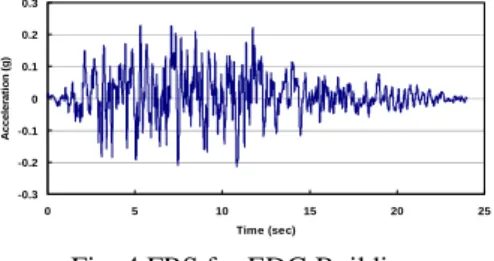
For the seismic analysis, the Floor Response Spectrum (FRS) of the Yonggwang 5 unit EDG building was used. This FRS was developed based on the US NRC RG 1.60 design spectrum and the FRS is shown in Figure 4. In the case of a vibration analysis, the unit harmonic load works on the center of gravity. The frequency of a harmonic load is 8.57Hz during the operation the RPM of the EDG.
-0.3 -0.2 -0.1 0 0.1 0.2 0.3 0 5 10 15 20 25 Time (sec) A c c e le ra ti o n (g )
Fig. 4 FRS for EDG Building 3.3 Acceleration Results of Seismic Analysis
Acceleration response time history and response spectrum are shown in the Figure 5.
-0.3 -0.2 -0.1 0 0.1 0.2 0.3 0 5 10 15 20 25 Time (sec) A c c e le ra ti o n (g ) response input
(a) Time History
0 0.2 0.4 0.6 0.8 0.1 1 10 100 Frequency (Hz) S p e c tra l A c c e le ra ti o n (g ) responseinput (b) Response Spectrum Fig. 5 Seismic Analysis Response
As shown in Figure 5, the maximum acceleration responses were decreased by up to 30% and the resonant frequency was shift to 1Hz from 3Hz. As a result, the
proposed isolation system is effective for a seismic isolation.
3.4 Vibration Analysis Results
As mentioned before, a vertical vibration analysis was performed. The vertical harmonic load was applied to the EDG model. The frequencies of the exciting force were 8.57Hz and 4.28Hz. That is because the operating velocity of the target EDG was 514RPM. Then from the measurement test of our research [2], the resonant frequency of the target EDG was 4.28Hz. The resonant frequency was half of the operating frequency. The input force history and the output results are shown in Figure 6. As shown in the figure, the amplitudes were dramatically decreased and the natural frequencies were changed. As a result, it can be said that the proposed isolation system is effective for a seismic and a vibration isolation system.
-0.3 -0.2 -0.1 0 0.1 0.2 0.3 0 1 2 3 4 5 Time (sec) R eact ion For c e ( tf ) spring fix -0.3 -0.2 -0.1 0 0.1 0.2 0.3 0 1 2 3 4 5 Time (sec) R e act ion For c e ( tf ) spring fix (a) 8.57Hz (b) 4.28Hz Fig. 6 Vertical Vibration Analysis of EDG
4. Conclusion
In this study, numerical analyses were performed for the EDG model. The purpose of this study is seismic and vibration isolation for an operating EDG system. As a result, the proposed isolation system can reduce the seismic force by 30% and provide a vibration reduction of 60%.
ACKNOWLEDGEMENT
This research was supported by the Mid- and Long-Term Nuclear Research & Development Program of the Ministry of Science and Technology, Korea.
REFERENCES
[1] Young-Sun Choun, In-Kil Choi, and Jeong-Moon Seo, Improvement of the Seismic Safety of Nuclear Power Plants by an Increase of Equipment Seismic Capacity, 13th WCEE, 2004 [2] SAP2000, Computers and Structures, Inc., 1998.
[3] Min Kyu Kim, Young Sun Choun, Hyoung Oh Kwon, Jeong Moon Seo, Evaluation of a Spring-Viscous Damper Vibration Isolation System by Measuring the Vibration of the Emergency Diesel Generator, Proceeding of the Korean Nuclear Society Spring Meeting, Jeju, Korea, May, 2005.