[001] 및 [011] 방향 분극의 압전 단결정 PMN-PZT 를 이용한
진동 에너지 수확 특성
Performance Characteristics of Vibration Energy Harvesting Using [001] and
[011]-Poled PMN-PZT Single Crystals
선경호*
·
김영철**
·
김재은
†Kyung Ho Sun, Young-Cheol Kim and Jae Eun Kim
Key Words : Vibration Energy Harvesting(진동 에너지 수확), Piezoelectric Single Crystal(압전 단결정), Energy
Conversion Efficiency(에너지 변환 효율)
ABSTRACT
This work investigated the electromechanical performance of a cantilevered vibration energy harvester incorporating the single crystal PMN-PZT, manufactured with the most recent technology of solid-state single crystal growth. Single crystal PMN-PZTs with two different crystallographic axes such as [011] and [001] were considered. For the [011] orientation, because material properties such as the stiffness, piezoelectric strain coefficients are not the same in the directions normal to the crystallographic axis, the effects of the transversely anisotropy on the magnitude and frequency bandwidth of output power were also analyzed.
1. 서 론 압전 진동 에너지 수확 기술은 수확 대상 에너 지 원인 진동 에너지가 주변 환경 어디에나 존재 하여 수집하기 쉬울 뿐만 아니라 수확 장치 구성 의 간단함, 소형화의 용이성으로 인한 MEMS 구 현의 적합성, 높은 출력 전압, 다른 에너지 변환 수단에 비해 비교적 높은 에너지 밀도와 에너지 변환 효율 등의 장점이 있어 이에 대한 많은 연구 가 이뤄져 왔다(1~3). 그럼에도 불구하고, 전기 출 력량 향상(2,4,5), 전기 출력 주파수 대역폭의 광역 화(6~10) 및 다축 진동원 가진 방향성 고려(9~12)를 위한 연구가 계속 필요하다. 또한, 진동 에너지 수확 장치의 소형화에 수반되는 진동 가진 주파수 대역 대비 높은 고유 진동수 및 유효 질량 감소로 † 김재은; 정회원, 대구가톨릭대학교 기계자동차공학부 E-mail : [email protected] Tel : (053)850-2657, Fax : (053)850-2710 * 발표자; 정회원, 한국기계연구원 시스템다이나믹스실 ** 정회원, 한국기계연구원 시스템다이나믹스실 인한 출력 감소에 대한 연구도 중요하다(13~16). 압전 진동 에너지의 전기 출력량 향상을 위한 기존 연구는 크게 에너지 밀도 및 변환 효율 향상 을 위한 압전 재료의 개발(15,17,18), 진동 에너지 변 환 수단의 조합 적용(15,19,20), 진동 에너지 수확 장 치의 구조 개발/최적화(21~26) 및 출력 손실 최소화 를 위한 전력 관리 회로의 개발(27,28)로 나눌 수 있다. 본 논문에서는 압전 진동 에너지 수확 장치의 전기 출력 향상을 위한 연구로서, 단위 부피당 출 력 밀도가 높다고 보고되어 있는 압전 단결정 PMN-PZT (세라콤, www.ceracomp.com(29)) 기 반의 외팔보 진동 에너지 수확 장치의 전기 출력 특성을 살펴보았다. 특히, 고상 단결정 성장법 (SSCG: Solid-state Single Crystal Growth)에 의 해 제작되는, 서로 다른 결정 방위에 따른 압전 단결정 진동 에너지 수확 장치의 전기 출력 특성 을 분석하고, 에너지 변환 효율 및 출력 주파수 대역폭에 대해 비교하였다. 본 연구에서는 이를 위해 ANSYS 를 이용한 유한 요소 해석 결과를 이용하였다. 한국소음진동공학회 2014년 추계학술대회
Fig. 1 Configuration of the cantilevered bimorph piezoelectric
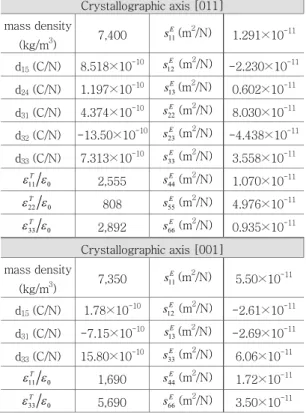
vibration energy harvester with the electrodes connected in parallel 2. PMN-PZT 진동 에너지 수확 장치의 특성 2.1 진동 에너지 수확 장치의 구성 본 연구에서 전기 출력 특성을 분석할 진동 에너 지 수확 장치의 구성을 Fig. 1에 나타내었다. 압전 재료는 알루미늄 기판의 상·하면에 부착되어 있으며 상호 전극은 병렬로 연결되어 있다. 압전 재료로 사 용된 단결정 PMN-PZT (LCSC145-90(29))는 [001] 및 [011]의 결정 방위에 대해 물성치 특성 이 서로 다르다. 또한, Table 1에 나타낸 바와 같이 [011] 결정 방위를 갖는 경우에 대해서도 PZT 계 열의 압전 세라믹과는 달리 분극 방향 수직 평면에 서 비등방성 특성을 갖는다 (d32≠ d31, s11≠ s22) . Fig. 2에 결정 방위별 단결정 PMN-PZT의 부착 상태를 나타내었다. 2.2 단결정 압전 진동 에너지 수확 장치의 에 너지 변환 및 출력 특성 (1) 결정 방위에 따른 전기-역학적 특성 비교 본 연구에서는 압전 단결정 PEH의 특성을 알아보 기 위해 유한요소해석 소프트웨어 ANSYS를 사용 하였다. 압전 재료의 물성치는 Table 1에 보인 바 와 같으며, 끝단 질량 및 기판은 각각 황동 (밀도: 8,470 kg/m3, 탄성계수: 110 GPa) 및 알루미늄 (밀 도: 2,700 kg/m3, 탄성계수: 69 GPa)으로 만들어졌 다. 각각의 압전 단결정이 사용될 경우 압전 진동 에 너지 수확 장치에 대한 고유 진동수 해석 결과를 Table 2에 나타내었다. Fig. 1에 보인 바와 같이 에 너지 수확 장치의 치수는 모두 같지만 압전 단결정 의 물성치가 3가지 경우 모두 다르기 때문에, 폐회
Fig. 2 PMN-PZTs with different crystallographic axes for the
present PEH
Table 1 Material properties of the single crystal PMN-PZT
(LCSC145-90) (29) for two different crystallographic axes Crystallographic axis [011] mass density (kg/m3) 7,400 11 E s (m2/N) 1.291×10⁻¹¹ d15 (C/N) 8.518×10⁻¹⁰ 12 E s (m2/N) -2.230×10⁻¹¹ d24 (C/N) 1.197×10⁻¹⁰ 13 E s (m2/N) 0.602×10⁻¹¹ d31 (C/N) 4.374×10⁻¹⁰ 22 E s (m2/N) 8.030×10⁻¹¹ d32 (C/N) -13.50×10⁻¹⁰ 23 E s (m2/N) -4.438×10⁻¹¹ d33 (C/N) 7.313×10⁻¹⁰ 33 E s (m2/N) 3.558×10⁻¹¹ 11 0 T 2,555 44 E s (m2/N) 1.070×10⁻¹¹ 22 0 T 808 55 E s (m2/N) 4.976×10⁻¹¹ 33 0 T 2,892 66 E s (m2/N) 0.935×10⁻¹¹ Crystallographic axis [001] mass density (kg/m3) 7,350 11 E s (m2/N) 5.50×10⁻¹¹ d15 (C/N) 1.78×10⁻¹⁰ 12 E s (m2/N) -2.61×10⁻¹¹ d31 (C/N) -7.15×10⁻¹⁰ 13 E s (m2/N) -2.69×10⁻¹¹ d33 (C/N) 15.80×10⁻¹⁰ 33 E s (m2/N) 6.06×10⁻¹¹ 11 0 T 1,690 44 E s (m2/N) 1.72×10⁻¹¹ 33 0 T 5,690 66 E s (m2/N) 3.50×10⁻¹¹ 로 및 개회로 상태의 고유 진동수도 모두 다르다. 특히, [011]-d32의 경우에는 보의 길이 방향 강성 이 상대적으로 낮아 폐회로 고유 진동수가 매우 낮 게 나오는 것을 확인할 수 있다. 그럼에도 불구하고, d32의 값이 상대적으로 높아 개회로 상태의 고유 진 동수는 매우 높다. Table 2의 고유 진동수 결과들을 이용하면 다음과 같이 전기-역학 연성 계수 (EMCC: Electro-Mechanical Coupling Coefficient)(30,31) , 2 sys k 을 구할 수 있다. 2 2 2 2 oc sc sys oc f f k f (1) 위의 전기-역학 연성 계수는 압전 에너지 수확 장
Table 2 Short-circuit and open-circuit resonant frequencies
of the PEH shown in Fig. 1 for three PMN-PZTs
PMN-PZT short-circuit resonance (fsc) open-circuit resonance (foc) EMCC ( 2 sys k ) [011]-d32 150.2 Hz 222.8 Hz 0.545 [011]-d31 262.6 Hz 285.0 Hz 0.151 [001] 154.0 Hz 169.7 Hz 0.177
(a) (b)
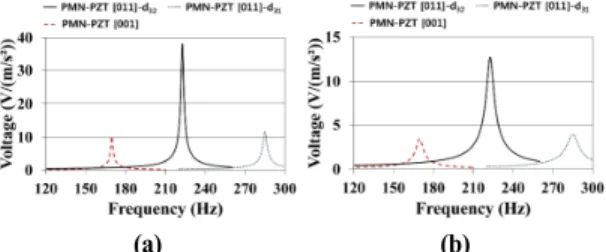
Fig. 3 Comparisons of open-circuit voltage with the modal
damping ratios of (a) 0.005 and (b) 0.015
(a) (b)
Fig. 4 Comparisons of output power for the optimal impedance
at each frequency in the case of the damping ratios of (a) 0.005 and (b) 0.015 치의 에너지 변환 효율을 나타내는 것으로서, 물리 적으로는 외부 진동 가진에 의해 폐회로 상태의 에 너지 수확 장치에 저장되는 변형 에너지 대비 개회 로 상태의 수확 장치에 저장되는 전기 에너지를 나 타낸다. Table 2의 결과로 부터 댐핑 값 및 등가 질 량이 모두 같다고 가정하면, 생성되는 전기 출력량 은 [011]-d32 > [001] > [011]-d31 의 순서라고 예 측할 수 있다(32). Fig. 3 과 Fig. 4에는 개회로 상태 의 출력 전압 및 외부 부하가 각각의 주파수에서 에너지 수확 장치의 임피던스와 같은 값을 가질 때 의 전기 출력량을 나타낸다. 에너지 수확 장치의 댐 핑 값을 미리 알 수 없기 때문에 임의로 2개의 값 을 선정하여 각각에 대한 결과를 표현하였다. [011]-d32 의 경우에는 개회로 출력 전압 값이 월 등히 높고, 전기-역학 연성 계수 값이 높기 때문에 최적 저항에서의 출력 값이 넓은 주파수 대역에 걸 쳐 존재함을 알 수 있다. (2) 고유 진동수 정규화를 통한 전기-역학적 특 성 비교 공진형 진동 에너지 수확 장치의 성능 비교를 위 해서는 동일한 고유 진동수를 갖는 경우에 대하여 비교하는 것이 타당하다. 주어진 가진 주파수에 대 해 에너지 수확 장치로 유입되는 진동 에너지 및 출력 특성이 주파수에 따라 다르기 때문이다. 따라 서, Fig. 1에 나타낸 치수 중 등가 질량의 증감에
Table 3 Short-circuit and open-circuit resonant frequencies
of the resonant-frequency normalized PEHs
PMN-PZT short-circuit resonance (fsc) open-circuit resonance (foc) EMCC ( 2 sys k ) [011]-d32 150.2 Hz 222.8 Hz 0.545 [011]-d31 150.4 Hz 157.4 Hz 0.087 [001] 150.2 Hz 165.5 Hz 0.176 미치는 영향이 제일 작은 기판의 두께를 변경하여 (33) 고유 진동수를 모두 150 Hz로 맞추었다. Table 3에 고유 진동수 해석 결과 및 계산된 전기-역학 연성 계수의 값을 나타내었다. 에너지 변환 효율의 순서가 여전히 동일함을 알 수 있다. 즉, 본 연구에 서 사용된 압전 단결정을 이용하여 외팔보 압전 에 너지 수확 장치를 구성할 경우 에너지 변환 효율 관점에서는 [011]-d32의 사용이 유리함을 알 수 있 다. 또한, Fig. 5에 나타낸 개회로 상태의 전압 및 최적 부하 저항에서의 출력값을 살펴보면, [011]-d32의 경우에 출력 대역폭이 상당이 넓은 것을 확인 할 수 있다. 그러나, 이 경우 2개의 최대 출력 주파 수 사이의 간격이 넓어짐에 따라 중간 주파수 영역 에서의 출력량이 적다. 따라서, 외부 가진 주파수가 광대역이 아니라면 오히려 [001] 결정 방위의 단결 정이 유리할 수 있다. 3. 결 론 본 연구에서는 유한 요소 해석을 통하여 최근 개 발된 압전 단결정 PMN-PZT 의 결정 방위에 따른 전기 출력 특성을 살펴 보았다. 압전 단결정을 외팔 보 형태의 진동 에너지 수확 장치에 이용할 경우, 전기-역학 연성 계수의 크기를 통한 에너지 변환 효율의 관점에서만 본 다면 [011]-d32 단결정을 사 용하는 것이 타당할 것이다. 그러나, 전기 출력 특 성의 관점에서 외부 가진 대역폭이 넓다면 [011]-d32 의 사용이 여전히 유리한 반면, 가진 대역폭이
Fig. 5 Comparisons of output power of resonant frequency-
tuned PEHs through the thickness variations in the case of the damping ratio of 0.015
협대역의 경우 오히려 [001] 또는 [011]-d32의 사 용이 유리할 수 있음을 확인할 수 있었다. 후 기 이 논문은 한국기계연구원 자체사업 (KM3510) 및 미래창조과학부의 재원으로 한국연구재단의 지 원을 받아 글로벌 프론티어 연구개발 사업으로 수 행된 연구임 (과제번호: 2014063711). 참 고 문 헌
(1) Roundy, S., Wright, P. K. and Rabaey, J., 2003, A study of low level vibrations as a power sources for wireless sensor nodes, Computer Communications. Vol. 26, pp. 1131~1144.
(2) Cook-Chennault, K. A., Thambj, N. and Sastry, A. M., 2008, Powering MEMS portable devices-a review of non-regenerative and regenerative power supply systems with special emphasis on piezoelectric energy harvesting systems, Smart Materials and Structures. Vol. 17, 043001.
(3) Priya, S. and Inman, D. J., 2009, Energy Harvesting Technologies, Springer, New York.
(4) Sodano, H. A., Inman, D. J. and Park, G., 2004, A review of power harvesting from vibration using piezoelectric materials, The Shock and Vibration Digest. Vol. 36, pp. 197~205.
(5) Sodano, H. A. and Anton, S. R., 2007, A review of power harvesting using piezoelectric materials (2003-2006), Smart Materials and Structures. Vol. 16, R1-R21.
(6) Tang, L., Yang, Y. and Soh, C. K., 2010, Toward broadband vibration-based energy harvesting, Journal of Intelligent Material Systems and Structures. Vol. 21, pp. 1867~1897.
(7) Twiefel, J. and Westermann, H., 2013, Survey on broadband techniques for vibration energy harvesting, Journal of Intelligent Material Systems and Structures. Vol. 24, pp. 1291~1302.
(8) Pellegrini, S. P., Tolou, N., Shenk, M. and Herder, J. L., 2013, Bistable vibration energy harvesters: A review, Journal of Intelligent Material Systems and Structures. Vol. 24, pp. 1303~1312.
(9) Nguyen, S. D., Halvorsen, E. and Paprotny, I., 2013, Bistable springs for wideband
microelectro-mechanical energy harvesters, Applied Physics Letters. Vol. 102, 023904.
(10) Yang, J., Wen, Y., Li, P., Yue, X., Yu, Q. and Bai, X., 2013, A two-dimensional broadband vibration energy harvester using magnetoelectric transducer, Applied Physics Letters. Vol. 103, 243903.
(11) Moss, S. D., McLeod, J. E., Powlesland, I. G. and Galea, S. C., 2012, A bi-axial magnetoelectric vibration energy harvester, Sensors and Actuators A: Physical. Vol. 175, 165~168.
(12) Lumentut, M. F. and Howard, I. M., 2011, Analytical modeling of self-powered electro-mechanical piezoelectric bimorph beams with multidirectional excitation, International Journal of Smart and Nano Materials. Vol. 2, No. 3, 134~175.
(13) Hudak, N. S. and Amatucci, G. G., 2008, Small-scale energy harvesting through thermoelectric, vibration, and radiofrequency power conversion, Journal of Applied Physics. Vol. 103, 101301.
(14) Karami, M. A. and Inman, D. J., 2011, Analytical modeling and experimental verification of the vibrations of the zigzag microstructure for energy harvesting, ASME Journal of Vibration and Acoustics. Vol. 133, 011002.
(15) Patil, D. R., Zhou, Y., Kang, J.-E., Sharpes, N., Jeong, D.-Y., Kim, Y.-D., Kim, K. H., Priya, S. and Ryu, J., 2014, Anisotropic self-biased dual phase low frequency magneto-mechano-electric energy harvesters with giant power densities, APL Materials. Vol. 2, 046102.
(16) Sun, K. H., Kim, Y.-C. and Kim, J. E., 2014, A small-form-factor piezoelectric vibration energy harvesters using a resonant frequency-down conversion, submitted to AIP Advances.
(17) Sun, C., Qin, L., Li, F. and Wang, Q.-M., 2009, Piezoelectric energy harvesting using single crystal Pb(Mg1/3Nb2/3)O3-xPbTiO3 (PMN-PT) device, Journal of
Intelligent Material Systems and Structures. Vol. 20, pp. 559~568.
(18) Yang, Y., Tang, L. and Li, H., 2009, Vibration energy harvesting device using macro-fiber composites, Smart Materials and Structures. Vol. 18, 115025.
(19) Challa, V. R., Prasad, M. G. and Fisher, F. T., 2009, A coupled piezoelectric-electromagnetic energy harvesting technique for achieving increased power output through damping matching, Smart Materials
and Structures. Vol. 18, 095029.
(20) Dai, X., Wen, Y., Li, P., Yang, J. and Zhang, G., 2009, Modeling, characterization and fabrication of vibration energy harvester using Terfenol-D/PZT/Terfenol-D composite transducer, Sensors and Actuators A: Physical. Vol. 156, pp. 350~358.
(21) Wang, Z. and Xu, Y., 2007, Vibration energy harvesting device based on air-spaced piezoelectric cantilevers. Applied Physics Letters. Vol. 90, 263512.
(22) Kim, J. E. and Kim, Y. Y., 2013, Power enhancing by reversing mode sequence in tuned mass-spring unit attached vibration energy harvester, AIP Advances. Vol. 3, 072103.
(23) Kim, J. E., 2013, Perfromance study of diagonally segmented piezoelectric vibration energy harvester, Transactions of the Korean Society for Mechanical Engineers A. Vol. 37, No. 8, pp. 983~989.
(24) Kim, J. E. and Kim, Y. Y., 2009, Shape design of a cantilever-type piezoelectric energy harvester. Proceedings of the KSNVE Annual Spring Conference, pp. 456~457.
(25) Ma, P. S., Kim, J. E. and Kim, Y. Y., 2009, Topology optimization of a cantilevered piezoelectric energy harvester having a vibrating base. Proceedings of the KSME Fall Annual Meeting, pp. 432~434.
(26) Rupp, C. J., Evgrafov, A., Maute, K. and Dunn, M. L., 2009, Design of piezoelectric energy harvesting systems: A topology optimization approach based on a multilayer plates and shells. Journal of Intelligent Material Systems and Structures. Vol. 20, pp. 1923~1939.
(27) Wickenheiser, A. M. and Garcia, E., 2010, Power optimization of vibration energy harvesters utilizing passive and active circuits, Journal of Intelligent Material Systems and Structures. Vol. 21, pp. 1343~1361.
(28) Badel, A., Guyomar, D., Lefeuvre, E. and Richard, C., 2006, Piezoelectric energy harvesting using a synchronized switch technique, Journal of Intelligent Material Systems and Structures. Vol. 17, No. 8~9, pp. 831~839.
(29) Ceracomp Co., Ltd. (www.ceracomp.com). (30) Ikeda, T., 1996, Fundamentals of Piezo-electricity, Oxford University Press, New York.
(31) Kim, J. E. and Kim, Y. Y., 2011, Analysis of
piezoelectric energy harvesters of a moderate aspect ratio with a distributed tip mass, ASME Journal of Vibration and Acoustics. Vol. 133, 041010.
(32) Kim, J. E., Kim, H., Yoon, H., Kim, Y. Y. and Youn, B. D., 2014, An energy conversion model for cantilevered piezoelectric vibration energy harvesters using only measurable parameters, submitted to Internal Journal of Precision Engineering and Manufacturing.
(33) Patel, R., McWilliam, S. and Popov, A. A., 2011, A geometric parameter study of piezoelectric coverage on a rectangular cantilever energy harvester, Smart Materials and Structures. Vol. 20, 085004.