2019 ⦽ǎႊᔍᖒ⠱ʑྜྷ⦺⫭ ⇹ĥ⦺ᚁݡ⫭ םྙ᧞Ḳ
259
Study on Activation Evaluation of the Kori unit 1 Bioshield Concrete
Ju-Young Yoon* and Young Hwan Hwang
KHNP Central Research Institute, 70, Yuseong-daero 1312beon-gil, Yuseong-gu, Daejeon, Republic of Korea *
1. Introduction
The first step to prepare for the cutting process for disassembly of the Kori Unit 1 is to evaluate the release.
The focus of this activation evaluation is accurate modeling of the structure and evaluation of the full cycle.
This is because the difference in the small information of the structure may be significantly different from the evaluation result and bioshield concrete of the Kori unit 1 used for 1 to 32 cycles.
2. Structure Modeling
In order to evaluate the correct activation evaluation, we analyzed the structure of the Kori Unit 1.
We analyzed the effects of nuclear fuel, reactor vessel, reactor vessel internals, and surrounding structures on the bioshield concrete.
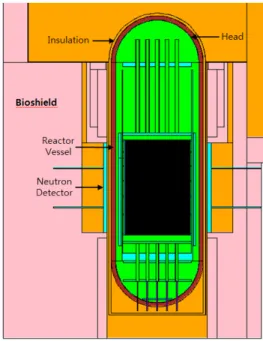
Structural modeling was performed using the MCNP 6 code. The results are shown in Fig 1.
Critical evaluation was performed using the KCODE option in the MCNP 6 code calculation and the ENDF / B-VII.1 nuclear data library was used.
In the three - dimensional MCNP 6 model for each cycle, only the information of the nuclear fuel assemblies of the inner and outer regions of the core was modified and evaluated.
Fig. 1. Modeling of the Kori Unit 1.
3. Activation Evaluation
3.1 Neutron Flux Calculations
During the total of 32 cycles, the neutron irradiation of the Kori Unit 1 resulted in the activation of the surrounding structures of the reactor. So flux was calculated for 1 to 32 cycles.
The neutron flux evaluation was performed with the MCNP 6 code. As a result, the core part is about 1.0E+13 #/cm2Âs, and it is decreased to 1.0E+03 #/cm2Âs to fall down.
The neutron flux in the upper and lower parts was very low and almost no spinning occurred.
Most neutrons are located in the center of the core, and the distribution of neutrons becomes smaller toward the outside.
260
2019 ⦽ǎႊᔍᖒ⠱ʑྜྷ⦺⫭ ⇹ĥ⦺ᚁݡ⫭ םྙ᧞Ḳ Fig. 2. Neutron Flux Distribution.3.2 Activation Evaluation of the Bioshield Concrete
Based on the neutron fluxes obtained for a total of 32 cycles, specific activity was calculated by performing ORIGEN-S code of positional activation evaluation.
Activation evaluation was performed at this point in anticipation of decommissioning after a cooling period of 10 years after the shutdown.
The results of the specific activity are shown in the Table 1 below.
Table 1. The results of activation assessment Structure Mass(kg)* Total
Activity(Bq) Classifi cation Core center part 63,920 6.36E+09 VLLW the other
part 506,080 1.58E+09 Clearance 570,000 7.94E+09
* Assuming a total of 570 tons
Based on the neutron flux and specific activity calculated for each structure location, the waste classifications of the bioshield concrete were classified and the mass and total activities were calculated.
4. Conclusion
The computational system for the activation evaluation computes the neutron flux and specific activity using the MCNP 6 and ORIGEN-S codes and classifies the waste classifications.
The calculations show that the concrete adjacent to the center of the reactor core is classified as very low level radioactive waste(VLLW), and the other parts are classified as clearance wastes.
The results of the activation evaluation need to be verified through some sampling performed in the future. For accurate evaluation, it is necessary to perform sample such as coring and to analyze the radioactivity.
REFERENCES
[1] I.C. Gauld, O.W. Hermann, R.W. Westfall, ORIGEN-S: SCALE System Module to Calculate Fuel Depletion, Actinide Transmutation, Fission Product Buildup and Decay, and Associated Radiation Source Terms, ORNL/TM-2005/39, Ver.6, Vol.II, Sect. F7, Oak Ridge National Laboratory (2009).
[2] J.T. Goorley, et al., Initial MCNP6 Release Overview - MCNP6 version 1.0, LA-UR-13-22934, Los Alamos National Laboratory (2013).
[3] J.C.Evans, E.L.Lepel, R.W.Sanders, C.L.Wilkerson, W.Silker, C.W.Thomas, K.H.Abel, D.R.Robertson, Long-Lived Activation Products in Reactor Materials, NUREG/CR-3474 (1984).