1. Introduction
There is a stainless steel alloy as a corrosion resistant alloy casting material, and Cermet and Stellite alloy are representa-tive wear-resistant casting alloys. Stainless steel alloy has ex-cellent corrosion resistance against nitric acid and sulfuric acid etc. at room temperature as compared with spheroidal graphite cast iron[1-4]. Cermet is a heat resistance material composed of metal and ceramic. It possesses heat resistance that makes it withstand high temperature and has oxidation re-sistance from corrosion, chemical rere-sistance capable of with-standing chemicals, wear-resistance, high strength approach-ing to metal, and plasticity for easy processapproach-ing, but it is brittle against impact[5].
Stellite alloy has excellent mechanical wear resistance and
corrosion resistance at high temperature. Besides, it prevents corrosion, erosion, and wear and tear since chrome (Cr), car-bon (C), tungsten (W), and molybdenum (Mo) are added in cobalt. Further, Stellite alloy has excellent antioxidant prop-erty due to its high temperature characteristics, and can be finished to excellent surface roughness. Besides, it has a low friction coefficient, thereby excellent wear resistance. That is, it has excellent wear resistance and low friction co-efficient, thus it is not damaged much when contacted with other metals, and has a very excellent property against erosion. In addition, it has high hardness at high temperature and is highly resistant to corrosion and is used for valve or pump plunger which requires wear resistance and corrosion resistance.
Pouring temperature for the aluminum and magnesium die
Development of Sleeve Parts for Continuous Hot Zinc Plating Roll Applied to
Wear-Resistant Alloy Cast Steel
Dong-Hwan Park
a, Jin-Tae Hong
b, Hyuk-Hong Kwon
c*a
Gyeongbuk Hybrid Technology Institute, 24-24, Goeyeon 1-gil, Yeongcheon, Gyeongbuk-do, 38899, Korea
b Bugang Special Co., Ltd., 42, Bonchongongdan-gil, Yeongcheon, Gyeongbuk-do, 38899, Korea c
Department of Computer Aided Mechanical Engineering, Daejin University, 1007, Hoguk-ro, Pocheon, Gyeonggi-do, 11159, Korea
ARTICLE INFO
ABSTRACT
Article history: Metal casting is a process in which molten metal or liquid metal is poured into a mold made of sand, metal, or ceramic. The mold contains a cavity of the desired shape to form geometrically complex parts. The casting process is used to create complex shapes that are difficult to make using conventional manufacturing practices. For the optimal casting process design of sleeve parts, various analyses were performed in this study using commercial finite element analysis software. The simulation was focused on the behaviors of molten metal during the mold filling and solidification stages for the precision and sand casting products. This study developed high-life sleeve parts for the sink roll of continuous hot-dip galvanizing equipment by applying a wear-resistant alloy casting process. Received 8 June 2017 Revised 23 July 2017 Accepted 2 August 2017 Keywords: Metal casting Sleeve parts Stellite Wear-resistant alloy Precision casting Sand casting
* Corresponding author. Tel.: +82-31-539-1972 Fax: +82-31-539-1970
the wear-resistant casting alloy Stellite is quite high at around 1,500°C[6-10]. Because the pouring temperature is high in the wear-resistant alloy cast iron material as compared with aluminum and magnesium alloys, precaution is required during handling. Zinc plating is a surface treatment technique for the steel products, which is implemented to extend life of steel and to improve its properties. The steel product produced by zinc plating is applied in many fields such as automobiles, appliances, and construction. Continuous hot-dip galvanizing device is an equipment with an objective of continuous production of galvanized steel sheet. Steel companies produce galvanized steel sheets using a hot-dip galvanizing method. Equipments involved in the continuous hot-dip galvanizing are zinc plating bath and chemical heat treatment. Among these, zinc plating bath is composed of sink roll, stab roll, and correct roll.
Galvanized steel sheet is produced by dipping a steel plate inside the zinc plating bath at around 500°C, making steel sheets pass through sink roll, stab roll, and correct roll. While going through this series of process, zinc is coated on the steel sheet during a specific duration. In the zinc plating bath, sink roll, stab roll, and correct roll are immersed and rotated, and sink roll is contacted with the general steel plate first after steel plate is immersed into the zinc plating bath, resulting it receives the largest load. Due to this, sink roll and bearings at both end of the sink roll are also simultaneously rotated, imposing serious abrasion in the bearing parts, consequently bearings are frequently replaced. Bearing parts at the sink roll are composed of bush and sleeve, and if bush and sleeve parts are frequently replaced due to wear during zinc plating, issues of low productivity, quality impairment, and working environ- ment would be posed.
Sleeve for sink roll is a part that is rotated in the continuous hot-dip galvanizing bath at around 500°C, therefore it is subjected to severe corrosion and wear, spending a long-time to replace parts. To improve this problem, development of high-life sleeve parts is needed by applying wear-resistant alloy casting material[11-14]. Therefore, this study aims to develop high-life sleeve parts for the sink roll of continuous hot-dip galvanizing equipment by applying the casting process of wear-resistant alloy casting which can reduce the manufac- turing cost and extend the life.
2.1 Wear Test
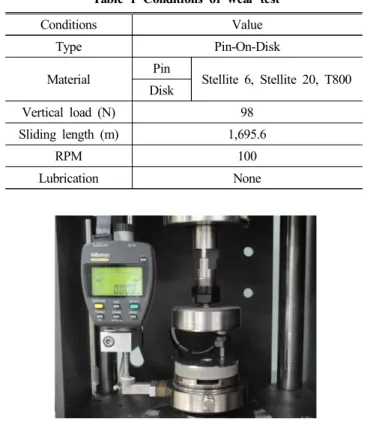
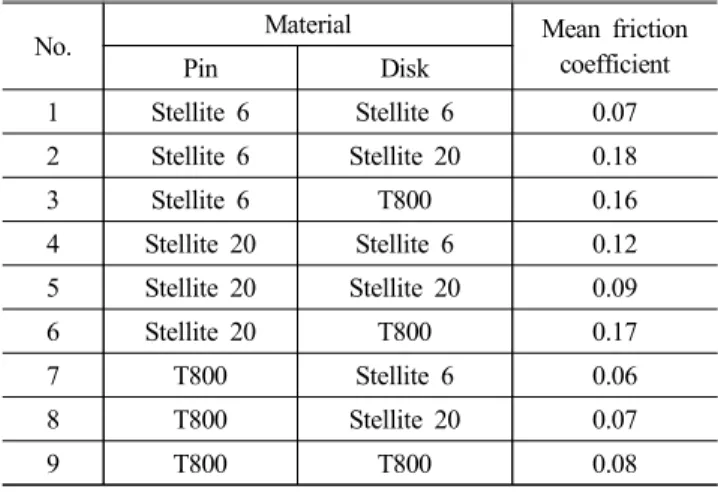
For the wear test, pin-on-disk method is generally used. Pin-on-disk wear test was performed to evaluate friction coefficient for the wear-resistant alloy casting material[15]. Accordingly, pin and disk specimens were prepared for the wear test. Metal wear is known to be affected by roughness of contacted surfaces, temperature, contacted condition, hardness, vertical load, and lubrication. The equipment and specimens for wear test are presented in Fig. 1, and testing conditions are tabulated in Table 1. In the wear test, the sleeve parts were abraded due to friction at high temperature, so the wear test according to the material was carried out. Wear test was performed with wear resistant alloy cast irons for pin as well as disk, with vertical load of 98N on the pin, while disk was not lubricated as shown in Fig. 2. Wear test results showed that the mean friction coefficients were in a range of 0.06~0.18 as in Table 2. The wear test was conducted to obtain the lowest friction coefficient on the pin and disk. The lowest coefficient 0.06 was obtained from T800 (pin) and Stellite 6 (disk) from the wear test.
Table 1 Conditions of wear test
Conditions Value Type Pin-On-Disk
Material Pin Stellite 6, Stellite 20, T800 Disk
Vertical load (N) 98 Sliding length (m) 1,695.6
RPM 100
Lubrication None
2.2 Design and Fabrication of Cast Mold 2.2.1 Precision Casting
A casting mold was designed and fabricated using a precision casting process and a sand casting process to produce sleeve parts. Precision casting process is applied to achieve a good roughness, to minimize the machining volume, and to reduce weight of the casting with the mold that produces a wax pattern. After filling the wax, the wax tree is prepared and the ceramic coating is applied to the wax tree for 1~8 times. After the dewaxing process is performed in an autoclave at high temperature and high pressure, a firing (residual wax combustion and reinforce of mold strength) is executed, and then the wax pattern is eluted and a ceramic mold is made. This ceramic casting is burned at around 1,000°C and then molten metal is filled into it. With this precision casting process, mass production is possible with a good surface roughness and a reduced machining volume. Fig. 3 shows the precision casting mold for sleeve parts. Precision
was filled into the mold by injection molding machine within a short duration, and aluminum having a fast cooling and a good machining property was used. At the center of the precision casting mold, a core was located as a cavity, while a total of gates one at the top and one at the bottom of the sleeve was selected.
2.2.2 Sand Casting
Sand casting process is a process wherein a wooden pattern is designed and fabricated, and mold is made with this wooden pattern using casting sand, and then molten metal is poured into the sand casting. Sand casting has benefits of short duration taken for preparing casting and takes a low cost. But the resulting product has a poor roughness on its surface and machining volume becomes high. The most importantly consideration in the sand casting process is a riser design. The riser was set on the top of the product with its height more than 1/2 of the product’s height, with a constant thickness, and an exothermic sleeve was attached.
Fig. 4 shows the wooden pattern for the sleeve sand casting mold. Major process of the sand casting was inspected if it was same as the wooden pattern drawing, and molding was done two number each by mixing molding sand and sodium
Stellite 6
Stellite 20
T800
Fig. 2 Specimens for the wear test
Table 2 Mean friction coefficient results of the wear test
No. Material Mean friction coefficient Pin Disk 1 Stellite 6 Stellite 6 0.07 2 Stellite 6 Stellite 20 0.18 3 Stellite 6 T800 0.16 4 Stellite 20 Stellite 6 0.12 5 Stellite 20 Stellite 20 0.09 6 Stellite 20 T800 0.17 7 T800 Stellite 6 0.06 8 T800 Stellite 20 0.07 9 T800 T800 0.08
Fig. 3 Bush wooden pattern
on the prepared mold with a help of brush so that the molds could be combined at the bottom.
Material was melted using an electric furnace having a capacity of 100 kg, the raw material was charged while checking the temperature with an immersion type thermometer. Injection of the raw material was executed with a ladle most suiting to the weight of the product at 1,550°C. Before injecting the raw material, Ca-Si deoxidant was coated at the top of the furnace. Furthermore, SLAX coagulant was coated on the top of the furnace so that the non-metal inclusion can be removed regularly. Injection rate was carried out within three seconds. After charging the material, an exothermic material was coated on the top of the casting so that solidification can be progressed from the product at first. In order to dismantle the mold, sand removal was performed caring not to damage the product. The product after sand removal went through a shot blast to ensure visible impurities would not be presented on their surface. Sprue was cut while caring not to damage the product. For the products which need heat treatment, heat treatment was given accordingly. After heat treatment, roughing and finishing were performed as per the drawing. Finally, composition test, penetration test, and dimension inspection were carried out.
3. Analysis of Casting Solidification
3.1 Analysis Conditions
In order to perform a solidification analysis of precision casting for the sleeve parts, surface element was done using a wax tree model, and then shell was prepared for precision casting. With shell generation thickness at 8mm, 618,484 numbers of volume element were created. During the precision casting solidification analysis of the sleeve parts, it was found that wear-resistant alloy cast steel material T800 (pin) and Stellite 6 (disk) had the lowest friction coefficient (0.06). Therefore, analysis was carried out for two types of materials, i.e., Stellite 6 and T800. For the precision casting solidification analysis condition for the sleeve, the injection temperature of the molten metal was set at 1,550°C, the mold material was made of zircon, and the mold temperature was set at 1,050°C as shown in Table 3. The interfacial heat transfer coefficient among casting product, mold, core was set at 500 W/m2k for both sand
casting and precision casting. Fig. 5 shows the finite element analysis model for the sleeve precision casting. A software for commercial casting analysis ProCAST was used for casting solidification analysis.
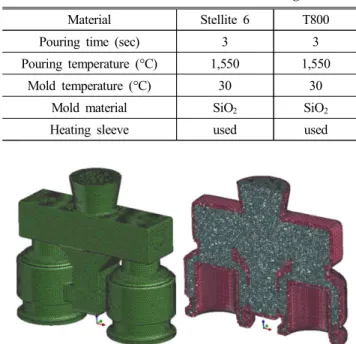
3D modeling was performed for the casting product, core, sprue, runner, and riser for solidification analysis of sand casting, and it was divided into triangle elements. The size of the element was set at 10 mm for sand casting mold, at 5mm for casting product, core, and runner. Furthermore, gravity direction setting, material for casting product, core, and sand casting mold, heat transfer coefficient, filling time, cooling condition, and atmospheric temperature were input. The conditions for analysis used in the casting solidification analysis are as in Table 4. Injection temperature of the molten metal was set at 1,550°C, sand material for sand casting was silica (SiO2), and pre-heat temperature was at 30°C. Fig. 6 presents 3D modeling of the sand casting, while Fig. 7 presents the finite element analysis model for sand casting.
Material Stellite 6 T800 Pouring time (sec) 3 3 Pouring temperature (°C) 1,550 1,550
Mold temperature (°C) 1,050 1,050 Mold material Zircon Zircon Heating sleeve used used
Table 4 Simulation conditions of sand casting mold
Material Stellite 6 T800 Pouring time (sec) 3 3 Pouring temperature (°C) 1,550 1,550
Mold temperature (°C) 30 30 Mold material SiO2 SiO2
Heating sleeve used used
3.2 Analysis Results
The temperature range of alloys according to filling rate in the precision casting process revealed that the cooling speed during filling was high for T800, followed by Stellite 6 as shown in Fig. 8. That is, cooling was faster in T800 than Stellite 6, thus fluidity is impaired and then filling became slower. Fig. 9 shows the casting analysis results that were performed to predict mis-run. From all the materials of T800 and Stellite 6, mis-run was not occurred. Fig. 10 shows analysis results for shrinkage cavity in the precision casting. In case of T800, shrinkage was expected in the sleeve product. This might be because T800 alloy cooled faster than Stellite 6, thus fluidity became impaired, resulting a shrinkage. Fig. 11 shows analysis results for shrinkage cavity in the precision casting of the sleeve when the filling temperature of T800 alloy was raised to 1,650°C. When the injection temperature
Fig. 6 3D Modeling of sand casting
Fig. 7 FEM model of sand casting
(a) Stellite 6 (b) T800
Fig. 8 Temperature distribution of precision casting in the filling rate of 98%
(a) Stellite 6 (b) T800
Fig. 9 Mis-run of precision casting
(a) Stellite 6 (b) T800
Fig. 10 Shrinkage cavity of precision casting
(a) 1,550°C (b) 1,650°C
Fig. 11 Pouring temperature of shrinkage cavity for precision casting (T800)
(a) Stellite 6 (b) T800
Fig. 12 Temperature distribution of sand casting in the filling rate of 98%
is increased to 1,650°C, the shrinkage cavity is removed inside the product, but a new shrinkage cavity is expected to occur outside the product due to heat generation near the runner.
Temperature distribution according to filling rate in the sand casting showed that T800 was cooled faster than Stellite 6 as shown in Fig. 12. Fig. 13 shows the casting analysis results conducted to predict mis-run. In the analysis results, mis-run was not occurred in the Stellite 6. On the contrary, mis-run was found in the T800 alloy as orange color. It could be prevented by increasing filling temperature. Fig. 14 shows analysis results for shrinkage cavity in the sand casting under the filling temperature at 1,550°C. Shrinkage cavity was not generated in the Stellite 6, but shrinkage was expected in the T800 alloy.
4. Results and Discussion
Sleeve precision casting process is a structure that can manufacture two sleeves in one tree, and hanging the inner side having core on the holder so that outside and inside could be cooled simultaneously after casting. Fig. 15(a) shows the sleeve precision casting mold, while Fig. 15(b) shows the
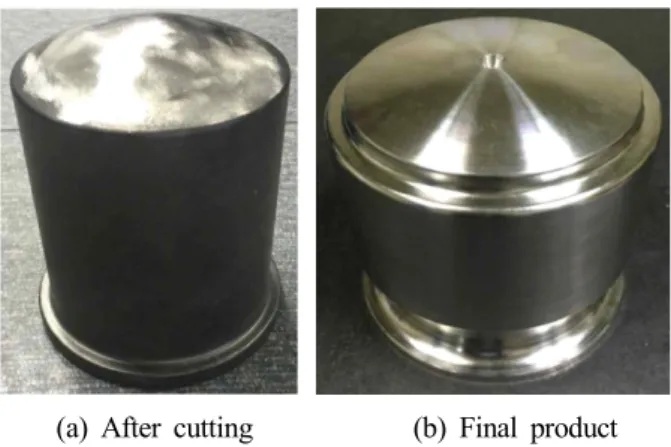
cooled sleeve product after casting. In particular, compressed air from the outside is blown into the mold so that the cooling can be performed quickly. Fig. 16(a) shows the sleeve product after cutting and finishing, and Fig. 16(b) shows the finished sleeve product. The penetrant inspection was performed on the post-treated sleeve product, and it was found that a good casting without pinholes could be secured as shown in Fig. 16(a). That is, good sleeve products could be obtained for Stellite 6 in the precision casting with the filling temperature at 1,550°C. In the precision casting process of the sleeve parts, all of the Stellite 6 materials were able to obtain good products. In the T800 alloy material, the injection temperature was raised to 1,650°C to induce shrinkage cavity in specific
(a) Stellite 6 (b) T800
Fig. 13 Mis-run of sand casting
(a) Stellite 6 (b) T800
Fig. 14 Shrinkage cavity of sand casting
(a) Casting mold (b) After cooling process
Fig. 15 Casting mold and cooling process for sleeve precision casting
(a) After cutting (b) Final product
Fig. 16 Sleeve parts for precision casting
(a) Wooden pattern (b) Casting mold
areas to obtain good sleeve products.
In the case of Stellite 6, good sleeve products could be obtained same as in the analysis result. Fig. 17 shows the wooden pattern and casting mold for sleeve sand casting, while Fig. 18 shows the sleeve product manufactured by sand casting. The molding was executed with the molding sand and sodium silicate at a constant mixing ratio. Combination of the mold was done by stirring coatings and alcohol as a specific mixing ratio to coat on the casting after molding. It was expected that T800 alloy would have mis-run or shrinkage cavity in the sand casting analysis, filling temperature was raised to 1,650°C to induce shrinkage cavity at a specific area.
Sleeve parts were designed as a precision casting and a sand casting. The solidification analysis of casting process according to alloy cast steel material was conducted. Temperature distri- bution, filling time, and shrinkage cavity were investigated according to the filling rate. Good sleeve products could be obtained in both the precision casting and sand casting with the Stellite 6 under the filling temperature at 1,550°C. While,
1,550°C. Fig. 19 shows an example of a pinhole defect during penetrant inspection. In order to machine the wear-resistant alloy cast steel material, the sleeve parts were subjected to roughing and finishing, and final component inspection, penetrant inspection and dimensional inspection were carried out to complete the product.
5. Conclusions
In this study, a precision casting and a sand casting process are proposed to develop high-life sleeve parts for continuous hot-dip galvanizing roll with a wear resistant alloy steel cast material. Wear test, casting solidification analysis, mockup manufacturing, and performance evaluation for the prototype were performed to get optimal sleeve parts in the casting process. The summary of the study result is as follows;
The average friction coefficient could be determined through wear test to manufacture sleeve parts having a long-life. The average friction coefficient was the lowest in the T800 of the pin and Stellite 6 of disk so that material for sleeve product could be chosen. Sleeve parts were designed as a precision casting and a sand casting. The solidification analysis of casting process according to alloy cast steel materi-al was conducted. Temperature distribution, filling time, and shrinkage cavity were investigated according to the filling rate. With the obtained results, optimum casting method could be designed. Good sleeve products could be obtained in both the precision casting and sand casting with the Stellite 6 under the filling temperature at 1,550°C. While, with the T800 alloy, the casting defect could be confirmed at 1,550°C. For T800 alloy material, filling temperature was increased to 1,650°C to cause shrinkage cavity at a specific area and finally good sleeve products could be obtained.
References
[1] Ann, S. J., Kang, M. R., Seo, D. S., Kim, Y. H., Lee, K. H., Kim, H. S., 1998, A Study on the High Temperature Strength of Ferritic Stainless Cast Steels, Journal of the Korean Foundrymen's Society, 18:6 563-569. [2] Lee, K. D., Ha, T. K., Jung, J. Y., 2009, Characterization of High
Temperature Mechanical Properties of Cast Stainless Steels for Exhaust Manifold, Trans. Mater. Process. 18:3 217-222.
[3] Kim, S. W., Park, J. S., Khalil, K. A., 2006, Effects of C, Si and RE on
Fig. 18 Sleeve casting product of sand casting
Fig. 19 Pinhole defects during penetrant inspection of sleeve parts
[4] Kim, S. T., Park, Y. S., 2009, Effects of Copper and Sulfur Additions on Machinability Behavior of High Performance Austenitic Stainless Steel, Metals and Materials International, 15:2 221-230.
[5] Kim, Y. S., Kwon, W. T., Seo, M. S., Kang, S. H., 2012, Tool Performance of New Wear-Resistant Cermets, Int. J. Precis. Eng. Manuf., 13:6 941-946.
[6] Yoon, H. S., Oh, Y. K., 2011, Numerical Study on Thermal Deformation of AC4C and AC7A Casting Material, Korean Society of Manufacturing Technology Engineers, 20:5 541-546.
[7] Kim, E. S., 2005, Die Casting Process Design for Gear Housing of Automobile Transmission by using MAGMA Soft, Trans. Mater. Process. 14:2 112-120.
[8] Kim, Y. C., Choi, S. W., Cho, J. I., Jeong, C. Y., Kang, C. S., 2008, Optimization of the Thin-walled Aluminum Die Casting Die Design by Solidification Simulation, Journal of the Korean Foundrymen's Society, 28:4 44-48.
[9] Cho, S. H., Jang, J. Y., 2016, Strength Analysis of Die-Cast Aluminum Alloy Brake Pedals for Use in Lightweight Cars, Journal of the Korean
[10] Han, J. J., Kwon, H. W., 2011, Effects of Alloying Element and Grain Refinement on the Tensile Properties of Mg Alloy Casted with Sand Mold, Journal of the Korean Foundrymen's Society, 31: 4 212-217. [11] Choi, S. R., Kim, C. K., Park, K., Oh, C. H., 2000, Development of
Precision Casting Technology for Inlet Gear Box using Selective Laser Sintering, Journal of the Korean Society of Machine Tool Engineers, 9:1 30-37.
[12] Lakshmanan Singaram, 2010, Improving Quality of Sand Casting using Taguchi Method and Analysis, International Journal on Design and Manufacturing Technologies, 4:1 1-5.
[13] Nawi, I., Siswanto, W. A., Ismail, A. E., 2014, A Study of Auto Pour in Sand Casting Process, Applied Mechanics and Materials, 660:1 74-78. [14] Kim, M. G., Kim, Y. J., 2002, Investigation of Interface Reaction
between TiAl Alloys and Mold Materials, Metals and Materials International, 8:3 289-293.
[15] Chang, S. K., Pyun, Y. S., 2016, Wear and Fatigue Properties of Surface-Hardened Rail Material, Journal of the Korean Society of Manufacturing Technology Engineers, 25:5 380-385.