Abstract
This paper presents a novel collided tag signals’s periodic characteristic based radio frequency identification (RFID) tag collision detection method for the ultra high frequency (UHF) RFID. The proposed method utilizes that periodicity of tag signals is maintained even under tag collision. In the proposed method, the correlation between received signal and reference edge signal is used. Simulation result shows that the detection performance using the proposed method is about 10 dB better than that of existing method. In addition, the detection performances with different magnitude difference, phase difference, delay, number of tags are analyzed.
Key words:UHF, RFID, Tag collision, Periodicity, EPC
* Dept. of Electronic and IT Media Eng., Seoul National University of Science and Technology ★ Corresponding author
E-mail:[email protected], Tel: 02-970-6460 ※ Acknowledgment
This study was supported by the Research Program funded by the SeoulTech (Seoul National University of Science and Technology).
Manuscript received Nov. 16, 2020; revised Dec. 23, 2020; accepted Dec. 28, 2020.
This is an Open-Access article distributed under the terms of the Creative Commons Attribution Non-Commercial License (http://creativecommons.org/licenses/by-nc/3.0) which permits unrestricted non-commercial use, distribution, and reproduction in any medium, provided the original work is properly cited.
Ⅰ. Introduction
While a barcode requires line-of-sight scanning, UHF RFID technology reads tag information through radio frequency. Hence, UHF RFID technology does not require line-of-sight. And, communication range of UHF RFID technology is longer than that of barcode. Recently, these advantages of UHF RFID technology get more attention as the IoT technology has gained popularity [1]-[3]. However, since the communication range is long, multiple tags may reply simultaneously which called as tag collision. The reader must detect the tag collision and should adjust a time slot for efficient tag identification [4]-[5]. In the RFID inventory policy, multiple tags may reply with RN16(Random Number 16 bits) simultaneously.
Various methods for detecting tag collision have been studied in previous works [6].
This paper presents a collision detection method utilizes that periodicity of tag signals is maintained even under tag collision. Section II describes tag collision in UHF RFID inventory policy. The proposed tag collision detection method is described in Section III. Section IV presents simulation results. Finally, conclusions are presented in Section V.
Ⅱ. UHF RFID Tag Collision
RFID inventory policy is based on the slotted ALOHA and the tag selects the time slot randomly [7]. When at least two tags share the same time slot, they reply the RN16 simultaneously according
Fig. 1. Tag collision example.
to the reader’s command as shown in Fig. 1. It causes the tag collision. Since tags transmit data by back scattering the carrier signal from a reader, there is no carrier frequency offset between tag signals and reader receiver. The baseband
equivalent collided multiple tag signal is
written as
(1)Where is the index of the th tag signal,
is the th tag signal, and are channel
coefficients, and is the channel noise. is
written as
(2)where is discrete time index, is a series of
values, either –1 or +1, is a pulse valued 1
when b and 0 else where, Tb is bit period
and , are the strength and initial phase of
the th tag signal [6].
Ⅲ. Proposed Tag Collision Detection Method
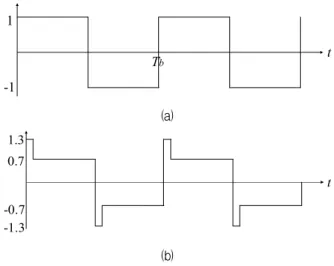
To improve the tag collision detection performance, we propose a method using the collided tag signals’ periodic characteristic. The proposed method uses preamble of tag signal. UHF RFID tag uses FM0 or Miller encoding for modulation. In the preamble of both FM0 and Miller encoding, periodic square waves can be included [8]. Fig. 2 compares periodic square waves of a single tag and two-tag signals. In Fig. 2, amplitude and delay of second
tag signal are -0.3 and 0.1*Tb, respectively, as
example. 1 -1 Tb t (a) 1.3 0.7 -0.7 -1.3 t (b)
Fig. 2. Periodic square waves of tag signals. (a) single tag and (b) two-tag.
Compared with Fig. 2(a) and Fig. 2(b), position of second edge, which is generated with two-tag signals, is also periodic. If the number of periodic
edge in 1Tb is more than 1, it is determined that
tag collision has occurred. Edge can be also generated by noise. However, since the position of edge generated by noise may not be periodic, it can not be determined as tag collision.
To examine the edge position, the correlation between received signal and reference edge signal
is used. Reference edge signal of NTb is written
as
(3)
where is Dirac delta function. is shown
1E-4 1E-3 1E-2 1E-1 3 4 5 6 7 8 9 10 11 12 13 14 15 16 17 18 19 20 21 22 D et ec tio n er ro r pr ob ab ili ty Eb/N0(dB) Proposed method Existing method
Fig. 4. Simulated detection performance in an AWGN channel.
1E-5 1E-4 1E-3 1E-2 1E-1 3 4 5 6 7 8 9 10 11 12 13 14 15 D et ec tio n er ro r pr ob ab ili ty Eb/N0(dB) 10% 30% 50% 70%
Fig. 6. Simulated detection performance with different magnitude difference between tags.
And, the correlation between received signal and reference edge signal is written as
(4)
where is Dirac delta function. As shown in
Fig. 2(b), since is piecewise square wave,
is also piecewise square wave. To determine
the edge position, must be differentiated.
And then, time indices in 1Tb are arranged in
descending order of . If only the time
index for largest is not changed for
MTb (M > 2), it is determined that a single tag
signal is received. If the first k (k > 1) time
indices are not changed for MTb (M > 2), it is
determined that tag collision has occurred.
Ⅳ. Performance evaluation
In this section, tag collision detection performance with various tag collision environments is evaluated in the presence of AWGN(Additive White Gaussian Noise). Fig. 4 compares the tag collision detection
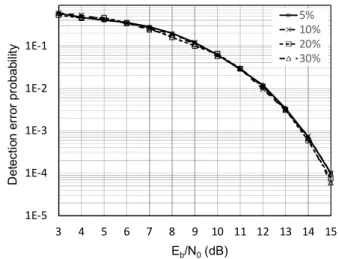
magnitude of second tag signal is 30 percent of that of first tag signal. Fig. 5 shows that the detection performance using the proposed method is irrelevant to the delay between tags.
1E-5 1E-4 1E-3 1E-2 1E-1 3 4 5 6 7 8 9 10 11 12 13 14 15 D et ec tio n er ro r pr ob ab ili ty Eb/N0(dB) 5% 10% 20% 30%
Fig. 5. Simulated detection performance with different delay between tags.
Fig. 6 shows the simulated detection performance according to magnitude between tags. In Fig. 6, it is assumed that two tags reply simultaneously
shows that the detection performance using the proposed method is improved as the magnitude difference between tags increases.
Fig. 7 shows the simulated detection performance according to number of tags replying simultaneously. In Fig. 7, it is assumed that delay and magnitude of second, third, and forth tags are {10%, 30%}, {25%, 30%}, {40%, 30%} of those of first tag, respectively. Fig. 7 shows that the detection performance using the proposed method is improved a little as the number of tags increases. The proposed method only determines whether or not tag collision has occurred, not the number of collided tags. Hence, as the number of tags replying simultaneously increases, tag collision detection probability is increased. 1E-5 1E-4 1E-3 1E-2 1E-1 3 4 5 6 7 8 9 10 11 12 13 14 15 D et ec tio n er ro r pr ob ab ili ty Eb/N0(dB) 2 tags 3 tags 4 tags
Fig. 7. Simulated detection performance with different number of tags replying simultaneously.
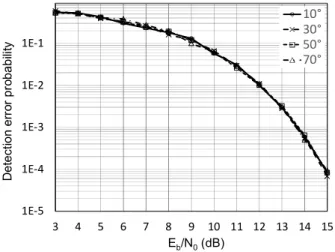
1E-5 1E-4 1E-3 1E-2 1E-1 3 4 5 6 7 8 9 10 11 12 13 14 15 D et ec tio n er ro r pr ob ab ili ty Eb/N0(dB) 10° 30° 50° 70°
Fig. 8. Simulated detection performance with different phase difference between tags.
Fig. 8 shows the simulated detection performance according to phase difference between tags. In Fig. 8, it is assumed that two tags reply simultaneously and delay and magnitude of second tag are 20% and 30% of those of first tag. Fig. 8 shows that the detection performance using the proposed method is irrelevant to the phase difference between tags.
Ⅴ. Conclusion
In this paper, we presented UHF RFID tag collision detection method utilizing periodicity. The proposed method utilizes that periodicity of tag signals is maintained even under tag collision. In the proposed method, the correlation between received signal and reference edge signal is used. Simulation result has shown that the detection performance using the proposed method is about 10 dB better than that of existing method. In addition, the detection performance using the proposed is irrelevant delay and/or phase difference between tags and improved as the number of tags replying simultaneously increases.
References
[1] Soumil Niltin Shah, Abdelshakour Abuzneid, “IoT Based Smart Attendance System (SAS) Using RFID,” 2019 IEEE Long Island Systems, Applications and Technology Conference (LISAT), pp.1-6, 2019. DOI: 10.1109/LISAT.2019.8817339 [2] Sara Amendola, Rossella Lodato, Sabina Manzari, Cecilia Occhiuzzi, Gaetano Marrocco,
“RFID Technology for IoT-Based Personal
Healthcare in Smart Spaces,” IEEE Internet of Things Journal, vol.1 no.2, pp.144-152, 2014. DOI: 10.1109/JIOT.2014.2313981
[3] Rohan P Suresh, Shasna Shajahan Kavalakkal, Shifana Shereef, A S Sreeragh, Jerrin Sebastian, “IoT Based Toll Gate System Using RFID,” 2019 3rd International Conference on Trends in Electronics and Informatics (ICOEI), pp.1-5, 2019.
Tag Anticollision,” IEEE Transactions on Parallel and Distributed Systems, vol.24, no.1, pp.19-31, 2013. DOI: 10.1109/TPDS.2012.120
[6] Xi Tan, He Wang, Lingzhi Fu, Junyu Wang, Hao Min, and Daniel W. Engels, “Collision Detection and Signal Recovery for UHF RFID Systems,” IEEE Transactions on Automation Science and Engineering, vol.15, no.1, pp.239-250, 2018. DOI: 10.1109/TASE.2016.2614134
[7] John G. Proakis, Digital Communications, McGraw-Hill, 2008.
[8] EPC™ Radio-Frequency Identity Protocols Generations-2 UHF RFID Standard, 2018.
BIOGRAPHY
Wan-Seung Yang (Member)2014:BS degree in Electronic and IT Media Engineering, Seoul National University of Science and Technology. 2014~:Research Engineer, Phychips. 2018~:MS degree course in Electronic Engineering, Seoul National University of Science and Technology.
Hyung Chul Park (Member)
1996:BS degree in Electrical Engineering, KAIST. 1998:MS degree in Electrical Engineering, KAIST. 2003:PhD degree in Electrical Engineering, KAIST.
2003~2005:Research Engineer, Hynix Semiconductor. 2005~2010:Assistant Professor, Hanbat National University
2010~:Professor, Seoul National University of Science and Technology