ICCAS2005 June 2-5, KINTEX, Gyeonggi-Do, Korea
A Heterogeneous Home Network Control System Using HNCP
Joseph Jeon and Wook-Hyun Kwon
Control Information Systems Lab.,
SoEECS, Seoul National University, Seoul, 151-742, Korea
Abstract: : In this paper, a heterogeneous home network control system using HNCP is proposed and implemented. A power line and 802.15.4 are used as media for the system. Information about home environment gathered by sensors is transferred to a power line connected device through the 802.15.4. HNCP stimulate the home network based on the both media. Sensor device definition for the HNCP address and message set is proposed. TinyOS supports the HNCP stack on the wireless sensor board. The home network control system implemented with these techniques has a benefit of user friendly operation of home appliances based on the sensing data. Implementation and experiment shows validity of the system.
Keywords: Home network, HNCP, PLC, 802.15.4, TinyOS
1. Introduction
A home network system is composed of various devices and communication media [1]. Not only there is no dominating technology or standard in the market, but also user’s require-ments are various according to the user’s own interest. These are why the home network system is equipped with various network media and technologies. With regard to the media, the technologies used in the home network system can be classified as the following standards. Wired or wireless, new wires or existing networks, low rate or high rate, and protocol complexity [5]. As the home network system have a strong relationship with an end-user, performance support for the digital applications - data, A/V, and control - are required, as well [6]. A home network control system (HNCS) involves devices that are connected to the network for the control and monitoring purposes. The HNCS includes a wide variety of applications often called smart home. Applications include lighting and home appliances control; external monitoring and control; home security etc. These applications generally require low bandwidth and operate on a best effort. A power line communication (PLC), bluetooth, and IEEE 802.15.4 provide low rate communication without additional installation. While IEEE 802.11, bluetooth, and IEEE 802.15.4 operate in 2.4GHz band where a microwave oven interferes, the power line can provide reliable transmission. Home network control protocol (HNCP) [3] is a 4-layer pro-tocol designed to control and monitor the home appliances based on the PLC. HNCP defines an application specific mes-sage set that enables users manage the appliances easily. We define a sensor message specification of HNCP to provide in-telligent service based on the sensors. Legacy home network protocols only depend on either user-defined scenarios or a direct access control. To manage the appliances actively in a home, sensors should be connected to the home network protocol.
In this paper, we focuses on the PLC and IEEE 802.15.4 with TinyOS [4]. The PLC is used to manage the home ap-pliances. IEEE 802.15.4 is used for wireless sensors. TinyOS is ported to the sensor board to guarantee the various func-tions. HNCP provides an upper layer protocol for both tech-nologies. A brief introduction of the PLC and IEEE 802.15.4
is presented in Chapter 2. In Chapter 3, HNCP is introduced and a proposal is given to complement the sensor function in HNCP. Implementation and experiment result are given in Chapter 4. In Chapter 5, conclusion and future works will be given.
2. PLC and IEEE 802.15.4
2.1. PLC
The power distribution network, also called power line, is the most widely available home network. For more than 10 years, various committees and standardization bodies have tried to develop a technology that is able to utilize the power line net-work for in-home data transfer. The PLC have the benefits of no new wiring labor and many outlets in the home. How-ever, due to the power line was not aimed to data transmis-sion, it have to endure severe noise. Technologies and algo-rithms including orthogonal frequency-division multiplexing (OFDM), rapid adaptive equalization, wideband signalling, forward error correction (FEC), segmentation and reassem-bly (SAR), and token passing MAC (Media Access Control) layers are employed to enhance transmission robustness, in-crease the bandwidth, guarantee the quality and provide both asynchronous and isochronous transmission [5]. 2.2. IEEE 802.15.4
IEEE 802.15.4 has been developed to provide low complex-ity, cost, and power consumption for low data-rate wireless connectivity. The IEEE 802.15.4 defines two PHY layers, the 2.4 GHz and 868/915 MHz band PHYs. Total 27 chan-nels with three different raw data rates are allocated in the IEEE 802.15.4: 16 channels with a data rate of 250 kb/s (or, expressed in symbols, 62.5 ksymbols/s) in the 2.4 GHz band, 10 channels with a data rate of 40 kb/s (40ksymbols/s) in the 915 MHz band, and 1 channel with a data rate of 20 kb/s (20 ksymbols/s) in the 868 MHz band. The standard de-fines two channel access mechanisms, depending on whether beacon frames (sent periodically by the coordinator to syn-chronize communications) are used or not. The standard also supports two topologies: in the star topology network, all communications must go through the PAN coordinator which is the central controller device of the WPAN [8].
3. HNCP
3.1. HNCP introduction
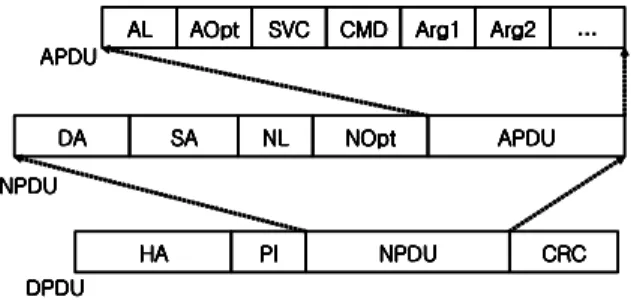
HNCP is a communication protocol based on the low speed PLC [3]. HNCP is aimed to control home appliances. It is composed of 4 layers to reduce an overhead of the commu-nication packet. Target networked home appliances are as-sumed to be operated on an 8-bit microprocessor. Multi mas-ter structure is supported so that user can use devices from multiple masters. Device address of HNCP, which is 2 bytes long, is separated into two group. The first byte announces defined device type and the second byte logical address or location address of the device. This address structure makes an easy initializing operation. Furthermore, a supported standard message set facilitates the inter-operability between home appliances. The message set includes all the defined services and actions of each devices. The message set is composed of a command, argument, and service. The com-mand is the function the device supports. The argument is the value of the function. The service is the operation al-lowed to the user like read and write the argument. HNCP is targeted to the indoor network, hence techniques that im-plement gateways are required to access via the internet. A HNCP layer architecture is showed in Figure 1.
AL AL AL
AL AOptAOptAOptAOpt SVCSVCSVCSVC CMDCMDCMDCMD Arg1Arg1Arg1Arg1 Arg2Arg2Arg2Arg2 …
DA DA DA
DA SASASASA NLNLNLNL NOptNOptNOptNOpt APDUAPDUAPDUAPDU
HA HA HA
HA PIPIPIPI NPDUNPDUNPDUNPDU CRCCRCCRCCRC APDU APDU APDU APDU NPDU NPDUNPDU NPDU DPDU DPDU DPDU DPDU
APDU : Application layer data unit. NPDU : Network layer data unit.
DPDU : Data link layer data unit. AL : APDU length. AOpt : application layer option. DA : destination address. SA : source address. NL : NPDU length.
NOpt: Network layer option. HA : house address. PI : packet information
AL AL AL
AL AOptAOptAOptAOpt SVCSVCSVCSVC CMDCMDCMDCMD Arg1Arg1Arg1Arg1 Arg2Arg2Arg2Arg2 …
DA DA DA
DA SASASASA NLNLNLNL NOptNOptNOptNOpt APDUAPDUAPDUAPDU
HA HA HA
HA PIPIPIPI NPDUNPDUNPDUNPDU CRCCRCCRCCRC APDU APDU APDU APDU NPDU NPDUNPDU NPDU DPDU DPDU DPDU DPDU
APDU : Application layer data unit. NPDU : Network layer data unit.
DPDU : Data link layer data unit. AL : APDU length. AOpt : application layer option. DA : destination address. SA : source address. NL : NPDU length.
NOpt: Network layer option. HA : house address. PI : packet information
Fig. 1. HNCP layer architecture
In [7], the home server that controls, monitors, and manages HNCP networked devices was developed. The home server receives a device description file from users or internet re-sources. Then it organizes a device data base and prepares an user interface.
3.2. Sensor message set
To use sensors in the HNCP network, the address and mes-sage set for sensors have to be defined. HNCP left spaces for additional appliances. The HNCP address is 2-bytes long. First 1 byte represent the device. Last byte is allocated to distinguish the same devices or to show the location. In the reserved device code space, the sensor board that have a sen-sor can have address from 0xA0 to 0xAF. The table 1 shows device code allocation for the single sensor board.
If the sensor board has multiple sensors, 0xB0 is set to the board as the device code. To get the sensing data from the board with multiple sensors, the command set is defined like the following table 2.
Table 1. Sensor group address allocation
sensor address Light A0 Audio Microphones A1 Accelerometers A2 Touch A3 Temperature A4 Air pressure A5 Motion detector A6 Bio A7 Gas A8 etc reserved
Table 2. Sensing data command
sensing data command
Light 0x10 Audio 0x11 Acceleration 0x12 Touch 0x13 Temperature 0x14 Air pressure 0x15 Motion 0x16 Bio 0x17 Gas 0x18 etc reserved 4. Implementation
The HNCS system is composed of a PLC home appliances part and an IEEE 802.15.4 wireless sensors part. Two parts communicate using HNCP. HNCP home appliances in [3] is used. Sensor boards communicate via air using IEEE 802.15.4. The HNCP protocol is inserted on the board with support of TinyOS. To relay the packet in both side, a PC is set to be a HNCP master with the wireless interface. In a real home, a master device have to relay the packet as a base station. The following figure shows the HNCS architecture.
Fig. 2. An architecture of the home network control system with wireless sensors
A HNCP home server manages the HNCP network. Due to the master-slave structure, the HNCP network have to have at least a master to make the system. We force the home server have an ability of a base station of IEEE 802.15.4. If the server detects the packet that comes from or goes to a sensor, it relays the packet in another media.
To receive and send the sensing message to the HNCP
ances, sensor boards have the HNCP stack. Figure 4 shows HNCP message processing in TinyOS.
Fig. 3. HNCP home server implemented on a PC
Fig. 4. HNCP protocol on the TinyOS
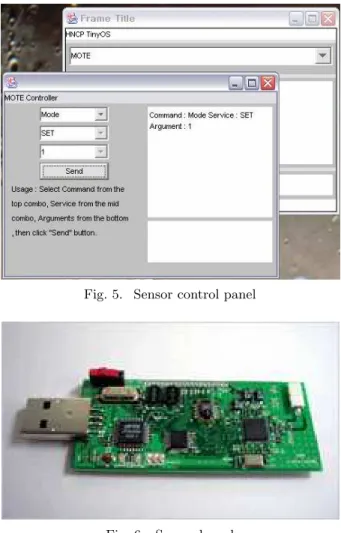
With the sensor control panel in the server, an user can con-trol or monitor the sensor directly. We experimented to show how home appliances operate with wireless sensors. The home server requests the sensors to alarm when the tem-perature goes up above a value. A sensor that monitored temperature sends packet to the base station when temper-ature reached to a given value. Then the home server sends command ”On” to the air-conditioner to turn on the de-vice. In distributed manner, the sensor board with a photo sensor sends its sensing data to the base station. Network layer destination is set to the lighting devices. The packet is relayed to the lighting devices through the master. The lighting devices react to the received data according to their own setting. Implementation and the experiment shows the system expand efficiency and the function of both home ap-pliances and sensors.
5. Conclusion and Future Works
We implemented the heterogeneous home network control system using HNCP. The PLC and IEEE 802.15.4 were used as communication media for home appliances and wireless sensors respectively. The additional address and command
Fig. 5. Sensor control panel
Fig. 6. Sensor board
set were defined to insert sensor functions into HNCP. The experiment shows its validity and usability. Future works in-clude implementation of a simple board that just relay IEEE 802.15.4 packet to the PLC domain and vice versa. Also an efficient data gathering scheme and routing protocol of the wireless sensor for the heterogeneous home network - where the sensors are connected to the wired media in several points - will be followed.
References
[1] Joseph Jeon, et al., “Design and Implementation of the HNCP-UPnP bridge using a Virtual device ,”
Interna-tional Symposium on Power Line Communication, pp.
357-361, April 2004.
[2] Kenneth Wacks, et al., ”Home Systems Standards: Achievements and Challenges”IEEE Communications
Magazine , Volume 40, Issue 4, pp. 152–159, 2002.
[3] Jae-Min Lee, et al., “New Home Network Protocol for controlling and monitoring Home Appliances - HNCP,”
International Conference on Consumer Electronics, pp.
312–313, 2002.
[4] TinyOS Forum, http://www.tinyos.net
[5] Th. Zahariadis, et al., “A comparison of compet-ing broadband in-home technologies,” Electronics and
Communication Engineering Journal, Volume 14, Issue
4, pp. 133-142, 2002
1600
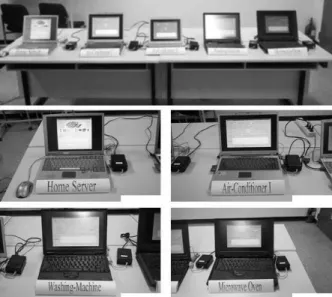
Fig. 7. HNCP appliance emulators
Fig. 8. demo system using PLC and sensor board
[6] Sandy Teger, et al., “End-User Perspectives on Home Networking,”IEEE Communications Magazine, Volume 40, Issue 4, pp. 114–119, 2002
[7] Joseph Jeon, et al., ”Design and implementation of PLC based HNCP network home server,” KIEE 2002 autumn
conference, pp. 223-226, 2002
[8] 802.15.4-2003 IEEE Standard for Information Technology-Part 15.4: Wireless Medium Access Control (MAC) and Physical Layer (PHY) specifica-tions for Low Rate Wireless Personal Area Networks (LR-WPANS), 2003.