P1-88 / Y.-S. Seo
IMID 2009 DIGEST •
Abstract
We have developed highly efficient blue phosphorescent organic light-emitting devices (PHOLEDs) with simplified architectures using new host materials. The Blue PHOLED with new host:FIrpic emitting layer exhibits a maximum luminance efficiency of 34 cd/A and a low operating voltage 5 V at a high luminance of 1212 cd/m².
1. Introduction
Organic light emitting-devices (OLEDs) have been attracted great interests for full color displays and solid state lighting applications. Although there have been great progress in white OLEDs, the efficiency of blue OLEDs is still the bottleneck to achieve high efficiency white OLEDs for solid state lighting applications 1. Research on blue phosphorescent
emitters is especially important, because this emitter is critical to white organic light emitting-devices (WOLEDs) performances. Indeed, WOLEDs with the highest efficiency use blue phosphorescent emitters. Many efforts of improving efficiency of phosphorescent OLEDs (PHOLEDs) have been reported 2,3 since Kawamura, et al. have discovered phosphorescent OLEDs utilizing triplet energy for light emission 4. One of the ways of achieving higher EL efficiency is to balance hole/electron recombination in the emission layer (EML) of OLEDs which, in general, do not necessarily provide the configuration that is conducive to a balanced carrier recombination5,6. In designing PHOLEDs, the use of a
host material with a higher triplet-excited-state energy than that of a phosphorescent dopant is essential efficient energy transfer. However, until now it has been very difficult to synthesize a suitable host material for blue phosphorescent dopants, because achieving triplet energy higher than that of the blue
phosphors is not a simple task. In this paper, we demonstrate a simple structure blue PHOLED employing by using a new host material.
2. Experimental procedures
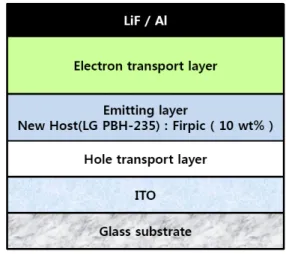
We have fabricated blue PHOLEDs shown in fig 1. Blue PHOLEDs were fabricated with simple three organic layer structure of ITO / HTL / EML ; New host (LG PBH-235) : FIrpic 10 wt% / ETL /LiF/Al.
Fig 1. Schematic structure of the blue PHOLED.
Blue PHOLEDs were fabricated on ITO coated glass substrates. The sheet resistance of ITO film was about 10 Ω/ . After defining ITO anode patterns by standard photolithography process, the substrates were cleaned in acetone and isopropyl alcohol, and then
Highly efficient blue phosphorescent organic
light-emitting device using new host materials
Yu-Seok Seo*, Tae-Yong Kim and Dae-Gyu Moon
Department of Materials Engineering, Soonchunhyang University,
646 Eupnae-ri, shinchang-myun, Asan-si, Chungnam 336-745, Korea
TEL:82-41-530-1710, e-mail: [email protected]
P1-88 / Y.-S. Seo
• IMID 2009 DIGEST
treated with oxygen plasma for 5 min. All organic and metal layers were deposited by using vacuum thermal evaporation method. The devices structure used in this study are shown in Fig. 1. ITO was used as an anode. As an emitting layer, new host material (LG PBH-235) doped with 10 wt % bis(3,5-difluoro-2-(2-pyridyl)phenyl-(2-carboxypyridyl) iridium III (FIrpic) was used. Next, the electron transport layer was deposited. After the deposition of organic layers, a 0.5 nm thick LiF and a 100 nm thick aluminum were evaporated for the cathode. The deposition rate was typically set to be 0.5~1 Å /s with the chamber pressure of 9 x 10⁻⁷ Torr. The active area of the devices was 4 x 4 mm2. The spectrum of the
fabricated devices was measured by a Minolta model CS-1000 spectroradi-ometer. The current density (J) – voltage (V) and lu-minance (L) characteristics of the blue PHOLEDs were measured by a Keithley 2400 source meter and calibrated photo-diode, respectively.
3. Results and discussion
We have fabricated red phosphorescent OLED with a new host material. Fig.2 shows the electroluminescence spectra of the devices. The EL spectra of blue PHOLED exhibit a characteristic FIrpic emission with a total absence of host emission. All the devices show strong EL peaks at wavelength of 473 nm and 496 nm. While the peak at 473 nm and 496 nm corresponds to the characteristic emission of FIrpic,
Fig. 2. EL spectra of blue PHOLED
Fig. 3. Current efficiency - current density characteristic of the blue PHOLED.
Fig. 3 shows the current efficiency–current density (cd/A – J) characteristics of the blue PHOLEDs on the doped of FIrpic in the new host material. When doping 10% blue dopant material in the emitter, the device exhibited a current efficiency of 34 cd/A with low driving voltage of 4.6 V (1.6 mA/cm2).
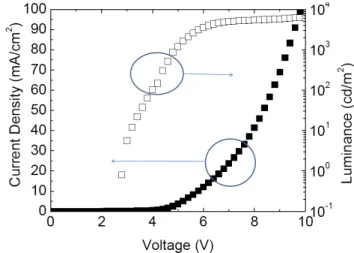
Fig 4. Current density–voltage–luminance characteristic of the bleu PHOLED.
The typical J-V-L (current density-voltage-luminance) characteristics of the blue PHOLEDs are shown in Fig 4.The device indicates high luminance at a very low driving voltage. It can be seen that the threshold voltage at 1 cd/m2 is about 2.8 V. The device
reaches a current density of 10 mA/cm2 at 5.8 V and
P1-88 / Y.-S. Seo
IMID 2009 DIGEST •
4. Summary
We have fabricated blue PHOLED with new host materials, which can provide high electroluminescent efficiency. The blue PHOLED exhibit a maximum efficiency of 34 cd/A and a power efficiency of 22 lm/W. The improvement is due to the new host materials which provide improved charge balance.
Acknowledgements: The host material (LG
PBH-235) supported by Information & Electronic Materials R&D LG chem. Research park / LG chem., Ltd.
5. Reference
1. B. W. D'Andrade and S. R. Forrest, Adv. Mater.
16, pp1585 (2004).
2. J. Pommerehne, H. Vestweber, Y H. Tak, and H. Bassler, Synth Met 76, pp67 (1996).
3. C. Qie, L. Wang, H. Chen, M. Wong, and H. S Kwok, Appl Phys Lett 79, No. 14, pp2276 (2001)..
4. Y. Kawamura, K. Goushi, J. Brooks, J. J. Brown, H. Sasabe, and C. Adachi, Appl. Phys. Lett. 86, pp071104 (2005).
5. J. Holmes, S. R. Forrest, Y. J. Tung, R. C. Kwong, J. J. Brown, S. Garon, and M. E. Thompson, Appl. Phys. Lett. 82, pp2422 (2003).
6. S. Tokito, T. Iijima, Y. Suzuri, H. Kita, T. Tsuzuki, and F. Sato, Appl. Phys. Lett. 83, pp569 (2003).