devices: Supercapacitors and triboelectric
nanogenerators
Cite as: APL Mater. 8, 110701 (2020); https://doi.org/10.1063/5.0028628
Submitted: 07 September 2020 . Accepted: 16 October 2020 . Published Online: 02 November 2020 Sanghee Nam, Jong-Nam Kim, Saewoong Oh, Jaehwan Kim, Chi Won Ahn, and Il-Kwon Oh
ARTICLES YOU MAY BE INTERESTED IN
Research progress of MXenes-based wearable pressure sensors
APL Materials
8, 110702 (2020);
https://doi.org/10.1063/5.0026984
Recent advancements in the study of intrinsic magnetic topological insulators and
magnetic Weyl semimetals
APL Materials
8, 090701 (2020);
https://doi.org/10.1063/5.0015328
Unraveling the electronic structure, mechanical, and dielectric properties of ZnPurBr-MOF:
Ab initio calculations
Ti
3
C
2
T
x
MXene for wearable energy devices:
Supercapacitors and triboelectric
nanogenerators
Cite as: APL Mater. 8, 110701 (2020);doi: 10.1063/5.0028628
Submitted: 7 September 2020 • Accepted: 16 October 2020 • Published Online: 2 November 2020
Sanghee Nam,1 Jong-Nam Kim,1 Saewoong Oh,1 Jaehwan Kim,2 Chi Won Ahn,3 and Il-Kwon Oh1,a)
AFFILIATIONS
1National Creative Research Initiative for Functionally Antagonistic Nano-Engineering, Department of Mechanical Engineering, Korea Advanced Institute of Science and Technology (KAIST), 291 Daehak-ro, Yuseong-gu, Daejeon 34141, South Korea
2Department of Mechanical System Engineering, Kumoh National Institute of Technology (KIT), 61 Daehak-ro, Gumi-si, Gyengsangbuk-do 39177, South Korea
3National Nanofab Center (NNFC), 291 Daehak-ro, Yuseung-gu, Daejeon 34141, South Korea a)Author to whom correspondence should be addressed:[email protected]
ABSTRACT
A family of two-dimensional (2D) transition metal carbides and/or nitrides, the so-called MXenes, has been discovered and investigated for advanced energy devices with outstanding performances. The outstanding physical and chemical properties of MXenes with 2D layered structures, high mechanical strength, metallic electrical conductivity, sufficient surface functional groups, hydrophilic nature, high negative zeta-potential, high surface area, large potential charge capability, and ability to accommodate intercalants are attractive for engineering applications to energy devices, particularly in wearable supercapacitors and triboelectric nanogenerators. This research update provides an overview of practical challenges and recent advances of synthetic routes and a perspective on applications to wearable energy storage and energy harvesting devices.
© 2020 Author(s). All article content, except where otherwise noted, is licensed under a Creative Commons Attribution (CC BY) license (http://creativecommons.org/licenses/by/4.0/).https://doi.org/10.1063/5.0028628., s
I. INTRODUCTION
Two-dimensional (2D) materials such as graphene,1 graphene oxide,2,3phosphorene,4,5transition metal dichalcogenides (TMDs), and boron nitride6–9 have been attracting attention due to their outstanding features, including atomic-level thickness, tunable elec-tronic properties, high ionic conductivity, and good mechanical strength.10–13 As a state-of-the-art 2D layered material, transition metal carbides and/or nitrides, namely, MXenes, have attracted increasing attention and offer a wide range of applications in areas of electronics, energy storage, and harvesting systems due to metallic-like electrical conductivity, polar surface functional groups, negative zeta-potential, and tunable electronic properties.14–18MXene can be represented by the formula Mn+1XnTx, where M is an early
transi-tion metal (Ti, Zr, V, Nb, Ta, or Mo), X is carbon and/or nitrogen, and Tx represents surface functional groups such as fluorine (–F),
oxygen (–O), hydroxyl (–OH), and/or chlorine (–Cl), which lead to the formation of semiconducting functionalized MXene.12,16,19–21 This material is generally prepared via the etching process of A lay-ers from the MAX phase, nominated as Mn+1AXn(n = 1, 2, or 3),
where A is a IIIA or IVA group. In 2011, Yury Gogotsi’s research group first synthesized titanium carbides (Ti3C2Tx) by etching of Al
elements from Ti3AlC2with hydrofluoric acid (HF) as the etchant.22
There has been a significant increase in the number of research stud-ies and publications on MXene since 2011. As one of the widely used etchants, a fluoride salt such as lithium fluoride (LiF) was also utilized with hydrochloric acid (HCl) in a process called mild etch-ing. The MXene resulting from mild etching had a larger MXene grain and a small defect size, delivering higher electrical conduc-tivity (6500 S cm−1) than the value of HF-etched MXene (1000 S cm−1) and a larger interlayer spacing of 40 Å (20 Å by HF).23,24The versatile and attractive abilities of MXene allow for the tuning of
properties for a specific application, particularly in areas of energy storage and energy harvesting, electromagnetic interference (EMI) shielding,25–27and electro- and chemical catalysts.28–30
Supercapacitors (SCs) are energy storage devices based on the faradaic reaction at the electrode and electrolyte interface. Charge is stored by electrostatic adsorption of cations onto an electrode sur-face. Thus, the SC performance is highly dependent on the surface area accessible to cations and the electrical conductivity. To enhance the performance of SCs, high electrical conductivity, high surface area, and high electrochemical activity are required as an active electrode material. MXene with metallic electrical conductivity and abundant surface functional groups can satisfy the basic require-ments. Moreover, MXene-based SCs exhibit high power density, fast charge–discharge rates, and long cycle stability.
Triboelectric nanogenerators (TENGs), which were first invented in 2012 by Fan,31 can be used to convert mechanical
kinetic energy into electricity. TENG is suitable for wearable devices because it can be modified to be light, flexible, and stretchable and has several advantages such as low-cost production, ease of fabri-cation, and high energy conversion efficiency.32 The most
impor-tant factor in the performance of TENGs is to choose two tacting materials considering electronegativity and dielectric con-stant.33,34 In order to obtain the maximum TENG output per-formance, contacting materials are selected to maximize the dif-ferences in the triboelectric series.35,36 As a triboelectric material, MXene can be expected to enhance TENG performances by prop-erly controlling surface functional groups and tuning work func-tions. In this research update, we present the latest advances and challenges of a perspective on the synthesis of Ti3C2Tx MXene
and suggest wearable energy devices based on MXene, particu-larly focusing on supercapacitors and triboelectric nanogenerators (Figs. 1).
FIG. 1. Overview of this research update for MXene-based wearable supercapacitors and triboelectric nanogenerators. 2D titanium carbide films, reused with permission
from Zhang et al., Adv. Mater. 29, 1702678 (2017). Copyright 2017 Wiley. MXene/RuO2asymmetric SCs, reused with permission from Jiang et al., Adv. Energy Mater.
8, 1703043 (2018). Copyright 2018 Wiley. MXene aqueous ink, reused with permission from Wu et al., Energy Storage Mater 25, 563 (2020). Copyright 2020 Elsevier.83
Printing and patterned MXene, reused with permission from Kurra et al., Adv. Energy Mater. 6, 1601372 (2016). Copyright 2016 Wiley.84MXene sediment inks, reused with permission from Abdolhosseinzadeh et al., Adv. Mater. 32, 1 (2020). Copyright 2020 Wiley.85MXene-rGO, reused with permission from Zhou et al., ACS Nano 14, 3576 (2020). Copyright 2020 American Chemical Society 2020. PDMS/MXene, reused with permission from Jiang et al., Nano Energy 66, 104121 (2019). Copyright 2019 Elsevier. PVA/MXene electrospun nanofiber, reused with permission from Jiang et al., Nano Energy 59, 268 (2019). Copyright Elsevier. MXene-based MSCs integrated with TENGs, reused with permission from Jiang et al., Nano Energy 45, 266 (2018). Copyright Elsevier. MXene hydrogel, reused with permission from Lee et al., ACS Nano 14, 3199 (2020). Copyright 2020 American Chemical Society. MXene/PET–ITO, reused with permission from Dong et al., Nano Energy 44, 103 (2018). Copyright 2017 Elsevier.
II. PERSPECTIVE: SYNTHESIS OF 2D MXENE AND ENERGY DEVICES
A. Synthesis method
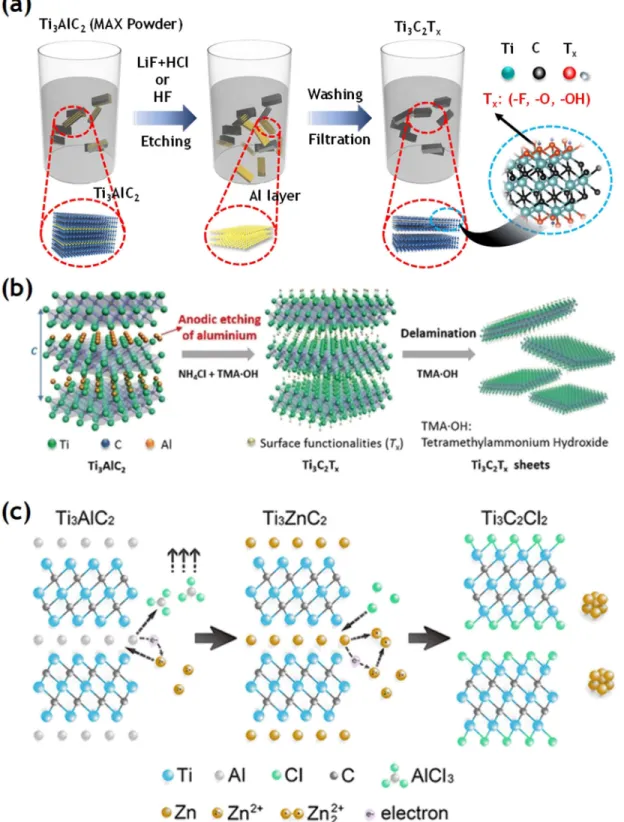
The etching process is generally employed for synthesis of MXene because it is difficult to mechanically break metallic bonds between the A and M elements (Figs. 2). Wet etching with hydro-gen fluoride (HF) has been widely utilized to exfoliate the MAX phase.37,38On the basis of experimental findings, as the atomic num-ber of M increases, a longer etching time and stronger etchant are required.37Instead of HF etching, a mixture of a strong acid and a fluoride salt can be employed as the etchant in a process called mild etching.24,39–41Ghidiuet al. used a mixture of HF and lithium chloride (LiCl) and achieved excellent etching results and expanded interlayer spacing between MXene layers.42Mild etching processes using fluoride salts such as lithium fluoride (LiF), sodium fluoride (NaF), and potassium fluoride (KF) have advantages over pure HF etching because of less defect sites on the surface, indicating higher electrical conductivity.43,44When etching with HF, the delamination step is necessary because it is not simultaneous etching and exfo-liation. On the other hand, during the mild-etching, metal cations intercalate and expand the interlayer spacing between the MXene layers.24
As the other method, ammonium hydrogen bifluoride (NH4HF2) and ammonium fluoride (NH4F) were successfully
uti-lized for etching. Halimet al. employed NH4HF2 as the etchant
and synthesized MXene having a 25% larger c-lattice parameter than that etched with HF.45 Karlsson et al. also used NH4HF2
for 5 days, and chemical and structural properties related to sur-face functional groups were studied at the atomic level by aberra-tion corrected STEM-EELS.46Intrinsic defects in surface and edge terminations of MXene were suppressed, and the fluorine group was not visible on the single sheet. The present lack of –F on the single sheet indicates that –F may be dissociated from the surfaces after the etching process as a consequence of its volatile nature.
Recently, another important advance has been the development of processes for fluoride-free etching.12 Li et al. in 2019 utilized the molten zinc chloride (ZnCl2) salt for the synthesis of MXene.47
Chlorine terminations on MXene sheets were derived by an exfo-liation of Ti3ZnC2 and Ti2ZnC because of the strong Lewis acid
with molten ZnCl2. This etching method provides an eco-friendly
and fluoride-free chemical approach. The MXenes are employed as active materials and triboelectric materials for SCs and TENGs and will be intensively reviewed for SCs and TENGs in the following. B. Energy storage application
Supercapacitor is an electrochemical device to store energy by polarized electrolyte. Two classes of charge storage mechanism were classified; electrical double layer capacitors (EDLCs) and pseudoca-pacitors. EDLCs store charge at the electrolyte–electrode interface by the non-faradaic reaction of intercalation and de-intercalation, and pseudocapacitors are operated by the redox reaction at the inter-face.48,49Among them, EDLCs can operate intrinsically at high cur-rent density and can deliver fast charging–discharging speed and high power density without degradation over long-term repeated cycles because of the high reversible reaction.50Recently, MXenes
have been highly promising as electrode materials due to their metal-lic conductivity, enhancing the electronic transport of redox reac-tions (Figs. 3). Also, the 2D structure of MXene has an advantage for flexible energy storage, offering good mechanical properties and strain tunability.16,51–53Based on these properties, planar thin film electrodes prepared by vacuum-filtration of Ti3C2Txdispersion have
been widely studied in flexible SCs because 2D materials with high mechanical flexibility can be utilized for wearable devices.54–56Jiang
et al. in 2018 reported MXene as the anode for asymmetric SCs based on carbon fabrics (CFs). Use of CFs provides advantages in flexible and wearable SCs. Due to their 3D structure, high elec-trical conductivity, flexibility, excellent mechanical properties, and chemical/physical stability, CFs have attracted increasing attention as the multifunctional current collector.10,21 Synthesized Ti3C2Tx
MXene ink was drop casted on CFs and electrochemically measured with RuO2and 1M H2SO4as the cathode and electrolyte,
respec-tively, in 0 V–1.5 V of the potential range. This process resulted in energy densities of 45 μWh cm−2and 37 μWh cm−2at power densities of 6 mW cm−2and 40 mW cm−2, respectively. Yuet al. fabricated MXene-bonded activated carbon with a synergic effect of Ti3C2Txand activated carbon.57Ti3C2TxMXene layers can play
multifunctional roles such as binders, flexible backbones, and con-ductive networks. Meanwhile, activated carbon particles were added to bond the interlayers of delaminated MXene, thereby eliminating the need for insulating binders. The resultant materials exhibited a specific capacitance of 126 F g−1at 0.1 A g−1 and remarkably sustained stability to 57.9% at 100 A g−1. Zhanget al. developed transparent and flexible SCs with MXene/single-walled carbon nan-otubes (SWCNT) and polyvinyl alcohol (PVA)/H2SO4 electrolyte
(0 V–1.0 V). These electrodes exhibited values of 1.6 mF cm−2and 0.05 μWh cm−2 of areal capacitance and energy density, respec-tively, without capacitance degradation over 20 000 cycles.58 In
order to resolve restacking issues and provide a conductive path, Li et al. proposed multi-walled carbon nanotubes (MWCNT)/MXene nanocomposites formed by in situ growth of MWCNT between MXenes on carbon clothes for flexible SCs.59 MWCNT served as
a interlayer pillar between MXene sheets, prevented spontaneous collapse, and enabled stable maintenance of resistance during 2000 bending cycles. The as-prepared electrode delivered a specific capac-itance of 114.58 mF cm−2at 1 mA cm−2and high retention dur-ing 16 000 cycles. Zhou et al. reported Ti3C2Tx MXene/reduced
graphene oxide (rGO) composite electrodes for stretchable SCs. The mechanical robustness of rGO provided sturdy interactions and mechanical flexibility, while MXene delivered superior electro-chemical properties.60MXene/rGO composite electrodes showed a wrinkled and ridged structure, which maintained structural integrity under various uni-axial pre-strains of 100%, 200%, and 300%. The as-prepared stretchable SC delivered a specific capacitance of 18.6 mF cm−2(90 F cm−3 and 29 F g−1) and stretchability of up to 300%. Well-dispersed Ti3C2Txin various solvents can be utilized
as coating on various substrates such as fabric, yarn, and textile by printing Ti3C2Tx ink with conductive and electroactive electrodes
for wearable SCs.61–68 Uzunet al. reported Ti3C2Tx coated
cellu-lose yarns and seamlessly knitted yarns into wearable textiles.69The MXene loading was 77%, and the electrical conductivity increased up to ∼440 S cm−1, a 1000 times increase compared to carbon materials and offering a specific capacitance of 759.5 mF cm−2at 2 mV s−1. Moreover, as-prepared electroactive cellulose-based yarn
FIG. 2. Schematic of the etching process of MAX phases and formation of MXene. (a) Wet-etching process with HF or mild-etching using LiF + HCl, reused with permission
from Nam et al., Compos. Part B: Eng. 181, 107583 (2020). Copyright 2020 Elsevier. (b) Fluoride-free etching with NH4BF2and NH4F, reused with permission from Yang
et al., Angew. Chem., Int. Ed. 57, 15491 (2018). Copyright 2018 Wiley.86(c) New synthesis method with Lewis acid in molten ZnCl
2salt to provide chlorine terminations,
FIG. 3. Design of flexible and
wear-able SCs based on MXene. (a) Mech-anism of storage by intercalation and de-intercalation for cations in the flex-ible MXene interlayer. (b) Fabrication of Ti3C2Tx MXene based transparent
and flexible symmetric supercapacitor, reused with permission from Zhang et al., Adv. Mater. 29, 1702678 (2017). Copyright 2017 Wiley. (c) Knittable and washable MXene-coated cellulose yarn integrated with a supercapacitor and energy harvesting device, reused with permission from Uzun et al., Adv. Funct. Mater. 29, 1905015 (2019). Copyright 2019 Wiley. (d) MXene-based textile supercapacitor on 1 and 2-ply cotton yarn, reused with permission from Levitt et al., Mater. Today 34, 17 (2020). Copy-right 2020 Elsevier.87
SCs can endure harsh environments, maintaining MXene loading (2 mg cm−1) and low resistance (3 Ω cm−1) after 45 h of washing in a temperature range of 30○
C–80○
C. With the high advancement and demand of portable electronics and wearable devices, flexible SCs have been intensively investigated.49 MXene with high flexi-bility, high surface area, and high electrochemical activity by the abundant surface functional group is suitable to overcome the lim-itation of unbendable traditional SCs because of their nature in the electrode.
C. Energy harvesting application
TENG generates electrical energy with the combination of triboelectrification and electrostatic induction between dissimilar materials. TENG, normally composed of triboelectric materials and electrodes, has different work functions, indicating that two elec-trodes are differently charged (positively and negatively) when two different materials contact each other. After separating each other, the charged surfaces cause electrons in electrodes to move
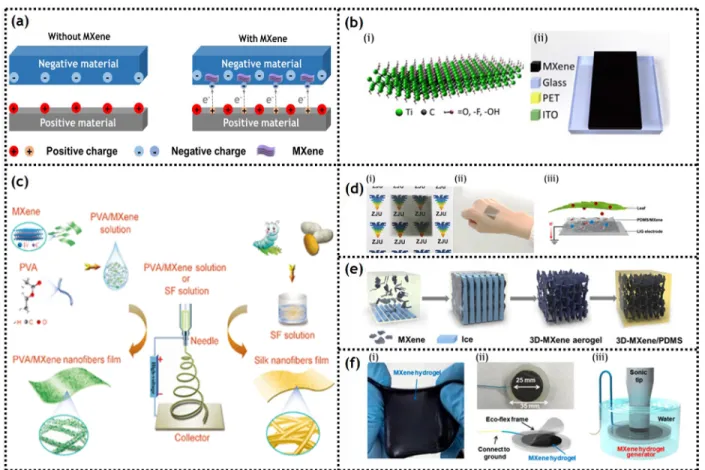
to the opposite electrodes. According to the fundamental theory of TENG, the important properties for the performance of TENG are charge density and dielectric constant of materials.70 MXene can enhance not only the charge density but also the dielectric con-stant of materials because fluorine and oxygen functional groups on MXene strongly attract electrons and the 2D structure of MXene accumulates charge between interlayer sheets and the polymer matrix (Figs. 4). Therefore, unique physical and chemical proper-ties of MXene are beneficial for TENG.71–75Initially, the commercial electronegative polymers such as polytetrafluoroethylene (PTFE), polydimethylsiloxane (PDMS), and fluorinated ethylene propylene (FEP) have been utilized as triboelectric materials.76MXenes have
attracted much attention for enhancement of the performance of TENGs by increasing the electronegativity and electrical conduc-tivity of materials. Donget al. coated MXene on glass to utilize the negative triboelectric material and the electrode.77MXene enhanced
the triboelectric material to make it more negative than PTFE. Fur-thermore, an MXene-based TENG in the single electrode mode was
FIG. 4. Design of MXene-based flexible triboelectric nanogenerators. (a) Schematic description of interaction between MXene and triboelectric materials. (b) MXene coated
PET–ITO film, reused with permission from Dong et al., Nano Energy 44, 103 (2018). Copyright 2018 Elsevier. (c) PVA/MXene electrospun nanofiber-based flexible TENGs, reused with permission from Jiang et al., Nano Energy 59, 268 (2019). Copyright 2019 Elsevier. (d) Porous PDMS/MXene film integrated with the laser-induced graphene electrode, reused with permission from Jiang et al., Nano Energy 66, 104121 (2019). Copyright 2019 Elsevier. (e) 3D-MXene aerogel and PDMS nanocomposites, reused with permission from Wang et al., Compos. Part A: Appl. Sci. Manuf. 130, 105754 (2020). Copyright 2020 Elsevier 2020. (f) Stretchable MXene hydrogel generator, reused with permission from Lee et al., ACS Nano 14, 3199 (2020). Copyright 2020 American Chemical Society.
demonstrated with the polyethylene terephthalate–indium tin oxide (PET–ITO) film and generated 650 V and an instantaneous peak power of 0.65 mW. The MXene-based TENG was attached to a sub-ject’s thumb to harvest waste energy from human motion. Jiang et al. integrated an MXene nanosheet with PVA to make wearable TENGs.78 The MXene nanosheet was added to PVA to fabricate highly electronegative electrospun nanofibers; the TENG device pro-duced an instantaneous maximum peak power density of 1087.6 mW m−2at 5 MΩ. Jianget al. fabricated a PDMS/MXene compos-ited TENG.71MXene enabled PDMS to improve not only the tribo-electric negativity but also the tribo-electrical conductivity. Also, the sur-face area of the PDMS/MXene film is increased and it enhanced the instantaneous power density of the PDMS/MXene TENG to a value of 609.1 mW m−2, which is seven times greater than that of pure PDMS-based TENG. Wang et al. developed a three-dimensional MXene skeleton for electrical, thermal, and triboelectric applica-tions.79 After MXene was integrated with PDMS into a 3D struc-ture, the MXene/PDMS composite showed not only high thermal and electrical conductivity but also enhanced negative triboelec-tricity. The TENG based on MXene/PDMS generated a potential and current of 45 V and 0.6 μA, respectively. Lee et al. converted the ultrasound power into electrical energy by fabricating a tissue-mimicking MXene-hydrogel.80 The existing method to harvest ultrasound power requires special material and complex devices. Furthermore, the biocompatibility and acoustic impedance match-ing should be considered for implantable energy harvesters. Basi-cally, the electric power from ultrasound generated from MXene-hydrogel composed of the MXene and PVA is attributed to stream-ing vibration potential (SVP). Triboelectrification enhanced the out-put power of the MXene-hydrogel generator, resulting in 8 V and 21 μA of the output voltage and current of the MXene-hydrogel gen-erator, respectively. As described above, MXene can be utilized not only to tune the electronegativity of contacting materials but also to realize very unique and multi-functional electrode in TENGs. In general, Al and Cu have been widely employed as a positive tribo-electric material. MXene as a conductive and negative tribotribo-electric material is necessary to expand selection of triboelectric materials, and a relatively thin MXene electrode is very suitable for devel-oping flexible wearable devices compared with purely rigid metal electrodes.
III. CONCLUSIONS
This research update outlined 2D Ti3C2TxMXene and its use
for wearable energy devices. Current wearable devices are bulky and uncomfortable and have limitations for compact design due to their use of lithium-ion batteries as a power source. Recent stud-ies on MXene-based applications have shown high flexibility and good mechanical strength when using knitted electrodes and flex-ible polymer electrolytes. Metallic conductivity, abundant surface functional groups, and high specific capacitance derived from the specific surface area of MXene have a potential to be promising elec-trode materials for SCs. Moreover, high flexibility of the 2D struc-ture can be advantageous for flexible and wearable devices. TENGs were recently invented and have become an attractive and promising technology for harvesting electricity from mechanical kinetic energy. Unfortunately, due to the instantaneous AC signal and low current
output of TENGs, these devices have not been directly considered to operate wearable devices. However, as a promising solution, inte-grating with energy storage devices, particularly SCs, TENGs can be feasible as self-charging wearable electronics to convert the mechan-ical energy of human activity into electricity, which will be electro-chemically stored.81By using flexible electrodes based on MXene, a wearable device combining TENG with SCs can be fabricated as compact, stretchable, flexible, wearable, and self-powering energy devices. They will also be integrated with various next generation electronics and sensor networks in the future. As a big problem, the electrical conductivity of MXene in an ambient environment has gradually degraded around 15 days, forming primarily TiO2.82To
prevent the oxidation, controlling the number of surface functional groups is required with an antioxidant. Furthermore, an effective method to maintain long-term stability of MXene should be urgently developed.
AUTHORS’ CONTRIBUTIONS
S.N. and J.N.K. contributed equally to this work.
ACKNOWLEDGMENTS
This research was supported by the Alchemist Project (No. 20007014) of the Ministry of Trade, Industry and Energy. This work was supported by the Defense Acquisition Program Administration and the Agency for Defense Development in Korea under the Con-tract No. UD170023DD. This research was supported by the Global Research Development Center Program through the NRF funded by the MSIT (NNFC-KAIST-Drexel-SMU FIRST Nano Co-op Center; Grant No. NRF-2015K1A4A3047100).
DATA AVAILABILITY
Data sharing is not applicable to this article as no new data were created or analyzed in this study.
REFERENCES
1S. De Liberato, C. Ciuti, D. Auston, M. Nuss, S. Keiding, M. Van Exter, C. Fattinger, A. J. Taylor, C. Highstrete, M. Lee, R. D. Averitt, E. Smirnova, A. Azad, H. Chen, A. J. Taylor, G. Scalari, M. I. Amanti, M. Beck, and J. Faist, Science335, 1326 (2012).
2
D. A. Dikin, S. Stankovich, E. J. Zimney, R. D. Piner, G. H. B. Dommett, G. Evmenenko, S. T. Nguyen, and R. S. Ruoff,Nature448, 457 (2007).
3S. Stankovich, D. A. Dikin, R. D. Piner, K. A. Kohlhaas, A. Kleinhammes, Y. Jia, and Y. Wu,Carbon45, 1558 (2007).
4
M. C. Watts, L. Picco, F. S. Russell-Pavier, P. L. Cullen, T. S. Miller, S. P. Bar-tu´s, O. D. Payton, N. T. Skipper, V. Tileli, and C. A. Howard,Nature568, 216 (2019).
5
A. Carvalho, M. Wang, X. Zhu, A. S. Rodin, H. Su, and A. H. Castro Neto,Nat. Rev. Mater.1, 16061 (2016).
6M.-R. Gao, Y.-F. Xu, J. Jiang, and S.-H. Yu,Chem. Soc. Rev.
42, 2986 (2013). 7S. Manzeli, D. Ovchinnikov, D. Pasquier, O. V. Yazyev, and A. Kis,Nat. Rev. Mater.2, 17033 (2017).
8
9
V. H. Nguyen, R. Tabassian, S. Oh, S. Nam, M. Mahato, P. Thangasamy, A. Rajabi-Abhari, W.-J. Hwang, A. K. Taseer, and I.-K. Oh,Adv. Funct. Mater. 2020, 1909504.
10
S. Nam, S. Umrao, S. Oh, K. H. Shin, H. S. Park, and I.-K. Oh,Compos. Part B: Eng.181, 107583 (2020).
11
F. Bonaccorso, L. Colombo, G. Yu, M. Stoller, V. Tozzini, A. C. Ferrari, R. S. Ruoff, and V. Pellegrini,Science347, 1246501 (2015).
12B. Anasori, M. R. Lukatskaya, and Y. Gogotsi,Nat. Rev. Mater. 2, 16098 (2017).
13J. Qin, P. Das, S. Zheng, and Z.-S. Wu,APL Mater.
7, 090902 (2019). 14X. Tang, X. Guo, W. Wu, and G. Wang,Adv. Energy Mater.
8, 1801897 (2018). 15
P. Urbankowski, B. Anasori, K. Hantanasirisakul, L. Yang, L. Zhang, B. Haines, S. J. May, S. J. L. Billinge, and Y. Gogotsi,Nanoscale9, 17722 (2017).
16J. Pang, R. G. Mendes, A. Bachmatiuk, L. Zhao, H. Q. Ta, T. Gemming, H. Liu, Z. Liu, and M. H. Rummeli,Chem. Soc. Rev.48, 72 (2019).
17
X. Sang, Y. Xie, M.-W. Lin, M. Alhabeb, K. L. Van Aken, Y. Gogotsi, P. R. C. Kent, K. Xiao, and R. R. Unocic,ACS Nano10, 9193 (2016).
18
X. Wang, X. Shen, Y. Gao, Z. Wang, R. Yu, and L. Chen,J. Am. Chem. Soc.137, 2715 (2015).
19I. R. Shein and A. L. Ivanovskii,Micro Nano Lett.8, 59 (2013). 20
A. L. Ivanovskii and A. N. Enyashin,Russ. Chem. Rev.82, 735 (2013). 21
Q. Jiang, N. Kurra, M. Alhabeb, Y. Gogotsi, and H. N. Alshareef,Adv. Energy Mater.8, 1703043 (2018).
22
M. Naguib, M. Kurtoglu, V. Presser, J. Lu, J. Niu, M. Heon, L. Hultman, Y. Gogotsi, and M. W. Barsoum,Adv. Mater.23, 4248 (2011).
23A. D. Dillon, M. J. Ghidiu, A. L. Krick, J. Griggs, S. J. May, Y. Gogotsi, M. W. Barsoum, and A. T. Fafarman,Adv. Funct. Mater.26, 4162 (2016).
24M. Ghidiu, M. R. Lukatskaya, M. Q. Zhao, Y. Gogotsi, and M. W. Barsoum, Nature516, 78 (2015).
25
F. Shahzad, M. Alhabeb, C. B. Hatter, B. Anasori, S. Man Hong, C. M. Koo, and Y. Gogotsi,Science353, 1137 (2016).
26
M. Han, C. E. Shuck, R. Rakhmanov, D. Parchment, B. Anasori, C. M. Koo, G. Friedman, and Y. Gogotsi,ACS Nano14, 5008 (2020).
27X. Li, X. Yin, S. Liang, M. Li, L. Cheng, and L. Zhang,Carbon
146, 210 (2019). 28
J. Zhang, Y. Zhao, X. Guo, C. Chen, C.-L. Dong, R.-S. Liu, C.-P. Han, Y. Li, Y. Gogotsi, and G. Wang,Nat. Catal.1, 985 (2018).
29P. Li, J. Zhu, A. D. Handoko, R. Zhang, H. Wang, D. Legut, X. Wen, Z. Fu, Z. W. Seh, and Q. Zhang,J. Mater. Chem. A6, 4271 (2018).
30
X. Yang, N. Gao, S. Zhou, and J. Zhao,Phys. Chem. Chem. Phys.20, 19390 (2018).
31F.-R. Fan, Z.-Q. Tian, and Z. Lin Wang,Nano Energy
1, 328 (2012). 32Q. Shi, T. He, and C. Lee,Nano Energy
57, 851 (2019).
33H.-J. Kim, E.-C. Yim, J.-H. Kim, S.-J. Kim, J.-Y. Park, and I.-K. Oh,Nano Energy 33, 130 (2017).
34
V. T. Bui, Q. Zhou, J. N. Kim, J. H. Oh, K. W. Han, H. S. Choi, S. W. Kim, and I. K. Oh,Adv. Funct. Mater.29, 1901638 (2019).
35J.-N. Kim, J. Lee, T. W. Go, A. Rajabi-Abhari, M. Mahato, J. Y. Park, H. Lee, and I.-K. Oh,Nano Energy75, 104904 (2020).
36
V.-T. Bui, J.-H. Oh, J.-N. Kim, Q. Zhou, D. P. Huynh, and I.-K. Oh,Nano Energy71, 104561 (2020).
37M. Naguib, V. N. Mochalin, M. W. Barsoum, and Y. Gogotsi,Adv. Mater. 26, 992 (2014).
38
M. Naguib, O. Mashtalir, J. Carle, V. Presser, J. Lu, L. Hultman, Y. Gogotsi, and M. W. Barsoum,ACS Nano6, 1322 (2012).
39J. Halim, S. Kota, M. R. Lukatskaya, M. Naguib, M.-Q. Zhao, E. J. Moon, J. Pitock, J. Nanda, S. J. May, Y. Gogotsi, and M. W. Barsoum,Adv. Funct. Mater. 26, 3118 (2016).
40Z. W. Seh, K. D. Fredrickson, B. Anasori, J. Kibsgaard, A. L. Strickler, M. R. Lukatskaya, Y. Gogotsi, T. F. Jaramillo, and A. Vojvodic,ACS Energy Lett.1, 589 (2016).
41S. Umrao, R. Tabassian, J. Kim, V. H. Nguyen, Q. Zhou, S. Nam, and I.-K. Oh, Sci. Robot.4, eaaw7797 (2019).
42
M. Ghidiu, J. Halim, S. Kota, D. Bish, Y. Gogotsi, and M. W. Barsoum,Chem. Mater.28, 3507 (2016).
43
C. E. Ren, M.-Q. Zhao, T. Makaryan, J. Halim, M. Boota, S. Kota, B. Anasori, M. W. Barsoum, and Y. Gogotsi,ChemElectroChem3, 689 (2016). 44A. Lipatov, M. Alhabeb, M. R. Lukatskaya, A. Boson, Y. Gogotsi, and A. Sinitskii, Adv. Electron. Mater.2, 1600255 (2016).
45
J. Halim, M. R. Lukatskaya, K. M. Cook, J. Lu, C. R. Smith, L.-Å. Näslund, S. J. May, L. Hultman, Y. Gogotsi, P. Eklund, and M. W. Barsoum,Chem. Mater. 26, 2374 (2014).
46
L. H. Karlsson, J. Birch, J. Halim, M. W. Barsoum, and P. O. Å. Persson,Nano Lett.15, 4955 (2015).
47M. Li, J. Lu, K. Luo, Y. Li, K. Chang, K. Chen, J. Zhou, J. Rosen, L. Hultman, P. Eklund, P. O. Å. Persson, S. Du, Z. Chai, Z. Huang, and Q. Huang,J. Am. Chem. Soc.141, 4730 (2019).
48H. Tang, J. Wang, H. Yin, H. Zhao, D. Wang, and Z. Tang,Adv. Mater. 27, 1117 (2015).
49
S. Huang, X. Zhu, S. Sarkar, and Y. Zhao,APL Mater.7, 100901 (2019). 50
A. Sugahara, Y. Ando, S. Kajiyama, K. Yazawa, K. Gotoh, M. Otani, M. Okubo, and A. Yamada, “Negative dielectric constant of water confined in nanosheets,” Nat. Commun.10, 850 (2019).
51
Q. Jiang, C. Wu, Z. Wang, A. C. Wang, J.-H. He, Z. L. Wang, and H. N. Alshareef,Nano Energy45, 266 (2018).
52B. Mendoza-Sánchez and Y. Gogotsi,Adv. Mater.
28, 6104 (2016). 53M. Beidaghi and Y. Gogotsi,Energy Environ. Sci.
7, 867 (2014).
54Z. Zhang, S. Yang, P. Zhang, J. Zhang, G. Chen, and X. Feng,Nat. Commun. 10, 2920 (2019).
55
T. Habib, X. Zhao, S. A. Shah, Y. Chen, W. Sun, H. An, J. L. Lutkenhaus, M. Radovic, and M. J. Green,npj 2D Mater. Appl.3, 8 (2019).
56Q. Yang, Y. Wang, X. Li, H. Li, Z. Wang, Z. Tang, L. Ma, F. Mo, and C. Zhi, Energy Environ. Mater.1, 183 (2018).
57
L. Yu, L. Hu, B. Anasori, Y.-T. Liu, Q. Zhu, P. Zhang, Y. Gogotsi, and B. Xu, ACS Energy Lett.3, 1597 (2018).
58C. J. Zhang, B. Anasori, A. Seral-Ascaso, S.-H. Park, N. McEvoy, A. Shmeliov, G. S. Duesberg, J. N. Coleman, Y. Gogotsi, and V. Nicolosi,Adv. Mater.29, 1702678 (2017).
59H. Li, R. Chen, M. Ali, H. Lee, and M. J. Ko,Adv. Funct. Mater.(published online).
60
Y. Zhou, K. Maleski, B. Anasori, J. O. Thostenson, Y. Pang, Y. Feng, K. Zeng, C. B. Parker, S. Zauscher, Y. Gogotsi, J. T. Glass, and C. Cao,ACS Nano14, 3576 (2020).
61
K. Maleski, V. N. Mochalin, and Y. Gogotsi,Chem. Mater.29, 1632 (2017). 62
Z. Fan, C. Wei, L. Yu, Z. Xia, J. Cai, Z. Tian, G. Zou, S. X. Dou, and J. Sun,ACS Nano14, 867 (2020).
63Y. Z. Zhang, Y. Wang, Q. Jiang, J. K. El-Demellawi, H. Kim, and H. N. Alshareef, Adv. Mater.32, 1908486 (2020).
64
Z. Wang, Y. Chen, M. Yao, J. Dong, Q. Zhang, L. Zhang, and X. Zhao,J. Power Sources448, 227398 (2020).
65Z. Wang, S. Qin, S. Seyedin, J. Zhang, J. Wang, A. Levitt, N. Li, C. Haines, R. Ovalle-Robles, W. Lei, Y. Gogotsi, R. H. Baughman, and J. M. Razal,Small14, 1802225 (2018).
66X. Li, J. Hao, R. Liu, H. He, Y. Wang, G. Liang, Y. Liu, G. Yuan, and Z. Guo, Energy Storage Mater 33, 62 (2020).
67
W. Eom, H. Shin, R. B. Ambade, S. H. Lee, K. H. Lee, D. J. Kang, and T. H. Han, Nat. Commun.11, 2825 (2020).
68
X. Pu, M. Liu, L. Li, S. Han, X. Li, C. Jiang, C. Du, J. Luo, W. Hu, and Z. L. Wang, Adv. Energy Mater.6, 1601254 (2016).
69S. Uzun, S. Seyedin, A. L. Stoltzfus, A. S. Levitt, M. Alhabeb, M. Anayee, C. J. Strobel, J. M. Razal, G. Dion, and Y. Gogotsi,Adv. Funct. Mater.29, 1905015 (2019).
70
S. Niu, S. Wang, L. Lin, Y. Liu, Y. S. Zhou, Y. Hu, and Z. L. Wang,Energy Environ. Sci.6, 3576 (2013).
71C. Jiang, X. Li, Y. Yao, L. Lan, Y. Shao, F. Zhao, Y. Ying, and J. Ping,Nano Energy66, 104121 (2019).
72
M. Hu, R. Cheng, Z. Li, T. Hu, H. Zhang, C. Shi, J. Yang, C. Cui, C. Zhang, H. Wang, B. Fan, X. Wang, and Q.-H. Yang, Nanoscale12, 763 (2020).
73
S. Tu, Q. Jiang, J. Zhang, X. He, M. N. Hedhili, X. Zhang, and H. N. Alshareef, ACS Appl. Mater. Interfaces11, 27358 (2019).
74M. Hu, Z. Li, T. Hu, S. Zhu, C. Zhang, and X. Wang,ACS Nano 10, 11344 (2016).
75
M. R. Lukatskaya, S.-M. Bak, X. Yu, X.-Q. Yang, M. W. Barsoum, and Y. Gogotsi,Adv. Energy Mater.5, 1500589 (2015).
76H. Zou, Y. Zhang, L. Guo, P. Wang, X. He, G. Dai, H. Zheng, C. Chen, A. C. Wang, C. Xu, and Z. L. Wang,Nat. Commun.10, 1427 (2019).
77
Y. Dong, S. S. K. Mallineni, K. Maleski, H. Behlow, V. N. Mochalin, A. M. Rao, Y. Gogotsi, and R. Podila,Nano Energy44, 103 (2018).
78C. Jiang, C. Wu, X. Li, Y. Yao, L. Lan, F. Zhao, Z. Ye, Y. Ying, and J. Ping,Nano Energy59, 268 (2019).
79
D. Wang, Y. Lin, D. Hu, P. Jiang, and X. Huang,Compos. Part A: Appl. Sci. Manuf.130, 105754 (2020).
80K. H. Lee, Y.-Z. Zhang, Q. Jiang, H. Kim, A. A. Alkenawi, and H. N. Alshareef, ACS Nano14, 3199 (2020).
81
S. De Mulatier, M. Ramuz, D. Coulon, S. Blayac, and R. Delattre,APL Mater.7, 031505 (2019).
82
C. J. Zhang, S. Pinilla, N. McEvoy, C. P. Cullen, B. Anasori, E. Long, S.-H. Park, A. Seral-Ascaso, A. Shmeliov, D. Krishnan, C. Morant, X. Liu, G. S. Duesberg, Y. Gogotsi, and V. Nicolosi, Chem. Mater. 29, 4848 (2017).
83C.-W. Wu, B. Unnikrishnan, I.-W. P. Chen, S. G. Harroun, H.-T. Chang, and C.-C. Huang,Energy Storage Mater25, 563 (2020).
84
N. Kurra, B. Ahmed, Y. Gogotsi, and H. N. Alshareef,Adv. Energy Mater.6, 1601372 (2016).
85
S. Abdolhosseinzadeh, R. Schneider, A. Verma, J. Heier, F. Nüesch, and C. Zhang,Adv. Mater.32, 1 (2020).
86S. Yang, P. Zhang, F. Wang, A. G. Ricciardulli, M. R. Lohe, P. W. M. Blom, and X. Feng,Angew. Chem., Int. Ed.57, 15491 (2018).
87A. Levitt, D. Hegh, P. Phillips, S. Uzun, M. Anayee, J. M. Razal, Y. Gogotsi, and G. Dion,Mater. Today34, 17 (2020).