한국해안․해양공학회 학술발표논문집 (2009) 2009년 11월 5일-11월 6일
제18권, pp. 164-167
Wave-current interaction process with consideration of wave
breaking in arbitrary water depth
임의수심에서의 쇄파현상을 고려한 파랑-해류상호작용에 관한 연구
Han Soo Lee1 , Takao Yamashita2이한수1, 야마시타 다카오2
1. INTRODUCTION
The interaction between air and sea is one of the most complicated problems that cannot be described in an exact and direct mathematical form due to interplay of several multiple-scale stochastic phenomena (Kitaigorodskii and Lumley 1983). Numerous researches in theoretical, experimental, and numerical approaches on air-sea interaction have been performed in terms of exchanging heat, momentum and water through the air-sea interface. On the long term, the convergence and divergence of oceanic heat transport provide source and sinks of heat for the atmosphere and partly responsible for the mean climate of the Earth. In large and long-term scale air-sea interactions, the understanding on how much the atmosphere and ocean influence each other is the key subject. On the other hand, the air-sea interaction process in small and short-term scale occurs quickly due to a turbulent nature of mechanical motions at sea surface layer. Waves at air-sea interface are a medium for momentum transfer from wind to those mechanical motions at sea surface layer.
Understanding on these air-sea interaction processes and numerical modeling of such interactions are very important for improving of wave and current prediction, calculation of heat and water exchange, and turbulent mixing, material transport, event bed formation,and many other applications. Recent researches on air-sea interaction using a coupled atmosphere-ocean model or a coupled wind-wave-current model consider it through a heat and water mass exchange, and a momentum transfer between air and sea. In most of numerical studies on air-sea interaction (James Edson et al. 1999; Fabrice Ardhuin et al. 2005), the momentum transfer from wind waves to surface current is only considered in deep water through wave energy dissipation by
whitecapping.
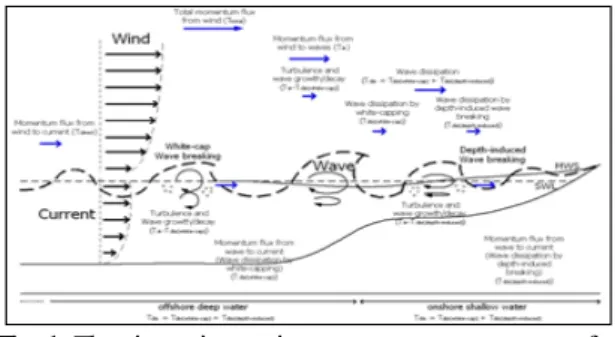
In this study, we focus on the air-sea interaction, particularly the wind waves and currents interaction process of momentum, in deep and shallow water with consideration of turbulence production implicitly by wave breaking. (See Figure 1 for the schematic diagram of momentum transfer between wind-wave-current systems). Then this interaction process is implemented in atmosphere-wind waves-ocean coupled model to consider their interaction explicitly using the exchanging variables among the systems.
2. MOMENTUM TRANSFER FROM WIND WAVES TO SURFACE CURRENTS
Even it is difficult to describe the waves and currents interaction in direct mathematical form, the description in some extent has been achieved due to spectral presentation of wind wave dynamics (Polnikov and Tkalich 2006).
Due to the wave instability and breaking, some part of dissipated wave energy is generating turbulence in sea surface layer in both deep and shallow water. These intensive small scale motions are important in many applications dealing with air bubbles entrainment, vertical mixing of admixtures, heat and gas exchange, and many others (Tkalich and Chan 2002) (Qiao et al. 2004). Here we assume the all dissipated wave energy is used for turbulent production in sea surface layer and for generating or enhancing the large scale motions such as currents. Therefore, the rest of the dissipated wave energy by wave breaking is changed into momentum to generate or enhance currents. Wave breaking phenomena considered in this study is whitecapping dominant in deep water and depth-induced wave breaking dominant in shallow water.
1 일본 히로시마대학교 국제협력연구과 특임조교
Whitecapping mainly depends on the wave steepness whereas wave breaking in shallow water depends on water depth. Thus, wind wave energy dissipation due to whitecapping in deep water affects the upper layer of water column while the transformed momentum from dissipated wave energy due to depth-induced wave breaking in shallow water may have influence on the state of the entire water column.
We introduce a new method to consider the role of depth-induced wave breaking in shallow water separately from the whitecapping in deep water. In addition, dissipation coefficients are also introduced totake into account the turbulence production in sea surface layer due to wave breaking both in deep and shallow waterimplicitly as well as the momentum transfer from waves to surface currents explicitly.
Fig. 1. The air-sea interaction process; momentum transfer between wind-wave-current considering the whitecapping and depth-induced wave breaking in deep and shallow water respectively.
It is now possible to estimate the wave energy dissipation due to wave breaking quantitatively by using a spectral wind wave model, although the observations are difficult under strong storm condition. In a spectral wind wave model, SWAN, the wind wave energy spectrum grows or decays corresponding to the energy balance in source and sink terms. Sink terms due to whitecapping (Sds(w)) in deep water and depth-induced wave breaking (Sds(dep)) in shallow water are also estimated from the spectral action balance equation. The action balance equation in SWAN can be written in spherical coordinate for the large scale applications as 1 cos cos g N S N N kN N t φ φφ θ λλ k θθ σ ∂ + ∂ + ∂ + ∂ + ∂ =
∂ ∂ & ∂ & ∂ & ∂ & (1)
where λ and are the longitude and latitude. The source and sink terms (S) are given as;
( ) 4 ( ) 3
in ds w nl bot ds dep nl
S=S +S +S +S +S +S (2) Among the source and sink terms, the energy input source term from wind to waves (Sin), the whitecapping sink term (Sds(w)) and the nonlinear wave energy transfer due to quadruplet interaction (Snl4) are estimated in deep water while the dissipation sink term due to bottom friction
(Sbot), the depth-induced wave breaking sink term (Sds(dep)), and the nonlinear triad interaction (Snl3) are calculated in the shallow water.
Then the shear stresses to surface currents induced by whitecapping and depth-induced wave breaking in deep and shallow water respectively are given as;
( ) ( ) ( ) ( , ) ds w dis whitecapping s w S K g d d C σ θ τ = ρ
∫∫
σ θ (3) ( ) ( ) ( ) ( , ) ds dep dis depth induced s depS
K g d d
C
σ θ
τ − = ρ
∫∫
σ θ (4)where ρ, g, σ, and θ are the density of water, the gravitational acceleration, the frequency, and the direction. The Ks(w) and Ks(dep)are dissipation coefficients for whitecapping and depth-induced wave breaking respectively, which represent on how much of dissipated wave energy is used for generating or enhancing the currents. The dissipation coefficient in shallow water can be determined by concept of radiation stress based on the idea that the principal force for currents under breaking waves is represented by the reduction in radiation stress, which in turn may be related to the dissipation of wave energy (Nairn et al. 1990). Therefore, we introduce the dissipation coefficient in shallow water as follows;
( )
( )
dis depth induced s dep K F τ − = (5) 2 2 2 2 xx xy yx yy x y S S S S F F F x y x y ∂ ∂ ∂ ⎛ ∂ ⎞ ⎛ ⎞ = + = ⎜− − ⎟ + −⎜ − ⎟ ∂ ∂ ∂ ∂ ⎝ ⎠ ⎝ ⎠ (6)
where Fx and Fy are wave-driven stresses and SXX is the radiation stress. The dissipation coefficient due to whitecapping is inductively determined by comparing final storm surge level after determination of the dissipation coefficient due to depth-induced wave breaking in coupled modeling.
Fig. 2. The atmosphere-wind waves-ocean coupled model showing the interaction process in terms of momentum transfer between wind-wave-current. 3. IMPLEMENTATION IN ATMOSPHERE-WIND
WAVE-OCEAN COUPLED MODEL The waves and currents interaction through Eq. (2) to (6) are implemented in atmosphere-wind waves-ocean coupled model. The atmosphere-wind waves-ocean coupled model
consists of a mesoscale meteorological model, MM5 (Grell et al. 1991), a third-generation spectral wind wave model, SWAN (Booij et al. 2004), and a sigma-coordinate ocean circulation model, POM (Mellor 2003). Component models of the coupled model are connected through the own-developed coupler (Kim and Yamashita 2004) and being operated on devoted computing environments (Lee 2006).
Figure 2 shows the synoptic diagram of the coupled model in terms of momentum transfer from wind to waves, from wind to currents, and from waves to currents considering the wave breaking in deep and shallow water.
4. STORM SURGE SIMULATIONS : APPLICATIONS of WAVE-CURRENT INTERACTION Storm surge simulations using the atmosphere-wind wave-current coupled model were conducted for three tropical storms. They are 1991 Bangladesh Cyclone and Cyclone Nargis of 2008 generated in Bay of Bengal and Hurricane Katrina of 2005 in Gulf of Mexico. They are all one of the deadliest tropical storms in the regions causing numerous casualties and damages in low-lying coastal area. Another salientfuture in three tropical storm events is the bathymetry in the regions of Bay of Bengal and Gulf of Mexico where the very shallow and vast shelves in mild slope are developed in front of low-lying coastal area. Under the severe tropical storm events, these unique bathymetries play a critical role in shallow water waves and storm surge dynamics due to wave breaking in addition to the principal forcing of storm surge such as the wind and pressure. The momentum transfer from waves to currents due to depth-induced wave breaking in these shallow water environments also has strong influences on material and sediment transport, event bed formation, etc.
In this study, the preliminary result for only Hurricane Katrina from atmospheric and wind waves simulations in term of momentum flux due to whitecapping and depth-induced wave breaking is presented to show the importance of wave breaking in shallow water using Ks(w)=Ks(dep)=1.
4.1 Model Configurations
For all cases, the MM5 simulations were conducted for three domains with 27, 9, and 3km grid intervals. The background and initial data for 1991 Bangladesh Cyclone was taken from JRA-25 data (1.125deg) of JMA (Onogi 2007) while for Hurricane Katrina and Cyclone Nargis from NCEP FNL Operational Model Global Tropospheric Analyses (1deg) (http://dss.ucar.edu/datasets/ds083.2/). The simulation periods are as follows; a) 22.Apr.1991 to 30.Apr.1991 for 1991 Bangladesh Cyclone, b) 20.Aug.2008 to 31.Aug.2008 for Hurricane Katrina, and c) 27.Apr.2008
to 4.May.2008 for Cyclone Nargis.
In SWAN simulations, the wind forcing for three domains for each case were taken from MM5 results consideringthe whitecapping and depth-induced wave breaking separately for interaction processes. In the wave modeling, underestimation of wave energy spectrum in low-frequency in SWAN was modified for the simulations.
Fig. 3. The bathymetries and the modeled domains of the coupled model for 1991 Bangladesh Cyclone, Hurricane Katrina, and Cyclone Nargis showing the tracks of tropical storms in black dots every 6hrs. In storm surge simulations with POM in this study, only domain 3 in each case was used for same periods with atmosphere and wave modelings. The meteorological forcings (wind and pressure) and wave forcings (momentum flux due to whitecapping and depth-induced wave breaking) were considered for external forcings as well as the prescribed tidal forcing of 8 constituents (M2,S2,K1,O1,N2,K2,P1,Q1) at lateral open ocean boundaries from the National Astronomical Observatory’s ocean tide model (Matsumoto 2000). For all storm surge simulations, the barotropic ocean states were considered such that the influences of temperature and salinity profiles in the ocean were remained uniform.
4.2 Modeling Results
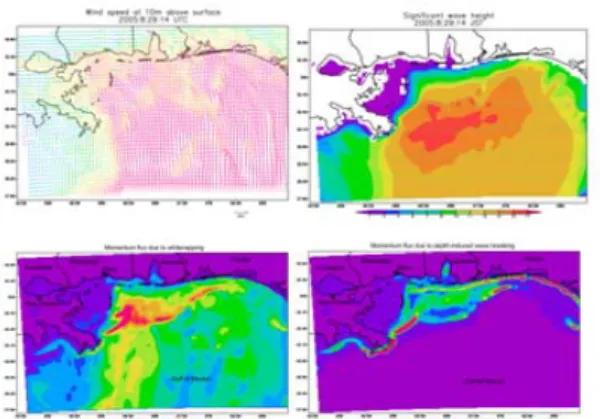
Figure 4 shows the wind velocity field from MM5, significant wave height from SWAN, the momentum flux due to whitecapping determined by Eq. (3) and the momentum flux due to depth-induced wave breaking by Eq. (4) at in case of Hurricane Katrina. As found in Figure 4, the spatial distribution of momentum flux due to depth-induced wave breaking is very distinctive along the Gulf coast. In particular, the high momentum flux due to depth-induced wave breaking was found along the Barrier Islands in Mississippi Bight and in Mobile Bay. Since the wave breaking has influence on the whole water column in shallow water, it is a critical factor that has to be considered in storm-event bed formation and erosion as reported by (Keen et al. 2006) in case of Hurricane Katrina.
In the mean time, the momentum flux due to whitecapping shows the spatial distribution corresponding to that of the wind velocity in magnitude. It is because the whitecapping sink term is the most unknown part among source and sink terms (Cavaleri et al. 2007) and is rather
determined diagnostically considering the total energy balance in action balance equation.
Fig. 4. Wind velocity (m/sec) at 14:00UTC on 29.Aug.2005 just before landfall, significant wave heights (m), momentum flux due to whitecapping, and momentum flux due to depth-induced wave breaking in case of Hurricane Katrina.
5. CONCULSION
In this study, a new idea to consider the wave breaking in deep and shallow water in wind wave-current interaction process explicitly in atmosphere-wind wave-ocean coupled model has been proposed. The wave breaking (whitecapping in deep water and depth-induced wave breaking in shallow water) is particularly considered in momentum transfer processes explicitly using common exchanging variables between wind wave and current models, while the turbulence production and other phenomena under wave breaking is considered implicitly using the wave energy dissipation coefficients due to whitecapping and depth-induced wave breaking. The momentumflux transfer processes are also important in wave and current prediction, calculation of heat and water budget, turbulent mixing, material transport, sediment dynamics such as storm-event bed formation and erosion, etc as well as storm surge and storm waves. From the preliminary results of three tropical storm events, distinctive results of spatial distribution of momentum flux were found over the developed shelf areas.
REFERENCES
Booij, N., Haagsma, I.G., Holthuijsen, L.H., Kieftenburg, A.T.M.M., et al. (2004). SWAN User Manual, SWAN Cycle III version 40.41, Delft University of Technology. Cavaleri, L., Alves, J.H.G.M., Ardhuin, F., Babanin, A., et
al. (2007). Wave modelling - The state of the art. Progress In Oceanography, 75(4), 603-674.
Fabrice Ardhuin, Alastair D. Jenkins, Daniéle Hauser, Ad Reniers, et al. (2005). Waves and Operational
Oceanography: Toward a Coherent Description of the Upper Ocean. EOS, Transactions, 86(4), 37-44.
Grell, G.A., Dudhia, J. and Stauffer, D.R. (1991). A description of the fifth-generation Penn State-NCAR Mesoscale Model (MM5), National Center for Atmospheric Research.
James Edson, T.P., Scott Sandgathe, Linwood Vincent, Louis Goodman, Tom, Curtin, J.H., Marie Colton,, Steven Anderson, E.A., Stephen Burk, Shuyi Chen, Gennaro Crescenti, Eric D’Asaro,, Kenneth Davidson, M.D., James Doyle, David Farmer, Ann Gargett, Hans Graber, Dale, et al. (1999). Coupled Marine Boundary Layers and Air-Sea Interaction Initiative: Combining Process Studies, Simulations, and Numerical Models, 140.
Keen, T.R., Furukawa, Y., Bentley, S.J., Slingerland, R.L., et al. (2006). Geological and oceanographic perspectives on event bed formation during Hurricane Katrina. Geophys. Res. Lett., 33.
Kim, K.O. and Yamashita, T. (2004). Hindcast of storm surge and wave ?elds of typhoon 9918 by wind–wave– current coupled model. Annual Journal of Coastal Engineering (JSCE) 51, 236-240.
Kitaigorodskii, S. and Lumley, J. (1983). Wave-turbulence interactions in the upper ocean. part I: The energy balance of the interacting fields of surface wind waves and wind-induced three-dimensional turbulence. Journal of Physical Oceanography, 13(11), 1977-1987.
Lee, H.S. (2006). Regional Environmental Simulator - Users manual, 54.
Matsumoto, K., T. Takanezawa, and M. Ooe (2000). Ocean Tide Models Developed by Assimilating TOPEX/POSEIDON Altimeter Data into Hydrodynamical Model: A Global Model and a Regional Model Around Japan. Journal of Oceanography, 56, 567-581.
Mellor, G.L. (2003). Users guide for a three-dimensional, primitive equation, numerical ocean model. Prog. in Atmos. And Ocean. Sci., 53pp %W Princeton University.
Nairn, R.B., J.A. Roelvink and Southgate, H.N. (1990). Transition zone width and implications for modelling surfzone hydrodynamics. Proc. 22nd International Conference on Coastal Engineering, 68-81.
Onogi, K., J. Tsutsui, H. Koide, M. Sakamoto, S. Kobayashi, H. Hatsushika, T. Matsumoto, N. Yamazaki, H. Kamahori, K. Takahashi, S. Kadokura, K. Wada, K. Kato, R. Oyama, T. Ose, N. Mannoji and R. Taira (2007). The JRA-25 Reanalysis. J. Meteor. Soc. Japan, 85, 369-432.
Polnikov, V.G. and Tkalich, P. (2006). Influence of the wind waves dissipation processes on dynamics in the water upper layer. Ocean Modelling, 11(1-2), 193-213.