Tae Wan Lim1,*, Su Kang Kim2,*, Ju Yeon Ban3, Joo-Ho Chung2, Jeong Yoon Song4,
Kyung Lim Yoon4, Sung Wook Park5, Keon Sik Kim5& Ok Young Shin5 1Department of Anesthesiology and Pain Medicine, Seoul National University Hospital, Seoul 110-744, Korea 2Kohwang Medical Research Institute, School of Medicine, Kyung Hee University, Seoul 130-701, Korea
3Department of Dental Pharmacology, College of Dentistry, Dankook University, Cheonan, Chungnam 330-716, Korea 4East-West Neo Medical Center, School of Medicine, Kyung Hee University, Seoul 134-727, Korea
5Department of Anesthesiology and Pain Medicine, School of Medicine, Kyung Hee University, Seoul 130-701, Korea *These authors contributed equally to this work
Correspondence and requests for materials should be addressed to O.Y. Shin ([email protected])
Accepted 19 November 2009
Abstract
Kawasaki disease (KD) is believed to be infectious but etiology and the mechanism of development re-main elusive. The aim of this study was to investigate the association between transmembrane channel-like 1 (TMC1) gene and KD. One hundred nine KD patients and 424 normal controls were enrolled. Of all KD patients, 34 developed coronary artery lesions (CALs). Eleven single nucleotide polymorphisms (SNPs) within TMC1 gene were selected and SNP genotyping was performed by the direct sequenc-ing. Genotype frequencies were analyzed with the SNPAnalyzer, Helixtree, and SNPStats programs. In the present study, six SNPs (rs7851577, rs10781105, rs2589615, rs1663743, rs1373628, and rs1373626) were significantly associated with the risk of KD. In further haplotype analysis, one haplotype (CGGACC-CT) showed a significant association between KD and control groups. These results suggest that TMC1 gene may be a susceptibility gene for KD in Korean population.
Keywords: Kawasaki disease, Polymorphism, Transmem-brane channel-like 1 gene, Haplotype
Kawasaki disease (KD) is an acute, self-limited va-sculitis of infants and children characterized by the following: prolonged fever unresponsive to antibio-tics; polymorphous skin rash; erythema of the oral mucosa, lips, and tongue; erythema of the palms and soles; bilateral conjunctival injection; and cervical lymphadenopathy1. KD is often complicated by co-ronary artery aneurysm2. It is the leading cause of ac-quired heart disease in children from East Asian coun-tries3and may be a potential risk factor for adult ische-mic heart disease and/or sudden death in early adult-hood4-7. Despite a widely held belief that KD is an in-fectious disease, its etiology and the mechanism of the development of KD remain elusive.
Transmembrane channel-like 1 (TMC1) gene is considered a member of a family of 8 genes encoding transmembrane proteins (UniProt, http://beta.uniprot. org; SwissProt, http://www.expasy.org). It is located on chromosome 9q21.12 and contains 24 exons8. TMC1 protein consists of 760 amino acids and the molecular mass of TMC1 is 87,768 Da. Moreover, it is predicted to contain 6 transmembrane domains and to have cytoplasmic orientation of N and C termini. TMC1 is mainly expressed in the bone marrow, the brain, the kidney, the prostate, and the testis. The spe-cific function of this gene is not fully defined. How-ever, it is known to be required for normal function of cochlear hair cells9,10. Mutations in this gene have been associated with progressive postlingual hearing loss and profound prelingual deafness11,12. Recently, Tlili et al. reported that mutations of the TMC1 gene are
responsible for autosomal recessive nonsyndromic hearing impairment in Tunisian families13. The aim of this study was to investigate the association between TMC1 gene and KD in 109 KD patients and 424 heal-thy control subjects.
Associations between TMC1 Polymorphisms and Kawasaki Disease
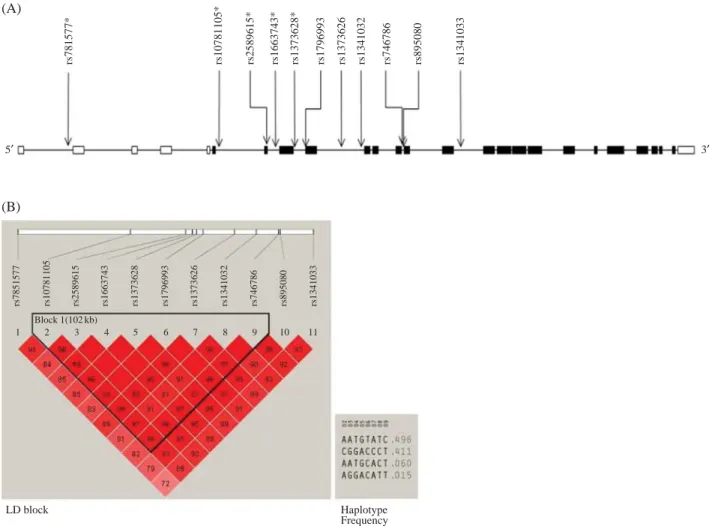
To evaluate whether TMC1 is associated with KD in Korean population, 11 SNPs were genotyped. Loca-tions of 11 SNPs on the TMC1 gene region are shown in Figure 1. No deviation of Hardy-Weinberg equilibri-um (HWE) in genotype distributions of each SNP was found in KD and control subjects (data not shown).
Polymorphisms of Transmembrane Channel-like 1 Gene are
Associated with Kawasaki Disease in Korean Population
In Table 2, logistic analysis of codominant, domi-nant, and recessive models showed that there were
sig-nificant differences between patients with KD and con-trol subjects. Of the eleven SNPs, six SNPs were stati-Figure 1. Gene map and linkage disequilibrium (LD) in transmembrane channel-like 1 (TMC1) gene. A, Gene map of single nucleotide polymorphisms (SNPs) in TMC1. Exons are marked with box. The coding region is black-boxed and untranslated regions are white-boxed. Asterisk (*) indicates a significant SNP. Arrow indicates the location of each SNP. B, LD coefficient (⎜D′⎜) and LD blocks among SNPs of TMC1. A block consists of rs10781105, rs2589615, rs1663743, rs1373628, rs1796993, rs1373626, rs1341032, and rs746786. rs781577* rs7851577 rs10781105 rs2589615 rs1663743 rs1373628 rs1796993 rs1373626 rs1341032 rs746786 rs895080 rs1341033 rs10781105* rs2589615* rs1663743* rs1373628* rs1796993 rs1373626 rs1341032 rs746786 rs895080 rs1341033 5′ 3′ Block 1(102 kb) 1 2 3 4 5 6 7 8 9 10 11 LD block Haplotype Frequency (A) (B)
Table 1. Primer of each single nucleotide polymorphism in TMC1 gene.
SNP Size (bp) Sense (5′-3′) Anti-sense (5′-3′)
rs7851577 295 CCCTCAAACCCAGAATTTTGAGT TTCCAAAGTTTACGCACAGGACT rs10781105 336 GCTATGAAGGGACAGAACAAGCC GGATGGAGCTGGAAGACATTATCC rs2589615 386 CTGTTTGCTGAACTTGATTCCTC GGCATTGTATAAGATGCTGTAGC rs1663743 503 TATCTGCAGCATACCTTTCTGTG GTGCTATTGTACTCCAGCTTGGG rs1373628 433 CACATGGCCCCATTTCCTAGAAG TTTCCTCCTCCTCTTCCCCAGCT rs1796993 398 CAGTGTATGTGTGTGTGTGTGTG CCTGCATCAGTGTTCAGATTTG rs1373626 396 GGTGAGCTCCACAACCTGAATTC TACCTGGCATGTCTATAGGGAAG rs1341032 357 GGTGCAGCTTGTGAGTTTTTGAG GAACAAGGTGGGATCATAGATGTG rs746786 427 AGGCCAAAAAGCTAGACTGAGGT CACATCAGCATTATGTGACTCCA rs895080 474 TCAAGGTCTCAGGCTTGCCCAGG CGTTACTTAGTGTCAGATGCAGG rs1341033 375 AAATCATGTGCTATACGTAACCC AGTCAAATGACCTTGTGCAGTTC
stically associated with the risk of KD. The frequen-cies of GG, GA, and AA genotypes for the rs7851577 were 32.5%, 46.9%, and 20.5% in the control subjects and 21.1%, 54.1%, and 24.8% in patients with KD, respectively. The SNP rs7851577 was significantly associated with KD in the codominant (OR==0.73, 95% CI==0.55-0.99, P==0.040) and dominant (OR==0.55, 95% CI==0.34-0.92, P==0.017) models, respectively. The frequencies of AA, AC, and CC genotypes for the rs10781105 were 36.1%, 47.4%, and 16.5% in the control subjects, 25.7%, 52.3%, and 22.0% in pati-ents with KD, respectively. The SNP rs10781105 showed a statistically significant association with KD
in the codominant model (OR==0.72, 95% CI= =0.54-0.98, P==0.035). The frequencies of AA AG, and GG genotypes for the rs2589615 were 34.0%, 47.9%, and 18.2% in the control subjects, 23.9%, 54.1%, and 22.0% in patients with KD, respectively. The SNP rs2589615 showed a significant association with KD in the dominant model (OR==0.61, 95% CI= =0.38-0.99, P==0.039). The frequencies of TT, TG, and GG genotypes for the rs1663743 were 34.0%, 47.9%, and 18.2% in the control subjects, 23.9%, 54.1%, and 22.0% in patients with KD, respectively. The SNP rs1663743 was significantly associated with KD in the dominant model (OR==0.61, 95% CI==0.38-0.99, Table 2. Genotype frequencies of TMC1 gene polymorphism in patients with Kawasaki disease and control subjects.
SNP
Genotype KD Control Codominant P Dominant P Recessive P
Location n==109 (%) n==424 (%) OR (95% CI) OR (95% CI) OR (95% CI)
rs7851577 G/G 23 (21.1) 138 (32.5) 0.73 (0.55-0.99) 0.040 0.55 (0.34-0.92) 0.017 0.78 (0.48-1.29) 0.340 (intron 1) A/G 59 (54.1) 199 (46.9) A/A 27 (24.8) 87 (20.5) rs10781105 A/A 28 (25.7) 153 (36.1) 0.72 (0.54-0.98) 0.035 0.61 (0.38-0.98) 0.037 0.70 (0.42-1.18) 0.190 (intron 5) A/C 57 (52.3) 201 (47.4) C/C 24 (22.0) 70 (16.5) rs2589615 A/A 26 (23.9) 144 (34.0) 0.75 (0.56-1.02) 0.064 0.61 (0.38-0.99) 0.039 0.79 (0.47-1.32) 0.370 (exon 6) A/G 59 (54.1) 203 (47.9) G/G 24 (22.0) 77 (18.2) rs1663743 T/T 26 (23.9) 144 (34.0) 0.75 (0.56-1.02) 0.064 0.61 (0.38-0.99) 0.039 0.79 (0.47-1.32) 0.370 (intron 6) T/G 59 (54.1) 203 (47.9) G/G 24 (22.0) 77 (18.2) rs1373628 G/G 26 (23.9) 144 (34.0) 0.75 (0.56-1.02) 0.064 0.61 (0.38-0.99) 0.039 0.79 (0.47-1.32) 0.370 (intron 7) A/G 59 (54.1) 203 (47.9) A/A 24 (22.0) 77 (18.2) rs1796993 C/C 27 (24.8) 108 (25.5) 1.13 (0.84-1.53) 0.410 0.96 (0.59-1.57) 0.880 1.49 (0.88-2.51) 0.130 (exon 8) T/C 61 (56.0) 205 (48.4) Glu81Lys T/T 21 (19.3) 111 (26.2) rs1373626 A/A 28 (25.7) 148 (34.9) 0.74 (0.55-1.00) 0.049 0.64 (0.40-1.04) 0.064 0.70 (0.42-1.18) 0.190 (intron 8) A/C 57 (52.3) 206 (48.6) C/C 24 (22.0) 70 (16.5) rs1341032 T/T 23 (21.1) 119 (28.1) 0.83 (0.62-1.12) 0.230 0.69 (0.41-1.14) 0.140 0.89 (0.54-1.45) 0.640 (intron 8) T/C 59 (54.1) 209 (49.3) C/C 27 (24.8) 96 (22.6) rs746786 C/C 21 (19.3) 112 (26.4) 0.87 (0.65-1.17) 0.360 0.66 (0.39-1.12) 0.120 1.01 (0.62-1.65) 0.960 (intron 11) T/C 61 (56.0) 206 (48.6) T/T 27 (24.8) 106 (25.0) rs895080 T/T 27 (24.8) 144 (34.0) 0.79 (0.59-1.06) 0.120 0.64 (0.40-1.03) 0.062 0.85 (0.51-1.42) 0.540 (intron 11) T/C 58 (53.2) 198 (46.7) C/C 24 (22.0) 82 (19.3) rs1341033 T/T 35 (32.1) 114 (26.9) 1.19 (0.89-1.58) 0.240 1.29 (0.82-2.03) 0.280 1.24 (0.75-2.03) 0.400 (intron 13) T/C 49 (45.0) 196 (46.2) C/C 25 (22.9) 114 (26.9)
Total number of each SNP is different, because genotypes of some SNPs are unreadable
TMC1, transmembrane channel-like 1; SNP, single nucleotide polymorphism; KD, Kawasaki disease; OR (95% CI), odds ratio (95% confidence interval); SNP, single nucleotide polymorphism
P==0.039). The frequencies of GG, GA, and AA
geno-types for the rs1373628 were 34.0%, 47.9%, and 18.2% in the control subjects, 23.9%, 54.1%, and 22.0% in patients with KD, respectively. The SNP rs1373628 was also associated with KD in the do-minant model (OR==0.61, 95% CI==0.38-0.99, P==
0.039). The frequencies of AA, AC, and CC geno-types for the rs1373626 were 34.9%, 48.6%, and 16.5% in the control subjects, 25.7%, 52.3%, and 22.0% in patients with KD, respectively. The SNP rs1373626 showed a significant association with KD
in the codominant model (OR==0.74, 95% CI=
=0.55-1.00, P== 0.049). The missense SNP rs1796993
(Glu81Lys) was not statistically associated with KD. The other 4 SNPs (rs1341033, rs895080, rs746786, and rs1341032) were not associated with KD (Table 2).
We also assessed the association of the TMC1 poly-morphisms with the risk of coronary artery lesions (CALs) in KD patients. Unfortunately, there was no association between each SNP of TMC1 and the risk of CALs in KD patients (Table 3).
Table 3. Genotype frequencies TMC1 gene polymorphism in patients Kawasaki disease with and without coronary artery lesions.
SNP
Genotype Without CALs With CALs Codominant P Dominant P Recessive P
Location n (%) n (%) OR (95 CI) OR (95 CI) OR (95 CI)
rs7851577 A/A 17 (24.3) 9 (26.5) 1.13 (0.62-2.07) 0.690 0.89 (0.35-2.28) 0.810 1.58 (0.60-4.17) 0.360 (intron 1) A/G 40 (57.1) 16 (47.1) G/G 13 (18.6) 9 (26.5) rs10781105 A/A 17 (24.3) 10 (29.4) 0.71 (0.39-1.30) 0.260 0.77 (0.31-1.93) 0.580 0.50 (0.17-1.48) 0.190 (intron 5) A/C 35 (50.0) 19 (55.9) C/C 18 (25.7) 5 (14.7) rs2589615 A/A 15 (21.4) 10 (29.4) 0.66 (0.36-1.22) 0.180 0.65 (0.26-1.66) 0.380 0.50 (0.17-1.48) 0.190 (exon 6) A/G 37 (52.9) 19 (55.9) G/G 18 (25.7) 5 (14.7) rs1663743 T/T 15 (21.4) 10 (29.4) 0.66 (0.36-1.22) 0.180 0.65 (0.26-1.66) 0.380 0.50 (0.17-1.48) 0.190 (intron 6) T/G 37 (52.9) 19 (55.9) G/G 18 (25.7) 5 (14.7) rs1373628 G/G 15 (21.4) 10 (29.4) 0.66 (0.36-1.22) 0.180 0.65 (0.26-1.66) 0.380 0.50 (0.17-1.48) 0.190 (intron 7) A/G 37 (52.9) 19 (55.9) A/A 18 (25.7) 5 (14.7) rs1796993 C/C 18 (25.7) 8 (23.5) 1.00 (0.54-1.85) 0.990 1.12 (0.43-2.93) 0.810 0.86 (0.30-2.47) 0.770 (exon 8) T/C 38 (54.3) 20 (58.8) Glu81Lys T/T 14 (20.0) 6 (17.6) rs1373626 A/A 17 (24.3) 10 (29.4) 0.71 (0.39-1.30) 0.260 0.77 (0.31-1.93) 0.580 0.50 (0.17-1.48) 0.190 (intron 8) A/C 35 (50.0) 19 (55.9) C/C 18 (25.7) 5 (14.7) rs1341032 C/C 18 (25.7) 8 (23.5) 0.94 (0.51-1.71) 0.830 1.12 (0.43-2.93) 0.810 0.72 (0.25-2.05) 0.540 (intron 8) T/C 36 (51.4) 20 (58.8) T/T 16 (22.9) 6 (17.6) rs746786 T/T 18 (25.7) 8 (23.5) 1.00 (0.54-1.85) 0.990 1.12 (0.43-2.93) 0.810 0.86 (0.30-2.47) 0.770 (intron 11) T/C 38 (54.3) 20 (58.8) C/C 14 (20.0) 6 (17.6) rs895080 T/T 14 (20.0) 11 (32.4) 0.66 (0.36-1.22) 0.180 0.52 (0.21-1.32) 0.170 0.67 (0.24-1.88) 0.440 (intron 11) T/C 39 (55.7) 17 (50.0) C/C 17 (24.3) 6 (17.6) rs1341033 T/T 23 (32.9) 11 (32.4) 1.08 (0.61-1.90) 0.790 1.02 (0.43-2.45) 0.960 1.23 (0.46-3.30) 0.680 (intron 13) T/C 33 (47.1) 15 (44.1) C/C 14 (20.0) 8 (23.5)
Total number of each SNP is different, because genotypes of some SNPs are unreadable
TMC1, transmembrane channel-like 1; CALs, coronary artery lesions; SNP, single nucleotide polymorphism; OR (95% CI), odds ratio (95% confidence interval); SNP, single nucleotide polymorphism
Associations between TMC1 Haplotypes and Kawasaki Disease
One linkage disequilibrium (LD) block including eight SNPs (rs10781105, rs2589615, rs1663743, rs1373628, rs1796993, rs1373626, rs1341032, and rs746786) was constructed by the Gabriel method (Figure 1). Four haplotypes in the block had frequen-cies greater than 0.1 (Figure 1). In the analysis of ha-plotype association, only one haha-plotype (CGGACCCT)
showed a significant association between KD and control groups (case/control frequency==0.477/0.396,
chi square==4.726, P==0.030) (Table 4). Taken
togeth-er, the results suggest that TMC1 gene may be affect the development of KD.
Next, we investigated ethnic differences of each SNP using website (http://www.ncbi.nlm.nih.gov/ SNP) (Table 5). Genotype frequencies of most SNP in Korean population were similar to them in Asian Table 4. Haplotype analysis of TMC1 gene polymorphism in patients with Kawasaki disease and control subjects.
Haplotype Kawasaki Control Kawasaki, Control Chi Square P
+ + - ++ - Frequencies AATGTATC 102.0 : 116.0 424.0 : 420.0 0.468, 0.502 0.824 0.364 CGGACCCT 104.0 : 114.0 334.0 : 510.0 0.477, 0.396 4.729 0.030 AATGCACT 8.0 : 210.0 58.0 : 786.0 0.037, 0.069 3.048 0.081 AGGACATT 2.0 : 216.0 13.8 : 830.2 0.009, 0.016 0.608 0.436
Table 5. Genotype frequencies of TMC1 SNPs in each population.
SNP Genotype Korean European Chinese Japanese Sub-Saharan
Kawasaki Control rs7851577 GG 0.211 0.325 0.293 0.178 0.205 0.712 GA 0.541 0.469 0.414 0.467 0.500 0.237 AA 0.248 0.205 0.293 0.356 0.295 0.051 rs10781105 AA 0.257 0.361 0.190 0.222 0.250 0.915 AC 0.523 0.474 0.552 0.511 0.500 0.085 CC 0.220 0.165 0.259 0.267 0.250 0.000 rs2589615 AA 0.239 0.340 0.119 0.200 0.200 0.517 AG 0.541 0.479 0.542 0.511 0.533 0.433 GG 0.220 0.182 0.339 0.289 0.267 0.050 rs1663743 TT 0.239 0.340 0.103 0.200 0.205 0.517 TG 0.541 0.479 0.552 0.511 0.523 0.431 GG 0.220 0.182 0.345 0.289 0.237 0.052 rs1373628 AA 0.220 0.182 0.333 0.289 0.273 0.050 AG 0.541 0.479 0.550 0.511 0.523 0.433 GG 0.239 0.340 0.117 0.200 0.205 0.517 rs1796993 CC 0.248 0.255 0.583 0.341 0.341 0.617 CT 0.560 0.484 0.400 0.545 0.500 0.317 TT 0.193 0.262 0.017 0.114 0.159 0.067 rs1373626 AA 0.257 0.349 0.203 0.222 0.250 0.617 AC 0.523 0.486 0.542 0.511 0.500 0.333 CC 0.220 0.165 0.254 0.267 0.250 0.050 rs1341032 CC 0.211 0.281 0.400 0.341 0.295 0.017 CT 0.541 0.493 0.483 0.523 0.523 0.250 TT 0.248 0.226 0.117 0.136 0.182 0.733 rs746786 CC 0.193 0.264 0.017 0.114 0.159 0.100 CT 0.560 0.486 0.400 0.523 0.500 0.483 TT 0.248 0.250 0.583 0.364 0.341 0.417 rs895080 TT 0.248 0.340 0.150 0.244 0.227 0.183 TC 0.532 0.467 0.533 0.444 0.455 0.617 CC 0.220 0.193 0.317 0.311 0.318 0.200 rs1341033 TT 0.321 0.269 0.483 0.333 0.386 0.167 TC 0.450 0.462 0.450 0.511 0.432 0.600 CC 0.229 0.269 0.067 0.156 0.182 0.233
population.
Discussion
KD is an acute febrile vasculitis occurring predo-minantly in infants and young children. Although its etiology still remains elusive, epidemiological find-ings suggest that genetic factors play a role in the pa-thogenesis of KD. Recently, several genetic polymor-phisms were reported to be associated with increased susceptibility to KD. Cheung et al. reported that C-reactive protein (CRP) ++1444 C/T and tumor necro-sis factor-α (TNF-α) -308 G/A polymorphisms were associated with predisposition to KD14. Ikeda et al. reported that allele and genotype frequencies of mat-rix metalloproteinase 13 (MMP13) -77A/G polymor-phism showed significant differences between KD patients with CALs and without CALs15. Onouchi et al. identified a functional SNP (itpkc_3) in the inosi-tol 1,4,5-trisphosphate 3-kinase C (ITPKC) gene on chromosome 19q13.2 that was significantly associat-ed with KD susceptibility and also with an increasassociat-ed risk of CALs in both Japanese and US children16. Hsueh et al. reported the association of vascular en-dothelial growth factor C-634 g polymorphism in Tai-wanese children with KD17. Jin et al. showed that the IL-10 (-627 A/C) promoter polymorphism may be associated with coronary aneurysms and low serum albumin in Korean children with KD18. Nishimura et al. reported that a polymorphism in the promoter of the CD14 gene (CD14/-159) is associated with the development of CAL in patients with KD19. These re-sults suggest that several other genes significantly con-tribute to the KD susceptibility.
In the present study, we investigated whether TMC1 gene polymorphisms are related to the development of KD in Korean children. This study showed that TMC1 is associated with KD in Korean children. Of the 11 SNPs selected in TMC1, six SNPs (rs7851577, rs10781105, rs2589615, rs1663743, rs1373628, and rs1373626) were significantly associated with KD. Moreover, one haplotype (CGGACCCT) showed a significant association with KD. These results sug-gest that TMC1 may be also related to the develop-ment of KD.
In conclusion, the results in the present study re-vealed that SNPs and haplotype in the TMC1 gene were significantly associated with KD. To our know-ledge, this is the first report to assess on the genetic study between TMC1 gene polymorphisms and KD in Korean population. Since no other association stu-dies concerning the TMC1 gene for KD have yet been reported, more studies as to confirm the possible role
of TMC1 in the development of KD will be needed.
Materials & Methods
Patients
All patients with KD were recruited at the Depart-ment of Pediatrics at the Kyung Hee University Me-dical Center, Seoul, Korea. The KD group included 109 patients (76 males and 33 females; mean age± S.D., 2.6±2.1 years), all of whom met the appro-priate diagnostic criteria for KD20. KD was diagnos-ed by its clinical features, which is fever persisting for at least 5 days and accompanied by at least 4 of the 5 classic clinical criteria: 1) changes in extremities; 2) polymorphous exanthem; 3) bilateral bulbar conjunc-tival injection; 4) changes in lips and oral cavity; 5) cervical lymphadenopathy (¤1.5 cm in diameter). Standard therapy consisted of a single intravenous immunoglobulin (IVIG) infusion (2 g/kg). A second IVIG infusion was administered when clinical symp-toms (i.e., fever) persisted for 36 hours. Two-dimen-sional echocardiography was used to detect the pre-sence of CALs, defined as coronary arteries with dia-meter larger than 3 mm (4 mm in patients older than 5 years). Of all patients studied, 34 developed CALs, while the remaining patients revealed no evidence of CALs. Four hundred twenty four normal controls (185 males and 239 females; mean age±S.D., 41.7 ±12.1 years) were included. In the control group, subjects with hypertension, hyperlipidemia, stroke, or other cardiac diseases were excluded. This study was approved by the Institutional Review Board of Kyung Hee University Medical Center, Seoul, Korea. Written informed consent was obtained from all subjects. Blood samples were obtained from all participants with informed written consent. Genomic DNA was extracted from blood samples using QIAamp® DNA mini kit (QIAGEN, Valencia, CA).
SNP Selection and Genotyping
In the TMC1 gene region, 11 SNPs [rs7851577 (in-tron 1), rs10781105 (in(in-tron 5), rs2589615 (exon 6, Asp15Asp), rs1663743 (intron 6), rs1373628 (intron 7), rs1796993 (exon 8, Glu81Lys), rs1373626 (intron 8), rs1341032 (intron 8), rs746786 (intron 11), rs895080 (intron 11), and rs1341033 (intron 13)] were selected using human SNP websites (http://www.hapmap.org/; genome build 34). The SNPs with unknown heterozy-gosity and minor allele frequency (below 5%) were ex-cluded. SNP genotyping was performed using direct se-quencing. Genomic DNA was amplified using the each primer (Table 1). The samples were sequenced using an ABI Prism 377 automatic sequencer (PE Applied
Biosystems, Foster City, CA). Sequence data were ana-lyzed using the SeqManII software (DNASTAR Inc., Madison, WI).
Statistical Analysis
Statistical analyses were performed using the stati-stical Package for the Social Sciences software SAS (release 8.02; SAS Institute Inc, Cary, NC). The chi-square (χ2) test was used to value Hardy-Weinberg equilibrium (HWE). SNP analyses were using the SNPAnalyzer, Helixtree, and SNPStats programs (http://bioinfo.iconcologia.net/index.php). Genotyp-ing of each SNP was analyzed by logistic regression models using three models (codominant, dominant, and recessive models). Odds ratios (ORs), 95% confi-dence intervals (CIs), and corresponding P values, controlling gender as co-variables were calculated. A LD block of polymorphisms was tested using Haplo-view version 3.32. The significant level was set at 0.05.
Acknowledgements
This study was supported by the Governance Pro-gram of Kyung Hee University.
References
1. Burns, J. C. Commentary: translation of Dr. Tomi-saku Kawasaki’s original report of fifty patients in
1967. Pediatr Infect Dis J21:993-995 (2002).
2. Baer, A. Z. et al. Prevalence of coronary artery le-sions on the initial echocardiogram in Kawasaki syn-drome. Arch Pediatr Adolesc Med 160:686-690 (2006).
3. Burns, J. C. et al. Kawasaki disease: A brief history. Pediatrics 106:E27 (2000).
4. Hibbard, J. U., Fajardo, J. E. & Briller, J. Kawasaki disease with coronary artery sequelae. Obstet Gyne-col 109:517-519 (2007).
5. McCrindle, B. W. et al. Are patients after Kawasaki disease at increased risk for accelerated atherosclero-sis? J Pediatr 151:244-248, 248 e241 (2007).
6. Rozin, L. et al. Kawasaki disease: a review of patho-logic features of stage IV disease and two cases of sud-den death among asymptotic young adults. Am J For-ensic Med Pathol 24:45-50 (2003).
7. Tsuda, E. et al. Changes in causes of sudden deaths by decade in patients with coronary arterial lesions due to Kawasaki disease. Cardiol Young 15:481-488 (2005).
8. Kurima, K., Yang, Y., Sorber, K. & Griffith, A. J. Characterization of the transmembrane channel-like (TMC) gene family: functional clues from hearing loss and epidermodysplasia verruciformis. Genomics
82:300-308 (2003).
9. Kurima, K. et al. Dominant and recessive deafness caused by mutations of a novel gene, TMC1, required for cochlear hair-cell function. Nat Genet 30:277-284 (2002).
10. Marcotti, W. et al. Tmc1 is necessary for normal functional maturation and survival of inner and outer hair cells in the mouse cochlea. J Physiol 574:677-698 (2006).
11. Kalay, E. et al. Four novel TMC1 (DFNB7/DFNB11) mutations in Turkish patients with congenital autoso-mal recessive nonsyndromic hearing loss. Hum Mutat
26:591 (2005).
12. Makishima, T., Kurima, K., Brewer, C. C. & Griffith, A. J. Early onset and rapid progression of dominant nonsyndromic DFNA36 hearing loss. Otol Neurotol
25:714-719 (2004).
13. Tlili, A. et al. TMC1 but not TMC2 is responsible for autosomal recessive nonsyndromic hearing impair-ment in Tunisian families. Audiol Neurootol 13:213-218 (2008).
14. Cheung, Y. F. et al. Inflammatory gene polymorphi-sms and susceptibility to Kawasaki disease and its arterial sequelae. Pediatrics 122:e608-614 (2008). 15. Ikeda, K. et al. Genetic analysis of MMP gene
poly-morphisms in patients with Kawasaki disease. Pedi-atr Res 63:182-185 (2008).
16. Onouchi, Y. et al. ITPKC functional polymorphism associated with Kawasaki disease susceptibility and formation of coronary artery aneurysms. Nat Genet
40:35-42 (2008).
17. Hsueh, K. C. et al. Association of vascular endothe-lial growth factor C-634 g polymorphism in Taiwa-nese children with Kawasaki disease. Pediatr Cardiol
29:292-296 (2008).
18. Jin, H. S. et al. The IL-10 (-627 A/C) promoter poly-morphism may be associated with coronary aneu-rysms and low serum albumin in Korean children with Kawasaki disease. Pediatr Res 61:584-587 (2007). 19. Nishimura, S. et al. A polymorphism in the promoter of the CD14 gene (CD14/-159) is associated with the development of coronary artery lesions in patients with Kawasaki disease. J Pediatr 143:357-362 (2003). 20. Newburger, J. W. et al. Diagnosis, treatment, and
long-term management of Kawasaki disease: a state-ment for health professionals from the Committee on Rheumatic Fever, Endocarditis and Kawasaki Disease, Council on Cardiovascular Disease in the Young, American Heart Association. Circulation 110:2747-2771 (2004).