1. Introduction
The Li-reduction process involves the chemical reduction of spent fuel oxides by liquid lithium metal in a molten LiCl salt bath at 650oC followed by a separate electrochemical reduction of the lithium oxide (Li2O), which builds up in the salt bath. This process requires a high purity inert gas atmosphere inside a remote hot cell nuclear facility to prevent an unwanted Li oxidation and fires during the handling of the chemically active Li metal. In light of the limitations of the Li-reduction process, a direct electrolytic reduction technology is being developed by KAERI to enhance the process safety and economic viability. The electrolytic reduction of spent oxide fuel involves the liberation of the oxygen in a molten LiCl electrolyte, which results in a chemically aggressive environment that is too corrosive for typical structural materials. Even so, the electrochemical process vessel must be resilient at 650oC in the presence of oxygen to enable high processing rates and an extended service life. But, the mechanism and the rate of the corrosion of the metals in a LiCl-Li2O molten salt under an oxidation condition are not clear. In the present work, the corrosion behavior and corrosion mechanism of a surface modified Inconel 713LC have been studied in the molten salt of LiCl-Li2O under an oxidation condition.
2. Experimental Procedure
Corrosion tests were conducted in a molten LiCl-Li2O using an oxidizing atmosphere at 675oC for 216 hrs with an Ar-10%O2 sparge gas. Inconel 713LC was employed as a substrate for these investigations. By using Plasma Spray process, bond coat of NiCoCrAlY or NiCrAlY was coated on the substrate, Al-diffusion was conducted, and then ceramic oxide was coated onto the bond coat. The chemical compositions of coating materials and substrate are listed in Table 1. The corroded specimens were analyzed by Electron Probe Micro-analysis (EPMA) and Scanning Electron Micro-Scopy(SEM) coupled with an Energy Dispersive X-ray Spectroscope(EDS).
3. Results and Discussion 3.1 Corrosion behavior of Inconel 713LC
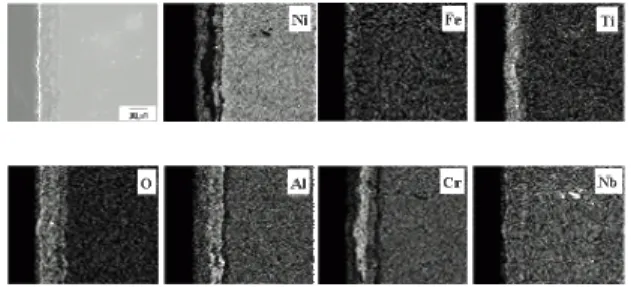
Fig. 1 presents the cross-sectional SEM image of bare Inconel 713LC corroded for 72 hrs, the
Table. 1. Chemical compositions of coating materials and substrate.
Layer Compositions(wt.%) Process Thickness ZrO2-8Y2O3 Top coat ZrO2 -24MgO APS ~250㎛ Ni-23Co-17-Cr-13-Al-0.5Y Bond
coat Ni-22Cr-10Al-1.0Y APS ~150㎛ Substrate Ni : 74.0, Cr : 11.57, Fe : 0.1, Al : 6.05, Nb : 1.95, Mo : 4.15 Rolled and Heat treated 2mm
corrosion layer consisted of Ti, Cr and Al-based complex oxides. There was no attack into the substrate. These oxygen active elements such as Ti and Al are expected to prevent ion from diffusing into the matrix[1]. As shown in Fig. 2, with the increase of corrosion time, cracking was observed near the interface of oxide layer and matrix. Corrosion attack in the matrix was observed underneath it. In the inner corroded zone, Cr depletion was observed and the reason was attributed to the consumption of Cr to form oxide layer. A Ni-rich phase was observed underneath the oxide layer. In thermodynamic view, the affinity of oxygen and chlorine on Ni is relatively weaker than other elements in the matrix[2]. From this, it can be deduced that an enrichment of the Ni underneath oxide layer can prevent internal oxidation and corrosion attack.
Fig. 1. Cross-sectional SEM image and elemental distribution of Inconel 713LC corroded at 675oC for 72 hrs.
3.2 Corrosion behavior of a surface modified Inconel 713LC
After corrosion test, regardless of the species of top coats, the surfaces of the tested specimens were not wetted by a molten salt, confirming the chemical
Corrosion Behavior of a Surface Modified Inconel 713LC
in a Hot Lithium Molten Salt
Soo-Haeng Cho, Jong-Ho Lim, Chung-Seok Seo, Ki-Jung Jung, Seoung-Won Park Korea Atomic Energy Research Institute, Daejeon 305-353
Transactions of the Korean Nuclear Society Autumn Meeting Busan, Korea, October 27-28, 2005
Fig. 2. Cross-sectional SEM image and elemental distribution of Inconel 713LC corroded at 675oC for 216 hrs.
stability in a molten salt. Cross-sectional microstructures of the different top coats before and after the corrosion tests are shown in Fig. 3. The rates of porosity on the top coats before corrosion tests are similar, regardless of the species of the oxides.
NiCoCrAlY as a bond coating layer appeared less porous than NiCrAlY coating layer. There was no difference between the morphologies of the top and bond coating layer before and after the corrosion test for 216 hrs. After corrosion tests, the top coating layer still remained dense, however, partially cracks began to appear near the interface of NiCrAlY coating layer and top coating layer of MgO+ZrO2.
YSZ MgO+ZrO2
NiCoCrAlY NiCrAlY NiCoCrAlY NiCrAlY
Fig. 3. Cross-sectional SEM images of coated Inconel 713LC before and after corrosion tests.
Fig. 4 shows cross-sectional SEM image and elemental distribution of Inconel 713LC coated NiCoCrAlY and MgO+ZrO2 corroded for 216 hrs.
As shown in Fig. 4, the internal corrosion was not occurred. The interface of the top coating layer/bond coating layer and bond coating layer/substrate showed soundness. So, the top coat behaved as a protective layer.
3. Conclusion
From the results of corrosion tests of bare Inconel 713LC, outer formed Ti and Al-oxide are dense and expected to prevent ion from diffusing into the matrix. Excessive addition of Cr can deteriorate the corrosion resistance and Ni can prevent internal
Fig. 4. Cross-sectional SEM image and elemental distribution of NiCoCrAlY/MgO-ZrO2 coated Inconel 713LC corroded at 675oC for 216 hrs.
oxidation and corrosion attack. After corrosion test, the surface of the top coating layer showed soundness and internal corrosion attack did not occur, however, partially cracks began to appear near the interface of NiCrAlY coating layer and top coating layer of MgO+ZrO2. So, the top coat behaved as a protective layer.
REFERENCES
[1]. Y. Ishikawa, Y. Hayashi, and Y. Matsumoto, Preparation of Titanium(IV) Oxide Film on a Hard Alumite Substrate, J. Mat. Res. Vol.17, No.9, pp.2373 – 2378, 2002.
[2]. E. T. Turkdogan, Physical Chemistry of High Temperature Technology, Academic Press, New York, pp.883-891, 1980.
[3]. Maurice Gell, Liangde Xie, Eric H. Jordan and Nitin P. Padture, Mechanisms of Spallation of Solution Precursor Plasma Spray Thermal Barrier Coatings, Surface & Coatings Technology, Vol.188-189, pp.101-106, 2004.