Perfect Matchings in Claw-free Cubic Graphs
Sang-il Oum
∗Department of Mathematical Sciences KAIST, Daejeon, 305-701, Republic of Korea
Submitted: Nov 9, 2009; Accepted: Mar 7, 2011; Published: Mar 24, 2011 Mathematics Subject Classification: 05C70
Abstract
Lov´asz and Plummer conjectured that there exists a fixed positive constant c such that every cubic n-vertex graph with no cutedge has at least 2cn perfect matchings. Their conjecture has been verified for bipartite graphs by Voorhoeve and planar graphs by Chudnovsky and Seymour. We prove that every claw-free cubic n-vertex graph with no cutedge has more than 2n/12 perfect matchings, thus verifying the conjecture for claw-free graphs.
1
Introduction
A graph is claw-free if it has no induced subgraph isomorphic to K1,3. A graph is cubic if
every vertex has exactly three incident edges. A well-known classical theorem of Petersen [10] states that every cubic graph with no cutedge has a perfect matching. Sumner [11] and Las Vergnas [7] independently showed that every connected claw-free graph with even number of vertices has a perfect matching. Both theorems imply that every claw-free cubic graph with no cutedge has at least one perfect matching.
In 1970s, Lov´asz and Plummer conjectured that every cubic graph with no cutedge has exponentially many perfect matchings; see [8, Conjecture 8.1.8]. The best lower bound has been obtained by Esperet, Kardoˇs, and Kr´al’ [6]. They showed that the number of perfect matchings in a sufficiently large cubic graph with no cutedge always exceeds any fixed linear function in the number of vertices.
So far the conjecture is known to be true for bipartite graphs and planar graphs. For bipartite graphs, Voorhoeve [12] proved that every bipartite cubic n-vertex graph has at least 6(4/3)n/2−3 perfect matchings. Recently, Chudnovsky and Seymour [2] proved
that every planar cubic n-vertex graph with no cutedge has at least 2n/655978752 perfect
matchings.
∗Supported by Basic Science Research Program through the National Research Foundation of Korea
(NRF) funded by the Minister of Education, Science and Technology (2010-001655) and TJ Park Junior Faculty Fellowship.
Figure 1: Claw-free cubic graphs with only 9 perfect matchings
We prove that every claw-free cubic n-vertex graph with no cutedge has more than 2n/12 perfect matchings. The graph should not have any cutedge; in Figure 1, we provide
an example of a claw-free cubic graph with only 9 perfect matchings.
Our approach is to use the structure of 2-edge-connected claw-free cubic graphs. The cycle space C(H) of H is a collection of the edge-disjoint union of cycles of H. It is well known that C(H) forms a vector space over GF (2) and
dim C(H) = |E(H)| − |V (H)| + 1
if H is connected, see Diestel [3]. Roughly speaking, almost all 2-edge-connected claw-free cubic graph G can be built from a 2-edge-connected cubic multigraph H by certain operations so that members of C(H) can be mapped injectively to 2-factors of G. We will have two cases to consider; either H is big or small. If H is big, then C(H) is big enough to prove that G has many 2-factors. If H is small, then we find a 2-factor of H using many of the specified edges of H so that when transforming this 2-factor of H to that of G, each of those edges of H has many ways to make 2-factors of G.
2
Structure of 2-edge-connected claw-free cubic graphs
Graphs in this paper have no parallel edges and no loops, and multigraphs can have parallel edges and loops. We assume that a loop is counted twice when measuring a degree of a vertex in a multigraph. Every 2-edge-connected cubic multigraph cannot have loops because if it has a loop, then it must have a cutedge.
We describe the structure of claw-free cubic graphs given by Palmer et al. [9]. A triangle of a graph is a set of three pairwise adjacent vertices. Replacing a vertex v with a triangle in cubic graph is to replace v with three vertices v1, v2, v3 forming a triangle
so that if e1, e2, e3 are three edges incident with v, then e1, e2, e3 will be incident with
v1, v2, v3 respectively.
Every vertex in a claw-free cubic graph is in 1, 2, or 3 triangles. If a vertex is in 3 triangles, then the component containing the vertex is isomorphic to K4. If a vertex is in
exactly 2 triangles, then it is in an induced subgraph isomorphic to K4\ e for some edge
e of K4. Such an induced subgraph is called a diamond. It is clear that no two distinct
diamonds intersect.
A string of diamonds is a maximal sequence D1, D2, . . . , Dk of diamonds in which,
for each i ∈ {1, 2, . . . , k − 1}, Di has a vertex adjacent to a vertex in Di+1. A string of
diamonds has exactly two vertices of degree 2, which are called the head and the tail of the string. Replacing an edge e = uv with a string of diamonds with the head x and the tail y is to remove e and add edges ux and vy.
A connected claw-free cubic graph in which every vertex is in a diamond is called a ring of diamonds. We require that a ring of diamonds contains at least 2 diamonds. It is now straightforward to describe the structure of 2-edge-connected claw-free cubic graphs as follows.
Proposition 1. A graph G is 2-edge-connected claw-free cubic if and only if either (i) G is isomorphic to K4,
(ii) G is a ring of diamonds, or
(iii) G can be built from a 2-edge-connected cubic multigraph H by replacing some edges of H with strings of diamonds and replacing each vertex of H with a triangle. Proof. Let us first prove the “if” direction. It is easy to see that G is 2-edge-connected cubic and has no loops or parallel edges. If G is built as in (iii), then clearly G has neither loops nor parallel edges, and every vertex of G is in a triangle and therefore G is claw-free. Note that since H is 2-edge-connected, H cannot have loops.
To prove the “only if” direction, let us assume that G is a 2-edge-connected claw-free cubic graph. We may assume that G is not isomorphic to K4 or a ring of diamonds. We
claim that G can be built from a 2-edge-connected cubic multigraph as in (iii). Suppose that G is a counter example with the minimum number of vertices.
If G has no diamonds, then every vertex of G is in exactly one triangle and therefore V (G) can be partitioned into disjoint triangles. By contracting each triangle, we obtain a 2-edge-connected cubic multigraph H.
So G must have a string of diamonds. Let D be the set of vertices in the string of diamonds. Since G is cubic, G has two vertices not in D, say u and v, adjacent to D. If u = v, then because the degree of u is 3, u must have another incident edge e but e will be a cutedge of G. Thus u 6= v.
If u and v are adjacent in G, then u and v must has a common neighbor x, because otherwise G will have an induced subgraph isomorphic to K1,3. However one of the edges
incident with x will be a cutedge of G, a contradiction.
Thus u and v are nonadjacent in G. Let G′ = (G \ D) + uv, that is obtained from
G by deleting D and adding an edge uv. Then G′ has no parallel edges or loops and
moreover G′ is 2-edge-connected claw-free cubic. Since G has a vertex not in a diamond,
so does G′ and therefore G′ can be built from a 2-edge-connected cubic multigraph H
by replacing some edges with strings of diamonds and replacing each vertex of H with a triangle. Since D is chosen maximally, u and v are not in diamonds and therefore H has the edge uv. So we can obtain G from H by doing all replacements to obtain G′ and then
replacing the edge uv with a string of diamonds. This completes the proof.
We remark that Proposition 1 can be seen as a corollary of the structure theorem of quasi-line graphs by Chudnovsky and Seymour [1]. A graph is a quasi-line graph if the neighborhood of each vertex is expressible as the union of two cliques. It is obvious that every claw-free cubic graph is a quasi-line graph. Chudnovsky and Seymour [1]
proved that every connected quasi-line graph is either a fuzzy circular interval graph or a composition of fuzzy linear interval strips. For 2-edge-connected claw-free cubic graphs, a fuzzy circular interval graph corresponds to a ring of diamonds and a composition of fuzzy linear interval strips corresponds to the construction (iii) of Proposition 1.
3
Main theorem
Theorem 2. Every claw-free cubic n-vertex graph with no cutedge has more than 2n/12
perfect matchings.
Proof. Let G be a claw-free cubic n-vertex graph with no cutedge. We may assume that G is connected. If G is isomorphic to K4, then the claim is clearly true. If G is a ring of
diamonds, then G has 2n/4+1 perfect matchings. Thus we may assume that G is obtained
from a 2-edge-connected cubic multigraph H by replacing some edges of H with strings of diamonds and replacing each vertex of H with a triangle.
Let k = |V (H)|. In other words, 3k is the number of vertices not in a diamond of G. Equivalently, V (G) can be partitioned into (n − 3k)/4 diamonds and k triangles each of which has exactly three distinct neighbors outside of the triangle.
Suppose that k ≥ n/6. Since H has 3k/2 edges, the cycle space of H has dimension 3k/2−k +1 = k/2+1 and therefore |C(H)| = 2k/2+1. To obtain a 2-factor from C ∈ C(H),
we transform C into a member C′ ∈ C(G) so that it meets all 3 vertices of G corresponding
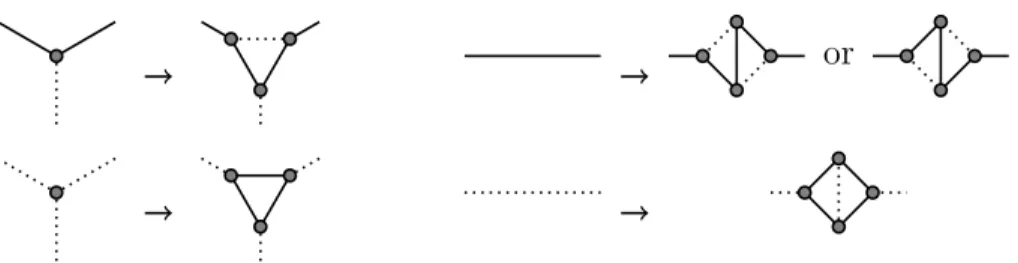
to v for each vertex v of H incident with C as well as it meets all the vertices in each diamond that corresponds to an edge in C. Then for each vertex w of G unused yet in C′, we add a cycle of length 3 or 4 depending on whether the vertex is in a diamond;
see Figure 2. Then this is a 2-factor of G because it meets every vertex of G. Since the complement of the edge-set of a 2-factor is a perfect matching, we conclude that G has at least 2k/2+1 ≥ 2n/12+1 perfect matchings.
Now let us assume that k < n/6. We know that G has (n − 3k)/4 diamonds. The length of an edge e of H is the number of diamonds in the string of diamonds replaced with e. (If the edge e is not replaced with a string of diamonds, then the length of e is 0.) Edmonds’ characterization of the perfect matching polytope [4] implies that there exist a positive integer t depending on H and a list of 3t perfect matchings M1, M2, . . ., M3t
in H such that every edge of H is in exactly t of the perfect matchings. (In other words, H is fractionally 3-edge-colorable.) By taking complements, we have a list of 3t 2-factors of H such that each edge of H is in exactly 2t of the 2-factors in the list. Since G has (n − 3k)/4 diamonds, the sum of the length of all edges of H is (n − 3k)/4. Therefore there exists a 2-factor C of H whose length is at least n−3k
4 2
3 = (n − 3k)/6.
We claim that G has at least 2(n−3k)/6 2-factors corresponding to C. For each diamond
in the string replacing an edge e of C, there are two ways to route cycles of C through the diamond, see Figure 2. Since C passes through at least (n − 3k)/6 diamonds, G has at least 2(n−3k)/6 2-factors. Since k < n/6, G has more than 2n/12 2-factors. Thus G has
or
Figure 2: Transforming a member of C(H) into a 2-factor of G (Solid edges represent edges in a member of C(H) or a 2-factor of G.)
We remark that every 3-edge-connected claw-free cubic n-vertex graph G has exactly 2n/6+1 perfect matchings, unless G is isomorphic to K
4. That is because G has no
di-amonds and so, from the idea of the above proof, there is a one-to-one correspondence between the set of all 2-factors of G and the cycle space of a multigraph H obtained by contracting each triangle of G.
Note added in proof
A proof of the Lov´asz-Plummer conjecture has recently been submitted to the arXiv [5].
References
[1] M. Chudnovsky and P. Seymour. The structure of claw-free graphs. In Surveys in combinatorics 2005, London Math. Soc. Lecture Note Ser. 327, pages 153–171. Cambridge Univ. Press, Cambridge, 2005.
[2] M. Chudnovsky and P. Seymour. Perfect matchings in planar cubic graphs. Submit-ted, 2008.
[3] R. Diestel. Graph theory, Graduate Texts in Mathematics 173. Springer-Verlag, Berlin, third edition, 2005.
[4] J. Edmonds. Maximum matching and a polyhedron with 0, 1-vertices. J. Res. Nat. Bur. Standards Sect. B, 69B:125–130, 1965.
[5] L. Esperet, F. Kardoˇs, A. King, D. Kr´al’ and S. Norine, Exponentially many perfect matchings in cubic graphs, arXiv:1012.2878v1, http://arxiv.org/abs/1012.2878. [6] L. Esperet, F. Kardoˇs, and D. Kr´al’. Cubic bridgeless graphs have more than a linear
number of perfect matchings. Accepted to Eurocomb’09, 2009.
[7] M. Las Vergnas. A note on matchings in graphs. Cahiers Centre ´Etudes Recherche Op´er., 17(2-3-4):257–260, 1975. Colloque sur la Th´eorie des Graphes (Paris, 1974). [8] L. Lov´asz and M. D. Plummer. Matching theory, North-Holland Mathematics Studies
121. North-Holland, Amsterdam, 1986. Annals of Discrete Mathematics, 29.
[9] E. M. Palmer, R. C. Read, and R. W. Robinson. Counting claw-free cubic graphs. SIAM J. Discrete Math., 16(1):65–73, 2002.
[10] J. Petersen. Die Theorie der regul¨aren graphs. Acta Math., 15(1):193–220, 1891. [11] D. P. Sumner. Graphs with 1-factors. Proc. Amer. Math. Soc., 42:8–12, 1974. [12] M. Voorhoeve. A lower bound for the permanents of certain (0, 1)-matrices. Nederl.