54-3 / S. Kim
IMID 2009 DIGEST •
Abstract
Conventional stereoscopic (3D) displays using binocular parallax generate unnatural conflicts between convergence and accommodation. Those conflicts can affect the ability to fuse binocular images and may cause visual fatigue. This study examined time-series changes in visual fatigue and depth sensation while viewing stereoscopic images with changing parallax. We examined the physiological changes, including the subjective symptoms of visual fatigue, when viewing five parallax conditions. The time-series results suggest that 2D and 3D images produce significantly different types of visual fatigue over the range of binocular disparity.
1. Introduction
3D displays can show designs in a 3D space, eliminating the need for the construction of expensive models and thereby greatly reducing development costs. 3D displays also serve as simulation and training aids, allowing users to learn in a virtual world instead of the real world. Many fields, including advertising, scientific research, entertainment, and medicine, are developing 3D display systems.[1-2]
Most 3D display technologies use binocular parallax to produce 3D images. The human eyes are located at different points in the skull, so each eye receives a slightly different image of any given object. This is called binocular disparity. The brain perceives the two retinal images of the object as a 3D image. Binocular parallax is the degree of disparity between the two retinal images, or the difference in the angles at which an object is fixed by the right and left eyes. 3D images with binocular parallax, however, create unnatural conflicts between convergence and accommodation that can affect the ability to fuse binocular images and may cause visual fatigue.[3-5]
When creating 3D content, therefore, two aspects
must be considered: safety by preventing visual fatigue, and comfort by providing appropriate depth sensation. Content creators with little 3D-image experience will have difficulty creating 3D content that is safe and comfortable to view. Furthermore, a method has yet to be formulated for creating such 3D content, despite the fact that the binocular parallax must be adjusted so that viewers will see the objects in front of or behind the display.
In this study, we examined the positions of 3D images with binocular parallax as well as time-series changes in visual fatigue and depth sensation. As a result, we have a basic knowledge of the safety and comfort aspects of creating and viewing 3D images.
2. Method
The subjects viewed the visual stimuli on a 3D display while wearing polarized glasses (Hyundai IT, E465S). The experiment was performed under average illuminance of 150 lux based on Japanese Industrial
Time-series changes in visual fatigue and
depth sensation while viewing stereoscopic images
Sanghyun Kim
1, Shinsuke Kishi
1, Takashi Kawai
1and Toyohiko Hatada
21
Graduate School of Global Information and Telecommunication Studies,
Waseda University, 1011 Okuboyama, Nishi-Tomida, Honjo-shi, Saitama 367-0035, Japan
TEL:81-495-24-6076, e-mail: [email protected]
2
Tokyo Optometric College, 2-15-10 Hyakunin-cho Shinjuku-ku Tokyo, 169-0073
Keywords: stereoscopic display, visual fatigue, depth sensation, time-series change54-3 / S. Kim
• IMID 2009 DIGEST
Standards. Temperature and humidity were 26°C and 45%, respectively. The subjects sat on a chair placed in front of the display and the display was adjusted so that center of the screen was level with the subject’s eyes.
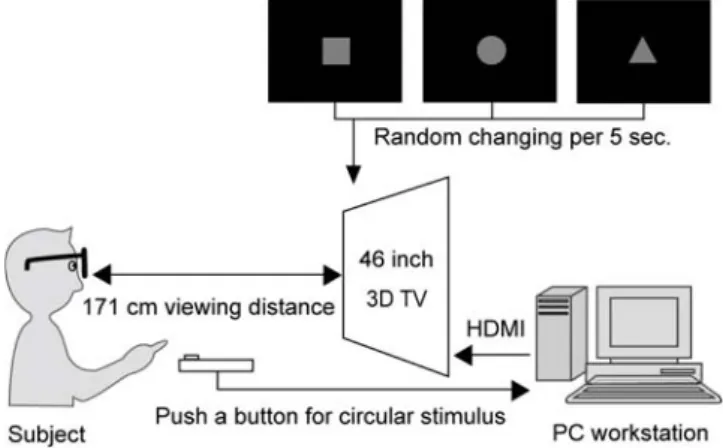
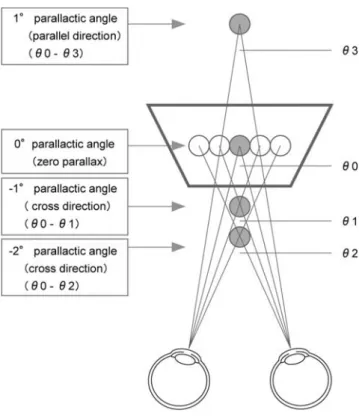
The stimuli were stereo images of a 50% gray square, circle, and triangle on black backgrounds. The series was viewed for 15 min. Each stimulus had a viewing angle of two degrees on a side or diameter. The stimuli were presented with one of four parallactic angles: 1° (uncrossed disparity), 0° (2D image), -1° (crossed disparity), and -2° (crossed disparity). Figure 1 and 2 shows the arrangement and depth conditions of the experiment. The stimuli were presented in random order at 5-second intervals. The subjects were asked to concentrate on the center of each stimulus and push a button when the circle was presented.
In experimental conditions 1, 2, 3, and 4, the subjects viewed a stimulus with a parallactic angle of -1° for 10 min., then viewed each stimulus at different parallactic angles (1, 0, -1, and -2°) for five minutes. In condition 5, a stimulus with a parallactic angle of 0° was presented for 15 min. Figure 3 shows the conditions of the experiment. The subjective experiences of visual fatigue and depth sensation were evaluated according to a 5-point self-rating method using a simple oral questionnaire consisting of two questions: 1. How tired are your eyes? and 2. What was your impression of the depth sensation? The subjects reported their symptoms and perceptions every 5 min. The five-stages of visual fatigue were a) no symptoms, b) mild, c) fair, d) strong, and e) severe. The five-stages of depth sensation were a) no depth, b) mild, c) fair, d) good, and e) excellent.
Fig. 3. The experimental conditions. Fig. 2. The depth conditions.
54-3 / S. Kim
IMID 2009 DIGEST • In post-experiment interviews, the subjects were
asked about their viewing impressions. The subjects were 13 graduate student volunteers, aged 23-30 years old, with emmetropia and normal binocular stereoscopic vision.
3. Results
In all conditions, the subjective symptoms of visual fatigue showed an upward tendency for 10 min. after the stimuli were presented. Significant differences were noted among the conditions following the change in parallactic angle after 15 min. In condition 1, the average rate of visual fatigue was 1.00, as did all of the other conditions before the stimuli were presented. The rate gradually increased to 2.23 after 10 min. and soared to 3.08 after 15 min. In condition 2, it gradually increased to 1.92 after 10 min. and to 2.38 after 15 min. In conditions 3 and 4, it increased to the same point as in condition 1 after 10 min., and then after 15 min. decreased to 2.00 in condition 3 and 2.62 in condition 4. In condition 5, it gradually increased to 1.85 after 10 min. and then slightly increased to 1.92 after 15 min. A primary efficacy analysis of visual fatigue was performed using a 2-way analysis of variance (ANOVA) with the Bonferroni test according to measurement time (pre-experiment, 5, 10, and 15 min., and post-experiment), the five conditions, and the time-by-condition interaction. The measurement time (F= 39.385, p < .01) and time-by-condition interaction (F = 2.760, p < .01) differed significantly. For the 15 min. examination, conditions 3 and 5 had significantly lower values than condition 1 (p < .05). Figure 4 shows average rate of visual fatigue on the five conditions.
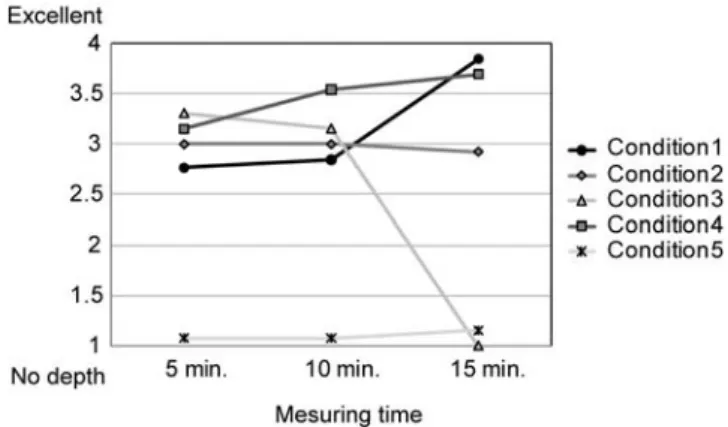
In all conditions, the subjects felt a depth sensation associated with the changing parallactic angle. In
condition 1, the average rate of depth sensation was 2.77 after 5 min., which slightly increased to 2.85 after 10 min. and soared to 3.85 after 15 min. In condition 2, it remained at 3.00 up to the 10 min. mark, then slightly decreased to 2.92 after 15 min. In condition 3, it remained at 3.31 up to the 5 min. mark, then increased to 3.15 after 10 min. and plunged to 1.00 after 15 min. In condition 4, it stood at 3.15 after 5 min., increased to 3.54 after 10 min. and then to 3.69 after 15 min. In condition 5, it remained at 1.08 up to the 10 min. mark and then increased slightly to 1.15 after 15 min. The 2-way ANOVA also showed significant differences in depth sensation for time-by-condition interaction (F =27.563, p < .01). Compared with the 15 min. data, significant differences were seen between a) condition 1 and conditions 3 and 5, b) conditions 2 and 5, c) condition 3 and conditions 1, 4, and 5, d) condition 4 and conditions 3 and 5, and e) condition 5 and conditions 1, 2, 3, and 4 (p < .05). Figure 5 also shows average rate of depth sensation on the five conditions.
Post-experiment interviews suggested that the subjects felt different visual fatigue symptoms under different parallax conditions. In conditions 1, 2 and 4, the subjects perceived visual fatigue with the changing of the binocular parallax. In condition 3, however, the subjects stated that their visual fatigue was reduced by the poor depth sensation. The subjects also felt visual comfort when the binocular parallax was changed to 0°.
4. Conclusion
In this study, we analyzed time-series changes in visual fatigue and depth sensation in order to elucidate the safety and comfort of 3D image viewing. We examined the physiological changes, including the
Fig. 4. Average rate of visual fatigue.
54-3 / S. Kim
• IMID 2009 DIGEST
subjective symptoms of visual fatigue, under five viewing conditions with various stimuli and parallax conditions.
In all conditions, the subjective symptoms of visual fatigue showed an upward tendency for 10 min. after viewing a stimulus at a parallactic angle of -1° or 0°. Moreover, significant differences were seen among conditions 1, 3, and 5 after the parallactic angle was changed at 15 min. In condition 1, the average rate of visual fatigue increased over the range of parallactic angles. In condition 3, it decreased when the parallactic angle was changed to 0°. In condition 5 (2D condition), it was slightly increased at 15 min. These results mean that the degree of visual fatigue for the stereoscopic images and the 2D images differed significantly with time-series changes over the range of binocular disparity. Time-series changes in visual fatigue may be influenced by the frequency at which the parallactic angle of related images became 0°. There seemed to be no significant difference between condition 2 and conditions 4 and 5. These results agree with those of other studies on ocular accommodation function.[6-7] In particular, in condition 4 with accommodation at a point beyond the display, visual fatigue gradually increased to almost the same level as in condition 2, in which the accommodation was at a point in front of the display (-1°). Visual fatigue from viewing 3D images may be influenced by the absolute value of the parallactic angle, which was changed over time.
The following conclusions were reached as a result of the experiment.
1. Stereoscopic images and 2D images have significantly different levels of visual fatigue over time.
2. Time-series changes in visual fatigue may be influenced by the frequency at which the parallactic angle of the related images becomes 0°. 3. Visual fatigue from viewing stereoscopic images
is influenced the absolute value of the parallactic angle, which changes over time.
In the future, we will investigate various types of depth information, study 3D visual stimuli containing motion components, and conduct objective evaluations.
Acknowledgements
This research was carried out under a contract awarded by The Mechanical Social Systems
Foundation and supported by a grant from the Japan Keirin Association.
References
1. Kawai, T., Shibata, T., Shimizu, Y., Kawata, M., Suto, M.: Development and evaluation of amusement machine using autostereoscopic 3D display, SPIE, 5291, pp. 1-8. (2004).
2. Ilgner, J., Kawai, T., Shibata, T., Yamazoe, T., Westhofen, M.: Evaluation of stereoscopic medical video content on an autostereoscopic display for undergraduate medical education, SPIE, 6055, pp. 46-56. (2006).
3. Kishi, S., Yamazoe, T., Shibata, T., Kawai, T., Inoue, T., Sakaguchi, Y., Okabe, K., Kuno, Y.: An ergonomic evaluation system for stereoscopic 3-D images, J of the Institute of Image Information and Television Engineers, 60, No.6, pp. 96-104. (2006). (in Japanese)
4. Yano, S., Emoto, M., Mitsuhashi, T.: Two factors in visual fatigue caused by stereoscopic HDTV images, Displays, 25, pp. 141–150. (2004).
5. Emoto, M., Niida, T., Okano, F.: Repeated vergence adaptation causes the decline of visual functions in watching stereoscopic television, J of Display Technology, 1, pp. 328–340. (2005)
6. Inoue, T. Noro, K., Iwasaki, T., Ohzu, H.: Evaluation of Stereoscopic 3D Display in Terms of Human Visual Function, J of the Institute of Image Information and Television Engineers, 48, No.10, pp. 1301-1305. (1994). (in Japanese)
7. Iwasaki, T., Kubota, T., Tawara, A.: The tolerance range of binocular disparity on a 3D display based on the physiological characteristics of ocular accommodation, Displays, 30, pp. 44–48. (2009).