INTRODUCTION
Mushrooms, the fruiting bodies of macrofungi, are simply known as a protein rich vegetable, and have been used for their gastronomic and medicinal values by mankind for thou-sands of years all around the world. Mushrooms can also degrade virtually any lignocellulosic waste and play a vital role in disposing of a lot of waste including domestic, indus-trial, and agricultural waste (Okhuoya 2011). Brodkorb and Legge (1992), Heinfling et al. (1997) and Knapp et al. (1997) observed that mushrooms are more efficient than bacteria in the biodegradation of a number of recalcitrant compounds such as xenobiotics owing to their extracellular enzyme sys-tem. Oyster mushrooms (Pleurotus spp.) occupy the second place in the world’s production of edible mushrooms, after the popular white button mushroom, Agaricus bisporus (Kues
and Liu 2000; Berne et al. 2008), and the genus Pleurotus comprises about 40 species (Jose and Janardhanan 2000). Lignocellulose, the principal component of the plant cell wall, accounts for about 50% of the biomass in the world with an estimated annual production of 10~50×1012kg (Classen et al. 1999), and it is mostly wasted in the form of post-harvest agricultural residue and the waste from food processing industries (Mtui 2009). This natural, potentially cheap, and abundant polymer can be effectively utilized for the cultivation of mushrooms as the bioconversion of agri-culture and industrial waste into food has attracted the world’s attention in recent years (Ingale and Ramteke 2010). Mush-room cultivation is a highly efficient method of disposing agro-lignocellulosic waste as well as producing nutritious food (Cohen et al. 2002), and this in turn can minimize the environmental pollution owing to unutilized agricultural waste as well as reduce air pollution associated with the burning of agricultural waste (Ahmed et al. 2009). As cellu-lose is one of the major components of lignocellucellu-loses, efforts should be made to obtain high levels of cellulose degrading
─ ─ 181 ──
Improvement of Cellulolytic Activity of Pleurotus florida
through Radiation Mutagenesis
Chandran Sathesh-Prabu and Young-Keun Lee*
Advanced Radiation Technology Institute, Korea Atomic Energy Research Institute, Jeongeup 580-185, Korea
Abstract -- A mushroom mutant with increased cellulolytic activity was developed through radia-tion mutagenesis. The homogenized hypha suspension of Pleurotus florida was exposed to gamma radiation (60Co, AECL) at the dose of LD99(0.51 kGy, D10; 0.26 kGy). Among 16 mutants, Pf CM4 showed 17.24% more cellulolytic activity than the wild type (p⁄⁄0.05). It was observed that Pf CM4 can utilize all kinds of carbon sources tested for their mycelia growth. Starch, xylan, and glucose favourably supported the radial mycelia extension. Yeast extract and NH4NO3have been recorded as the best organic and inorganic nitrogen sources, respectively. Pf CM4 was found to grow significantly faster, even at high temperature (30��C), than wild type (p⁄⁄0.05), and the optimal pH was 5.5~~6.5. This study reveals that the mutant Pf CM4 could be employed for the effective recycling of cellulosic wastes, in addition to mushroom farming.
Key words : Cellulase, Mushroom, Pleurotus florida, Radiation mutagenesis
* Corresponding author: Young-Keun Lee, Tel. +82-63-570-3300, Fax. +82-63-570-3309, E-mail. [email protected]
enzymes producing mushroom strains to potentially utilize cellulose waste. Mutation breeding is a process by which mutant variants with desirable traits to be bred are developed, without altering the remaining genotype, by physical, chemi-cal and biologichemi-cal mutagenic agents (Sathesh-Prabu and Lee 2011). Gamma-ray radiation can change the genetic diversity of filamentous fungi and induce positive mutants (Boomi-nathan et al. 1990). Among 242 mutant varieties, about 61% of the mutants were induced by gamma-ray irradiation in Japan indicating that mutation breeding through gamma-ray irradiation is an effective and highly successful approach for the generation of commercial cultivars (Nakagawa 2009). In this lime light, the present investigation was undertaken to develop Pleurotus spp. mutants with enhanced cellulose degrading activity through gamma radiation induced muta-genesis.
MATERIALS AND METHODS
1. Chemicals
All chemicals and microbiological media were purchased from Sigma-Aldrich and Difco, respectively. All chemicals used were of analytical grade unless otherwise stated.
2. Strains
The pure cultures of Pleurotus spp. such as P. eryngii (KACC 42719), P. sajor caju (KACC 42720), P. ostreatus (KACC 42738), and P. florida (KACC 52110) were procured from the Korean Agricultural Culture Collection Centre, Suwon, Korea. The cultures were maintained in a potato dextrose agar (PDA) medium at 4�C and sub-cultured at 30-day intervals.
3. Radiation sensitivity of mushroom strains Mycelia of four mushroom strains were collected by cen-trifuging 15 ml of seven-day old cultures grown in potato dextrose broth and washed twice with sterile distilled water. An aliquot (1.5 ml) of hypha suspension with sterile distilled water, prepared through the homogenization of mycelia by a homogenizer (Polytron PT 1200E, Kinematica AG), was used for radiation sensitivity studies. The homogenized hypha suspension was irradiated in a 60Co irradiator (dose
rate 920 Gy h-1, AECL) at 0.05 to 1 kGy at the Advanced Radiation Technology Institute, Korea Atomic Energy Re-search Institute, Korea. The dose rate was determined through alanine dosimetry (EPR (e-scan), Bruker). The hypha survival rate in the irradiated samples was determined using serial dilution and a plate count method. The D10-value was deter-mined by plotting the radiation dose (kGy) on the X-axis, and the survival ratio on the Y-axis. The negative reciprocal of the slope indicated the D10-value. The LD99-value was determined using the formula, LD99==log(0.01). slope-1.
4. Mutagenesis and screening of cellulase mutants
To induce the radiation mutagenesis, the hypha suspension was prepared as described above, and exposed to gamma radiation at the dose of LD99. Irradiated samples were plated onto a cellulase mutant screening medium (CMSM). CMSM contained Buswell mineral salt medium (BMSM, Buswell et al. (1996)) and 0.1% (v.v-1) triton X 100 and 4 g.l-1sorbose
to enable the screening of a large number mutants (Chand et al. 2004). BMSM contained (g.l-1): KH2PO4, 1.0; K2HPO4,
0.4; MgSO4.7H2O, 0.5; CaCl2.2H2O, 0.013; yeast extract, 0.1; L-asparagine, 1.5; NH4NO3, 0.5; thiamine.HCl, 0.0025; agar, 15; and 1 ml of a trace element solution consisting of (g.l-1): ferric citrate, 4.8; ZnSO4.7H2O, 2.64; MnCl2.4H2O,
2.0; CoCl2.6H2O, 0.4 and CuSO4.5H2O, 0.4. Carboxymethyl-cellulose (CMC) (1%) served as the carbon source. Six dif-ferent CMSMs (CMSM I to CMSM VI) were prepared to obtain the potent mutants and to understand the growth pat-tern of mushroom strains in irradiated samples. The composi-tion of CMSM I to CMSM VI were as follows: CMSM I (1% CMC++0.4% Sorbose++0.1% Triton X 100-Glucose); CMSM II (1% CMC-Sorbose-Triton X 100-Glucose); CMSM III (1% CMC++Sorbose++Triton X 100++0.5% Glu-cose); CMSM IV (1% CMC-Sorbose-Triton X 100++0.5% Glucose); CMSM V (1% CMC++0.4% Sorbose++0.1% Triton X 100++1% Glucose); and CMSM VI (1% CMC++0.4% Sor-bose++0.1% Triton X 100++2% Glucose). The plates were incubated at 25�C for 7~10 days. All the mutants formed only on CMSM I were taken for further studies, and pure cultures were made.
5. Cellulolytic activity of mutants
on the above mentioned BMSM with 1% CMC as the sole carbon source. Mycelium agar plugs (six mm in radius) of the respective mutants were punched out from the margin of an actively growing colony (seven days old) using a sterile cork borer and inoculated in the center of the CMC amended BMSM medium. The plates were incubated at 25�C for 144 h. Mycelia growth (radial extension, Rme) was measured in eight radius lengths of the colony from the centre of the ino-culum to the periphery of the colony at 24 h intervals for 144 h. Various growth kinetics of mutants such as colony radial growth (Kr), specific growth rate (α), peripheral growth zone (w), and percent of growth deviation were calculated as described elsewhere (Trinci 1971; Baumer 2008). Those mutants that showed better degradation activity over the wild type were selected for further studies.
6. Growth of mutant on different carbon and nitrogen sources
To study the utilization of different carbon and nitrogen sources by the mutant, the BMSM was prepared separately with 1% (w.v-1) of each cellulose, xylan, starch, pectin,
chi-tin, sorbose, and glucose, and 0.2% (w.v-1) of each yeast
extract, beef extract, tryptone, peptone, casaminoacids, L-asparagine, NH4Cl, NH4NO3, NaNO3, (NH4)2SO4and urea, respectively. The growth of the selected mutant on a PDA was also evaluated. The selected mutant was inoculated in the respective medium and incubated at 25�C for 144 h. Mycelia growth was measured, as described above, after 144 h of incubation. Mycelia density was also observed visually and categorized into five groups: very scanty (1++), scanty (2++), moderate (3++), dense (4++), and very dense (5++).
7. Effect of different temperatures and initial medium pH on mutant growth
The PDA medium was prepared (39 g.l-1) and the pH of
the medium was adjusted to be within the range of 5.0 to 9.0 at 0.5 pH intervals with 1 M HCl and 1 M NaOH using a bench top pH meter (520A, Orion). After inoculation, the respective plates were incubated at 25�C for 144 h. To study the suitable temperature for the mycelia growth of the mutant, the selected mutant was inoculated in the PDA medium, and the plates were incubated at different temperatures (18, 20, 22, 24, 25, 26, 28, 30 and 32�C) for 144 h. Mycelia growth was measured, as described earlier, after 144 h of incubation.
8. Statistical analysis
Data were subjected to a one-way analysis of variance (ANOVA) followed by a Tukey test and a t-test using an SPSS-20 package to determine the level of significance of the variants in all experiments caused by the variables studi-ed. The probability values (p) of ⁄0.05 or ⁄0.01 were con-sidered significant.
RESULTS AND DISCUSSION
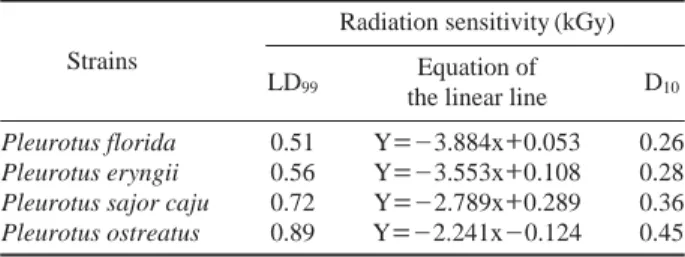
The radiation sensitivity of mushroom strains was studied to determine the D10and LD99values. The D10-value refers to the radiation dose required to effect a 90% reduction in colony forming units. P. ostreatus recorded the highest D10 value (0.45 kGy), followed by P. sajor caju (0.36 kGy), P. eryngii (0.28 kGy), and P. florida (0.26 kGy). The same trend was also observed in case of LD99-values (Table 1). Among the four strains, P. florida was found to be the most radiation sensitive strain. The reason for the low D10and LD99values may be due to the use of mycelia (Mechanical homogenizer may cause cell wall breakage) for the radiation studies, which was found to be more radiation sensitive than basidiospores (Lee and Chang 1999).
A homogenized hypha suspension was irradiated at the dose of LD99to obtain the mutants. The mutants formed in the CMSM I were considered as potent mutants because CMSM I was devoid of glucose, but supplemented with growth restrictors such as sorbose and triton X 100. Sorbose is an inhibitor of 1,3-β glucan biosynthesis (Bisaria et al. 1986). Triton X 100 was used to limit the colony size, thus enabling the screening and isolation of mutants (Gadgil 1995; Jiang et al. 2011). P. ostreatus produced 5, 36, 6, 48, 7, and 7 mutants in CMSM I to CMSM II, respectively. Though P. eryngii gave only one potent mutant in CMSM I, but no mutants were observed in CMSM III, V and VI. P. eryngii
Table 1. Radiation sensitivity of Pleurotus spp.
Strains
Radiation sensitivity (kGy) LD99
Equation of
D10 the linear line
Pleurotus florida 0.51 Y==-3.884x++0.053 0.26
Pleurotus eryngii 0.56 Y==-3.553x++0.108 0.28
Pleurotus sajor caju 0.72 Y==-2.789x++0.289 0.36
gave the highest number of mutants (108) in CMSM IV com-pared with P. ostreatus (48), P. sajor caju (62), and P. florida (34). P. florida gave 6, 16, 7, 34, 6, and 7 mutants in CMSM I to CMSM VI, respectively. The number of mutants formed by P. sajor caju were 4, 40, 3, 62, 5, and 6 in CMSM I to CMSM VI, respectively. The results of mutant screening in six different CMSMs showed that the addition of glucose did not show any significant effect on the growth or forma-tion of mutants (p⁄0.05) except an increase in the mycelia density. On the other hand, the addition of sorbose and triton X 100 influenced the growth of mutants, which in turn facil-itated the isolation of the potent mutants in the irradiated sam-ples (p⁄0.05). In the present study, it was observed that even though P. florida was found to be the most radiation sensitive strain among the four mushroom strains taken for the study, but it gave maximum number of potent mutants in CMSM I compared with the other strains. A total of 16 potent mutants were obtained from four strains of mushrooms (P. florida (6), P. ostreatus (5), P. sajor caju (4), and P. eryngii (1)) and all of them were taken for a cellulolytic
acti-vity assay.
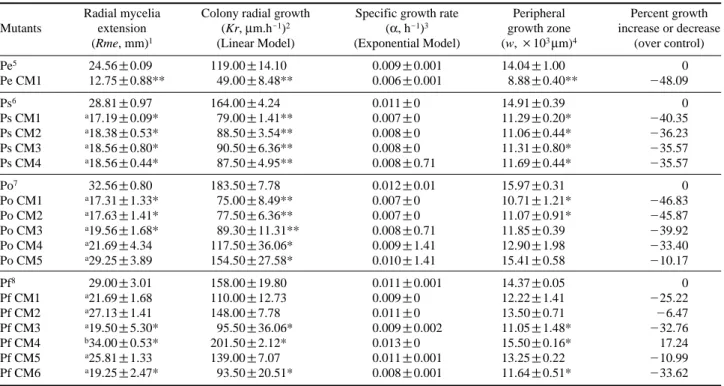
The cellulolytic activity of the selected mutants was eval-uated in BMSM supplemented with 1% (w.v-1) CMC as the sole carbon source. Table 2 describes the various growth kinetic parameters such as radial mycelia extension (Rme), colony radial growth (Kr), specific growth rate (α), peripheral growth zone (w), and percent of growth deviation of the selected mutants and their respective wild types. It was found that of 16 potent mutants; only one mutant (Pf CM4) recorded a positive growth percentage (17.24%) showing the maximum cellulolytic activity over the wild type (p⁄0.05). All the growth kinetic parameters obtained with Pf CM4 were higher than that of the other mutants. It is clear that Pf CM4 was the most efficient mutant in degrading cellulose in terms of CMC. Therefore, Pf CM4 was selected for further studies. This characteristic (increased cellulolysis) was found to be stable at up to four generations of sub-culturing. Lee et al. (2000) developed lignocellulolytic mutants of P. ostreatus by irradiating the mycelia with gamma-rays (1~2 kGy) and found that the extracellular enzymes of the mutants were up
Table 2. Growth kinetics of Pleurotus spp. and their respective mutants on CMC medium
Radial mycelia Colony radial growth Specific growth rate Peripheral Percent growth Mutants extension (Kr, μm.h-1)2 (α, h-1)3 growth zone increase or decrease
(Rme, mm)1 (Linear Model) (Exponential Model) (w, ×103μm)4 (over control)
Pe5 24.56±0.09 119.00±14.10 0.009±0.001 14.04±1.00 0 Pe CM1 12.75±0.88** 49.00±8.48** 0.006±0.001 8.88±0.40** -48.09 Ps6 28.81±0.97 164.00±4.24 0.011±0 14.91±0.39 0 Ps CM1 a17.19±0.09* 79.00±1.41** 0.007±0 11.29±0.20* -40.35 Ps CM2 a18.38±0.53* 88.50±3.54** 0.008±0 11.06±0.44* -36.23 Ps CM3 a18.56±0.80* 90.50±6.36** 0.008±0 11.31±0.80* -35.57 Ps CM4 a18.56±0.44* 87.50±4.95** 0.008±0.71 11.69±0.44* -35.57 Po7 32.56±0.80 183.50±7.78 0.012±0.01 15.97±0.31 0 Po CM1 a17.31±1.33* 75.00±8.49** 0.007±0 10.71±1.21* -46.83 Po CM2 a17.63±1.41* 77.50±6.36** 0.007±0 11.07±0.91* -45.87 Po CM3 a19.56±1.68* 89.30±11.31** 0.008±0.71 11.85±0.39 -39.92 Po CM4 a21.69±4.34 117.50±36.06* 0.009±1.41 12.90±1.98 -33.40 Po CM5 a29.25±3.89 154.50±27.58* 0.010±1.41 15.41±0.58 -10.17 Pf8 29.00±3.01 158.00±19.80 0.011±0.001 14.37±0.05 0 Pf CM1 a21.69±1.68 110.00±12.73 0.009±0 12.22±1.41 -25.22 Pf CM2 a27.13±1.41 148.00±7.78 0.011±0 13.50±0.71 -6.47 Pf CM3 a19.50±5.30* 95.50±36.06* 0.009±0.002 11.05±1.48* -32.76 Pf CM4 b34.00±0.53* 201.50±2.12* 0.013±0 15.50±0.16* 17.24 Pf CM5 a25.81±1.33 139.00±7.07 0.011±0.001 13.25±0.22 -10.99 Pf CM6 a19.25±2.47* 93.50±20.51* 0.008±0.001 11.64±0.51* -33.62 1measured in eight radius lengths of a colony from the centre of the inoculums after 144 h of inoculation.
2slope of the model or Kr==(r
1-r0)/(t1-t0). r1==colony radius at time t1. r0==colony radius at time t0 3r==roeαt. α==specific growth rate. r==radius in mm. t==time in hours.
4w==peripheral growth zone (region in which hyphae are able to contribute protoplasm to the apical extension of the colony’s leading hyphae). w==Kr/α 5P. eryngii, 6P. sajor caju, 7P. ostreatus, 8P. florida (5to 8all wild type)
Values are expressed as means±SD of triplicates. Same superscript letter refers no significant difference among mutants within group.
to 10-times higher than the control. From these results, it seems that the gamma-ray radiation induces the mutants that could be used to recycle the lignocellulosic wastes.
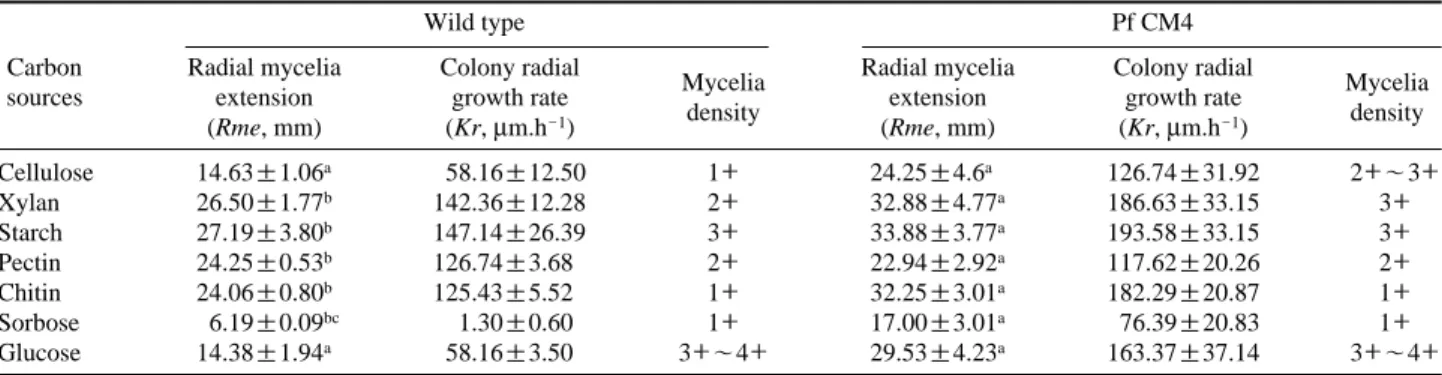
The utilizations of different carbon and organic and inor-ganic nitrogen sources by Pf CM4 were studied. The radial mycelia extension (Rme), colony radial growth (Kr), and mycelia density of Pf CM4 and the wild type for various carbon sources are given in Table 3. It was observed that apart from CMC, Pf CM4 can utilize all kinds of carbon sources including polysaccharides in addition to sorbose, an inhibitor of cell wall synthesis. It was found that radial mycelia extension was significantly supported by starch, xylan, and glucose, and the opposite was recorded in sorbose and chitin as a carbon source. Sorbose almost completely inhibited the growth of the wild type. All sugars were effec-tively utilized by Pf CM4 compared with the wild type (p⁄ 0.05). In the present study, it was found that Pf CM4 preferred polysaccharides (xylan and starch) more than glucose (p¤ 0.05). This result was consistent with the results of Jaindaik and Kapoor (1976), who reported that starch supports the growth of oyster mushrooms. This result is contrary, but partially similar to Anyakorah et al. (2004), who reported that P. ostreatus prefers polysaccharide, cellulose, rather than monosaccharides such as glucose and mannose. The results of the present study indicate that Pf CM4 tends to grow on a wide range of carbon sources, even on complex sugars. The radial mycelia extension (mm) of Pf CM4 and the wild type on PDA were 13.25±0.35 and 17.20±2.71. i.e., 29.81% more mycelia growth occurred in Pf CM4 than in the wild type. Djayanegara and Harsoyo (2009) obtained radiation-induced mutants of P. florida, which showed faster mycelia growth compared to the control.
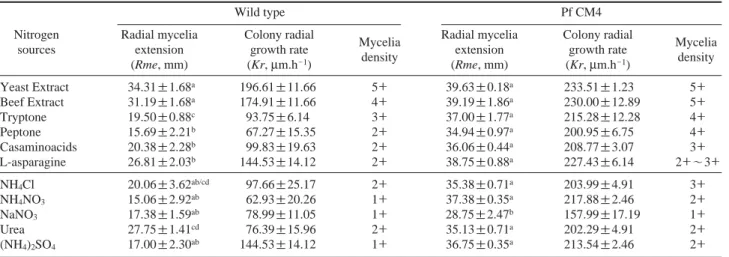
In the case of nitrogen sources, Pf CM4 preferred organic nitrogen more than inorganic nitrogen (Table 4). This result is consistent with the results of earlier studies on various Pleurotus spp. (Song et al. 2001; Qinnghe et al. 2004; Imtiaj et al. 2009). Among organic nitrogen, Pf CM4 showed the maximum growth and mycelium density in yeast and beef extracts. Even though L-asparagine gave similar values of colony radial growth rate as for yeast and beef extracts, it was observed that the mycelia density was only half of that of both extracts. Pf CM4 followed a yeast extract›beef extract ¤tryptone¤peptone¤casaminoacids¤L-asparagine sequ-ence for the mycelia growth. It was observed that inorganic nitrogen also favoured the growth of Pf CM4 as organic nitrogen, but the mycelia density was not as high as organic nitrogen. This could be explained by the limited nutrition in the growth media. In the case of inorganic nitrogen, Pf CM4 followed a NH4NO3¤(NH4)2SO4¤NH4Cl¤Urea¤NaNO3 sequence. NaNO3could be little utilized by Pf CM4 as a nitrogen source. In contrast, the wild type preferred the urea rather than NH4NO3, and followed a urea¤NH4Cl¤NaNO3 ›(NH4)2SO4¤NH4NO3sequence. This observation is in accordance with the results of Adebayo-Tayo et al. (2011) who observed that the maximum mycelia growth of P. ostreatus was achieved when urea was used as the sole nitrogen source. The most probable reason for the preferen-tial utilization of organic nitrogen over inorganic nitrogen is the accessibility of amino acids in organic nitrogen, as organic nitrogen contains all kinds of amino acids, which can be absorbed directly by the mycelia (Qinnghe et al. 2004). Hwang et al. (2003) stated that certain essential amino acids could not be synthesized from inorganic nitrogen sources.
In the present study, it was observed that the mycelia
Table 3. Growth of Pf CM4 on various carbon sources
Wild type Pf CM4
Carbon Radial mycelia Colony radial
Mycelia Radial mycelia Colony radial Mycelia sources extension growth rate extension growth rate
(Rme, mm) (Kr, μm.h-1) density (Rme, mm) (Kr, μm.h-1) density
Cellulose 14.63±1.06a 58.16±12.50 1++ 24.25±4.6a 126.74±31.92 2++~3++ Xylan 26.50±1.77b 142.36±12.28 2++ 32.88±4.77a 186.63±33.15 3++ Starch 27.19±3.80b 147.14±26.39 3++ 33.88±3.77a 193.58±33.15 3++ Pectin 24.25±0.53b 126.74±3.68 2++ 22.94±2.92a 117.62±20.26 2++ Chitin 24.06±0.80b 125.43±5.52 1++ 32.25±3.01a 182.29±20.87 1++ Sorbose 6.19±0.09bc 1.30±0.60 1++ 17.00±3.01a 76.39±20.83 1++ Glucose 14.38±1.94a 58.16±3.50 3++~4++ 29.53±4.23a 163.37±37.14 3++~4++
4++==dense; 3++==moderate; 2++scanty; 1++==very scanty. Values are expressed as means±SD of triplicates. Means followed by the same superscript indicate no
growths of the wild type and Pf CM4 were significantly in-fluenced by the incubation temperature (p⁄0.05), and it was found that Pf CM4 preferred a high temperature (30�C), while the wild type grew well at 25�C (Fig. 1). The lowest mycelia growth was recorded at 16�C for both Pf CM4 and the wild type. The lowest growth at low temperature may be due to the reduced metabolic activities necessary for the absorption of the essential nutrients required for growth (Garraway and Evans, 1984). According to Shim et al. (2003), the mycelia growth is expedited gradually in proportion to the increase in temperature. The same trend was observed in the present study with Pf CM4, but the mycelia growth was suppressed at 32�C. It was observed that the level of mycelia growth suppression at 32�C was not as low as that found at 25�C (p⁄0.01). The optimum temperature for the mycelia growth of P. ostreatus was 25�C (Adebayo-Tayo et al. 2011). Imtiaj et al. (2009) observed that the mycelia growth of Paecilomyces fumosoroseus was suppressed at temperatures higher than 30�C. Imtiaj et al. (2007) reported that 25�C was the most suitable temperature for the spontaneous mycelia growth of the majority of mushrooms, but our findings obtained using the mutant were not in agreement with this result. This could be correlated with the existence of genetic variations, result-ing from an induced radiation mutagenesis, in the tolerance to high temperature. Chen et al. (2008) developed a high temperature tolerant P. ferulae using mutagenesis through nitrogen ion implantation. In the present study, it should be noted that the mutant had the ability to grow even at high temperature compared with the wild type (p⁄0.05). This
characteristic appears to be a need of the hour for sustainable mushroom farming, mainly in tropical regions.
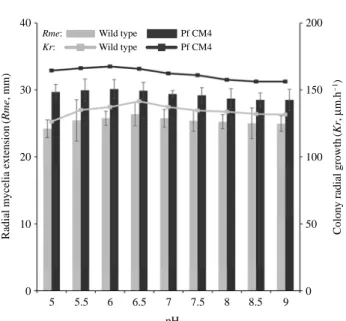
It was observed that all pH levels tested (5.0 to 9.0) favo-ured the growth of Pf CM4 and the wild type, and no signi-ficant difference in mycelia growth was found between pH 5.0 and 9.0 (p¤0.05). However, the optimal pH for the max-imal mycelia growth of Pf CM4 and the wild type was found to be 5.5 to 6.5, and 6.0 to 7.0, respectively, based on the maximum mean values (Fig. 2). Similar results were reported by Imtiaj et al. (2009), who studied 371 strains of mushrooms
Radial mycelia extension
(Rme
, mm)
Colony radial growth
(Kr , μ m.h -1) 40 35 30 25 20 15 10 5 0 250 200 150 100 50 0 16 18 20 22 24 25 26 28 30 32 Temperature (�C)
Fig. 1. Incubation temperature influenced the mycelia growth of
the wild type and Pf CM4. *Pf CM4 recorded significantly high growth compared with the wild type (p⁄0.05).
Rme: Kr: Wild type Pf CM4 Pf CM4 Wild type * * Table 4. Growth of Pf CM4 on various nitrogen sources
Wild type Pf CM4
Nitrogen Radial mycelia Colony radial
Mycelia Radial mycelia Colony radial Mycelia
sources extension growth rate extension growth rate
(Rme, mm) (Kr, μm.h-1) density (Rme, mm) (Kr, μm.h-1) density
Yeast Extract 34.31±1.68a 196.61±11.66 5++ 39.63±0.18a 233.51±1.23 5++ Beef Extract 31.19±1.68a 174.91±11.66 4++ 39.19±1.86a 230.00±12.89 5++ Tryptone 19.50±0.88c 93.75±6.14 3++ 37.00±1.77a 215.28±12.28 4++ Peptone 15.69±2.21b 67.27±15.35 2++ 34.94±0.97a 200.95±6.75 4++ Casaminoacids 20.38±2.28b 99.83±19.63 2++ 36.06±0.44a 208.77±3.07 3++ L-asparagine 26.81±2.03b 144.53±14.12 2++ 38.75±0.88a 227.43±6.14 2++~3++ NH4Cl 20.06±3.62ab/cd 97.66±25.17 2++ 35.38±0.71a 203.99±4.91 3++ NH4NO3 15.06±2.92ab 62.93±20.26 1++ 37.38±0.35a 217.88±2.46 2++ NaNO3 17.38±1.59ab 78.99±11.05 1++ 28.75±2.47b 157.99±17.19 1++ Urea 27.75±1.41cd 76.39±15.96 2++ 35.13±0.71a 202.29±4.91 2++ (NH4)2SO4 17.00±2.30ab 144.53±14.12 1++ 36.75±0.35a 213.54±2.46 2++
5++==very dense; 4++==dense; 3++==moderate; 2++scanty; 1++very scanty. Values are expressed as means±SD of triplicates. Means followed by the same super-script indicate no significant difference at the level of p==0.05.
and observed that most of the mushrooms have a broad range of pH (5.0~9.0) for their mycelia growth, but the most fav-ourable pH was between pH 6.0 and 7.0. In the case of Pf CM4, a slight decrease in growth at a basic pH was obtained (p¤0.05) compared with an acidic pH. This trend may be due to the sensitivity of a mutant to a basic pH compared with an acidic pH, as reported by Bilgrami and Verma (1992), who stated that mushroom mycelia are more tolerant to aci-dic media than to basic media. Ibekwe et al. (2008) observed that the optimum mycelia production of P. ostreatus was recorded at pH 6.5, while a pH range of less than 5.0 showed no significant growth. It seems that Pf CM4 has a broad pH range for its mycelia growth, similarly with that of the wild type, and that the irradiation might not have any effect on this trait.
CONCLUSION
The cellulolytic activity of P. florida could be significantly improved through gamma radiation induced mutagenesis. The mutant, Pf CM4, was found to be more potent (17.24%) than the wild type in terms of utilizing cellulose, in addition to various polysaccharides. In particular, Pf CM4 could grow better at a high temperature than the wild type. Further studies will focus on the genomics and proteomics of this mutant
for better employment in the recycling of cellulosic wastes and the sustainable production of edible mushrooms.
REFERENCES
Adebayo-Tayo BC, Jonathan SG, Popoola OO and Egbomuche RC. 2011. Optimization of growth conditions for mycelia yield and exopolysaccharide production by Pleurotus
ost-reatus cultivated in Nigeria. African J. Microbiol. Res. 5:
21230-2138.
Ahmed SA, Kadam JA, Mane VP, Patil SS and Baig MMV. 2009. Biological efficiency and nutritional contents of
Pleurotus florida (mont.) singer cultivated on different
agro-wastes. Nat. Sci. 7:44-48.
Anyakorah CI, Okafor N and Olatunji O. 2004. Carbon and nitrogen requirements for the cultivation of oyster mush-room (Pleurotus ostreatus). Nigerian Food J. 22:127-132. Baumer JD, Mas-Diego SM, Pacheco SMV, Morgado AFM and
Furigo AFJ. 2008. Comparative study of mycelia growth and production of cinnabarin by different strains of
Pycno-porus sanguineus. Revista de Biologia e Farmacia 2:1-5.
Berne S, Pohleven F, Turk T and Sepcic K. 2008. Induction of fruiting in oyster mushroom (Pleurotus ostreatus) by poly-meric 3-alkylpyridinium salts. Mycol. Res. 112:1085-1087. Bilgrami KS and Verma RN. 1992. Physiology of fungi. pp.
70-71. Villka’s Publishing House Pvt. Ltd. London. Bisaria VS, Nanda M and Ghose TK. 1986. Effect of L (-)
Sorbose on the release of β-glucosidase by Trichoderma
reesei QM9414. J. Gen. Microbiol. 132:973-978.
Boominathan K, Balachandra DS, Randall TA and Reddy CA. 1990. Nitrogen-deregulated mutants of Phanerochaete
chrysosporium-a lignin-degrading basidiomycete. Arch. Microbiol. 153:260-265.
Brodkorb TS and Legge RL. 1992. Enhanced biodegradation of phenanthrene in oil tar contaminated soils supplemented with
Phanerochaete chrysosporium. Appl. Environ. Microbiol. 58:3117-3121.
Buswell JA, Cai, YJ, Chang ST, Peberdy JF, Fu SY and Yu HS. 1996. Lignocellulolytic enzyme profiles of edible mushroom fungi. World J. Microbiol. Biotechnol. 12:537-542. Chand P, Aruna A, Maqsood AM and Rao LV. 2005. Novel
mutation for increased cellulase production. J. Appl.
Micro-biol. 98:318-323.
Chen H, Wan H, Zhang J and Zeng X. 2008. Mutation-screen-ing of Pleurotus ferulae with high temperature tolerance by nitrogen ion implantation. Plasma Sci. Technol. 10:503-505.
Classen PAM, Van-Lier JB, Lopez-Contreras AM, Van-Niel EWJ, Sijtsma L, deVries SS, Weusthuis RA and Van-Niel
Radial mycelia extension
(Rme
, mm)
Colony radial growth
(Kr , μ m.h -1) 40 30 20 10 0 200 150 100 50 0 5 5.5 6 6.5 7 7.5 8 8.5 9 pH
Fig. 2. Pf CM4 has a broad pH range for its mycelia growth
sim-ilarly with that of the wild type. Significant difference in the mycelia growth was observed between Pf CM4 and the wild type (p⁄0.05). Rme: Kr: Wild type Pf CM4 Pf CM4 Wild type
EWJ. 1999. Utilization of biomass for the supply of energy carriers. Appli. Microbiol. Biotechnol. 52:741-755. Cohen R, Persky L and Hadar Y. 2002. Biotechnological
appli-cations and potential of wood degrading mushrooms of the genus Pleurotus. Appl. Microbiol. Biotechnol. 58:582-594. Djajanegara I and Harsoyo. 2009. Mutation study on white
oyster mushroom (Pleurotus florida) using gamma (60Co)
irradiation. J. Chem. Nat. Resour. Eng. 4:12-21.
Gadgil NJ, Daginawala F, Chakrabarti T and Khanna P. 1995. Enhanced cellulase production by a mutant of Trichoderma
reesei. Enyme Microb. Technol. 17:972-946.
Garraway OM and Evans CR. 1984. Fungal nutrition and phy-siology. p. 401. Wiley Interscience, Toronto.
Heinfling A, Bergbauer M and Szewyk U. 1997. Biodegrada-tion of azo and phthalocyanin dyes by Trametes versicolor and Bjerkandera adusta. Appl. Microbiol. Biotechnol. 48: 261-266.
Hwang HJ, Kim SW, Choi JW and Yun JW. 2003. Production and characterization of exoploysaccharides from submerged culture of Phellinus linteus KCTC 6190. Enzyme Micrb.
Technol. 33:309-319.
Ibekwe VI, Azubuike PI, Ezeji EU and Chinakwe EC. 2008. Effects of nutrient sources and environmental factors on the cultivation and yield of oyster mushroom (Pleurotus
ostreatus). Pakistan J. Nutrit. 7:349-351.
Imtiaj A, Alam S, Islam AKMR, Kim SB and Lee TS. 2007. Screening of optimal culture conditions for the mycelia growth of edible and medicinal mushrooms. Bangladesh J.
Mush. 1:71-78.
Imtiaj A, Jayasinghe C, Lee GW and Lee TS. 2009. Comparative study of environmental and nutritional factors on the mycelia growth of edible mushrooms. J. Culture Collections 6:97-105.
Ingale A and Ramteke A. 2010. Studies on cultivation and bio-logical efficiency of mushrooms grown on different agro-residues. Innovative Romanian Food Biotechnol. 6:25-28. Jandaik CL and Kapoor JN. 1976. Effect of carbon and nitrogen
on growth of Pleurotus sajor-caju. Indian Phytopathol.
29:326-327.
Jiang X, Geng A, He N and Li Q. 2011. New isolate of
Tricho-derma viride strain for enhanced cellulolytic enzyme
com-plex production. J. Biosci. Bioeng. 111:121-127.
Jose N and Janardhanan KK. 2000. Antioxidant and antitumour
activity of Pleurotus florida. Curr. Sci. 79:941-943. Knapp JS, Zhang F and Tapley NK. 1997. Decolourization of
orange II by a wood-rotting fungus. J. Chem. Technol.
Bio-technol. 69:289-296.
Kues U and Liu Y. 2000. Fruiting body production in basidio-mycetes. Appl. Microbiol. Biotechnol. 54:141-152. Lee YK and Chang HH. 1999. Radiation sensitivity of
basidio-spore and mycelium in Pleurotus ostreatus. J. Korean
Nu-clear Soc. 31:287-293.
Lee YK, Chang HH, Kim JS, Kim JK and Lee KS. 2000. Ligno-cellulolytic mutants of Pleurotus ostreatus induced by gam-ma-ray radiation and their genetic similarities. Radiat. Phys.
Chem. 57:145-150.
Mtui GYS. 2009. Recent advances in pretreatment of lignocel-lulosic wastes and production of value added products.
African J. Biotechnol. 8:1398-1415.
Nakagawa H. 2009. Induced mutations in plant breeding and biological researches in Japan. pp. 48-54. In: Induced Plant Mutations in the Genomics Era (Shu QY ed.), Food and Agriculture Organization of the United Nations, Rome. Okhuoya JA. 2011. Mushrooms: what they are and what they
do. Inagural lecture series 114. 3rd March. University of Benin, Nigeria
Qinnghe C, Xiaoyu Y, Tiangui N, Cheng J and Qiugang M. 2004. The screening of culture condition and properties of xylanase by white-rot fungus Pleurotus ostreatus. Process
Biochem. 39:1561-1566.
Sathesh-Prabu C and Lee YK. 2011. Mutation breeding of mushroom by radiation. J. Radiat. Ind. 5:285-295. Shim SM, Lee KR, Kim SH, Im KH, Kim JW, Lee UY, Shim
JO, Lee MW and Lee TS. 2003. The optimal culture condi-tions affecting the mycelia growth of fruiting body forma-tion of Paecilomyces fumosoroseus. Mycobiol. 31:214-220. Song AR, Tian XM, Feng GF and Zhang YQ. 2001. A study of the utilization of Pleurotus eryngii with different carbon and nitrogen sources. Acta Edulis Fungi 8:10-14.
Trinci APJ. 1971. Influence of the width of the peripheral growth zone on the radial growth of fungal colonies on solid media.
J. Gen. Microbiol. 67:325-344.
Manuscript Received: April 8, 2012 Revised: April 18, 2012 Revision Accepted: May 22, 2012