Evaluation on the Effect of Steam Generator Model on Feedwater Line Break Accident
in terms of RCS pressurization
Cheol Shin Lee,Seung Su Baek, Shin Whan Kim
Korea Power Engineering Company, Inc., 150 Deokjin-dong, Yuseong-gu, Daejeon, 305-353
1. Introduction
A project to substitute CESEC-III, a licensing code for non-LOCA analysis of CE (Combustion Engineering) type nuclear plants, with the RETRAN-3D [1] code has been proceeded since 2001. Implemented with realistic models, RETRAN-3D can be applied to the simulations of non-LOCA, ATWS, and small break LOCA in both PWRs and BWRs. This paper presents an evaluation on the effect of the Steam Generator (SG) models on the analysis of Feedwater Line Break (FLB) accident. Dominant thermal hydraulic phenomena influencing the primary system pressurization during the accident include heat transfer in the SG and critical flow through break. In addition, node configuration for the SG and code specific conservative assumptions also has significant impact on the predicted RCS pressure. The effect of different SG models in RETRAN-3D and CESEC-III on the FLB was assessed by comparing code predictions of major system parameters.
2. Comparison of Models and Assumptions 2.1 Heat Transfer Model.
The RCS pressure excursion during the FLB is mainly dependent on the primary-to-secondary heat transfer in the steam generator. Table 1 summarizes heat transfer regimes and applied heat transfer correlations in the primary and secondary side of the U-tube in the RETRAN-3D and CESEC-III codes. In general, convective nucleate boiling heat transfer is more effective than the pool boiling process in removing heat.
2.2 Critical Flow Model
During the initial blowdown phase, secondary coolant is discharged through break at a critical condition. The critical flow model determines the amount of discharged fluid. In both codes, Henry-Fauske (subcooled) and Moody (saturated) models were used in predicting the critical flow. Although both codes utilize the same critical flow models, the predicted break flow rates can be significantly different if different assumptions are used on the fluid thermodynamic condition at the break.
In CESEC-III, it is assumed that saturated liquid is discharged until no liquid remains in the affected SG.
After that, saturated vapor is assumed to be discharged. This artificial assumption accelerates the dry-out time in the affected SG, and in turn, maximizes the rate of RCS pressurization. However, in reality, the discharged fluid would be initially subcooled liquid for a short period of time, a two-phase mixture thereafter, and finally steam after all coolant is discharged.
2.3 Node Configuration
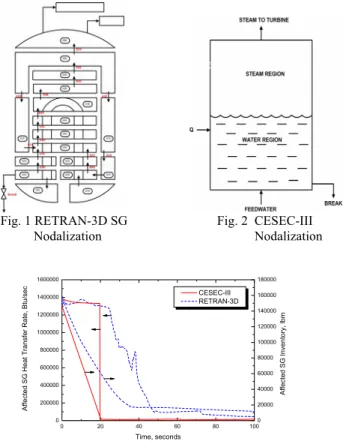
Steam generator node configurations for RETRAN-3D and CESEC-III significantly differ as shown in Figures 1 and 2. In RETRAN-3D, steam generator secondary side is divided into 14 nodes representing downcomer, economizer, evaporator, riser, and separator. On the other hand, SG node configuration of CESEC-III has only one node consisting of steam and water regions, in which the thermodynamic condition is assumed to be always saturated. With the detailed SG nodalization, RETRAN-3D can simulate thermal hydraulic behavior more realistically compared to CESEC-III with a simple node configuration.
3. Analysis Results
Fig. 3 shows the comparison of the heat transfer rates and inventories in the affected SG prediction by the RETRAN-3D and CESEC-III codes. Steam generator mass inventory decreases rapidly due to feedwater line break, and then ultimately steam generator dries out. CESEC-III predicts earlier dry-out of SG than RETRAN-3D. This is mainly due to the conservative assumption that saturated liquid is discharged through break in CESEC-III. On the other hand, thermodynamic condition of discharged fluid is predicted realistically to be a two-phase flow in RETRAN-3D.
After the affected SG dries out, saturated vapor discharges in CESEC-III. Abrupt discontinuity of break flow occurs at about 20 seconds in CESEC-III as shown in Fig. 4. In CESEC-III, heat transfer area is assumed to be constant at initial value until the affected SG dries out. This is a very conservative assumption in addition to the assumption of saturated liquid discharge. These assumptions lead a dramatic decrease of heat transfer rate at the time of SG dry-out time in CESEC-III (Fig. 3).
In RETRAN-3D, the heat transfer rate remains almost constant until the inventory reduces to about a quarter of Transactions of the Korean Nuclear Society Autumn Meeting
0 20 40 60 80 100 1800 1900 2000 2100 2200 2300 2400 2500 2600 CESEC-III RETRAN-3D P ressu rize r Pre ssur e, psia Time, seconds
initial value. After that, it gradually decreases to a value of free convection heat transfer regime. After dry-out, primary system pressure increases rapidly as shown in Fig. 5. How fast the heat transfer capability is lost in the affected SG determines the increase rate of primary system pressure. That is, more abrupt loss of the heat transfer capability causes more rapid RCS pressurization. In spite of the difference in the RCS pressure excursion time and rate, both codes predict similar RCS peak pressures. This shows that the peak RCS pressure heavily depends on the Reactor Protection System (RPS) and the pressurizer safety valve than the heat transfer characteristics in the affected SG.
4. Discussion
The effect of SG model on the primary system pressure response to FLB accident was evaluated by comparing the results of the RETRAN-3D and CESEC-III codes. It was found that there is significant difference in the models related to heat transfer and break flow in the affected steam generator between two codes. Model difference involves heat transfer model and node configuration. In addition, CESEC-III has its own code-specific conservative assumption for FLB accident. This leads to a different heat transfer and break flow behavior in the affected SG, and eventually to the timing and rate of abrupt primary system pressure excursion. Even though different models are applied in the two codes, both codes predicted similar peak primary system pressures.
For more reliable evaluation on the effect of conservative and realistic model on the FLB accident, the results of other realistic system simulation codes such as MEDUSA being developed by KOPEC and RELAP5 are needed to be compared with the results of this paper.
REFERENCES
[1] M. P. Paulsen, et al., "RETRAN-3D - A Program for Transient Thermal-Hydraulic Analysis for Complex Fluid Flow Systems," Computer Simulation & Analysis, Inc., July 2001
Table 1. Comparison of Heat Transfer Regimes and Correlations RETRAN-3D CESEC-III Primary Secondary Primary Secondary HT Regime Forced Convection
Convective Nucleate Boiling
Forced
Convection Pool Boiling HT Correlation Dittus-Boelter Thom Dittus-Boelter Modified Rosenow
Fig. 1 RETRAN-3D SG Fig. 2 CESEC-III Nodalization Nodalization
Fig. 3 Affected SG Heat Transfer Rate and Inventory Variations
Fig. 4 Break Flow Variation Fig. 5 Pressurizer pressure variations
0 20 40 60 80 100 0 2000 4000 6000 8000 CESEC-III RETRAN-3D Br eak Flow, lbm/ se c Time, seconds 0 20 40 60 80 100 0 200000 400000 600000 800000 1000000 1200000 1400000 1600000 0 20000 40000 60000 80000 100000 120000 140000 160000 180000 CESEC-III RETRAN-3D Affe cte d S G H ea t Tr an sfe r R ate , B tu /se c Time, seconds Affe ct ed SG In ve nt or y, l bm