Corresponding author: Sangwook Park
Department of Biomedical Laboratory Science, Sangji University, 83 Sangjidae-gil, Wonju 26339, Korea
E-mail: [email protected]
ORCID: https://orcid.org/0000-0003-2819-8621 ORIGINAL ARTICLE
Association between
PPARGC1A
Genetic
Polymorphisms and Type 2 Diabetes Mellitus in the
Korean Population
Hyun-Seok Jin
1, Sangwook Park
21
Department of Biomedical Laboratory Science, College of Life and Health Sciences, Hoseo University, Asan, Korea
2Department of Biomedical Laboratory Science, College of Health and Medical Science, Sangji University, Wonju, Korea
한국인 대상의
PPARGC1A
유전적 다형성과 제2형 당뇨병과의
상관성
진현석
1, 박상욱
21호서대학교 생명보건대학 임상병리학과, 2상지대학교 보건의료과학대학 임상병리학과
ARTICLE INFO ABSTRACT
Received February 16, 2021 Revised February 23, 2021 Accepted February 24, 2021
The prevalence of type 2 diabetes mellitus (T2DM) is increasing worldwide. T2DM is one of the most common types of diabetes and is caused by increased insulin resistance and reduced insulin secretion. Peroxisome proliferator-activated receptor γ coactivator 1 alpha (PPARGC1A) is a master modulator of mitochondrial biogenesis and of gluconeogenesis in liver. In this study, we analyzed genetic polymorphisms of PPARGC1A gene in a middle-aged Korean population with T2DM. Using the genotype data of 736 T2DM cases and 4544 healthy controls obtained from the Korean Association Resource (KARE), we analyzed genetic correlations between single nucleotide polymorphisms (SNPs) of PPARGC1A and T2DM. Fifteen SNPs of PPARGC1A demonstrated a statistically significant association with T2DM. Of these, rs10212638 exhibited the strongest correlation with T2DM (P-value=0.015, OR=1.29, CI=1.05∼1.59), and the minor G allele of
PPARGC1A increased the risk of T2DM. This is the first study to report a significant association between genetic polymorphisms in PPARGC1A and T2DM and suggests that SNPs of PPARGC1A
display genetic correlations to the etiology of T2DM.
Copyright Ⓒ 2021 The Korean Society for Clinical Laboratory Science. All rights reserved.
Key words
Insulin PPARGC1A SNP
Type 2 diabetes mellitus
서 론
국내 당뇨병 환자는 서양에 비해 낮지만 식습관의 변화로 인 해 성인 및 최근에는 소아, 청소년도 꾸준히 발생빈도가 증가하 고 있다[1]. 1980년 세계보건기구(WHO)는 당뇨병을 인슐린 치료 가 필요한 인슐린 의존성 당뇨병(insulin-dependent diabetes
mellitus, IDDM)과 인슐린 비의존성 당뇨병(noninsulin- dependent diabetes mellitus, NIDDM)으로 과거에 분류하 였으나 당뇨병을 유발하는 원인에 따라 제1형, 제2형, 기타 형태 (특정 질환이나 약물 등)의 당뇨병 그리고 임신성 당뇨병으로 재 분류하여 현재 널리 사용되고 있다[2]. 그 중에서도 제2형 당뇨 병(T2DM)은 우리나라 당뇨병 환자의 주요 원인이다. 과잉섭취 와 운동량 감소의 원인인 비만형과 비비만형(BMI 25 미만)으로 나뉜다. 제1형 당뇨병에 비해 임상증상이 뚜렷하지 않지만 유전 성임을 의미하는 가족성 유전경향이 있다. 식사조절과 운동요 법으로 당뇨질환이 호전되는 경우가 많다.
Korean Society for Clinical Laboratory Science
PPARGC1A 유전자는 1998년 생쥐의 갈색지방에서 처음 확 인되었는데, 미토콘드리아의 생합성을 위한 최상위 조절자의 역할과 간내 포도당신합성에 관여하는 등 다양한 기능들이 밝혀 졌다[3, 4]. 또한, PPARγ (Peroxisome proliferation-activated receptor γ)는 지방산 및 포도당 대사와 관련된 유전자들을 조 절하는 지방세포 분화의 주요 조절자로 알려져 있는데[5], PPARγ 공동 활성제 1α (PPARGC1A)는 PPARγ과 결합하여 다 양한 전사인자들과 상호작용할 수 있도록 여러 생물학적인 세포 내 대사과정에 관여한다[6, 7].
PPARGC1A는 PGC-1α라고도 표기되고 하는 다방면에서 다양한 기능에 관여를 한다. 알쯔하이머병(Alzheimer disease, AD), 파킨슨병(Parkinson disease, PD) [8], 헌팅턴병(Hunting-ton disease, HD) [9] 등과 같은 퇴행성 뇌질병을 완화시킬 수 있는 기전에 관여한다. 이 과정에서 전사인자 EB (transcription factor EB, TFEB)의 상류에 위치한 PPARGC1A가 자가포식 (autophagy) 작용을 통해 단백질 항상성을 유지시켜 준다[10]. 또한, 간에서는 포도당 합성에 관여하는 이 유전자 발현을 증가 시키는 중요한 조절인자 역할을 한다. 일반적으로 성인에게 발병하는 당뇨병은 주로 인슐린 수용체 가 제역할을 못하여 인슐린과 결합하지 못하는 제2형 당뇨 (T2DM)이고 이러한 현상을 인슐린 저항성(Insulin resistance) 이라고 한다. 이로 인해 간 세포내 AKT serine/threonine kinase 1 (Akt1)의 활성이 줄어들어 Forkhead Box Protein O1 (FOXO1)의 인산화도 감소하게 되고, 이는 글루카곤과 glucocorticoid 매개 CREB의 활성 및 FOXO1의 전사활성화 (transactivation)를 통해 세포내 PPARGC1A 유전자의 mRNA 수준을 증가시킨다. PPARGC1A 단백질과 FOXO1, Silent mating type information regulation 2 homolog) 1 (SIRT1), Hepatocyte nuclear factor 4 alpha (HNF4α) 등의 복합단백질 활성증가는 혈액내 혈당농도를 조절한다[11]. 이렇 듯, PPARGC1A 단백질은 인슐린 경로에서 포도당신합성을 촉 진하는 데 중요한 역할을 하는 것으로 알려져 있다. 본 연구에서는 전장유전체 분석을 이용하여 PPARGC1A 유 전자 영역에 위치한 SNP들과 제2형 당뇨상태와의 상관성 분석 을 통해 한국인에서도 PPARGC1A 유전자가 당뇨병과 연관되 어 있다는 것을 확인하고자 하였다. 재료 및 방법 1. 연구대상자 본 연구는 한국인 유전체 역학 조사 사업(Korean Genome
and Epidemiology Study, KoGES)의 일환인 한국인 유전체 분석자료(Korean Association Resource, KARE)를 이용하 여 연구대상자를 사용하였다[4]. 본 연구에서 사용한 자료는 질 병관리청 인체자원은행(Human Bioresource Bank)에서 분 양을 받아 사용하였다(KBN-2017-046). 질병관리청에서 한 국인을 대상으로 국민보건증진을 위한 유전체 연구의 일환으로 2001년부터 시작된 경기도 안성시와 안산시 거주자인 40세∼ 79세 남녀 모두 10,038명을 자원 모집하여 연구대상자로 삼은 코호트이다. 이 중 정도관리(QC)분석을 통과한 8842명(남성: 4,183명, 여성: 4,659명)을 연구대상자로 사용하였다. 본 연구 에 활용한 유전정보는 질병관리청(Korea Disease Control and Prevention Agency, KDCA) 국립보건연구원(Korea National Institutes of Health, KNIH)과 호서대학교에서 연 구윤리심의위원회(Institutional Review Board; IRB) 승인 을 받은 후 연구분석을 수행하였다(1041231-170822-BR- 062-01).
2. 임상적 특성
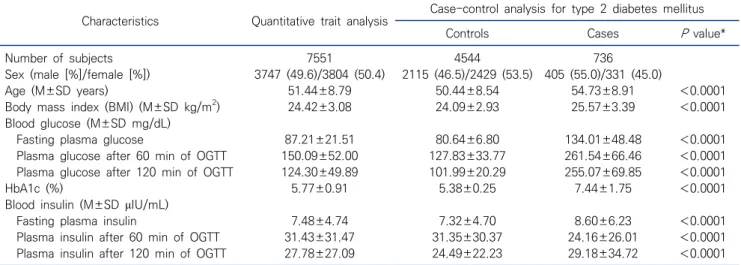
모든 피실험자는 세계보건기구(World Health Organization, WHO)의 기준을 바탕으로 당뇨병과 인슐린 저항성을 검사를 위 해 흔히 사용하는 경구당부하검사(oral glucose tolerance test, OGTT)를 시행하였다. OGTT는 75 g의 포도당을 경구로 투여하고 1∼2시간 후에 혈당을 측정하여 혈액에서 얼마나 빨 리 포도당이 제거되는지 확인한다. 포도당 섭취 직후, 60분 후와 120분 후에 각각 총 3회 피실험자로부터 혈액 검체를 채취하였 고, 포도당과 인슐린 농도를 분석하기 위해 혈장을 분리하였다. 환자-대조군 분석의 경우 정상 대조군(4,544명 환자)과 제2 형 당뇨병 환자(736명 환자)를 WHO 기준에 따라 분류하였다 [12]. 건강 대조군으로는 공복 혈당이 126 mg/dL 미만, 120분 후 혈당이 140 mg/dL 미만, 당화 헤모글로빈(HbA1c) 수준이 5.8% 미만인 사람들이 포함되었다. 제2형 당뇨병 환자군에는 포도당 섭취 후 120분 후 혈당 수치가 126 mg/dL 이상 또는 공 복 혈당 수치가 200 mg/dL이상인 환자들이 포함되었다. 연구 대상자에 대한 수, 남녀 비율, 나이, OGTT, HbA1c 등에 대한 기본 정보는 Table 1에 나타내었다. 3. 유전형 분석과 단일염기 다형성(single nucleotide polymorphism, SNP)의 선별 본 연구에서는 한국인 유전체 역학 자료인 KARE 유전형 자 료를 기반으로 해당 유전자 영역의 SNP들을 선별하였다. 연구 참여자들의 말초혈액의 백혈구에서 분리ㆍ추출한 DNA 시료의
Table 1. Basic characteristics of the controls and T2DM cases of the KARE study cohort
Characteristics Quantitative trait analysis Case-control analysis for type 2 diabetes mellitus Controls Cases P value* Number of subjects 7551 4544 736
Sex (male [%]/female [%]) 3747 (49.6)/3804 (50.4) 2115 (46.5)/2429 (53.5) 405 (55.0)/331 (45.0)
Age (M±SD years) 51.44±8.79 50.44±8.54 54.73±8.91 <0.0001 Body mass index (BMI) (M±SD kg/m2) 24.42±3.08 24.09±2.93 25.57±3.39 <0.0001
Blood glucose (M±SD mg/dL)
Fasting plasma glucose 87.21±21.51 80.64±6.80 134.01±48.48 <0.0001 Plasma glucose after 60 min of OGTT 150.09±52.00 127.83±33.77 261.54±66.46 <0.0001 Plasma glucose after 120 min of OGTT 124.30±49.89 101.99±20.29 255.07±69.85 <0.0001 HbA1c (%) 5.77±0.91 5.38±0.25 7.44±1.75 <0.0001 Blood insulin (M±SD μIU/mL)
Fasting plasma insulin 7.48±4.74 7.32±4.70 8.60±6.23 <0.0001 Plasma insulin after 60 min of OGTT 31.43±31.47 31.35±30.37 24.16±26.01 <0.0001 Plasma insulin after 120 min of OGTT 27.78±27.09 24.49±22.23 29.18±34.72 <0.0001 Abbreviations: HbA1c, glycosylated hemoglobin; HOMA-IR, homeostatic model assessment for insulin resistance; KARE, Korea Association REsource; M, mean value; OGTT, oral glucose tolerance test; SD, standard deviation; T2DM, type 2 diabetes mellitus.
*Significant differences in characteristics between the controls and T2DM cases were determined by the two-tailed Student’s t-test.
Table 2. The association analysis results of SNPs in the PPARGC1A gene with the T2DM in the Korean population No. SNP A1 Function MAF T2DM (controls 4544: cases 736)
controls cases OR (95% CI) Add P OR (95% CI) Dom P OR (95% CI) Rec P
1 rs9790699 T downstream 0.057 0.049 0.87 (0.67∼1.12) 0.279 0.86 (0.66∼1.13) 0.282 0.79 (0.17∼3.68) 0.759 2 rs2932966 C intron 0.086 0.079 0.90 (0.73∼1.11) 0.323 0.94 (0.76∼1.18) 0.602 0.13 (0.02∼1.00) 0.050 3 rs10938963 T intron 0.427 0.438 1.04 (0.93∼1.17) 0.489 1.08 (0.91∼1.28) 0.402 1.03 (0.83∼1.26) 0.815 4 rs1472095 A intron 0.085 0.078 0.90 (0.73∼1.12) 0.347 0.95 (0.76∼1.18) 0.625 0.14 (0.02∼1.04) 0.055 5 rs3774908 G intron 0.212 0.196 0.91 (0.79∼1.04) 0.171 0.94 (0.80∼1.11) 0.474 0.60 (0.38∼0.96) 0.033* 6 rs3774907 G intron 0.221 0.239 1.11 (0.97∼1.27) 0.130 1.19 (1.01∼1.40) 0.036* 0.89 (0.62∼1.30) 0.557 7 rs2290604 G intron 0.211 0.196 0.91 (0.79∼1.05) 0.183 0.94 (0.80∼1.11) 0.460 0.62 (0.39∼0.99) 0.046 8 rs6448226 C intron 0.490 0.484 0.99 (0.88∼1.11) 0.822 0.99 (0.83∼1.19) 0.933 0.97 (0.80∼1.18) 0.775 9 rs6448227 A intron 0.276 0.280 1.03 (0.91∼1.17) 0.651 1.11 (0.94∼1.30) 0.206 0.82 (0.60∼1.12) 0.212 10 rs10007750 G intron 0.203 0.215 1.12 (0.97∼1.28) 0.116 1.12 (0.95∼1.32) 0.173 1.26 (0.86∼1.85) 0.230 11 rs7656250 G intron 0.398 0.384 0.91 (0.81∼1.03) 0.123 0.94 (0.79∼1.11) 0.452 0.80 (0.63∼1.00) 0.055 12 rs10212638 G intron 0.073 0.088 1.29 (1.05∼1.59) 0.015* 1.29 (1.04∼1.60) 0.023* 2.13 (0.75∼6.04) 0.154 13 rs16874265 A intron 0.109 0.109 1.03 (0.86∼1.24) 0.724 1.03 (0.85∼1.26) 0.741 1.08 (0.50∼2.35) 0.841 14 rs17576121 G intron 0.023 0.014 0.59 (0.37∼0.94) 0.027* 0.59 (0.37∼0.94) 0.027* Not applicable -15 rs2946386 G intron 0.389 0.403 1.07 (0.95∼1.20) 0.288 1.09 (0.92∼1.29) 0.312 1.08 (0.87∼1.34) 0.498 Abbreviations: SNP, single nucleotide polymorphism; T2DM, type 2 diabetes mellitus; A1, minor allele; MAF, minor allele frequency; OR, odds ratio; CI, confidence interval; Add P, additive genetic model P value; Dom P, dominant genetic model P value; Rec P, recessive genetic model P value.
*Statistically significant values (P<0.05) are indicated in bold.
SNP유전형 판독을 위해서 Affymetrix SNP chip (Genome- Wide Human SNP array v.5.0; Affymetrix, CA, USA)을 사 용하였다. 유전형 판독 정확도가 98% 이하이거나 4% 이상의 높 은 missing genotype call rate을 보이거나, 30% 초과의 이형 접합성(heterozygosity)을 갖는 대상자들은 제외하였다. 본 연 구에서 유전자 영역은 PPARGC1A 전사체 양쪽 끝 말단에서 ±5 kb씩 확장한 범위에 위치한 SNP들을 대상으로 하였다 (Table 2). 이들 염색체상의 위치는 UCSC Genome Browser
on Human Mar. 2006 (NCBI36/hg18)을 기준으로 SNP들 을 표기하였다.
4. 상관성 분석과 통계 분석
염색체 4번에 위치한 PPARGC1A와 T2DM과의 상관성 통 계분석을 위해 PLINK (http://pngu.mgh.harvard.edu/∼ purcell/plink; v 1.07)와 PASW Statistics v.18.0 (SPSS, Chicago, IL, USA)을 사용하였다. 선택된 15개 SNP은 로지스
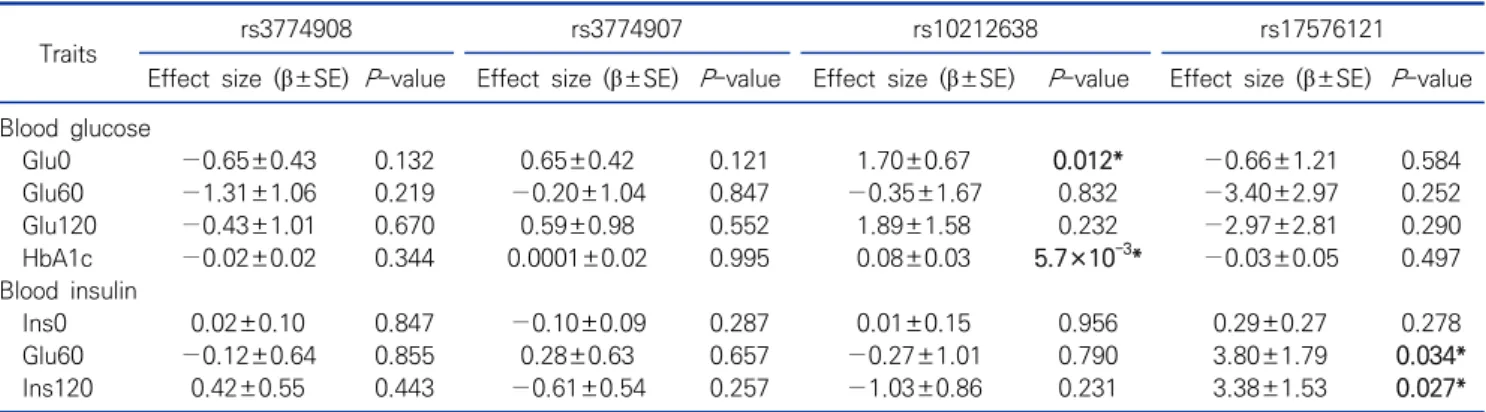
틱 회귀분석을 사용하여 환자-대조군간의 대립유전자 빈도 차 이를 분석하였으며 지역, 연령, 성별을 공변량으로 처리했다. 유 전 모형은 additive 유전 모델, 우성 및 열성 유전 모델 모두에서 확인하였으며, 분석 값에 대한 통계적 유의 수준은 0.05 이하를 기준으로 하였다. 또한, 추가적으로 당부하검사에서 측정된 당 수치, 인슐린 수치들과 당화혈색소에 대해서는 PPARGC1A의 유전적 변이들과 선형회귀분석(linear regression analysis) 을 사용하였으며 additive 유전 모델을 기반으로 하였다. 동일 하게 지역, 나이, 성별은 공변수(covariant)로 처리하여 회귀분 석을 수행하였고, 분석 값에 대한 유의 수준은 0.05 이하를 기준 으로 하였다. 결 과 1. PPARGC1A 유전자 영역의 SNP 선별 KARE 유전형 자료에서 상관성 분석에 사용할 SNP을 선별하 기 위하여 UCSC Genome Browser on Human Mar. 2006 (NCBI36/hg18)을 사용하여 대상 전사체(transcript)의 양방 향으로 5 kilo base pairs (Kbp)씩 범위를 확장하여 염색체 4 번에 위치한 PPARGC1A 유전자들의 영역을 설정하였다. 그 결 과 해당 전사체 범위에서 15개의 SNP을 확인하였고 본 연구에 서는 15개의 유전형 SNPs을 상관성 분석 대상으로 하였다 (Table 2). 2. PPARGC1A 유전자 SNP들과 T2DM과의 상관분석 연구대상자의 기본적인 특징은 Table 1에 나타내었다. 정상 인 대조군의 평균 연령(N=4,544)은 50.44세이고 제2형 당뇨병 (T2DM)의 평균 연령(N=736)은 54.73세였다. 나이, BMI, 혈 당 수치, 혈당 인슐린 수치, 당화혈색소(HbA1c) 수치는 건강대 조군과 T2DM 환자군간의 통계적인 차이가 있었다(Student’s T-test). 또한, 약물복용자들을 제외한 7,551명에 대해서는 혈 당 수치와 인슐린 수치에 대해 선형회기분석을 진행하였다 (Table 1). PPARGC1A 유전자의 분석 대상에 해당하는 15개 SNPs들 의 minor allele, 건강대조군의 minor allele frequency (MAF)와 T2DM의 MAF 및 빈도 차이를 확인한 로지스틱 회귀 분석 결과를 Table 2에 나타내었다. T2DM과의 상관분석 결과 를 살펴보면, 전체 분석 대상 15개의 SNP들 중에서 3개의 유전 모델(additive, dominant, recessive genetic model)을 모 두 통틀어서 4개의 SNP (rs3774908, rs3774907, rs10212638, rs17576121)들이 통계적인 유의수준(P≤0.05)을 보여주었고 SNP들은 모두 intron 부위에 위치하였다(Table 2). 이러한 4 개의 SNP들 중에서 rs10212638이 가장 높은 통계적 유의수준 을 나타내었는데, additive 유전 모델(P=0.015)과 우성 유전 모 델(P=0.023) 모두에서 유의성을 보여주었다. rs10212638의 상대적 위험도(odds ratio, OR)는 1.29이었고 신뢰구간(95% confidence interval, CI)은 1.05∼1.59이였다. 따라서, rs10212638의 minor allele인 G 염기를 가지고 있을 경우에 는 당뇨병(T2DM)의 상대적 위험도가 높아지는 것으로 확인되 었다. rs17576121의 경우에는 상대적 위험도가 반대 방향으로 오 히려 minor allele인 G 염기를 지니고 있을 경우에 상대적 위험 도가 0.59이며 신뢰구간은 0.37∼0.94이였는데, additive 유 전 모델과 우성 유전 모델에서의 결과가 동일하였다. 이것은 minor allele 빈도가 상당히 낮은 관계로 실제적으로 minor allele의 동형접합체(homozygote)는 전체 연구대상자 중에 1 명 밖에 존재하지 않았다. 그 외에서 rs3774908과 rs3774907 은 각각 우성 유전 모델과 열성 유전 모델에서 통계적 유의성을 보여주고 있었다. 3. 유의성 있는 SNP들과 T2DM 관련 수치들과의 상관분석 한편, PPARGC1A 유전자의 15개 SNP들 중에서 T2DM과 의 상관분석 결과 통계적 유의성을 보인 4개의 SNP들에 대해서 는 당뇨와 관련된 혈당, 인슐린 수치와는 어떠한 상관관계를 보 이는지 확인하였다. 이에 따라 T2DM에 관련된 수치[혈액 내 포 도당 수치, 인슐린 및 당화 헤모글로빈(HbA1c)] 들과의 선형 회 귀분석을 시행한 결과 2개의 SNP (rs10212638, rs17576121) 들이 유의 수준인 P≤0.05을 만족하고 있었다(Table 3). 그 중 에서도 rs10212638은 혈액 내 당수치들 중에서 공복시 혈당과 장기간의 혈당 수치를 반영하는 당화혈색소에서 minor allele 를 보유할 경우에 증가하는 유의한 상관관계 결과를 보여주는 데, 이것은 동일 SNP인 환자-대조군 분석에서는 상대적 위험도 가 높아지는 유의성이 있었던 로지스틱 회귀분석 결과와의 일치성을 보여주고 있었다. 유의성이 있는 또다른 SNP인 rs17576121의 경우에는 인슐린 수치 중에서 ins60과 ins120 에서 통계적 유의성을 보여주고 있었으며, 두 개의 insulin 수치 모두 minor allele를 보유하고 있을 때 인슐린 수치가 높아지는 경향을 보여주고 있었으며, 이 역시 환자-대조군 분석에서 당뇨 에 대한 상대적 위험도가 낮아지는 결과를 보여주었던 것과 일 치하였다(Figure 1).
Figure 1. The comparison among T2DM related traits’ mean values of genotype groups in rs1021638 and rs17576121. The minor allele (G) of rs10212638 were showed tendency with higher in Glu0 and HbA1c levels. Similarly, Ins60 and Ins120 were significantly higher in minor allele (G) of rs17576121.
Abbreviations: Glu0, fasting plasma glucose; HbA1c, glycosylated hemoglobin A1c; Ins60, plasma insulin at 60 min; Ins120, plasma insulin at 120 min.
Table 3. Results of an association analysis between the significant four SNPs in the PPARGC1A and T2DM-related traits in Korean population Traits rs3774908 rs3774907 rs10212638 rs17576121
Effect size (β±SE) P-value Effect size (β±SE) P-value Effect size (β±SE) P-value Effect size (β±SE) P-value Blood glucose Glu0 −0.65±0.43 0.132 0.65±0.42 0.121 1.70±0.67 0.012* −0.66±1.21 0.584 Glu60 −1.31±1.06 0.219 −0.20±1.04 0.847 −0.35±1.67 0.832 −3.40±2.97 0.252 Glu120 −0.43±1.01 0.670 0.59±0.98 0.552 1.89±1.58 0.232 −2.97±2.81 0.290 HbA1c −0.02±0.02 0.344 0.0001±0.02 0.995 0.08±0.03 5.7×10⁻³* −0.03±0.05 0.497 Blood insulin Ins0 0.02±0.10 0.847 −0.10±0.09 0.287 0.01±0.15 0.956 0.29±0.27 0.278 Glu60 −0.12±0.64 0.855 0.28±0.63 0.657 −0.27±1.01 0.790 3.80±1.79 0.034* Ins120 0.42±0.55 0.443 −0.61±0.54 0.257 −1.03±0.86 0.231 3.38±1.53 0.027* Abbreviations: Glu0, fasting plasma glucose; Glu60, plasma glucose at 60 min; Glu120, plasma glucose at 120 min; HbA1c, glycosylated hemoglobin A1c; Ins0, fasting plasma insulin; Ins60, plasma insulin at 60 min; Ins120, plasma insulin at 120 min; T2DM, type 2 diabetes mellitus.
*Statistically significant values (P<0.05) are indicated in bold. Age, sex, body mass index (BMI), and residential area were included as covariates in the additive genetic model.
고 찰 본 연구는 한국인 유전체 역학자료(KARE)를 사용하여 PPARGC1A 유전자를 발현하는 영역에 위치한 15개의 SNP 유 전변이들을 대상으로 제2형 당뇨병(T2DM)과의 상관관계를 통계분석으로 확인하였다. 이 중 4개의 SNP들(rs3774908, rs3774907, rs10212638, rs17576121)이 통계적 유의성(P< 0.05)을 나타내었다. 이 중에서 rs10212638이 T2DM과 통계 적으로 가장 유의한 값을 보였다(P=0.015). Park [13] 등의 논 문에서는 식품영양학적인 관점에서 당뇨병 위험이 있는 중년의 과량의 에너지 섭취와 PPARGC1A 유전자에 위치한 SNP와 개 별 GWAS 분석에서 genotyping되지 않은 유전변이형 정보를 추정한 imputation SNP들이 포함된 분석결과로써, rs105117030, rs1017032, rs10212638가 T2DM과의 연관 성을 언급하였다. rs10212638의 경우는 낮은 에너지 섭취 (low-energy intake)시만 당뇨병과 연관성을 보여주었다. 그 러나, 본 연구에서는 실제 genotyping된 15개의 SNP만을 대 상으로 분석하였다는 점과 진단의학적 측면에서 중간표현형에 해당하는 혈당, 인슐린(blood insulin)과 같은 정량적 특성 (quantitative trait) 분석의 유의성과 질병연관성을 분석한 결 과 내용이다. 실제로 PPARGC1A rs10212638뿐만 아니라 새 로운 rs17576121 SNP도 T2DM와 유의한 연관성을 나타냈다. Totomoch-Serra 등은 맥시코인을 대상으로 PPARGC1A rs8192678과 대사중간물인 포도당(P=0.023), triglycerides (P=0.013)을 대상으로 T2DM와의 연관성을 보고한 바[14] 있 고, Cheema 등도 플로리다주에 거주하는 아프리카계 미국인 (African Americans과 Haitian Americans)을 대상으로 PPARGC1A rs7656250, rs4235308과 T2DM와의 연관성이 보고된 바 있는데, 같은 아프리카 인종간에도 Haitian Americans인 경우에는 T2DM를 보호해 주는 역할을 하는 반 면에 African American이 보유한 rs4235308의 경우에는 오 히려 T2DM의 위험 SNP라는 점은 흥미롭다[15]. PPARγ는 제2형 당뇨 동물모델의 인슐린 감수성을 증가시키 는 당뇨병 치료제로 사용하고 있는 thiazolidinedione을 표적 단백질로 사용하고 있으며[16], 본 연구의 연관분석를 통해서 PPARGC1A 유전자와 제2형 당뇨병(T2DM)이 통계적으로 유 의한 연관성이 있음을 보여주었다. 국내에서는 유사한 연구결 과를 2005년, Kim 등이 보고하였고[17] 2017년, Park 등이 당 뇨병 환자의 PPARGC1A의 SNP와 영양분 섭취와의 연관성을
보고한 바 있다. 본 연구에서는 T2DM과 PPARGC1A의 유전형 조사(genotype)로 선정된 SNP과의 연관성 연구(case-control study)를 통해 상관관계를 규명하였고, 그 원인에 있어서도 혈 당 조절과 인슐린 분비 모두에 영향을 미칠 수 있는 가능성을 확 인한 점과 새로운 SNP를 보고했다는 점에서 차이가 있다. PPARGC1A 단백질의 세포내 기능 및 관련 기전들이 당뇨병뿐 만 아니라 관련된 대상질환에도 관련성이 있다는 것을 의미하기 때문에 다른 대사질환의 발생에 대해서는 PPARGC1A 유전자 에 대한 연구가 필요하다는 것을 확인하는 계기가 되었다. 요 약 제2형 당뇨병(T2DM)과 그 유병률은 전세계적으로 증가하 고 있다. T2DM은 인슐린 저항성이 높아지고 인슐린 분비가 감 소해 발생하는 당뇨병의 가장 흔한 유형 중 하나다. 과산화물 증 식활성수용체 감마 공활성제 1 알파(PPARGC1A)는 미토콘드 리아 생물 발생의 마스터 조절기와 간에서 포도당신합성에 관여 한다. 본 연구에서는 T2DM이 있는 한국인 중년층의 PPARGC1A 유전자의 유전적 다형성을 분석하였다. 그 결과, PPARGC1A 유전자 중 15개의 SNP가 T2DM과 통계적으로 유의한 연관성 을 보였으며, 그 중 PPARGC1A 유전자의 rs10212638은 T2DM (P=0.015, OR=1.29, CI=1.05∼1.59)과 통계적으로 가장 큰 유의한 상관관계를 보였다. PPARGC1A의 마이너 유전 자형(minor allele) G는 T2DM의 위험을 증가시켰다. 본 연구 는 T2DM와 PPARGC1A의 유전적 다형성 사이에 유의한 연관 성을 보여주고 있다. 이러한 결과는PPARGC1A의 SNP가 T2DM의 병의 원인이 되는 유전적 연관성이 있음을 시사한다. Acknowledgements: This study was supported by Basic Science Research Program through the National Research Foundation of Korea (NRF) grant (http://nrf.re.kr) to H.S.J (NRF-2017R1D1A3B03034752), and to S.P. (NRF- 2017R1D1A3B03029902). Epidemiologic data used in this study were from the Korean Genome and Epidemiology Study (KoGES) of the Korea Centers for Disease Control & Prevention, Republic of Korea.
Conflict of interest: None
Author’s information (Position): Jin HS1, Professor; Park S2, Professor.
REFERENCES
1. Nadeau KJ, Anderson BJ, Berg EG, Chiang JL, Chou H, Copeland KC, et al. Youth-onset type 2 diabetes consensus report: current status, challenges, and priorities. Diabetes Care. 2016;39:1635- 1642. https://doi.org/10.2337/dc16-1066
2. Shaw JE, Zimmet PZ, McCarty D, de Courten M. Type 2 diabetes worldwide according to the new classification and criteria. Diabetes Care. 2000;23:B5-10
3. Yoon JC, Puigserver P, Chen G, Donovan J, Wu Z, Rhee J, et al. Control of hepatic gluconeogenesis through the transcriptional coactivator PGC-1. Nature. 2001;413:131-138. https://doi.org/ 10.1038/35093050
4. Cho YS, Go MJ, Kim YJ, Heo JY, Oh JH, Ban HJ, et al. A large-scale genome-wide association study of Asian populations uncovers genetic factors influencing eight quantitative traits. Nat Genet. 2009;41:527-534. https://doi.org/10.1038/ng.357 5. Qiu L, Fan X, Zhang Y, Teng X, Miao Y. Molecular characterization,
tissue expression and polymorphisms of buffalo PPARGC1A gene. Arch Anim Breed. 2020;63:249-259. https://doi.org/10.5194/ aab-63-249-2020
6. Esterbauer H, Oberkofler H, Krempler F, Patsch W. Human per-oxisome proliferator activated receptor gamma coactivator 1 (PPARGC1) gene: cDNA sequence, genomic organization, chro-mosomal localization, and tissue expression. Genomics. 1999;62: 98-102. https://doi.org/10.1006/geno.1999.5977
7. Puigserver P, Wu Z, Park CW, Graves R, Wright M, Spiegelman BM. A cold-inducible coactivator of nuclear receptors linked to adaptive thermogenesis. Cell. 1998;92:829–839. https://doi.org/ 10.1016/s0092-8674(00)81410-5
8. Clark J, Reddy S, Zheng K, Betensky RA, Simon DK. Association of PGC-1alpha polymorphisms with age of onset and risk of Parkinson's disease. BMC Med Genet. 2011;12:69. https://doi. org/10.1186/1471-2350-12-69
9. Che HV, Metzger S, Portal E, Deyle C, Riess O, Nguyen HP. Localization of sequence variations in PGC-1α influence their modifying effect in Huntington disease. Mol Neurodegener. 2011;6:1. https://doi.org/10.1186/1750-1326-6-1
10. Salazar G, Cullen A, Huang J, Zhao Y, Serino A, Hilenski L, et al. SQSTM1/p62 and PPARGC1A/PGC-1alpha at the interface of au-tophagy and vascular senescence. Auau-tophagy. 2020;16:1092- 1110. https://doi.org/10.1080/15548627.2019.1659612
11. Soyal S, Krempler F, Oberkofler H, Patsch W. PGC-1 alpha: a po-tent transcriptional cofactor involved in the pathogenesis of type 2 diabetes. Diabetologia. 2006;49:1477-1488. https://doi.org/ 10.1007/s00125-006-0268-6
12. Zhu Li, Huang Q, Xie Z, Kang M, Ding H, Chen B, et al. PPARGC1A rs3736265 G>A polymorphism is associated with de-creased risk of type 2 diabetes mellitus and fasting plasma glu-cose level. Oncotarget. 2017;8:37308-37320. https://doi.org/10. 18632/oncotarget.16307
13. Park S, Kim BC, Kang S. Interaction effect of PGC-1α rs10517030 variants and energy intake in the risk of type 2 diabetes in mid-dle-aged adults. Eur J Clin Nutr. 2017;71:1442-1448. https://doi. org/10.1038/ejcn
Diaz-Badillo A. Association of common polymorphisms in the
VEGFA and SIRT1 genes with type 2 diabetes-related traits in Mexicans. Arch Med Sci. 2018;14:1361-1373. https://doi.org/ 10.5114/aoms.2018.74757
15. Cheema AK, Li T, Liuzzi JP, Zarini GG, Dorak MT, Huffman FG. Genetic associations of PPARGC1A with type 2 diabetes: differ-ences among populations with African origins. J Diabetes Res. 2015;2015:921274. https://doi.org/10.1155/2015/921274 16. Lehmann JM, Moore LB, Smith-Oliver TA, Wilkison WO, Willson
TM, Kliewer SA. An antidiabetic thiazolidinedione is a high affin-ity ligand for peroxisome proliferator-activated receptor γ (PPAR γ). J Biol Chem. 1995;270:12953–12956. https://doi.org/10.1074/ jbc.270.22.12953
17. Kim JH, Shin HD, Park BL, Cho YM, Kim SY, Lee HK, et al. Peroxisome proliferator-activated receptor gamma coactivator 1 alpha promoter polymorphisms are associated with early-onset type 2 diabetes mellitus in the Korean population. Diabetologia. 2005;48:1323-1330. https://doi.org/10.1007/s00125-005-1793-4