accepted after revision
July 21 , 2011 Bibliography DOI http://dx.doi.org/ 10.1055/s-0031-1285926 Published online: November 23, 2011 Int J Sports Med 2012; 33: 58–66 © Georg Thieme Verlag KG Stuttgart · New York ISSN 0172-4622
Correspondence
Joo Young Kim, PhD Ewha Womans University College of Pharmacy Rm207 Pharmacy Bldg. B Seoul Republic of Korea 120–750 Tel.: +82/2/3277 3016 Fax: +82/2/3277 3051 [email protected] Key words ● ▶ B cells ● ▶ CD4/CD8 ratio
● ▶ reactive oxygen species
● ▶ Taekwondo
● ▶ T cells
Immunological Impact of Taekwondo Competitions
tion of hydrogen ion, phosphorus, ammonia and lactate, aff ecting muscle metabolism, local mus-cle fatigue, and neuromuscular activities [ 19 , 38 ] . Such an excessive amount of either acute physi-cal activity or intensive training can cause a tem-porary modulation of immune function [ 14 , 27 ] . In response to acute exercise, lymphocyte sub-populations in vascular compartment, such as natural killer (NK) cells, B cells, and T cells increase and fall below pre-exercise values after exercise [ 16 ] . Furthermore, high intensity
exer-cise, such as 45 min of 80 % VO 2max intensity
treadmill exercise, is associated with a decrease in mitogen-stimulated lymphocyte proliferation immediately after exercise compared to resting values [ 28 ] .
These strenuous physical activities can result in immune suppression and reduction of lym-phocytes immediately after exercises, and this is associated with an increased susceptibility to viral infections [ 13 , 26 ] . One of the possible explanations for immune suppression and loss of
Introduction
▼
Taekwondo is the national martial art and sport of Korea with a 5 000 year history, and has gained an international reputation as a global sport. After the World Taekwondo Federation (WTF) was admitted to the International Olympic Com-mittee (IOC) in 1980, Taekwondo became a dem-onstration sport in the 1988 and 1992 Olympic
games, and it was fi nally admitted as an offi cial
event in the Sydney 2000 Olympiad [ 7 , 10 ] . Taekwondo is characterized by fast, high, and spinning kicks, as the name means “the art of kicking and punching”. In international tourna-ments such as the Olympic Games or World Taek-wondo Championships, TaekTaek-wondo competition is composed of 3 rounds that compete for 3 min and rest for 1 min between the competitions. For the fi nals, athletes have to compete more than 5 to 7 times during a single day [ 8 , 48 ] , and experi-ence physiological changes including
Authors Y. W. Lee 1 , * , K. W. Shin 2 , * , I.- Y. Paik 3 , W. M. Jung 3 , S.- Y. Cho 3 , S. T. Choi 4 , H. D. Kim 5 , J. Y. Kim 6 Affi liations Affi liation addresses are listed at the end of the article
Abstract
▼
Immunological changes in elite adolescent female athletes during Taekwondo competitions were investigated on-fi eld. 6 female athletes (16.7 ± 0.8 year-old) volunteered and performed 5 bouts of demonstration Taekwondo competi-tions simulating real tournaments in intensity, duration, and break-time intervals on the same day. Blood samples were taken before, after the competitions and during the recovery, respec-tively. Immunological changes and oxidative stress in peripheral blood mononuclear cells were evaluated by fl ow-cytometry. During the competitions, exercise intensity was 92.2 ± 3.8 % (86.1~95.7) of the maximal heart rate. Blood lactate increased immediately after the com-petitions ( p = 0.0165) and decreased to baseline
during recovery. Intracellular reactive oxygen species (ROS) in the peripheral blood increased continuously during recovery ( p < 0.05, respec-tively). Natural killer cells increased immediately after the competitions ( p = 0.0006), and decreased during recovery. B and T cells increased imme-diately after the competitions and remained elevated throughout recovery ( p < 0.05, respec-tively). CD4/CD8 ratio after the competitions was decreased ( p = 0.0091) and returned to base-line during recovery. These results suggest that the immunological function of the elite female adolescent athletes could be attenuated after Taekwondo competitions. Further large-scaled Taekwondo studies on immunologic and apop-totic changes related to oxidative stress should be performed for improving and protecting the health of adolescent athletes.
* The authors contributed equally.
lymphocytes during sports competitions is apoptotic cell death, whereas this type of programmed cell death does not occur in infl ammation [ 16 ] . Reactive oxygen species (ROS) generation is one of the signals that induce apoptosis in lymphocytes [ 34 ] . Many studies have demonstrated that heavy exercise induces apoptotic cell death and intracellular ROS generation [ 17 , 31 , 50 ] . Vider et al. demonstrated that physical exercise with heavy
intensity (80 % VO 2max , 1 h) increased oxidative stress and NF-κB
activation in human peripheral blood lymphocytes [ 50 ] . In mouse studies, caspase 3, one of the downstream targets for intracellular signalling of apoptosis, activated thymocytes after a single intensive bout of treadmill running (26 m/min, 6 degrees slope, 90 min) [ 31 ] , and annexin-V, a marker for early apoptosis, is increased in intraepithelial intestinal T cells 24 h after tread-mill running (32 m/min, 8 degrees slope, 90 min) [ 17 ] .
A temporary suppression of immune function and increased susceptibility to viral infection after various exhausting exer-cises has already been reported in many studies [ 42 ] . However, these investigations focused mainly on easily accessible physical activities categorized into intensity, duration, and type of exer-cise. Immunological changes during martial arts competitions including Taekwondo, which require more complex and dynamic physical activities, have not yet been fully investigated.
This study investigated the physiological and immunological changes experienced by female adolescent athletes during Taek-wondo competitions by simulating the tournaments leading up to the fi nal match. In addition, this approach could provide ideas for the improvement and protection of the health of female ado-lescent athletes.
Materials and Methods
▼
Subjects
23 female Taekwondo athletes of a high school located in the Republic of Korea were recruited. They were healthy and were not currently taking any medication. Among them, 6 athletes, who had similar technical skills, trained 20 h a week, and who had participated in the semifi nals or fi nal of the national Taek-wondo tournaments for at least the past 3 years, were selected
( ● ▶ Fig. 1 ). Their physical characteristics are shown in ● ▶ Table 1 .
Informed consent was obtained from all of the subjects and their parent(s)/guardian. This study was approved by the Institutional Review Board of Kwandong University College of Medicine, Myongji Hospital (Goyang, Republic of Korea) for the protection of human subjects and was performed in accordance with the ethical standards of the International Journal of Sports Medicine [ 15 ] .
Scheme of study
Subjects underwent a pre-test for analysis of their physical char-acteristics, and demonstrated a Taekwondo tournament similar to a real-life tournament. To avoid any potential infl uence on subject’s exercise performance, all subjects were requested to abstain from taking caff eine, vitamins, food and exercise during the 6 h preceding pre-test or demonstrated Taekwondo tourna-ment. The pre-test and competitions were held between 14:00 and 16:00 h. Prior to the study, all subjects had tutorials to become familiarized with the equipment and protocols for this study.
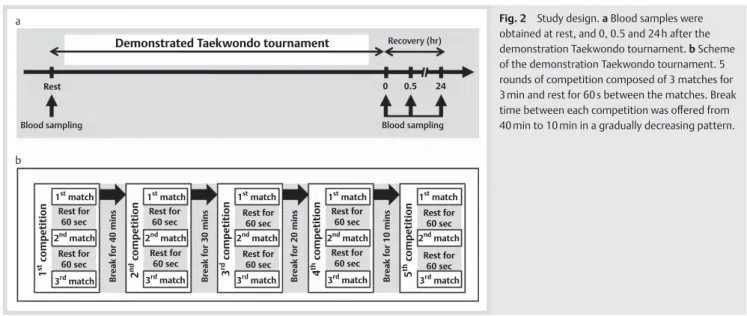
Blood samples were collected prior to the tournament, after the end of the tournament, and after 0.5 and 24 h of the recovery
phase, respectively ( ● ▶ Fig. 2a ). During the recovery phase,
sub-jects were provided with the same restricted meals that satis-fi ed essential nutrients requirement. This was standardized for all participants.
Preliminary measurement of baseline characteristics
Body composition ( %body fat) was assessed by bioelectrical impedance analysis (BIA) and Body Composition Analyzer Model 310 (Biodynamics, Seattle, WA, USA), and heart rate (HR) during the tournament was transmitted by Polar T31 transmitter (Polar Electro, Lake Success, NY, USA) and detected by MetaMax 3B Receiver (Cortex, Leipzig, Germany).To measure the maximal oxygen uptake (VO 2 max), we had the
subjects perform a maximal test on the Q65 treadmill (Quinton, Seattle, WA, USA) according to the Bruce protocol [ 2 ] . During this test, Borg’s 15RPE scale was used as an indication of impending fatigue [ 4 ] . Oxygen consumption during exercise was measured by MetaMax 3B (Cortex). HR and oxygen consumption were ana-lyzed by MetaSoft Ver. 3.9.5 (Cortex).
Demonstrated Taekwondo tournament
In order to satisfy conditions like those of a real tournament such as exercise intensity, the number of competitions, or break time between each competition, subjects performed 5 rounds of the Taekwondo competition [ 7 ] . Each competition was composed of 3 matches for 3 min and rest for 60 s between the matches. Break time between each competition was allowed from 40 min to
10 min in a gradually decreasing pattern ( ● ▶ Fig. 2b ).
Table 1 Physical characteristics of the subjects.
Characteristics Values 1 age (years) 16.7 ± 0.8 height (cm) 163.2 ± 5.3 weight (kg) 58.6 ± 12.8 body fat ( %) 15.4 ± 7.4 VO 2max (ml/kg/min) 49.2 ± 4.8
heart rate maximum (beat/min) 188.3 ± 8. 9
1 Values are mean ± SD of 6 independent subjects
Fig. 1 A fl ow chart indicating subject selection process.
Initial subjects (n=23)
3 years or more
(n = 18) years (n = 5)less than 3 Excluded Excluded Excluded Past Taekwondo training period Past experience of participation in the national tournaments Past experience of Semifinalist and/or Finalist in the national tournaments Yes (n = 16) Yes (n = 6) Final subjects (n = 6) No (n = 2) No (n = 10)
HR was monitored for all subjects, and oxygen consumption was measured for one of the subjects in the fi rst competition of the tournament. According to the manufacturer’s instructions, the MetaMax 3B is a mobile, mains independent indoor and outdoor metabolic exercise testing system for various sports activities. The exercise intensity was calculated by the HR reserve (HRR)
method [ 21 ] and VO 2 reserve (VO 2R) method, respectively
[ 24 , 53 ] .
Blood lactate levels
For the determination of blood lactate concentration levels, serum samples were collected from each subject and analyzed by Ektachem DT 60II (Kodak, Rochester, NY, USA). Briefl y, periph-eral venous blood was collected from the antecubital vein of the subjects used by plain vacuum tube, and spun down at 1 000 × g, at 4 °C for 30 min. The serum was separated and immediately stored at − 70 °C. The measurement of the blood lactate levels was duplicated.
Isolation of PBMCs
To isolate peripheral blood mononuclear cells (PBMCs), periph-eral venous blood was collected from the antecubital vein of the subjects. Heparin-containing vacuum tubes were used to collect 10 ml of blood. Ficoll-Hypaque density centrifugation was per-formed as follows. The samples were mixed into the same amount of PBS (phosphate based saline). The diluted blood sam-ples were overlaid on 12.5 ml of Ficoll and centrifuged at 800 × g continuously for 25 min. The interphase was then transferred to 30 ml of PBS and mixed by inverting the tubes, and then centri-fuged at 500 × g continuously for an additional 10 min. The supernatant was discarded and the cell pellet was suspended in 20 ml of PBS. For all experiments, the viable cells were obtained as determined by trypan blue staining, and were used immedi-ately for analysis.
Flow cytometry analysis
For the cytometric analysis of the ROS positive cells, natural killer (NK) cells, B cells and T cells, each cell was incubated with antibodies labelled with fl uorescein isothiocyanate (FITC) and/ or phycoerythrin (PE) in a FACS buff er (PBS, 1 % FCS, 0.05 % sodium-azide) for 30 min on ice, then washed twice with the FACS buff er. The data was acquired using a LSR II fl ow cytometer
(BD Biosciences, San Jose, CA, USA) and analyzed using BD FACS-Diva Software (BD Biosciences).
Flow cytometric analysis was performed in duplicate. The anti-bodies used for the cell staining and fl ow cytometry analysis were as follows: PE conjugated anti-CD19 mAb, FITC conjugated anti-CD3 mAb, FITC conjugated anti-CD4 mAb, PE conjugated anti-CD8 mAb, and PE conjugated anti-CD16+56 mAb (BD Pharmingen, SanDiego, CA, USA). The production of ROS was estimated by fl uorescence using
5-(and-6)-chloromethyl-2′,7′-dichlorodihydrofl uorescein diacetate (CM-H 2 DCFDA; Molecular
Probes, Eugene, OR, USA).
Statistical analysis
All data were expressed as the mean ± SD analysed by SPSS for windows version 18.0 (SPSS Inc., Chicago, IL, USA) and the statis-tical package R 2.13.1 using coin, multicomp, Bioconductor packages, and in-house scripts [ 12 , 36 ] . Considering the limited sample sizes (n = 6), nonparametric approaches were used for statistical analyses. The resting and post-exercise (0, 0.5, and 24 h) data were compared by using the non-parametric one-way repeated measures analysis (Friedman test). These results were followed up by post hoc analyses using both the Dunn’s multiple comparison test (attributed to Bonferroni) and the Wilcoxon-Nemenyi-McDonald-Thompson test [ 18 , 51 ] . The results with a
p-value < 0.05 were considered signifi cant ( ● ▶ Supplementary
Table 1 ). The intra- and inter-subject variabilities were
calcu-lated and expressed as the coefficient of variation: CV
( %) = 100 × SD/mean value. Statistical power was calculated by PASS 11 (NCSS, Kaysville, UT, USA).
Results
▼
The HR increased signifi cantly after each competition compared
with that in the resting stage ( ● ▶ Fig. 3a and ● ▶ Table 2 ). The
changes in HR and oxygen consumption were measured from one of the athletes in the fi rst competition of the tournament. Exercise intensity set according to HRR was approximately
equal to the percent value for the VO 2 R ( ● ▶ Fig. 3c and
● ▶ Supplementary Table 2 ).
Blood lactate level after the tournament increased signifi cantly
compared with that in the resting stage ( p = 0.0165) and
Fig. 2 Study design. a Blood samples were obtained at rest, and 0, 0.5 and 24 h after the demonstration Taekwondo tournament. b Scheme of the demonstration Taekwondo tournament. 5 rounds of competition composed of 3 matches for 3 min and rest for 60 s between the matches. Break time between each competition was off ered from 40 min to 10 min in a gradually decreasing pattern.
Demonstrated Taekwondo tournament Recovery (hr)
Rest Blood sampling Rest for 60 sec Rest for 60 sec Bre ak f or 40 mins Bre ak f or 30 mins Bre ak f or 20 mins Bre ak f or 10 mins Rest for 60 sec Rest for 60 sec Rest for 60 sec Rest for 60 sec Rest for 60 sec Rest for 60 sec Rest for 60 sec Rest for 60 sec 1 st c o mpe ti tion 1st match 2nd match 3rd match 1st match 2nd match 3rd match 1st match 2nd match 3rd match 1st match 2nd match 3rd match 1st match 2nd match 3rd match 2 nd c o mpe tit ion 3 rd co m p et it io n 4 th co m p et it io n 5 th co m p et it io n Blood sampling 0 0.5 24 a b
decreased at 0.5 and 24 h of the recovery phase, respectively
( ● ▶ Fig. 3b and ● ▶ Table 2 ). The average value of intra-CV for
duplicated lactate levels was 5.5 %, and the average values of inter-CV between lactate levels of each subjects ranged from 24.6 % to 47.0 % at each time point.
The NK cell population in PBMCs after the tournaments showed a signifi cant increase compared with that in the resting stage ( p = 0.0006), and fell at 0.5 and 24 h after the tournament,
respec-tively ( ● ▶ Fig. 4 and ● ▶ Table 2 ). The average value of intra-CV for
duplicated NK cell population was 1.6 %, and the average values of inter-CV between NK cell populations of each subject ranged from 15.2 % to 48.1 % at each time point.
The B cell and T cell populations in PBMCs after the tournament increased signifi cantly compared with that in the resting stage and such increments were maintained through the
recov-ery period, respectively ( p < 0.05, respectively) ( ● ▶ Fig. 5
and ● ▶ Table 2 ). The average values of intra-CV duplicated were
2.7 % for B cell populations and 0.6 % for T cell populations. The Fig. 3 Physiological changes in the demonstrated Taekwondo tournament. a Heart rate at rest and after each competition (n = 6). b Lactate concentration in the serum at rest, and 0, 0.5 and 24 h after the tournament (n = 6). Each value represents mean ± SD. *, Signifi cant diff erence from “Rest” (p < 0.05). c Comparison of %HR max and %VO 2max during the 1 st competition of the tournament in the one individual.
250 6 5 4 3 2 1 0 200 150 100 * * * * * * He ar t ra te (be at/min) La ct at e (mmol/ L) 50 120 100 80 60 40 20 %H Rma x %HRmax %V O2ma x %VO2max 0 0 200 400
1st Taekwondo competition (sec)
1st match 2nd match 3rd match
600 800
0
Rest Rest
After each competition After the competition (hr)
1st 2nd 3rd 4th 5th 0 0.5 24
a
c
b
Table 2 Changes of physiological and immunological factors during the demonstrated Taekwondo tournament.
Rest After each Taekwondo competition Recovery phase
1 st 2 nd 3 rd 4 th 5 th 0.5 h 24 h
heart rate (beat/min) 86.5 ± 6.7 180.0 ± 10.6* 180.8 ± 10.4* 175.0 ± 22.5* 183.0 ± 8.6* 183.8 ± 10.7* – – % HRmax (%) – 91.8 ± 4.5 92.7 ± 3.8 86.1 ± 16.7 94.9 ± 4.4 95.7 ± 7.8 – – lactate (mmol/L) 1.2 ± 0.6 – – – – 3.9 ± 1.2* 1.1 ± 0.3 1.4 ± 0.5 NK cells (%) 5.2 ± 2.5 – – – – 37.6 ± 5.7* 11.8 ± 3.5 19.1 ± 7.6 B cells (%) 3.5 ± 1.9 – – – – 10.8 ± 3.4* 11.0 ± 3.3* 12.1 ± 2.6* T cells (%) 19.9 ± 7.7 – – – – 39.3 ± 7.9* 62.0 ± 9.0* 57.2 ± 7.2* CD4 T cells (%) 13.3 ± 5.3 – – – – 18.3 ± 5.5 33.5 ± 2.5* 31.6 ± 2.3* CD8 T cells (%) 9.6 ± 4.1 – – – – 29.9 ± 7.8* 26.6 ± 7.4* 28.6 ± 7.9* CD4/CD8 ratio 1.2 ± 0.7 – – – – 0.5 ± 0.4* 1.1 ± 0.6 1.0 ± 0.5 ROS (MFI) 61.1 ± 12.5 – – – – 87.9 ± 9.9 178.4 ± 90.8* 166.6 ± 25.3*
All values are mean ± SD of 6 independent subjects; % HRmax, a percentage of the maximal heart rate; *, Signifi cant diff erence from “Rest” (p < 0.05)
average values of inter-CV between each subject ranged from 20.4 % to 57.3 % for B cell populations and ranged from 12.8 % to 38.9 % for T cell populations at each time point.
The CD4 + T cell population in PBMCs after the tournament was
similar to the resting stage. However, the CD4 + T cell population
increased signifi cantly at 0.5 and 24 h after the tournament ( p =
0.0044, and 0.0190, respectively) ( ● ▶ Fig. 6a,b , and ● ▶ Table 2 ).
The average value of intra-CV for duplicated CD4 + T cell
popula-tion was 0.9 %, and the average values of inter-CV between CD4 +
T cell populations of each subject ranged from 5.9 % to 32.5 % at each time point.
The CD8 + T cell population in PBMCs after the tournament
increased signifi cantly compared with that in the resting stage and such increments were maintained through the recovery
period ( p = 0.0043, and 0.0191, respectively) ( ● ▶ Fig. 6a,c
and ● ▶ Table 2 ). The average value of intra-CV for duplicated
CD8 + T cell population was 1.0 %, and the average values of
inter-CV between CD8 + T cell populations of each subjects ranged
from 25.8 % to 41.7 % at each time point.
The CD4/CD8 ratio after the tournament decreased signifi cantly compared with that in the resting stage ( p = 0.0091). The CD4/ CD8 ratio returned to the resting level at 0.5 and 24 h after the
tournament, respectively ( ● ▶ Fig. 6d and ● ▶ Table 2 ). The average
value of intra-CV for duplicated CD4/CD8 ratios was 8.4 %, and the average value of inter-CV between CD4/CD8 ratios of each subject ranged from 37.1 % to 53.9 % at each time point.
The ROS level in PBMCs increased markedly at 0.5 and 24 h after
the tournament ( p = 0.0040, and 0.0091, respectively) ( ● ▶ Fig. 7
and ● ▶ Table 2 ). The average value of intra-CV for duplicated ROS
level was 0.1 %, and the average values of inter-CV between ROS levels of each subject ranged from 9.1 % to 32.4 % at each time point.
Discussion
▼
Martial-arts including Taekwondo require intense competitions [ 5 , 7 , 23 , 35 ] . Chiodo, et al. reported that international-level Taek-wondo competitions imposed a high exercise load (HR > 90 % of individual HRmax) on 10 male and 6 female elite adolescent ath-letes independent of gender during mean 65.4 % of the competi-tion time [ 8 ] . It has already been reported that prolonged and strenuous physical activities like intense exercises could induce physical damages [ 43 ] , immunosuppression [ 40 , 44 ] , and
increased susceptibility to illness and/or infection [ 43 ] . The
immune system is temporarily impaired, as described in the ‘open window’ theory after intense exercise of long duration [ 25 , 47 ] . Such impairment is associated with an increased sus-ceptibility to opportunistic infections, particularly upper respi-ratory tract infections [ 13 ] .
Although common exercises, such as swimming, had been widely studied [ 22 ] , Taekwondo has not yet been fully evaluated
because of diffi culties in its physiological quantifi cation of the
loads and eff orts, especially in competition [ 7 ] . And there are only a few studies on the immunological impacts of Taekwondo competition on elite athletes [ 49 ] .
Fig. 4 Change of NK cell population during the tournament. a One representative data was performed by fl ow cytometry (FITC-CD3 and PE-CD16+56). b NK cell population in PBMCs at rest, and 0, 0.5 and 24 h after the tournament. NK cells , CD16+56 + and CD3 - cell population. Each value represents
mean ± SD. *, Signifi cant diff erence from “Rest” (p < 0.05). Rest * 50 40 30 20 10 0 Rest 0 0.5 24
After the competition (hr) 105 105 104 104 103 103 102 102 105 105 104 104 103 103 102 102 105 105 104 104 103 103 102 102 105 105 104 104 103 103 102 102 PE -C D16 + 56 NK c ells ( % ) FITC-CD3 0 hr 0.5 hr 24 hr a b
To investigate immunological changes after a Taekwondo tour-nament, the teenage female athletes demonstrated Taekwondo competitions simulating real tournaments in exercise-inten-sity, competition times, and break-time intervals. During the competitions, HR of the athletes was remarkably increased
(180.5 ± 12.9 bpm) and blood lactate concentrations varied
above 3.9 mmol/L. In previous reports about HR and blood lac-tate concentrations during Taekwondo competitions, HR ranged from 183.0 ± 9.0 to 190.1 ± 8.1 bpm and blood lactate concentrations ranged from 3.3 to 7.5 mmol/L [ 5 , 7 , 23 , 35 ] .
How-ever, one of the limitations of this study was insuffi cient
psycho-logical stress on the subjects imposed by the simulated competitions. In real sports tournaments, athletes usually expe-rience psychological stress, which is also one of the infl uencing factors on their performance, and simulated situations could underestimate stress-related psychobiological responses of ath-letes which occur under highly competitive real conditions [ 6 , 8 , 11 , 39 , 46 ] .
In the innate immune system the NK cell provides a preferential and expanded physical defense mechanism against virus-infected cells or certain types of tumour cells before the adaptive immune responses are activated [ 1 , 43 ] . Previous studies reported that the NK cell population in peripheral blood was
increased according to physical activity up to VO 2 max, and the
increased NK cell population of PBMCs immediately decreased in the recovery phase after the end of intense exercises [ 9 , 41 , 45 ] . They suggested that the endocrine system, such as catecho-lamines, aff ected the systemic immune response in the
periph-eral blood stream. In this study, the NK cell population in PBMCs of athletes was increased over 7-fold compared to the resting stage after the Taekwondo tournament, and decreased during the recovery phase. According to the severity of exercise inten-sity and duration at the tournament, this result was confi rmed by the preceding works of Shephard and Shek [ 45 ] .
Macrophages, immune cells mediated by innate immunity, intracellularly eliminate microbial antigens via phagocytosis [ 20 ] . A microbial endotoxin, a lipopolysaccharide, captured in a phagosome of macrophages is eliminated by nitric oxide (NO) and ROS produced by the macrophages [ 54 ] . If the removal of NO and ROS is inadequate, it will cause oxidative damage to the
phagocytes [ 32 ] . A tight balance between production and
removal (reduction and oxidation; redox) is critical. Excessive production of NO and ROS causes cellular apoptosis of the phagocytes themselves [ 3 ] .
This study showed that ROS production of PBMCs gradually increased from the end of the tournament to 24 h of the recovery phase. Radak et al. suggested that intracellular ROS increased due to intense exercise could negatively aff ect cellular viability in spite of physical protection [ 37 ] . Such results were also sup-ported by previous studies reporting that intracellular ROS accu-mulation was associated with the increase of cellular apoptotic markers including caspase 3 and annexin V [ 20 ] .
In this study, the B cell and T cell population in PBMCs increased from the end of the tournament up to 24 h of the recovery stage. These results were diff erent from the previous studies reporting that blood lymphocytes (NK cells, T cells, and B cells) increased Fig. 5 Change of T cell and B cell populations during the tournament. a One representative data was performed by fl ow cytometry (FITC-CD3 and
PE-CD19). b B cell population in PBMCs at rest, and 0, 0.5 and 24 h after the tournament. c T cell population in PBMCs at rest, and 0, 0.5 and 24 h after the tournament. Each value represents mean ± SD. *, Signifi cant diff erence from “Rest” (p < 0.05).
PE -C D19 105 105 104 104 103 103 102 102 105 105 104 104 103 103 102 102 105 105 104 104 103 103 102 102 105 105 104 104 103 103 102 102 Rest 0 hr FITC-CD3 16 80 60 40 20 0 14 * * * * * * 12 10 8 6 4 2 B c ells ( % ) T c ells ( % ) 0 Rest
After the competition (hr)
0 0.5 24
0.5 hr 24 hr
Rest
After the competition (hr)
0 0.5 24
a
b c
Fig. 6 Change of CD4 + T cell and CD8 + T cell population during the tournament. a One representative data was performed by fl ow cytometry (FITC-CD4
and PE-CD8). b CD4 + T cell population in PBMCs at rest, and 0, 0.5 and 24 h after the tournament. c CD8 + T cell population in PBMCs at rest, and 0, 0.5 and
24 h after the tournament. d CD4/CD8 ratio at rest, and 0, 0.5 and 24 h after the tournament. Each value represents mean ± SD. *, Statistical signifi cance from “Rest” (p < 0.05). 105 105 104 104 103 103 102 CD 8 +T ce lls (%) CD 4 + / CD 8 + T ce lls ra tio CD 4 +T ce lls (%) 102 Rest 40 40 50 2.0 1.5 1.0 0.5 0.0 30 30 20 20 10 10 0 0 Rest 0.5 24 0 PE -C D8 FITC-CD4 105 105 104 104 103 103 102 102 0 hr After the competition (hr) 0 Rest 0.5 24 After the competition (hr) 0 Rest 0.5 24 After the competition (hr) 105 105 104 104 103 103 102 102 0.5 hr 105 105 104 104 103 103 102 102 24 hr * * * * * * a b c d
Fig. 7 Change of ROS + PBMCs population during the tournament. a One representative data was performed by fl ow cytometry (CM-H 2 DCFDA).
b ROS + PBMCs population at rest, and 0, 0.5 and 24 h after the tournament. DCFDA , 5-(and-6)-chloromethyl-2′, 7′-dichlorodihydro-fl uorescein diacetate
(CM-H 2 DCFDA). Each value represents mean ± SD. *, Signifi cant diff erence from “Rest” (p < 0.05). Rest Rest 125 150 100 50 0 150 100 50 0 DCFDA 300 250 200 150 100 DCFD A (MFI) 50 0 0
After the competition (hr) 0.5 * * 24 0 100 75 50 25 100 75 50 25 0 102 103 104 105 102 103 104 105 102 103 104 105 102 103 104 105 0 hr 0.5 hr 24 hr a b
References
1 Abbas A K , Lichtman A H , Pillai S . Cellular and Molecular Immunology . ( 6 th edition ). Philadelphia, PA : WB Saunders Company , 2007 ; 566
2 American College of Sports Medicine : Thompson W R , Gordon N F , Pesc-atello L S . ACSM’s Guidelines for Exercise Testing and Prescription . ( 8 th
edition ). Philadelphia, PA : Lippincott Williams & Wilkins , 2010 ; 380 3 Baran C P , Zeigler M M , Tridandapani S , Marsh C B . The role of ROS and RNS in regulating life and death of blood monocytes . Curr Pharm Des 2004 ; 10 : 855 – 866
4 Borg G A . Psychophysical bases of perceived exertion . Med Sci Sports Exerc 1982 ; 14 : 377 – 381
5 Bridge C A , Jones M A , Drust B . Physiological responses and perceived exertion during international Taekwondo competition . Int J Sports Physiol Perform 2009 ; 4 : 485 – 493
6 Bridge C A , Jones M A , Hitchen P , Sanchez X . Heart rate responses to Taekwondo training in experienced practitioners . J Strength Cond Res 2007 ; 21 : 718 – 723
7 Butios S , Tasika N . Changes in heart rate and blood lactate concentra-tion as intensity parameters during simulated Taekwondo competi-tion . J Sports Med Phys Fitness 2007 ; 47 : 179 – 185
8 Chiodo S , Tessitore A , Cortis C , Cibelli G , Lupo C , Ammendolia A , De Rosas M , Capranica L . Stress-related hormonal and psychological changes to offi cial youth Taekwondo competitions . Scand J Med Sci Sports 2011 ; 21 : 111 – 119
9 Espersen G T , Elbaek A , Schmidt Olsen S , Ejlersen E , Varming K , Grunnet N . Short-term changes in the immune system of elite swimmers under competition conditions. Diff erent immunomodulation induced by various types of sport . Scand J Med Sci Sports 1996 ; 6 : 156 – 163 10 Feehan M , Waller A E . Precompetition injury and subsequent tourna-ment performance in full-contact taekwondo . Br J Sports Med 1995 ; 29 : 258 – 262
11 Filaire E , Alix D , Ferrand C , Verger M . Psychophysiological stress in tennis players during the fi rst single match of a tournament . Psy-choneuroendocrinol 2009 ; 34 : 150 – 157
12 Gentleman R C , Carey V J , Bates D M , Bolstad B , Dettling M , Dudoit S , Ellis B , Gautier L , Ge Y , Gentry J , Hornik K , Hothorn T , Huber W , Iacus S , Irizarry R , Leisch F , Li C , Maechler M , Rossini A J , Sawitzki G , Smith C , Smyth G , Tierney L , Yang J Y , Zhang J . Bioconductor: open software development for computational biology and bioinformatics . Genome Biol 2004 ; 5 : R80
13 Gleeson M . Can nutrition limit exercise-induced immunodepression? Nutr Rev 2006 ; 64 : 119 – 131
14 Gleeson M , Nieman D C , Pedersen B K . Exercise, nutrition and immune function . J Sports Sci 2004 ; 22 : 115 – 125
15 Harriss D J , Atkinson G . Update – Ethical Standards in Sport and Exer-cise Science Research . Int J Sports Med 2011 ; 32 : 819 – 821 16 Hoff man-Goetz L , Pedersen B K . Exercise and the immune system . In:
Tipton C M . ( ed. ). ACSM’s Advanced Exercise Physiology . Philadelphia, PA : Lippincott Williams & Wilkins , 2006 ; 482 – 500
17 Hoff man Goetz L , Quadrilatero J . Treadmill exercise in mice increases intestinal lymphocyte loss via apoptosis . Acta Physiol Scand 2003 ; 179 : 289 – 297
18 Hollander M , Wolfe D A . Nonparametric Statistical Methods . ( 2 nd
edi-tion ). New York : Wiley , 1999 ; 295
19 Iaia F M , Perez-Gomez J , Nordsborg N , Bangsbo J . Eff ect of previous exhaustive exercise on metabolism and fatigue development during intense exercise in humans . Scand J Med Sci Sports 2010 ; 20 : 619 – 629 20 Janeway C A , Travers P , Walport M , Shlomchik M J . Immunobiology . ( 5 th
edition ). New York : Garland Science , 2005 ; 887 during the exercises of approximate maximal intensity and
decreased below the levels of resting stage after cessation of the
exercises [ 52 ] . Furthermore, an insuffi cient number of previous
studies on the changes of immune cells during Taekwondo com-petitions exists. In addition to quantifying the changes of lym-phocytes, further functional evaluation including NK cell cytotoxic activity, lymphocyte activation markers, and cytokines release should be performed.
Recent evidence suggests that the CD4/CD8 ratio does not drop below 1.0 under normal conditions of healthy individuals [ 29 ] ; however, the ratio decreases below 1.0 in stressful conditions such as intensifi ed training in elite swimmers and HIV-1 patients [ 22 , 30 ] . The marked decrement of CD4/CD8 ratio shown in our study suggested that Taekwondo competitions could cause prominent changes of T cell-mediated immunity and might increase viral susceptibility in subjective athletes.
There are some limitations in this study. The small of only female study subjects might have attenuated the statistical power of data and led to biased results. However, several previous studies on Taekwondo competitions used a rationale similar to that in our study [ 7 , 23 ] . Statistical calculation based upon these previ-ous studies showed that more than 5 subjects would be needed to yield a power of 80 % (assuming α , 2-tailed, was set at 0.05) for the blood lactate level and HR between resting stage and ces-sation of Taekwondo competitions. The retrospective statistical calculation for this study also yielded a power of more than 80 % for the blood lactate level, HR, CD4/CD8 ratio and ROS level between resting stage and cessation of the competitions. The narrow age range of female-only subjects might make it possible to include more homogenous subjects and to reduce the inter-individual variability [ 8 ] . Most of the previous stud-ies on Taekwondo athletes also had maximally narrowed parameters on sex, age, and athletic competency of subjects
[ 5 , 7 , 8 , 23 , 35 , 48 ] . Lack of a control group and insuffi cient
analyses confi ned to quantifi cation of blood immune cells were also limitations of this study. In future, further control-led studies using molecular biological methods and subjects on a large scale should be performed for evaluating immuno-logical changes including proliferation, activation, and func-tional diff erentiation of immune cells during Taekwondo competitions. It was suggested that hormonal responses including cortisol and catecholamine might have a mechanis-tic role in exercise-related immunological changes [ 33 ] . More detailed studies investigating the association between cell apoptosis and ROS production may also be needed.
In conclusion, after the Taekwondo competitions, CD4/CD8 ratio decreased and intracellular ROS levels increased continuously. These results suggest that the immunological functions of female adolescent athletes could be attenuated after Taekwondo competitions. B, T, and NK cells increased immediately after the Taekwondo competitions. During the recovery, B and T cells remained elevated and NK cells decreased. Further investiga-tions on impacts of Taekwondo competiinvestiga-tions on blood immune cells including functional and apoptotic changes induced by intracellular ROS production should be performed on a large scale for the improvement and protection of the health of ado-lescent athletes.
Affi liations
1 Division of Allergy-Immunology and Rheumatology , Department of Internal Medicine , Kwandong University College of Medicine , Goyang , Republic of Korea
2 Division of Physical Education , Silla University College of Medical and Life Sciences , Pusan , Republic of Korea
3 Department of Physical Education , Yonsei University College of Sciences in Education , Seoul , Republic of Korea
4 Division of Rheumatology , Department of Internal Medicine , Chung-Ang University College of Medicine , Seoul , Republic of Korea
5 Department of Taekwondo , Dong-Eui University College of Sports Science , Pusan , Republic of Korea
6 Ewha Womans University College of Pharmacy , Seoul , Republic of Korea
39 Salvador A , Suay F , Gonzlez-Bono E , Serrano M A . Anticipatory cortisol, testosterone and psychological responses to judo competition in young men . Psychoneuroendocrinol 2003 ; 28 : 364 – 375
40 Shek P N , Shephard R J . Physical exercise as a human model of limited infl ammatory response . Can J Physiol Pharmacol 1998 ; 76 : 589 – 597 41 Shek P N , Sabiston B H , Buguet A , Radomski M W . Strenuous exercise and immunological changes: a multiple-time-point analysis of leuko-cyte subsets, CD4/CD8 ratio, immunoglobulin production and NK cell response . Int J Sports Med 1995 ; 16 : 466 – 474
42 Shephard R J . Special feature for the Olympics: eff ects of exercise on the immune system: overview of the epidemiology of exercise immu-nology . Immunol Cell Biol 2000 ; 78 : 485 – 495
43 Shephard R J . Sepsis and mechanisms of infl ammatory response: is exercise a good model? Br J Sports Med 2001 ; 35 : 223 – 230 44 Shephard R J , Shek P N . Immune responses to infl ammation and trauma:
a physical training model . Can J Physiol Pharmacol 1998 ; 76 : 469 – 472 45 Shephard R J , Shek P N . Eff ects of exercise and training on natural killer cell counts and cytolytic activity: a meta-analysis . Sports Med 1999 ; 28 : 177 – 195
46 Terry P C , Slade A . Discriminant eff ectiveness of psychological state measures in predicting performance outcome in karate competition . Percept Mot Skills 1995 ; 81 : 275 – 286
47 Tipton C M . ACSM’s Advanced Exercise Physiology . Philadelphia, PA : Lippincott Williams & Wilkins , 2006 ; 684
48 Tsai M L , Chou K M , Chang C K , Fang S H . Changes of mucosal immunity and antioxidation activity in elite male Taiwanese taekwondo athletes associated with intensive training and rapid weight loss . Br J Sports Med 2011 ; 45 : 729 – 734
49 Tsai M L , Ko M H , Chang C K , Chou K M , Fang S H . Impact of intense train-ing and rapid weight changes on salivary parameters in elite female Taekwondo athletes . Scand J Med Sci Sports . 2010
50 Vider J , Laaksonen D E , Kilk A , Atalay M , Lehtmaa J , Zilmer M , Sen C K . Physical exercise induces activation of NF-kappaB in human periph-eral blood lymphocytes . Antioxid Redox Signal 2001 ; 3 : 1131 – 1137 51 Viglietta V , Bourcier K , Buckle G J , Healy B , Weiner H L , Hafl er D A , Egorova
S , Guttmann C R , Rusche J R , Khoury S J . CTLA4Ig treatment in patients with multiple sclerosis: an open-label, phase 1 clinical trial . Neurol-ogy 2008 ; 71 : 917 – 924
52 Walsh N P , Gleeson M , Shephard R J , Woods J A , Bishop N C , Fleshner M , Green C , Pedersen B K , Hoff man-Goetz L , Rogers C J , Northoff H , Abbasi A , Simon P . Position statement. Part one: Immune function and exer-cise . Exerc Immunol Rev 2011 ; 17 : 6 – 63
53 Winett R A , Carpinelli R N . The quantity and quality of exercise for healthy adults . Med Sci Sports Exerc 1999 ; 31 : 916 – 920
54 Wu F , Tyml K , Wilson J X . iNOS expression requires NADPH oxidase-dependent redox signaling in microvascular endothelial cells . J Cell Physiol 2008 ; 217 : 207 – 214
21 Karvonen M J , Kentala E , Mustala O . The eff ects of training on heart rate; a longitudinal study . Ann Med Exp Biol Fenn 1957 ; 35 : 307 – 315 22 Mackinnon L T , Hooper S L , Jones S , Gordon R D , Bachmann A W . Hormo-nal, immunological, and hematological responses to intensifi ed train-ing in elite swimmers . Med Sci Sports Exerc 1997 ; 29 : 1637 – 1645 23 Matsushigue K A , Hartmann K , Franchini E . Taekwondo: Physiological
responses and match analysis . J Strength Cond Res 2009 ; 23 : 1112 – 1117 24 McArdle W D , Katch F I , Katch V L . Exercise Physiology . ( 5 th edition ).
Philadelphia : Lippincott Williams & Wilkins , 2001 ; 324
25 Nieman D C . Risk of upper respiratory tract infection in athletes: an epidemiologic and immunologic perspective . J Athl Train 1997 ; 32 : 344 – 349
26 Nieman D C . Marathon training and immune function . Sports Med 2007 ; 37 : 412 – 415
27 Nieman D C , Pedersen B K . Nutrition and Exercise Immunology . Boca Raton : CRC Press LLC , 2000
28 Nieman D C , Miller A R , Henson D A , Warren B J , Gusewitch G , Johnson R L , Davis J M , Butterworth D E , Herring J L , Nehlsen Cannarella S L . Eff ect of high- versus moderate-intensity exercise on lymphocyte subpopula-tions and proliferative response . Int J Sports Med 1994 ; 15 : 199 – 206 29 Nigam P K , Patra P K , Khodiar P K , Gual J . A study of blood CD3+, CD4+, and CD8+ T cell levels and CD4+:CD8+ ratio in vitiligo patients . Indian J Dermatol Venereol Leprol 2011 ; 77 : 111
30 O’Gorman M R , Zijenah L S . CD4 T cell measurements in the manage-ment of antiretroviral therapy – A review with an emphasis on pedi-atric HIV-infected patients . Cytometry B Clin Cytom 2008 ; 74 : (Suppl 1 ): S19 – S26
31 Patel H , Hoff man Goetz L . Eff ects of oestrogen and exercise on cas-pase-3 activity in primary and secondary lymphoid compartments in ovariectomized mice . Acta Physiol Scand 2002 ; 176 : 177 – 184 32 Pawate S , Shen Q , Fan F , Bhat N R . Redox regulation of glial infl
amma-tory response to lipopolysaccharide and interferongamma . J Neurosci Res 2004 ; 77 : 540 – 551
33 Pedersen B K , Kappel M , Klokker M , Nielsen H B , Secher N H . The immune system during exposure to extreme physiologic conditions . Int J Sports Med 1994 ; 15 : (Suppl 3 ): S116 – S121
34 Phaneuf S , Leeuwenburgh C . Apoptosis and exercise . Med Sci Sports Exerc 2001 ; 33 : 393 – 396
35 Pilz-Burstein R , Ashkenazi Y , Yaakobovitz Y , Cohen Y , Zigel L , Nemet D , Shamash N , Eliakim A . Hormonal response to Taekwondo fi ghting simulation in elite adolescent athletes . Eur J Appl Physiol 2010 ; 110 : 1283 – 1290
36 R-Development-Core-Team . R: A language and environment for statis-tical computing . Vienna, Austria R Foundation for Statisstatis-tical Comput-ing , ISBN 3-900051-07-0, URL http://wwwR-projectorg/ 2011 37 Radak Z , Chung H Y , Koltai E , Taylor A W , Goto S . Exercise, oxidative
stress and hormesis . Ageing Res Rev 2008 ; 7 : 34 – 42
38 Ravier G , Dugu B , Grappe F , Rouillon J D . Maximal accumulated oxygen defi cit and blood responses of ammonia, lactate and pH after anaero-bic test: a comparison between international and national elite karate athletes . Int J Sports Med 2006 ; 27 : 810 – 817