Research Article
Optimal Design for One-Dimensional ALOHA Ad Hoc Networks
Based on Stochastic Geometry
Seunghee Lee and Ganguk Hwang
Department of Mathematical Sciences, Korea Advanced Institute of Science and Technology, Daejeon 34141, Republic of Korea
Correspondence should be addressed to please provide Received 5 April 2015; Accepted 2 September 2015 Academic Editor: Gour C. Karmakar
Copyright © 2015 S. Lee and G. Hwang. This is an open access article distributed under the Creative Commons Attribution License, which permits unrestricted use, distribution, and reproduction in any medium, provided the original work is properly cited. The aims of this paper are to analyze the performance of a one-dimensional ALOHA ad hoc network and to investigate the impact of the access probability of the ALOHA protocol on the network performance. As a performance metric we consider the average number of nodes that successfully receive a packet from an arbitrary node. To mathematically model the random locations of nodes and the interference in the ad hoc network, we use stochastic geometry theory. With the help of stochastic geometry theory, we model the ad hoc network, derive an analytic form of the performance metric, and finally obtain the optimal access probability that maximizes the performance metric. Numerical examples are provided to validate our analysis and to investigate the performance behavior.
1. Introduction
Ad hoc networks have been paid much attention because of their wide applications such as Mobile Ad Hoc Networks (MANETs) and Vehicular Ad Hoc Networks (VANETs). One of important design issues in ad hoc networks is to optimize the performance of wireless channel access protocols such as Carrier Sense Multiple Access (CSMA) and ALOHA. Even though many real ad hoc networks consider the CSMA protocol, the analysis of the CSMA is complex when we consider the interference in the network. On the other hand, the ALOHA protocol is simple to implement. Moreover, since the ALOHA protocol is a good approximation of the CSMA protocol, for example, from the viewpoint of throughput [1], and the analysis of the ALOHA protocol is relatively simple, ad hoc networks with the ALOHA protocol are widely considered and analyzed, for example [2,3]. In fact, a recent simulation study in [4] shows that the behavior of CSMA appears similar to that of ALOHA as the network density becomes high and the analysis of dense VANETs with Aloha is performed to approximate the CSMA-based MAC protocol in [5].
In this paper we consider a one-dimensional ad hoc network with the ALOHA protocol. The motivation of a one-dimensional network comes from its application to vehicular
networks where vehicles are mostly located in a linear form. In the ALOHA protocol, each node having a packet in the network transmits independently with a given access probability, so that the performance of the ALOHA protocol is determined by the access probability. Hence, it is important to investigate the impact of the access probability on network performance of the ad hoc network, which is the objective of this paper.
Bearing broadcast messages in mind, we consider a neighbor of an arbitrarily tagged node and focus on the average number of nodes in the neighbor that successfully receive a transmitted packet from the tagged node. To con-sider the random locations of nodes and the interference, we use stochastic geometry [6,7], which is recently widely used in the analysis of wireless networks. Interference depends upon the path loss and the fading characteristics of wireless channels. Both of them can be interpreted as functions of the distance between users in the network, where stochastic geometry is involved. In the last decades, stochastic geometry and related techniques have attained so much interest among researchers in wireless network community. For its various applications, readers refer to [7–10] for cellular systems, [11] for ultrawideband, [12–16] for cognitive radio, [17, 18] for femtocells, and [19] for relay networks. For a comprehensive
Volume 2015, Article ID 934671, 7 pages http://dx.doi.org/10.1155/2015/934671
understanding, we refer the readers to a survey paper [20] and the references therein.
Regarding the analysis of VANETs with the Aloha protocol based on stochastic geometry, [2, 3] analyze the performance of VANETs. While they derive the probability of packet capture at some distance in [2, 3], we focus on an arbitrary node, called the tagged node, in the ad hoc network and consider the number of nodes that successfully receive a packet transmitted from the tagged node as the performance metric. To compute the performance metric, we derive the conditional probability of packet capture at some distance, given the location of the nearest interfering node. Using the conditional probability we compute the average number of nodes that successfully receive a packet from the tagged node. Noting that the access probability of the Aloha protocol significantly affects our performance metric, we use our analytical result to find the optimal access probability of the Aloha protocol that maximizes the average number of nodes that successfully receive a transmitted packet.
The remainder of this paper is organized as follows. In Section 2we describe our network model. In Section 3we analyze the performance of the VANET with the Aloha pro-tocol and formulate an optimization problem. InSection 4 we provide numerical and simulation results to validate our analysis and to investigate the performance behavior. In Section 5we give our conclusions.
2. System Modeling
We consider a one-dimensional ad hoc network where nodes are located according to a homogeneous Poisson point process (PPP) with intensity𝜆. For wireless channel access, the time axis is divided into slots of equal size and each node uses the ALOHA protocol with access probability 𝑝 (0 < 𝑝 < 1); that is, each node independently transmits its packet with probability𝑝 at each slot. We assume that simultaneous packet transmissions from multiple nodes might result in interference at receiving nodes and that interfered packets are deemed lost. To focus on the performance of the ALOHA protocol in the one-dimensional ad hoc network, we further assume that there are no other sources of packet loss. Under our assumption, we use stochastic geometry to capture the locations of nodes and the interference in packet transmis-sion. For wireless channels, we use the Rayleigh fading model. For our analysis, we tag an arbitrary node and call it the tagged node. Due to the reduced Palm distribution of a Poisson point process (PPP) [21], without loss of generality we assume that the tagged node is located at the origin and other nodes are located in the entire axis of one dimension according to a PPPΦ with intensity 𝜆.
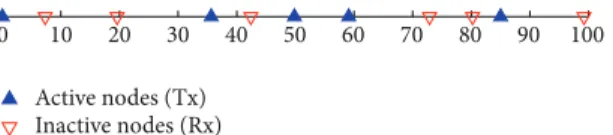
Consider an arbitrary slot time and suppose that the tagged node transmits its packet at the slot time. LetΦ𝑎 be the set of nodes that simultaneously transmit their packets at the slot time. The nodes inΦ𝑎 are called active nodes. The nodes inΦ𝑖𝑎 := Φ \ Φ𝑎are called inactive nodes that try to receive packets at the slot time. Since packet transmissions are performed independently from node to node, we see that Φ𝑎is a PPP with thinned intensity𝜆𝑝 [21]. Moreover,Φ𝑖𝑎is a
PPP with thinned intensity𝜆(1 − 𝑝) [21].
0 10 20 30 40 50 60 70 80 90 100 Active nodes (Tx)
Inactive nodes (Rx)
Figure 1: A snapshot of the one-dimensional ad hoc network with
active and inactive nodes in the range of100 m.
Figure 1provides a snapshot of the one-dimensional ad hoc network in the positive direction when the tagged node at the origin transmits a packet. In the figure triangles denote active nodes and upside down triangles denote inactive nodes. So the set of triangles formsΦ𝑎and the set of upside down triangles formsΦ𝑖𝑎in the figure.
We assume that one packet is transmitted during a slot time and that each node always has a packet to transmit. From the perspective of broadcast packets, as a performance metric we consider the average number of nodes in the neighbor of the tagged node, denoted by 𝐸[𝑁𝑠], that successfully receive the packet from the tagged node. If the tagged node transmits a packet in such a way that 𝐸[𝑁𝑠] is optimized, then the broadcasting speed becomes fast, which is desirable. Furthermore, the maximization of𝐸[𝑁𝑠] prevents the case where the nearest active node from the tagged node is too much close, which is not desirable in the design of an ad hoc network.
To be more specific in the definition of𝐸[𝑁𝑠], we define the neighbor of the tagged node by the interval between the tagged node and the nearest active node from the tagged node in the positive direction. Then𝐸[𝑁𝑠] is defined by the number of inactive nodes in the neighbor of the tagged node that successfully receive a packet transmitted from the tagged node. The reasons why we consider only inactive nodes in the positive direction in this paper are explained as follows. First, information forwarding is performed in the positive direction in practice. In fact, inactive nodes had better receive packets from their own nearest active nodes in front of them when the information is related with a safety or emergency situation in front of them such as the stopped-vehicle hazard warning. Second, the analysis of the average number of inactive nodes in the negative direction is the same as given in the next section, so we focus on the positive direction in this paper. Third, we assume that a node cannot transmit and receive a packet simultaneously. So only inactive nodes near the tagged node (i.e., the inactive nodes that are located between the tagged node and the nearest active node) are considered in the performance metric𝐸[𝑁𝑠].
3. Performance Analysis and Optimization
In this section, we use𝐸[𝑁𝑠] as the performance metric of an ad hoc network with the ALOHA protocol and derive an analytic form of𝐸[𝑁𝑠] as a function of the access probability 𝑝. Then we find an optimal access probability 𝑝∗that achievesthe maximum value of𝐸[𝑁𝑠].
We define the interference free distance𝑅 as the distance such that any inactive node located within the distance from the tagged node can successfully receive the packet
transmitted by the tagged node. To derive our performance metric, we first analyze𝑅 as follows.
Let 𝑋 be the location of the nearest active node. Since the set of active nodes Φ𝑎 is a PPP with intensity𝜆𝑝, the probability density function of𝑋 is given by
𝑓𝑋(𝑥) = 𝜆𝑝𝑒−𝜆𝑝𝑥 (1)
for𝑥 > 0. Conditioned on 𝑋 = 𝑥, suppose that there is an inactive node located at𝑟 (0 < 𝑟 < 𝑥).
Let𝑊 denote the noise that is independent of the fading between nodes and𝛼 denote the path loss exponent. Then the signal to interference and noise ratio (SINR) at the inactive node at𝑟 is given by
𝐹0/𝑟𝛼
𝑊 + 𝐹1/ (𝑥 − 𝑟)𝛼+ 𝐼++ 𝐼−1[0<𝑟<𝑥]. (2)
Here,𝐹0is the fading between the tagged node at the origin and the inactive node at 𝑟 and 𝐹1 is the fading between the nearest active node at 𝑥 and the inactive node at 𝑟. Moreover,𝐼+is the interference from all active nodes in the positive direction except the nearest active node, and𝐼−is the interference from all active nodes in the negative direction.
Correspondingly, letΦ+𝑎 be the set of active nodes in the positive direction except the nearest active node and letΦ−𝑎 be the set of active nodes in the negative direction. Then the interferences𝐼+and𝐼−are expressed as
𝐼+= ∑ 𝑋+ 𝑖∈Φ+𝑎 𝐹𝑖+ (𝑋+ 𝑖 + 𝑥 − 𝑟)𝛼 , 𝐼−= ∑ 𝑌− 𝑖∈Φ−𝑎 𝐹− 𝑖 (𝑌− 𝑖 + 𝑟)𝛼 , (3)
respectively. Here,𝑋+𝑖 is the location of the𝑖th nearest active node (from𝑋 = 𝑥) in Φ+𝑎 and 𝑌𝑖− is the location of the 𝑖th nearest active node in Φ−𝑎. Moreover, 𝐹𝑖+ is the fading between the𝑖th nearest active node in Φ+𝑎 and the inactive node at𝑟 and 𝐹𝑖−is the fading between the𝑖th nearest active node inΦ−𝑎and the inactive node at𝑟. Then |𝑋+𝑖| denotes the distance between𝑋 = 𝑥 and 𝑋+𝑖 and|𝑌𝑖−| denotes the distance between the origin and𝑌𝑖−. Since we use the Rayleigh fading model, we assume that𝐹0,𝐹1,𝐹𝑖+, and𝐹𝑖− are independent exponential random variables with parameter𝜇. Note that 1/𝜇 is the average transmission power.
Assume that the inactive node can successfully receive the packet from the tagged node if its SINR value is greater than a threshold𝜃. For the analysis of the interference free distance 𝑅, we have to consider the following important observation on the relation between the distance𝑅 and the location 𝑋 of the nearest active node.
Proposition 1. Let 𝑋 be the location of the nearest active node
from the tagged node in the positive direction and let𝑊 be
the exponential noise with mean1/]. Given that 𝑋 = 𝑥, the
conditional probability that𝑅 is greater than 𝑟 is given by
𝑃 {𝑅 > 𝑟 | 𝑋 = 𝑥} = 𝜇𝜃𝑟]𝛼+ ]⋅ 𝜃𝑟𝛼(𝑥 − 𝑟)𝛼 + (𝑥 − 𝑟)𝛼 ⋅ exp (−𝜆𝑝 ∫∞ 0 𝜃𝑟𝛼 𝜃𝑟𝛼+ (𝑡 + 𝑥 − 𝑟)𝛼𝑑𝑡) ⋅ exp (−𝜆𝑝 ∫∞ 0 𝜃𝑟𝛼 𝜃𝑟𝛼+ (𝑡 + 𝑟)𝛼𝑑𝑡) (4) for0 < 𝑟 < 𝑥.
Proof. For0 < 𝑟 < 𝑋, observe first that
{𝑅 > 𝑟} = { 𝐹0/𝑟𝛼
𝑊 + 𝐹1/ (𝑋 − 𝑟)𝛼+ 𝐼++ 𝐼− > 𝜃} . (5)
It then follows that 𝑃 {𝑅𝑋 > =𝑟𝑥} = 𝑃 { { { { { { { 𝐹0/𝑟𝛼 𝑊 + 𝐹1/ (𝑥 − 𝑟)𝛼+ 𝐼++ 𝐼− > 𝜃 } } } } } } } = 𝑃 { 𝐹0> 𝜃𝑟𝛼(𝑊 +(𝑥 − 𝑟)𝐹1 𝛼 + 𝐼++ 𝐼−)} = 𝐸 [𝑒−𝜇𝜃𝑟𝛼(𝑊+𝐹1/(𝑥−𝑟)𝛼+𝐼++𝐼−)](𝑎)= 𝐸 [𝑒−𝜇𝜃𝑟𝛼𝑊] ⋅ 𝐸 [𝑒−𝜇𝜃(𝑟𝛼/(𝑥−𝑟)𝛼)𝐹1] 𝐸 [𝑒−𝜇𝜃𝑟𝛼𝐼+] 𝐸 [𝑒−𝜇𝜃𝑟𝛼𝐼−] = ] 𝜇𝜃𝑟𝛼+ ]⋅ (𝑥1− 𝑟)𝛼 𝜃𝑟𝛼+ (𝑥 1− 𝑟)𝛼 ⋅ L𝐼+(𝜇𝜃𝑟𝛼) ⋅ L𝐼−(𝜇𝜃𝑟𝛼) . (6)
Equality (𝑎) in the above holds because 𝑊, 𝐹1,𝐹𝑖+, and𝐹𝑖−are
mutually independent. The derivation of Laplace transform L𝐼+(𝜇𝜃𝑟𝛼) of 𝐼+is presented below. Consider
L𝐼+(𝜇𝜃𝑟𝛼) = E [𝑒−𝜇𝜃𝑟 𝛼∑ 𝑋+𝑖∈Φ+𝑎𝐹𝑖+/(|𝑋+𝑖|+𝑥−𝑟)𝛼] = EΦ+ 𝑎[ [ ∏ 𝑋+ 𝑖∈Φ+𝑎 E𝐹+[𝑒−𝜇𝜃𝑟 𝛼𝐹+ 𝑖/(|𝑋+𝑖|+𝑥−𝑟)𝛼]] ] = EΦ+ 𝑎[ [ ∏ 𝑋+ 𝑖∈Φ+𝑎 𝜇 𝜇 + 𝜇𝜃𝑟𝛼/ (𝑋+ 𝑖 + 𝑥 − 𝑟)𝛼 ] ] = EΦ+ 𝑎[ [ ∏ 𝑋+ 𝑖∈Φ+𝑎 (𝑋+ 𝑖 + 𝑥 − 𝑟)𝛼 (𝑋+ 𝑖 + 𝑥 − 𝑟)𝛼+ 𝜃𝑟𝛼 ] ] = exp {−𝜆𝑝 ∫∞ 0 (1 − (𝑡 + 𝑥 − 𝑟)𝛼 (𝑡 + 𝑥 − 𝑟)𝛼+ 𝜃𝑟𝛼) 𝑑𝑡} = exp {−𝜆𝑝 ∫∞ 0 𝜃𝑟𝛼 (𝑡 + 𝑥 − 𝑟)𝛼+ 𝜃𝑟𝛼𝑑𝑡} . (7)
In the first equality, the expectation is taken over both the point process and the fading. Due to the independence in fading, the second equality holds. The third equality follows from the fact that
𝐸 [𝑒−𝑠𝐹+] = 𝜇
𝜇 + 𝑠. (8)
From Laplace functional of the homogeneous PPPΦ+𝑎 with intensity𝜆𝑝, we obtain the fifth equality.
Similarly, we derive Laplace transformL𝐼−(𝜇𝜃𝑟𝛼) of 𝐼−as
follows: L𝐼−(𝜇𝜃𝑟𝛼) = E[[[ [ 𝑒−𝜇𝜃𝑟 𝛼∑ 𝑌−𝑖 ∈Φ−𝑎 𝐹 − 𝑖 (|𝑌− 𝑖| + 𝑟)𝛼]]] ] = EΦ− 𝑎 [ [ [ [ ∏ 𝑌− 𝑖∈Φ−𝑎 E𝐹−[[[ [ 𝑒− 𝜇𝜃𝑟𝛼𝐹− 𝑖 (|𝑌− 𝑖 | + 𝑟)𝛼]]] ] ] ] ] ] = EΦ− 𝑎 [ [ [ [ [ ∏ 𝑌− 𝑖∈Φ−𝑎 𝜇 𝜇 + 𝜇𝜃𝑟𝛼/ (𝑌− 𝑖 + 𝑟)𝛼 ] ] ] ] ] = EΦ− 𝑎[ [ ∏ 𝑌− 𝑖∈Φ−𝑎 (𝑌− 𝑖 + 𝑟)𝛼 (𝑌− 𝑖 + 𝑟)𝛼+ 𝜃𝑟𝛼 ] ] = exp {−𝜆𝑝 ∫∞ 0 (1 − (𝑡 + 𝑟)𝛼 (𝑡 + 𝑟)𝛼+ 𝜃𝑟𝛼) 𝑑𝑡} = exp {−𝜆𝑝 ∫∞ 0 𝜃𝑟𝛼 𝜃𝑟𝛼+ (𝑡 + 𝑟)𝛼𝑑𝑡} , (9)
where we use Laplace functional of the homogeneous PPPΦ−𝑎 with intensity𝜆𝑝 in the fifth equality.
We are now ready to derive𝐸[𝑁𝑠]. By the definition of 𝑅, note that the packet from the tagged node can be successfully received by an inactive node if the distance between the tagged node and the inactive node is not greater than𝑅. Let Φ(𝑠)𝑖𝑎[0, 𝑋] be the set of inactive nodes in the interval [0, 𝑋] that successfully receive the packet. Note thatΦ𝑖𝑎 is a PPP with intensity𝜆(1 − 𝑝) and that an inactive node at 𝑟 (0 < 𝑟 < 𝑋) successfully receives the packet from the tagged node with probability𝑃{𝑅 > 𝑟 | 𝑋}. Let N(Φ(𝑠)𝑖𝑎[0, 𝑋]) denote the number of nodes inΦ(𝑠)𝑖𝑎[0, 𝑋]. ThenProposition 2presents the analytic form of𝐸[𝑁𝑠].
Proposition 2. The average number 𝐸[𝑁𝑠] of nodes that
successfully receive the packet from the tagged node is given by 𝐸 [𝑁𝑠] = (𝜆𝑝)2(1 − 𝑝) ∫∞ 𝑥=0∫ 𝑥 𝑟=0 ] 𝜇𝜃𝑟𝛼+ ] ⋅𝜃𝑟𝛼(𝑥 − 𝑟)𝛼 + (𝑥 − 𝑟)𝛼exp(−𝜆𝑝 ∫ ∞ 0 𝜃𝑟𝛼 𝜃𝑟𝛼+ (𝑡 + 𝑥 − 𝑟)𝛼𝑑𝑡) ⋅ exp (−𝜆𝑝 ∫∞ 0 𝜃𝑟𝛼 𝜃𝑟𝛼+ (𝑡 + 𝑟)𝛼𝑑𝑡) 𝑒−𝜆𝑝𝑥𝑑𝑟 𝑑𝑥. (10)
Proof. FromProposition 1the desired result is obtained as
follows: 𝐸 [𝑁𝑠]
= 𝑃 {The tagged node is active} 𝐸 [N (Φ(𝑠)𝑖𝑎 [0, 𝑋])] = 𝑝 ∫∞ 𝑥=0𝐸 [N (Φ (𝑠) 𝑖𝑎 [0, 𝑋]) | 𝑋 = 𝑥] 𝑓𝑋(𝑥) 𝑑𝑥 = 𝑝 ∫∞ 𝑥=0𝐸 [N (Φ (𝑠) 𝑖𝑎 [0, 𝑥]) | 𝑋 = 𝑥] 𝑓𝑋(𝑥) 𝑑𝑥. (11) To obtain 𝐸 [N (Φ(𝑠)𝑖𝑎 [0, 𝑥]) | 𝑋 = 𝑥] , (12) we need to condition it onΦ+𝑎∪ Φ−𝑎and compute
𝐸 [N (Φ(𝑠)𝑖𝑎 [0, 𝑥]) | 𝑋 = 𝑥] = 𝐸 [𝐸 [N (Φ(𝑠)
𝑖𝑎 [0, 𝑥]) | 𝑋 = 𝑥, Φ+𝑎 ∪ Φ−𝑎] | 𝑋 = 𝑥]
(13) because all transmissions from active nodes in Φ+𝑎 ∪ Φ−𝑎 simultaneously affect the packet receptions at the inactive nodes inΦ(𝑠)𝑖𝑎[0, 𝑥] which causes correlations in the packet receptions at the inactive nodes. However, for a givenΦ+𝑎 ∪ Φ−𝑎, which implies that the locations of all active nodes are fixed, only the channel fading does matter in the packet receptions at the inactive nodes. Noting that the fading in a channel is assumed to be independent of all the other channels, the inactive nodes in Φ(𝑠)𝑖𝑎[0, 𝑥] that successfully receive the packet from the tagged node form a (location dependent) thinned Poisson point process with thinning probability𝑃{𝑅 > 𝑟 | 𝑋 = 𝑥, Φ+𝑎∪ Φ−𝑎}. Hence, we have
𝐸 [N (Φ(𝑠)𝑖𝑎 [0, 𝑥]) | 𝑋 = 𝑥, Φ+𝑎∪ Φ−𝑎] = ∫𝑥 𝑟=0𝜆 (1 − 𝑝) 𝑃 {𝑅 > 𝑟 | 𝑋 = 𝑥, Φ + 𝑎∪ Φ−𝑎} 𝑑𝑟. (14)
It then follows that
𝐸 [N (Φ(𝑠)𝑖𝑎 [0, 𝑥]) | 𝑋 = 𝑥] = 𝐸 [𝐸 [N (Φ(𝑠)𝑖𝑎 [0, 𝑥]) | 𝑋 = 𝑥, Φ+𝑎∪ Φ−𝑎] | 𝑋 = 𝑥] = 𝐸 [∫𝑥 𝑟=0𝜆 (1 − 𝑝) ⋅𝑃 {𝑅 > 𝑟 | 𝑋 = 𝑥, Φ+ 𝑎 ∪ Φ−𝑎} 𝑑𝑟 | 𝑋 = 𝑥] = ∫𝑥 𝑟=0𝜆 (1 − 𝑝) 𝐸 [𝑃 {𝑅 > 𝑟 | 𝑋 = 𝑥, Φ + 𝑎 ∪ Φ−𝑎} | 𝑋 = 𝑥] 𝑑𝑟 = ∫𝑥 𝑟=0𝜆 (1 − 𝑝) 𝑃 {𝑅 > 𝑟 | 𝑋 = 𝑥} 𝑑𝑟. (15)
Combining the above two results together we get 𝐸 [𝑁𝑠] = 𝑝 ∫ ∞ 𝑥=0𝐸 [N (Φ (𝑠) 𝑖𝑎 [0, 𝑋]) | 𝑋 = 𝑥] 𝑓𝑋(𝑥) 𝑑𝑥 = 𝑝 ∫∞ 𝑥=0∫ 𝑥 𝑟=0𝜆 (1 − 𝑝) 𝑃 {𝑅 > 𝑟 | 𝑋 = 𝑥} 𝑑𝑟 𝑓𝑋(𝑥) 𝑑𝑥 = (𝜆𝑝)2(1 − 𝑝) ∫∞ 𝑥=0∫ 𝑥 𝑟=0 ] 𝜇𝜃𝑟𝛼+ ] ⋅ (𝑥 − 𝑟)𝛼 𝜃𝑟𝛼+ (𝑥 − 𝑟)𝛼exp(−𝜆𝑝 ∫ ∞ 0 𝜃𝑟𝛼 𝜃𝑟𝛼+ (𝑡 + 𝑥 − 𝑟)𝛼𝑑𝑡) ⋅ exp (−𝜆𝑝 ∫∞ 0 𝜃𝑟𝛼 𝜃𝑟𝛼+ (𝑡 + 𝑟)𝛼𝑑𝑡) 𝑒−𝜆𝑝𝑥𝑑𝑟 𝑑𝑥. (16)
Observe that if the access probability𝑝 is too large, then the active nodes transmitting packets are likely to be close and hence most of their transmission ranges are overlapped, which results in decreasing𝐸[𝑁𝑠] due to severe interference. On the other hand, if the access probability𝑝 is too small, then𝐸[𝑁𝑠] is also degraded due to low packet transmission opportunity for each node. So it is important to find the optimal access probability𝑝∗that maximizes𝐸[𝑁𝑠].
With the above observation, we formulate an optimiza-tion problem to obtain the optimal access probability 𝑝∗. However, before we provide our optimization problem we should mention a remark on the feasible region on the access probability𝑝. According to the technical report of NHTSA [22], the required broadcast packet latency is set to be 100 msec. To satisfy the requirement on average in our model and to bear in mind that there are 100 msec/one slot time slots during100 msec, each node should send at least one packet with the access probability of
𝑝min =one slot time100 msec . (17) So the feasible region of the access probability𝑝 is 𝑝min< 𝑝 < 1. With the feasible region of 𝑝 our optimization problem is formulated as follows:
𝑝∗:= argmax
𝑝min<𝑝<1
𝐸 [𝑁𝑠] . (18)
4. Numerical Results
In this section we provide numerical and simulation results to validate our analysis. The simulation is conducted using MATLAB. The procedure is summarized as follows. First, we generate a Poisson random variable and set it to be the total number of nodes. The locations of nodes are independently generated by using a uniform random variable over the observation window. Next, we classify each node as active with probability𝑝 and inactive with probability 1 − 𝑝, and each fading power between nodes is independently generated by using an exponential random variable. When the tagged node is active, pick up the nearest active node from the tagged node at the origin in the positive direction, and we only consider inactive nodes between the nearest active node and the tagged node, as explained before. Then we compute
0 0.2 0.4 0.6 0.8 1 0 0.05 0.1 0.15 0.2 0.25
The access probability p Analysis Simulation The a verag e n u m b er o f no des E[ Ns ]
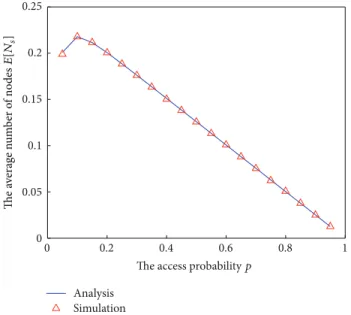
Figure 2: The average number of nodes that successfully receive the packet from the tagged node (𝑊 is exponential with mean
10−10mW).
the SINR value for each inactive node considered and check whether the inactive node receives the packet successfully. Consequently, 𝑁𝑠 is computed. The whole procedure is repeated5 × 105times so that the desired throughput𝐸[𝑁𝑠] is obtained.
We first validate our result on the average number𝐸[𝑁𝑠] of inactive nodes with successful packet reception and then find the optimal access probability𝑝∗. We use the following parameters throughout this section which are adopted from [3]:
(i) The intensity of the network:𝜆 = 0.01 nodes/m. (ii) The average of transmission power:1/𝜇 = 1 W. (iii) The path loss exponent:𝛼 = 4.
(iv) The success threshold:𝜃 = 10 dB. (v) The observation window:10 km.
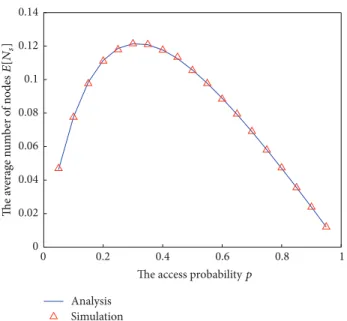
We use Proposition 2to compute 𝐸[𝑁𝑠] and plot it in Figures2and 3as we change the access probability𝑝. We consider a zero-mean additive white Gaussian noise (AWGN) in this paper, which is widely used to model a noise in most of communication systems [23]. In this case, the power of the noise is exponentially distributed; that is,𝑊 follows an exponential distribution with parameter]. Here, 1/] indi-cates the average noise power. The exponential noise is also considered in [24,25]. InFigure 2we use1/] = 10−10mW and in Figure 3we use 1/] = 10−6mW. We also plot the simulation results in the figures. As can be seen in the figures, there exists the optimal access probability𝑝∗that maximizes our performance metric𝐸[𝑁𝑠]. In addition, we see from the figures that our analytical and simulation results are well matched, which shows the validity of our analysis. Another important observation from the figures is that the impact of the noise power is significant. That is, when the average noise power is very small such as 10−10mW, the optimal access
0 0.2 0.4 0.6 0.8 1 0 0.02 0.04 0.06 0.08 0.1 0.12 0.14
The access probability p Analysis Simulation The a verag e n u m b er o f no des E[ Ns ]
Figure 3: The average number of nodes that successfully receive the packet from the tagged node (𝑊 is exponential with mean
10−6mW). 0 0.05 0.1 0.15 0.2 0.04 0.06 0.08 0.1 0.12 0.14 0.16 0.18 0.2 0.22 0.24
The intensity of network𝜆
The a verag e n u m b er o f no des E[ Ns ] Analysis (p = 0.3) Analysis (p = 0.2) Analysis (p = 0.1)
Figure 4: The average number of nodes that successfully receive the packet from the tagged node versus the intensity of network for fixed access probabilities.
probability𝑝∗ is very small. On the other hand, when the average noise power is not small such as10−6mW, the optimal access probability becomes large, that is, greater than0.3.
We next investigate the behavior of 𝐸[𝑁𝑠] when we change the intensity𝜆 of the PPP. We first fix 𝑝 to be 0.1, 0.2, and 0.3, and we plot 𝐸[𝑁𝑠] versus 𝜆 for each fixed 𝑝 in Figure 4. From the figure, we see that𝐸[𝑁𝑠] increases rapidly for small values of𝜆, but it becomes almost invariant soon in 𝜆. We see a similar behavior of 𝐸[𝑁𝑠] when we use the optimal access probability𝑝∗ := 𝑝∗(𝜆) for each 𝜆, which is plotted in Figure 5. 0 0.05 0.1 0.15 0.2 0.08 0.1 0.12 0.14 0.16 0.18 0.2 0.22 0.24 Analysis
The intensity of network𝜆
The a verag e n u m b er o f no des E[ Ns ]
Figure 5: The average number of nodes that successfully receive the packet from the tagged node versus the intensity of network for optimal access probabilities.
This is an interesting and useful result in practice. Con-sider the situation in an ad hoc network where the intensity of nodes is rapidly changing in time. In this case, since it is very difficult to adapt the access probability optimally according to the fast change in intensity, a fixed access probability is likely be used. Then, if the intensity𝜆 is not too small, then the result in the figures concludes that it suffices to find an optimal access probability from which𝐸[𝑁𝑠] becomes almost invariant. For instance, for the ad hoc network we consider in this section we recommend𝑝∗= 0.1 for 𝜆 > 0.1.
However, when the intensity𝜆 is small, for example, less than0.1, the access probability should be adapted according to the change in intensity to achieve the optimal performance. In fact, the optimal access probability becomes larger as𝜆 decreases.
5. Conclusions
In this paper we considered a one-dimensional ad hoc network with the ALOHA protocol. We used stochastic geometry theory to analyze the performance of the network. As a performance metric we considered the average number of inactive nodes that successfully receive a packet from an arbitrary node and derived an analytic form of the performance metric. With our analysis we formulated an optimization problem to obtain the optimal access probabil-ity that achieves the optimal performance. Our numerical and simulation studies showed the validity of our analysis. We also investigated the performance behavior of the ad hoc network with the ALOHA protocol.
Conflict of Interests
The authors declare that there is no conflict of interests regarding the publication of this paper.
Acknowledgment
This research was supported by Basic Science Research Program through the National Research Foundation of Korea (NRF) funded by the Ministry of Education (NRF-2014R1A1A2055410).
References
[1] F. Cal`ı, M. Conti, and E. Gregori, “Dynamic tuning of the IEEE 802.11 protocol to achieve a theoretical throughput limit,”
IEEE/ACM Transactions on Networking, vol. 8, no. 6, pp. 785–
799, 2000.
[2] B. Blaszczyszyn, P. M¨uhlethaler, and Y. Toor, “Maximizing throughput of linear vehicular ad-hoc NETworks (VANETs)— a stochastic approach,” in Proceedings of the European Wireless
Conference (EW ’09), pp. 32–36, IEEE, Aalborg, Denmark, May
2009.
[3] B. Błaszczyszyn, P. M¨uhlethaler, and Y. Toor, “Stochastic analy-sis of ALOHA in vehicular ad-hoc networks,” Annals of
Telecom-munications, vol. 68, no. 1-2, pp. 95–106, 2013.
[4] S. Subramanian, M. Werner, S. Liu, J. Jose, R. Lupoaie, and X. Wu, “Congestion control for vehicular safety: synchronous and asynchronous MAC algorithms,” in Proceedings of the 9th
ACM International Workshop on VehiculAr Inter-NETworking, Systems, and Applications (VANET ’12), pp. 63–72, June 2012.
[5] T. V. Nguyen, F. Baccelli, K. Zhu, S. Subramanian, and X. Wu, “A performance analysis of CSMA based broadcast protocol in VANETs,” in Proceedings of the IEEE INFOCOM, pp. 2805–2813, Turin, Italy, April 2013.
[6] D. Stoyan, W. Kendall, and J. Mecke, Stochastic Geometry and
Its Applications, John Wiley & Sons, 2nd edition, 1996.
[7] F. Baccelli, B. Błaszczyszyn, and M. K. Karray, “Up and down-link admission/congestion control and maximal load in large homogeneous CDMA networks,” Mobile Networks and
Appli-cations, vol. 9, no. 6, pp. 605–617, 2004.
[8] C. C. Chan and S. V. Hanly, “Calculating the outage probability in a CDMA network with spatial Poisson traffic,” IEEE
Transac-tions on Vehicular Technology, vol. 50, no. 1, pp. 183–204, 2001.
[9] F. Baccelli, B. Baszczyszyn, and F. Tournois, “Downlink admis-sion/congestion control and maximal load in CDMA networks,” in Proceedings of the 22nd Annual Joint Conference of the IEEE
Computer and Communications (IEEE INFOCOM ’03), vol. 1,
pp. 723–733, March 2003.
[10] X. Yang and A. P. Petropulu, “Co-channel interference modeling and analysis in a Poisson field of interferers in wireless commu-nications,” IEEE Transactions on Signal Processing, vol. 51, no. 1, pp. 64–76, 2003.
[11] P. C. Pinto, A. Giorgetti, M. Z. Win, and M. Chiani, “A stochastic geometry approach to coexistence in heterogeneous wireless networks,” IEEE Journal on Selected Areas in Communications, vol. 27, no. 7, pp. 1268–1282, 2009.
[12] T. V. Nguyen and F. Baccelli, “A stochastic geometry model for cognitive radio networks,” The Computer Journal, vol. 55, no. 5, pp. 534–552, 2012.
[13] C. Yin, L. Gao, and S. Cui, “Scaling laws for overlaid wireless networks: a cognitive radio network versus a primary network,”
IEEE/ACM Transactions on Networking, vol. 18, no. 4, pp. 1317–
1329, 2010.
[14] A. Babaei and B. Jabbari, “Throughput optimization in cognitive random wireless ad hoc networks,” in Proceedings of the 53rd
IEEE Global Communications Conference (GLOBECOM ’10), pp.
1–5, Miami, Fla, USA, December 2010.
[15] W. Ren, Q. Zhao, and A. Swami, “Power control in cognitive radio networks: how to cross a multi-lane highway,” IEEE
Journal on Selected Areas in Communications, vol. 27, no. 7, pp.
1283–1296, 2009.
[16] A. Ghasemi and E. S. Sousa, “Interference aggregation in spec-trum-sensing cognitive wireless networks,” IEEE Journal on
Sel-ected Topics in Signal Processing, vol. 2, no. 1, pp. 41–56, 2008.
[17] V. Chandrasekhar and J. G. Andrews, “Uplink capacity and interference avoidance for two-tier femtocell networks,” IEEE
Transactions on Wireless Communications, vol. 8, no. 7, pp.
3498–3509, 2009.
[18] J. Zhang and J. G. Andrews, “Distributed antenna systems with randomness,” IEEE Transactions on Wireless Communications, vol. 7, no. 9, pp. 3636–3646, 2008.
[19] O. Dousse, M. Franceschetti, and P. Thiran, “On the throughput scaling of wireless relay networks,” IEEE Transactions on
Infor-mation Theory, vol. 52, no. 6, pp. 2756–2761, 2006.
[20] M. Haenggi, J. G. Andrews, F. Baccelli, O. Dousse, and M. Franceschetti, “Stochastic geometry and random graphs for the analysis and design of wireless networks,” IEEE Journal on
Selected Areas in Communications, vol. 27, no. 7, pp. 1029–1046,
2009.
[21] F. Baccelli and B. Blaszczyszyn, Stochastic Geometry and
Wire-less Networks, Volume I-Theory, Foundation and Trends in Net-working, NoW Publishers, 2009.
[22] NHTSA Report, “Vehicle safety communications project,” Final Report DOT HS 809 859, US Department of Transportation, 2005.
[23] D. Tse and P. Viswanath, Fundamentals of Wireless
Communica-tion, Cambridge University Press, Cambridge, Mass, USA, 2005.
[24] F. Baccelli and B. Blaszczyszyn, Stochastic Geometry and
Wire-less Networks, Volume II—Applications, Foundation and Trends in Networking, Now Publishers, Norwell, Mass, USA, 2009.
[25] B. Błaszczyszyn, A. Laouiti, P. M¨uhlethaler, and Y. Toor, “Com-parison for VANETs: conventional routing vs an advanced opportunistic routing scheme using active signaling,” in
Pro-ceedings of the 8th International Conference on Intelligent Transport System Telecommunications (ITST ’08), pp. 288–293,
International Journal of
Aerospace
Engineering
Hindawi Publishing Corporationhttp://www.hindawi.com Volume 2014
Robotics
Journal ofHindawi Publishing Corporation
http://www.hindawi.com Volume 2014
Hindawi Publishing Corporation
http://www.hindawi.com Volume 2014 Active and Passive Electronic Components
Control Science and Engineering
Journal of
Hindawi Publishing Corporation
http://www.hindawi.com Volume 2014 Machinery
Hindawi Publishing Corporation
http://www.hindawi.com Volume 2014 Hindawi Publishing Corporation
http://www.hindawi.com
Journal of
Engineering
Volume 2014Submit your manuscripts at
http://www.hindawi.com
VLSI Design
Hindawi Publishing Corporation
http://www.hindawi.com Volume 2014
Hindawi Publishing Corporation
http://www.hindawi.com Volume 2014 Shock and Vibration Hindawi Publishing Corporation
http://www.hindawi.com Volume 2014
Civil Engineering
Advances inAcoustics and VibrationAdvances in
Hindawi Publishing Corporation
http://www.hindawi.com Volume 2014
Hindawi Publishing Corporation
http://www.hindawi.com Volume 2014
Electrical and Computer Engineering
Journal of
Advances in OptoElectronics
Hindawi Publishing Corporation
http://www.hindawi.com Volume 2014
The Scientific
World Journal
Hindawi Publishing Corporation
http://www.hindawi.com Volume 2014
Sensors
Journal of Hindawi Publishing Corporationhttp://www.hindawi.com Volume 2014
Modelling & Simulation in Engineering
Hindawi Publishing Corporation
http://www.hindawi.com Volume 2014
Hindawi Publishing Corporation
http://www.hindawi.com Volume 2014
Chemical Engineering
International Journal of Antennas and
Propagation International Journal of
Hindawi Publishing Corporation
http://www.hindawi.com Volume 2014
Hindawi Publishing Corporation
http://www.hindawi.com Volume 2014
Navigation and Observation International Journal of
Hindawi Publishing Corporation
http://www.hindawi.com Volume 2014