주 민 관* 김 규 선** 김 현 중*** 김 용 재*** 이 현 기**** 심 종 성***** Minkwan Ju Kim, Gyu Seon Kim, Hyun Joong Kim, Yong Jae Lee, Hyeon Gi Jongsung Sim
확률기법에 기초한 FRP rebar로 보강된 콘크리트
슬래브의 펀칭전단강도 모델에 대한 고찰
A Study on Probability-based Punching Shear Model of Concrete
Slabs Reinforced with FRP rebars
ABSTRACT
The objective of this study is to propose the new punching shear model for two-way concrete slabs of building structures and bridge decks structures reinforced with FRP or steel rebars. To do this, two evaluating methods are applied here. One is the ratio of test to model and the other is probability analysis with probabilistic uncertainties. In conclusion, it shows that the proposed punching shear model evaluates the tested punching shear strength as conservative with stability and it exhibits better probabilistic characteristics than existing punching shear models.
1. Introduction
To solve the degradation of structural capacity of RC structures, FRP rebars have been remarkably interested as substituting material to conventional steel rebars for concrete structures. Even though many researches for FRP rebars have been investigated, they have usually been focused on the one-way concrete structures such as beams. Thus, for more effective application of FRP rebars, it needs to extend to the two-way concrete structures reinforced with FRP rebars. The objective of this study is to propose the new punching shear model for two-way concrete slabs of building structures and bridge decks structures reinforced with FRP or steel rebars. To do this, probability-based method is applied in this study. It is to investigate reliability of the proposed punching shear model with probabilistic uncertainties such material, geometry and modeling error. The reliability of the proposed punching shear model is evaluated by investigating the compatibility between the nominal punching shear load and punching shear load according to the targeted confidence level of 95%.
* 정회원, 한국시설안전공단 진단본부 일반도로팀 특수교 통합유지관리센터 직원 ** 정회원, 한국시설안전공단 진단본부 일반도로팀 특수교 통합유지관리센터 파트장 *** 정회원, 한양대학교 토목공학과 콘크리트구조연구실 박사과정 **** 정회원, 한양대학교 토목공학과 콘크리트구조연구실 석박사과정 ***** 정회원, 한양대학교 토목공학과 교수 한국콘크리트학회 2010년 봄 학술대회 논문집
2. Existing punching shear models for comparative study
In this study, 61 test results that had been conducted is adopted. For the comparative study, 11 punching shear models which has been used and researched are considered as follows: Modified ACI 318-95, Modified ACI440-98, ACI440H, BS8110, EC2, El-Gamal et al (2005), Gardner (CEB Bulletin 168, 1990), JSCE, MC90, Ospina et al (2003), UW (Jacobson et al, 2005). 3. The suggestion of probability-based punching shear model
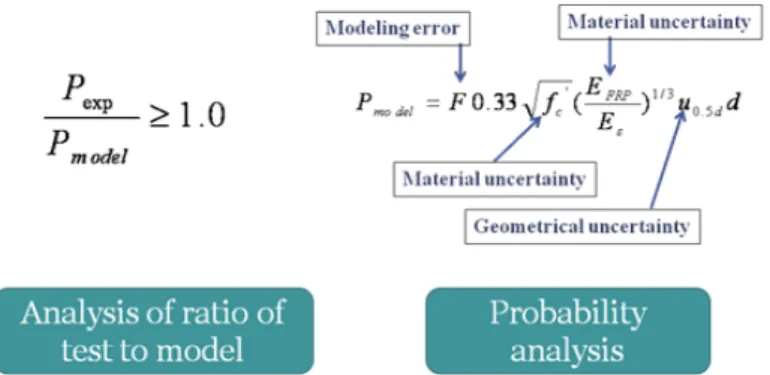
To develop more reasonable punching shear model, compatibility and reliability is considered in this study. The uncertainties of the proposed punching shear models may be exist and it brings the result of decrease of the possibility to predict the punching shear strength even though it shows the desirable compatibility from the ratio of test to model. That is why compatibility and reliability must be simultaneously considered (Figure 1). The compatibility can be acquired by investigating the ratio of test to model. Especially, it is important for concrete slabs reinforced with FRP rebars because of the brittle failure of punching shear.
Figure 1 The fundamental needs to propose punching shear model
4. Conclusion
The new punching shear model proposed in this study shows that it can evaluate the tested punching shear strength as conservative with stability and exhibits better probabilistic characteristics as existing punching shear models. Further studies to find effective parameters for more reasonable punching shear model are needed using additional experimental data and FEM.
References
1. Ang, A. H-S. and Tang, W. H., “Probability Concepts in Engineering Planning and Design (Volume II-Decision, Risk, and Reliability),” Book, JohnWiley & Sons, 1975, 557pp.
2. Mirza, S. A., “Reliability-Based Design of Reinforced Concrete Columns,” Structural Safety, Elsevier Science, V.18, No.2/3, 1996, pp.179-194.
3. Ju, M. K., “Probability-Based Punching Shear Model of Concrete Slabs Reinforced with FRP Rebars,” Ph.D theis, Hanyang University, Feb. 2009, 254pp.