8-3 / C.-S. Park
IMID 2009 DIGEST •
Abstract
Minimizing the residual impurity level on the MgO layer is the key factor for reducing temporal dark image sticking on bright screen. In this paper, to reduce the residual impurity level on the MgO layer of 50-in. full-HD ac-PDP with He (35%) - Xe (11%) contents, RF-plasma treatments on the MgO layer are adopted under various gases for plasma treatment. As a result of monitoring the difference in the display luminance between the before and after 5-min. sustain discharge with a square-type image at peak luminance, the Ar and Ar>O2 plasma
treatments can reduce the temporal dark image sticking on the bright screen in an ac-PDP.
1. Introduction
The realization of a high-quality plasma display panel (PDP) requires an urgent solution to the image sticking and image retention problems induced in the PDP cells when strong sustain discharges have been repeatedly produced during a sustain period [1]-[3]. Image retention means a temporal image sticking that is easily recoverable, whereas image sticking means a permanent image sticking that is not recoverable. As such, this paper focuses on the effect of the temporal dark image sticking on the bright screen using RF-plasma treatment on the MgO layer [4]-[6]. Our experimental observation illustrates that the RF-plasma treatment on the MgO layer under various gases for plasma treatment is closely related to the temporal dark image sticking phenomenon on the bright screen. Accordingly, this paper investigates the relation between the temporal dark image sticking on the bright screen and the various gases for RF-plasma treatment on the MgO layer.
2. Experimental setup
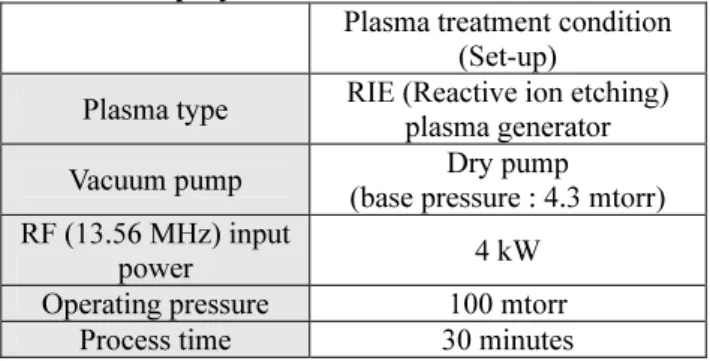
Tables 1 and 2 show the specifications of the RF-plasma treatment condition and variable RF-plasma treatment gas compositions employed in this research, which were exactly the same, except for the plasma treatment gas composition. The RF (13.56 MHz) input power and the process time for plasma treatment are 4 kW and 30 minutes, respectively [7]. The frequency for the sustain period was 200 kHz, and the sustain voltage was 205 V [7]. The gas chemistry in the experiment was Ne-Xe (11 %)-He (35 %) under a pressure of 430 Torr.
To produce a residual image caused by image sticking, the entire region of the 50-in. full-HD panel was abruptly changed to a full-white background image after displaying the square-shaped image at peak luminance (about 650 cd/m2) during a 5-minute
sustained discharge. In the discharge region, the luminance was measured before and after the 5-minute discharge [3], [7]. The cells in discharge region before the 5-minute discharge were non-image sticking cells, whereas after the 5-minute discharge the cells became image sticking cells.
TABLE 1. Specifications of plasma treatment condition employed in this research.
Plasma treatment condition (Set-up)
Plasma type RIE (Reactive ion etching) plasma generator Vacuum pump (base pressure : 4.3 mtorr) Dry pump RF (13.56 MHz) input
power 4 kW
Operating pressure 100 mtorr Process time 30 minutes
Experimental Study on Reduction of Temporal Dark Image
Sticking on Bright Screen in AC-PDPs Using RF-Plasma
Treatment on MgO layer
Choon-Sang Park, Jae-Hyun Kim, and Heung-Sik Tae
School of Electrical Engineering and Computer Science, Kyungpook National
University, Daegu, Korea
TEL:82-53-950-6563, e-mail: [email protected].
Keywords: Temporal Image Sticking, AC-PDP, MgO, RF-Plasma Treatment, Disappearing Time
8-3 / C.-S. Park
• IMID 2009 DIGEST
TABLE 2. Specifications of variable plasma treatment gas compositions employed in this research.
Plasma treatment gas compositions
Ref. Non plasma treatment O2 > Ar Plasma treatment O2 (201sccm) + Ar (22sccm) Ar Plasma treatment Ar (240sccm) Ar > O2 Plasma treatment Ar (189sccm) + O2 (21sccm)
TABLE 3. Changes in luminance difference between before and after discharge in region (B) under full-white background after iterant 5-min. sustain discharge measured from 50-inch full-HD panels using RF-plasma treatment on MgO layer with variable gas compositions.
Luminance [cd/m2]
Panel Before [L1] After [L2] ∆L [=|LL 1 -2|]
Ref. 151.8 145.5 6.3 O2>Ar 153.6 146.7 6.9
Ar 144.7 141.6 3.1 Ar>O2 151.4 148.3 3.1
3. Results and Discussion
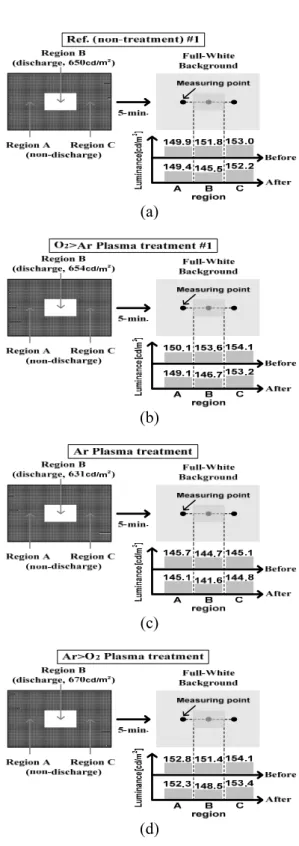
Fig. 1 illustrates the retention of a square-shaped image pattern under the ensuing full-white background image immediately after a 5-min. sustain discharge of the 50-in. test panels prepared using the RF-plasma treatment on the MgO layer with variable plasma gas compositions: (a) non-treatment, (b) O2>Ar, (c) Ar, and (d) Ar>O2 plasma treatments. Table
3 shows the luminance difference between the before and after discharge in region (B) under full-white background after iterant 5-min. sustain discharge measured from 50-inch full-HD panels using RF-plasma treatment on the MgO layer with variable gas compositions. As shown in Fig. 1 and Table 3, in the cases of O2>Ar plasma treatment, the luminance
difference between the before and after discharge in region (B) under full-white background were almost the same in comparison with the non plasma treatment (Ref. panel). However, in the cases of Ar and Ar>O2
plasma treatments, the luminance difference between the before and after discharge in region (B) under full-white background were remarkably reduced. It is expected that the Ar and Ar>O2 plasma treatments will
(a)
(b)
(c)
(d)
Fig. 1. Original image pattern and residual (or ghost) square-shaped pattern when displaying full-white background after iterant 5-min. sustain discharge captured from 50-inch full-HD panels using RF-plasma treatment on MgO layer with variable gas compositions. (a) Ref. panel (non-plasma treatment), (b) O2>Ar plasma treatment
panel, (c) Ar plasma treatment panel, and (d) Ar>O2 plasma treatment panel.
8-3 / C.-S. Park
IMID 2009 DIGEST •
contribute to reducing the temporal dark image sticking on bright screen of the ac PDP-TV.
4. Summary
A RF-plasma treatment was adopted to minimize the residual impurity level on the MgO layer, and the resultant change in temporal dark image sticking on bright screen examined in comparison with the non plasma treatment using 50-in. full-HD ac-PDPs with a high Xe (11%) content. As a result of monitoring the difference in the display luminance between the before and after 5-min. sustain discharge with a square-type image at peak luminance, the Ar and Ar>O2 plasma treatments can reduce the temporal
dark image sticking on the bright screen by decreasing the residual impurity level on the MgO layer. Thus, it is expected that these experimental results will help reduce the problem of the temporal dark image sticking on bright screen in PDP-TVs.
5. References
1. H.-S. Tae, C.-S. Park, B.-G. Cho, J.-W. Han, B. J. Shin, S.-I. Chien, and D. H. Lee, IEEE Trans. Plasma Sci., 34, p.996 (2006).
2. J. H. Kim, C.-S. Park, B.-S. Kim, K.-H. Park, and H.-S. Tae, Journal of Information Display, 8, p.29
(2007).
3. C.-S. Park and H.-S. Tae, IEICE Trans. Electronics,
E92-C, p.161 (2009).
4. S. H. Lee, B. J. Rhee, M. H. Joo, J. Kang, J. S. Chung, and M.-H. Park, Science Direct, Surface and Coating Technology, 171, p.247 (2003).
5. K. S. Nam, H. J. Lee, S. H. Lee, G. H. Lee, Y. S. Song, and D. Y. Lee, Science Direct, Surface and Coating Technology, 201, p.2567 (2006).
6. S. Lee and T. Ito, Science Direct, Materials Research Bulletin, 40, p.951 (2005).
7. C.-S. Park, H.-S. Tae, B.-K. Park, E.-Y. Jung, and J.-C. Ahn, SID’09 Technical Digest, Vol. 40, p.363