© Korean Powder Metallurgy Institute 942 -1. Introduction
Polymers are increasingly replacing traditional materials. That's why the requirements for machines in polymer production and processing become more and more demanding. Thus, machine parts must meet requirements such as high wear and corrosion resistance and also high mechanical strength.
2. Choice of chemical composition
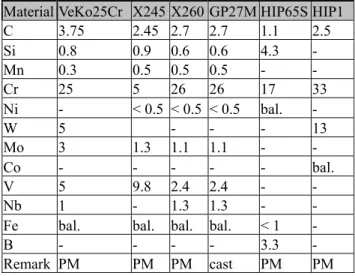
VeKo25Cr is a steel with the composition shown in Table 1. Each of the following elements influences the properties of the alloy and has been specifically selected to achieve a combination of high resistance to wear and corrosion.
Carbon forms carbides at various stoichiometries with Fe, Mn, Cr, Mo, V, W, and Nb. Its amount hardly influences the corrosion resistance to water, acid and hot gasses. The high content of 3.75 % provides sufficient carbon to form wear-inhibiting carbides with one of the mentioned elements. Chromium is a carbide former and responsible for the good corrosion resistance. A minimum amount of 13% is required in the matrix. Tungsten is a strong carbide former and increases the high-temperature strength. Vanadium is also a strong carbide former and binds nitrogen. Molybdenum is a strong carbide former as well and increases the hardenability by lowering the critical cooling rate. Niobium is another strong carbide former and acts as a chemical stabilizer, thus increasing the corrosion resistance. Silicon deoxidizes the alloy and narrows the γ range. It also increases wear resistance and strength. Manganese deoxidizes too and binds sulfur to form manganese sulfides. Iron as matrix is also a carbide former and thanks to the addition of chromium, the corrosion
Table 1. Chemical composition (in wt%).
Material VeKo25Cr X245 X260 GP27M HIP65S HIP1
C 3.75 2.45 2.7 2.7 1.1 2.5 Si 0.8 0.9 0.6 0.6 4.3 - Mn 0.3 0.5 0.5 0.5 - - Cr 25 5 26 26 17 33 Ni - < 0.5 < 0.5 < 0.5 bal. - W 5 - - - 13 Mo 3 1.3 1.1 1.1 - - Co - - - - - bal. V 5 9.8 2.4 2.4 - - Nb 1 - 1.3 1.3 - -
Fe bal. bal. bal. bal. < 1 -
B - - - - 3.3 -
Remark PM PM PM cast PM PM
resistance is improved.
The amount of carbon was selected high enough to allow all carbide formers to create carbides. Thus, no undesirable phases have to be expected. If weak carbide formers are present in small amounts, the alloying elements are absorbed by the cementite as solid solution and a mixed carbide is created. At large amounts of weak carbide formers or small amounts of strong carbide formers special carbides are created with a lattice and composition different from the cementite. Usually, the special carbides still absorb iron and create a solid solution. Sometimes double carbides are formed such as the iron-tungsten double carbide Fe3W3C. The carbon affinity of the alloying elements varies
considerably. In the following sequence it increases from left to right: Mn→Cr→W→Mo→V→Nb (also according to [1]).
The distribution of the carbides and alloying elements in 2006 POWDER METALLURGY
World Congress
C08-02-4
VeKo25Cr: A Corrosion and Wear Resistant Powder Metallurgical Alloy
with a Basic Hardness of 52 HRC
Beat W. Hofer, Michel Saner
Sintec HTM AG, Jurastrasse 59, CH-2503 Biel (Switzerland) [email protected], [email protected]
Abstract
To meet the demands for use in extremely abrasive and corrosive environments, a new material was developed. The VeKo25Cr distinguishes itself through specifically selected amounts of carbon and carbide forming elements such as Cr, Mo, V, W and Nb. The alloy is based on a Fe matrix. The strength after heat treatment and the wear and corrosion properties are compared to those of other materials. VeKo25Cr can be combined with easy-to-process materials such that the difficult handling is minimized to those places on the piece most subjected to operational wear.
© Korean Powder Metallurgy Institute 943
-the matrix can also be altered through heat treatments. With increasing temperature the solubility of carbon in the matrix increases, and the stoichiometry of the carbides is changed and moved towards a more stable equilibrium.
3. Fabrication of samples
Globular atomized powder with a grain size of <500 µm was poured into steel capsules which were evacuated and sealed air-tight. These bars were then fully densified in a hot isostatic press at 1100°C resp. 1160°C for 3 hours at 1000 bar. A low cooling rate was selected intentionally in order to achieve a soft microstructure.
The bars were then sawn and machined to the final dimension of ∅ 50x30 mm. These segments were divided into 3 lots and heat treated at 1080°C, 1140°C and 1180°C respectively for 30 minutes in vacuum. After that, the samples were tempered 3 times for 2 hours at different temperatures and the hardness was determined. The maximum hardness of 67 HRC was found after hardening at 1140°C and tempering at 450°C.
Above the tempering temperature of 300°C, the hardness increases due to the secondary hardening. The peek was found to be at 450°C. This phenomenon is due to the appearance of finely distributed precipitations created from the supersaturated solid solution. Above 450°C, the hardness decreases considerably since the alloy approaches its equilibrium.
4. Characterization
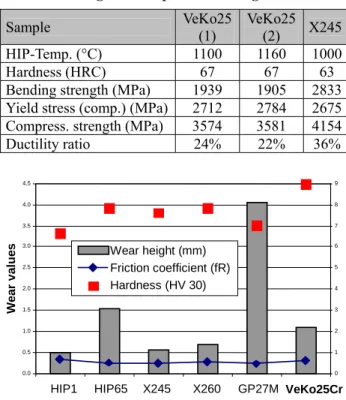
Bending and compression strength tests (Table 2) were carried out on samples which were hot isostatically pressed, hardened and tempered to maximum hardness.
The results show high strength in combination with a fairly high ductility ratio (ratio of yield stress to compression strength) from which good toughness can be derived.
Wear tests based on the ball and disk method [2] were carried out using the same samples as above. A carbide ball of type K 20 was rolled on the test material disk on a circular path with a load of 5 N. VeKo25Cr was compared to other powder metallurgical materials produced through HIP (Table 1). Fig. 1 compares the wear height which is the depth of the grove in the disk. In this test, VeKo25Cr performs similarly to the other materials and can thus be considered highly wear resistant.
Corrosion resistance of VeKo25Cr and other materials was tested using the potentio-dynamic corrosion measurement [3] according to ASTM G5 on the same samples as above. VeKo25Cr shows a passivation plateau and is thus highly corrosion resistant. However, depending to the environment and the type of stress these findings have to be verified.
Table 2. Bending and compression strength
Fig. 1. Wear resistance
5. Use in composites
The HIP technology allows to combine different materials [4]. In the case of VeKo25Cr, this possibility would be employed to produce composite bars with soft cores or to clad soft steel housings which serve as raw material for screws and barrels in polymer extruders.
6. Summary
The corrosion and wear properties of VeKo25Cr and the effect of HIP and heat treatment on the hardness were presented. This steel is suitable for components exposed to extreme corrosion and wear. To reduce brittleness of the material, the HIP composite solution is recommended.
7. References
1. H. Schumann et al., Metallographie 13., neu bearbeitete Auflage, 1991, p. 557.
2. Kragelski, I.W., Reibung und Verschleiss, Verlag Technik, Berlin, 1971.
3. B. Hofer and M. Thom, Schwindung und Eigen- schaftsveränderung einer verschleiβ-und korrosionsfesten PM-Legierung beim Heiβisostatischen Pressen, 23. Hagener Symposium, Hagen, 2004, p.159.
4. B.Hofer, Werkstoffverbund mittels Heissiso-statischem Pressen, Technische Rundschau Nr.4, 2000.
Sample VeKo25 (1) VeKo25(2) X245
HIP-Temp. (°C) 1100 1160 1000
Hardness (HRC) 67 67 63
Bending strength (MPa) 1939 1905 2833 Yield stress (comp.) (MPa) 2712 2784 2675 Compress. strength (MPa) 3574 3581 4154
Ductility ratio 24% 22% 36% 0.0 0.5 1.0 1.5 2.0 2.5 3.0 3.5 4.0 4.5
HIP1 HIP65 X245 X260 GP27M VeKo25Cr
Wear v a lu es 0 1 2 3 4 5 6 7 8 9 Wear height (mm) Friction coefficient (fR) Hardness (HV 30)