© Korean Powder Metallurgy Institute 710 -1. Introduction
7xxx series aluminium alloys, widely employed as wrought material, are high strength materials for highly stressed structural parts. Manufacturing light weight PM components opens an extended potential market for automotive applications. However, high-strength Al-Zn-Mg-Cu PM materials, produced by conventional press and sintering of elemental powder blends offers considerable difficulties due to swelling caused by transient liquid phases.(1,2) Objective of further research was to initiate the development of a commercial available press-ready powder blend for SLPS sintering (3) Hereby a controlled densification process occurs, without formation of liquid film throughout the powder compact, and leads to nearly full sintered density. An emerging, cost saving technology is the sinter forging that involves both, the PM alloy development and the metal forming. The sinter-forged method offers the advantages of better formability. (5, 6) .The characteristic of Al-Zn-Mg-Cu PM materials made by the sinter-forging method are studied .
2. Experimental and Results
2.1Powder alloying and preliminary sintering experiments By appropriate selection of the starting powders a press-ready binary powder blend nominal composition Al-5,7Zn-2,4Mg-1,8Cu (ALUMIX 431Nr.10490) was designed. Typically air-atomized prealloyed powder is homogenously
mixed with aluminium powder and lubricant. Fundamental characteristics of this powder blend included the alloy chemistry, the powder alloying technique, particle size distribution and SEM to ascertain the general morphology of the powders. The press-ready blend exhibit an a.d. of 1,25g/ccm and flow rate <30sec/50g.Powder compacts are molded to green density 2,65 g/ccm at 620MPa.The assessment for sintering temperature was predicted by the DSC curve of the master alloy powder. Interrupted sintering experiments followed by rapid quenching were carried out. Micro structural evaluation was characterized by LM,SEM and EDX analysis. Dimensional changes, density, tensile properties and microstructure of the sintered specimen were assessed at: as sintered (T1) natural aged
(T1a) and heat treated conditions (T4/T6). Elevated
temperature testing was carried out up to 250°C.
Solid-SLPS is an attractive new approach for direct sintering green preforms to near fully density .Sintering mechanism differs from transient LPS as fist liquid phases are formed inside the master alloy particles. The corresponding DSC curve has an endotherm with an onset temperature of 475°C The onset of densification is dominated by the amount of liquid on the grain boundaries and driven by the unbalanced alloy concentrations, diffusivities and solubilities. The binary powder blend broadens the sintering window enabling densification and grain growth without shape loss. It was shown that microstructure of the sintered alloy was strongly influenced by sintering temperature and time. At as sintered condition intermetallic precipitates along the grain boundaries are visible. Solutionising at 470°C had dissolved the majority 2006 POWDER METALLURGY
World Congress
C02-01-2
Innovative Materials and Production Techniques for
Sinterforged PM Aluminium Components with
Improved Performance
Hans-Claus Neubing1,a, Junichi Ichikawa2,b, Johann Gradl1 1
Ecka Granulate Velden GmbH, Germany
2
PM R & D Center, Hitachi Powdered Metals Co., Ltd., Japan
a
[email protected], [email protected] Abstract
High strength PM aluminium alloys Al-Zn-Mg-Cu (7075 type) were studied by using commercially available powder blends and the sinter-forging technique for component production. Principal areas of focus include the response to PM processing, micro structural assessment and material properties of Aluminium sinter forged products. Green preforms are successfully sintered to near full density by solid- supersolidus liquid phase sintering. Sinter forging method can produce components with net shape and mechanical characteristics of the material have improved greatly. Properties of this new PM Al-alloy were found to be reproducible in an industrial production environment.
Keywords: High strength PM aluminium; powder alloying technique; microstructural development; sinterforged components
© Korean Powder Metallurgy Institute 711
-of the integranular precipitates into the the α-Alu grains. Consequently an increase in tensile and fatigue properties are achieved. 585°C was found to be the most appropriate sintering temperature. This was also supported by data on hardness, tensile strength and microstructure.
Fig. 1. Elevated temp.tensile testing for AX 431 Nr .10490 MPa –bars ,as sintered, for both T1 and T6 condition. (4)
2.2Sinter forging Processing
Generally sintering aluminum alloy uses the liquid phase sintering. which leads to dimensioal changes. Therefore the part size varies easily. Consequently either sizing, coining , or cold and hot forming are needed for the following process steps.
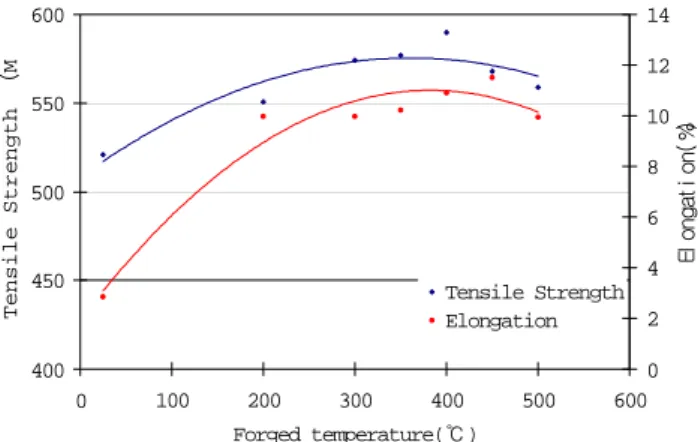
The application of the sinter-forged method was examined The high densification of this Al-Zn-Mg-Cu sinteralloy during sintering is combined with linear shrinkage of about 2%. For getting structural parts at closed tolerances the use of sinterforging method is therefore advanteous. At the same time the material performance is getting improved. The influence of the forging temperature on the tensile strength and elongation.is shown in Fig. 2
Fig. 2. Influence of forging temperature on tensile strength and elongation for sinterforged AX 431 Nr.10490
The tensile strength and elongation increase with the forging temperature. At about 400 °C high tensile strength closed to 600 MPa and elongation up to 10 % could be achieved It is thought to occure due to the increase of plastic deformation during hot forging.
3. Summary
Sinter forging an AlZnMgCu powder alloy exhibited the best combination of tensile properties ,hardness and densification This process can produce a better net shape then by extrusion and by using optimized conditions.The new PM-leightweight material shows improved performance properties which inlarge component application.
4. References
1. H. Danninger, H.-C. Neubing, J. Gradl, Proceedings of the PM World Congress Granada (1998)
2. H.-C. Neubing, H. Danninger, Proceedings Hagener Symposium (1998)
3. 2.J.Gradl,H.-C.Neubing,A.Mueller,EuroPM Proceedings of the EUROPM Vienna(2004)
4. A.D.LaDelpha, P.Bishop,ProgressReport (2006).
5. Junichi Ichikawa, Hideo Shikata, Hitachi Powdered Metals Technical Report Vol.3(2004)
6. Junichi Ichikawa, Hideo Shikata, EuroPM proceedings of the EURO PM Vienna(2004)
0 100 200 300 400 500 0 50 100 150 200 250 300 Temperature (C)
AX431D-T1 AX431D-T6 AC2014-T1
UTS (MPa ) 400 450 500 550 600 0 100 200 300 400 500 600 Forged temperature(℃) Ten sile Str engt h ( M 0 2 4 6 8 10 12 14 E l on g at i on ( %) Tensile Strength Elongation