≸⓸ 䚐ạ⫼⫤㜈㫴⏼㛨⫵䚍䟀 ḩ┍䚍㍔䟀 ⊰ⱬ㬅 2012
Effect of Optimal Urea Injection Rate on NO
XConversion
in a Steam Boiler with Zeolite-SCR Catalyst by Numerical Simulation
Myung-whan Bae
+, Elvira Fidelia Tanjung
1, Woo-cheol Kang
1and Byeong-ho Song
1The selective catalytic reduction (SCR) is well known as an effective and proven aftertreatment technology to reduce NOX emissions in combustion devices. The aim of this study is to investigate the effect of urea injection rate on NOX
conversion in a LPG steam boiler with zeolite-SCR catalyst by using three dimensional modeling. When the optimal urea amount determined in experiment for the respective boiler load is injected, the NOX conversion and NH3 slip in
a three dimensional modeling of zeolite-SCR catalyst by the SIMPLE algorithm are calculated and compared with the experimental results.
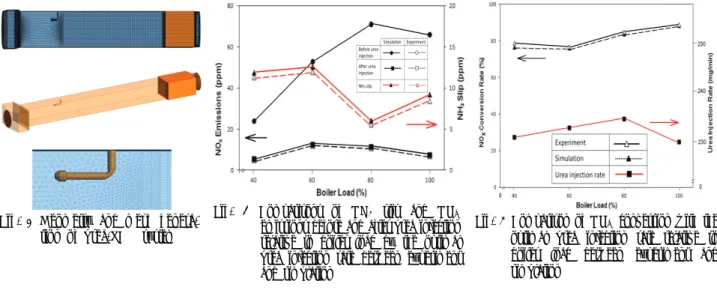
Fig. 1 shows the geometry of analytical domain for the model and mesh generation of urea-SCR system. Fig. 2 shows that the highest value of NOX emissions before urea injection is at the boiler load of 80% while the lowest one
is at the boiler load of 40%. In this case, 235 mg/min of urea is injected at the boiler load of 80% and the NOX
emissions are decreased from 71 ppm to 11.6 ppm . O n the other hand, only sm all am ount of N H3 does not react
with NOX emissions, as the result, the NH3 slip at the boiler load of 80% is below 7 ppm. As it is shown in Fig. 2,
the NOX emissions at the boiler load of 100% before urea injection is higher than one at the boiler load of 40%.
However, the urea injection rate at the boiler load of 40% is higher than that of 100%. This is because the reaction temperature of zeolite-SCR catalyst at the boiler load of 40% is lower than that of 100%. The similar phenomenon also occurred at the boiler load of 60%. The lowest NOX conversion rate is 76.2% at boiler load of 60% because the
activation efficiency in the urea-SCR reactor is the worst among four conditions of boiler load. The final concentrations of NOX emissions for the respective boiler load are less than 15 ppm and, on the other hand, the NH3 slips at lower
boiler loads are more than those of higher loads due to the low reaction temperature.
Fig. 2 Comparisons of NH3 slip and NOX
emissions before and after urea injection relative to boiler load by the optimal urea injection rate between experiment and simulation
F ig . 1 G eom etry an d m esh g en era-tio n of u rea-S C R system
Fig. 3 Comparison of NOX conversion with the
optimal urea injection rate relative to boiler load between experiment and simulation
References
[1] The U.S. Department of Energy and Southern Company Services, Inc.,뺵Control of Nitrogen Oxide Emission : Selective Catalytic Reduction,뺶Topical Report, No. 9, 1997.
[2] M. W. Bae, W. C. Kang and B. H. Song,뺵Reduction Characteristics of Nitrogen Oxides Emissions in LPG Steam Boiler with a Urea-SCR Reactor,뺶Proceedings of KSAE 2011 Annual Conference and Exhibition (KSAE11-A0041), pp.224-228, 2011. [3] J. H. Chae, S. T. Choo, H. Choi, I. S. Nam, H. S. Yang and S. L. Song,뺵Direct Use of Kinetic Parameters for Modeling and
Simulation of a Selective Catalytic Reduction Process,뺶 Ind. Eng. Chem. Res., Vol. 39, No. 5, pp.1159-1170, 2000. [4] ANSYS Inc.,뺵ANSYS FLUENT 12.0 Theory Guide,뺶2009.
+ Myung-whan Bae(Department of Mechanical Engineering for Production, Gyeongsang National University), E-mail: [email protected], Tel: 055)772-1631
1 School of Mechanical and Aerospace Engineering, Graduate School, Gyeongsang National University YWXY≸⓸G䚐ạ⫼⫤㜈㫴⏼㛨⫵䚍䟀Gḩ┍䚍㍔䟀⊰ⱬ㬅