INTRODUCTION
Manuka honey(MH) containing much higher antibacte-rial activity levels than regular honey was confirmed by the Unique Manuka Factor(UMF) which is due to the presence of methylglyoxal that non-peroxide activity(Weston et al. 1999; Snow et al. 2004; Lusby et al. 2005; Adams et al. 2008; Jose M et al. 2014), it is stable so there is no concern about losing its healing properties during storage. When applied to a wound, it is well known that MH not only ex-hibits anti-bacterial, anti-microbial(Patton et al. 2006; Lin et al. 2010; Aled et al. 2015), anti-septic, anti-viral, anti-in-flammatory, anti-oxidant and anti-fungal properties, but also stimulates the growth of new blood capillaries, and white blood cells and supplies nutrients that boost the
re-generation of new skin(Visavadia et al. 2008; Zerm et al. 2010; Huong et al. 2019).
Hydrogel wound dressings can absorb wound excreta and protect against excessive loss of bodily fluids due to their unique water absorption and retention properties. In a pre-vious study, carboxymethyl cellulose(CMC) hydrogel not only have a good water absorption and retention ability, but also are environmentally friendly due to their nontoxicity and biocompatibility(Coviello et al. 2007; Park et al. 2012; Kabir et al. 2018). This characterization was proven to be useful as a natural hydrogel substrate by creating a wet en-vironment for wound healing(Liu et al. 2005, Nabanita et al. 2019). Therefore, in this work, CMC(20wt%) with dif-ferent concentrations of Manuka honey(0, 5, 10wt%) were mixed and crosslinked to fabricate new functional hydrogel dressings, and the advantages of MH and CMC hydrogels were combined and studied for wound healing abilities. ─ 243 ─
Technical Paper
* Corresponding author: Jong-Seok Park, Tel. +82-63-570-3067, E-mail. [email protected]
Synthesis and Characterization of Manuka Honey
Loaded Carboxymethyl Cellulose Hydrogel Prepared by
Gamma-ray Irradiation
Jong-Seok Park1, Jin-Oh Jeong1, Hui-Jeong Gwon1, Sung-In Jeong1, Young-Chang Nho2 and Youn-Mook Lim1
1Advanced Radiation Technology Institute, Korea Atomic Energy Research Institute, 1266 Sinjeong-dong Jeongeup-si Jeollabuk-do 56212, Republic of Korea
2EB TECH CO., LTD, 170-9, Techno 2-ro, Yuseong-gu Daejeon 34208, Republic of Korea
Abstract - Manuka honey differs from normal honey because of its additional existence of non-peroxide antibacterial activity which has been used to treat infections in a wide range of wound types. In this study, Manuka honey mixed with carboxymethyl cellulose(CMC) was crosslinked and sterilized by using a γ-irradiation of 50kGy from a 60Co source to make a new hydrogel
wound dressing. The effects of various parameters such as honey concentration(0~20wt%), gel content, and the absorption ratio in water were investigated in detail. The antibacterial properties were evaluated by paper diffusion test. The antibacterial tests indicated that the manuka/CMC hydrogels have a good antibacterial activity against Escherichia coli(E. coli) and Staphylococcus
aureus(S. aureus). As effective therapeutic evidence, the rate of vivo wound healing process in db/
db mice was investigated based on real-time photographs and wound area contraction. Key words : Manuka honey, CMC crosslinking, Hydrogels, γ-irradiation, Wound dressing
MATERIALS AND METHODS
1. Materials
CMC was purchased from Sigma-Aldrich Co.,(St. Lou-is, USA). Its degree of substitution(DS) is 1.2. The av-erage molecular weight of CMC is about 2.5×10⁵. MH was obtained from Comvita New Zealand Ltd., and shows a UMF2® of 20+. The UMF relates to the potency of the antibacterial activity of the honey. The UMF numbers de-rive from a standard laboratory test with ‘Active’ Manuka which was compared with a standard antiseptic(phenol) to prove its potency. For example, honey with a UMF2® rat-ing of 10+ would be equivalent to the antiseptic potency of a 10% solution of phenol. From these tests, UMF factors are shown to relate to the strength of the antiseptic solution (Badet et al. 2011).
All aqueous solutions in this experiment were made by using deionized(DI) water from a water purification sys-tem, produced by Young Lin Instrument Co., ltd. All chemi-cals were used without any further purification.
2. Preparation of CMC-MH hydrogel dressings
MH(0, 5, 10, 15, 20wt%) and CMC powder(20wt%) were mixed and dissolved in DI water by using a planetary centrifugal mixer(Thunky company, Japan) at room tem-perature. The mixture was poured into a mould(40×20×2 mm) to form a dressing shape and irradiated using gam-ma-rays with a total dose of 50kGy at 10kGy·hr-1 to pro-duce the honey-hydrogel dressings.
3. Measurement
The gel content of the CMC-MH hydrogels was measured by extraction in DI water at 37°C for 48hr and dried in an oven at 37°C for 48hr until reaching a constant weight. The gel content(Gc) was defined by
Gc(%)=(Wd/Wi)×100.
where Wd is the oven-dried gel weight after swelling for
48hr, and Wi is the initial weight of the dried hydrogels,
re-spectively(Gwon et al. 2010).
The degree of swelling can be described as the water ab-sorptivity of the hydrogels. The hydrogels were immersed in distilled water for different intervals at room temperature until an equilibrium state of swelling was reached. After the
excess surface fluids were removed with filter paper, the weight of the swollen gels was measured at various times. The procedure was repeated until no further weight increas-es were observed. The degree of swelling(Sw) can be calcu-lated as follows:
Sw(%)=[(Ws-Wi)/Wi]×100
where, Ws is the weight of the swollen gels at various time intervals, and Wi is the initial weight of the dried gel.
The compressive strength of the hydrogels was measured using an INSTRON 5569(Instron Co., USA). The strength was measured through 50% compression and decompres-sion of the hydrogels between the plates of the test machine with a crosshead speed of 10mm/min.
4. Antibacterial test
The antibacterial activities of CMC-MH hydrogels were studied against S. aureus ATCC 6538P and E. coli ATCC 25922 on solid growth media. S. aureus/E. coli bacteria were grown on tryptic soy agar(TSA) plates after evenly smearing with 100μL of freshly grown bacterial inoculums (106 cellsml-1) and incubation at 37°C in an oven for 3hr. Afterwards, the plates were supplemented with cylindrical CMC hydrogel stabilized Ag NP samples(Diameter: 8mm, Height: 10mm) and incubated at 37°C for 24hr; the clear ratios were obtained by measuring the inhibition zones and calculated as follows:
Clear ratio(%)=(di2-d02)/d02×100
where, d0 is the diameter of samples(8mm) and di is the diameter of the clear zone after 24hr.
5. Wound healing experiment
The female db/db mice(C57BLKS/J Iar-+Leprdb/ + Leprdb, weight between 18 and 24g, age at 5 weeks) were ex-perimented in vivo wound healing assessment. Three exper-imental groups, namely, an untreated control, and those with CMC and CMC-MH hydrogel(Manuka honey of 10wt%) dressings, were composed of 10 mice each. Deep round skin traumas were inflicted on the dorsum of each body. The wound dressings were changed every 2 days, real-time pho-tograph observations were followed and the healing rates of the wound area contractions were calculated.
RESULTS AND DISCUSSION
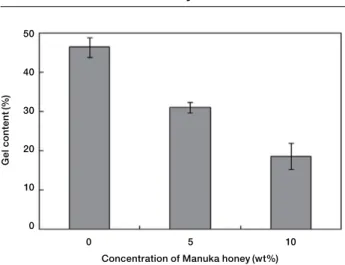
As shown in Fig. 1, the varied gelation content as a func-tion of the content of Manuka honey(0, 5, 10wt%) of the CMC-MH hydrogel samples. The gel content decreased as the concentration of honey increased. In our previous study, it was found that the gelation of CMC(with a DS of 1.2) increased when increasing the irradiation dose and concentration of CMC. However, when the honey, which is a complex mixture of highly concentrated sugars, is added (Kamal et al. 2011), this complex including sugars in MH discouraged the formation of the crosslinking structure of CMC.
Fig. 2 shows the dynamic swelling behavior of different CMC-MH hydrogel samples. As the concentration of Ma-nuka honey increased, the equilibrium swelling ratio of the hydrogels significantly increased. It is reasonable that the degree of crosslinking in the polymer networks restricted the chain relaxation process, thus causing a highly cross-linked gel content, leading to a low equilibrium swelling ra-tio. The results indicate that CMC-MH could be a better hy-drogel wound dressing material than pure CMC hyhy-drogel, and the CMC-MH may have a lower mechanical property due to fewer crosslinked chains, but it would supply a moist wound healing environment and absorb much more wound exudates, making the wound heal faster.
Fig. 3 shows the compressive strength for the CMC-MH hydrogel with the contents of CMC-MH. The compressive strength decreased when increasing the contents. In general, the compressive strength of the hydrogel was proportional to the gelation. In fact, the compressive strength of CMC
hydrogel substantially decreased due to the presence of MH as compared with neat CMC hydrogel.
The antibacterial activities of CMC-MH hydrogel against S. aureus and E. coli were proven and recorded through photographs. Fig. 4 and Table 1 shows the antibacterial im-age and clear ratios of the samples, which were calculated by measuring the inhibition zones on the tryptic soy agar (TSA) plates. As shown in Fig. 4 and Table 1, the antibacte-rial effects of CMC-MH hydrogel increased when increas-ing the MH content. The CMC-MH hydrogel exhibited good antibacterial activity both S. aureus and E. coli com-pared to the blank(neat CMC hydrogel). It is possible that the MH in CMC hydrogel chemically reacted with cell of the bacteria. Hydrogen peroxide, organic acids, flavonoids, mehtlylglyoxal in MH are important chemical factors that Fig. 1. Variation of gel content with different content of honey in
CMC-MH hydrogels. Fig. 2. The absorption ratio of CMC-MH hydrogels with different content of honey.
Fig. 3. Compressive strength of CMC-MH hydrogels with
differ-ent contdiffer-ent of honey.
G el c o nt ent (%) 50 40 30 20 10 0
Concentration of Manuka honey(wt%)
provide antibacterial activity(Atrott and Henle 2009; Wang et al. 2012). In addition, the CMC-MH hydrogel exhibits more good antibacterial activity against E. coli than S. au-reus. It is possible due to the difference in the structure of the cell wall between E. coli he Gram-positive and S. au-reus(Shrivastava et al. 2007; Park et al. 2013).
The clinical effect of CMC-MH for wound healing was assessed in db/db mice. Wound area contraction and re-al-time healing photographs have been followed.
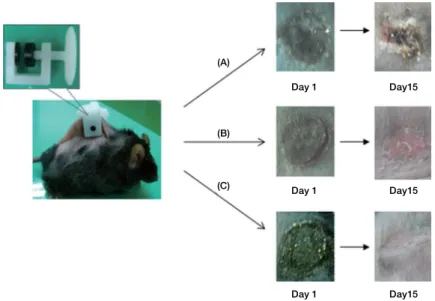
Figs. 5 and 6 show that the wound healing state of the mice at days 1 and 15. The mice were wounded by using a regular squeezing mold that made a deep round repeat-able skin trauma on the dorsum of the body. These wounds were covered by(A) normal gauze,(B) pure CMC hydrogel
dressings and(C) CMC-MH hydrogel dressings. The pho-tographs clearly represent that different therapeutic effects appeared after 15 days. The necrotic and inflammatory tis-sues could still be observed in the untreated control wound, while the wound treated only using CMC hydrogels had Fig. 4. Antibacterial image of CMC-MH hydrogels with different content of honey against S. aureus(a) and E. coli.
Table 1. Clear ratio of CMC-MH hydrogels with different content
of honey against S. aureus and E. coli. Contents of Manuka honey Inhibition zone S. aureus E. coli Blank 0wt% - -M5 5wt% 8% 11% M10 10wt% 27% 35% M15 15wt% 41% 47% M20 20wt% 62% 65%
(a) (b)
Fig. 5. Photographs of wound healing observation at day 1 and day 15: (A) untreated control wound,(B) CMC hydrogels treated wound,(C) CMC-MH treated wound. Day 1 Day15 Day 1 Day15 Day 1 Day15 (A) (B) (C)
already closed but still had a fresh red scar. However, in the CMC-MH treated wound, significant epithelial regenera-tion and tissue repair had already appeared, and the wounds were healed and clean.
The wound contractions(W) of the db/db mice were mea-sured every 2 days and calculated by using the following equation:
W(%)=St/S0×100.
Where St is the wound area of mouse at time intervals, S0 is the wound area of mouse at the initial time.
As shown in Fig. 6, both CMC and CMC-MH(10wt% of Manuka honey) hydrogel dressings significantly stimu-lated the rate of wound healing. The untreated wound ex-hibited an inflammation phenomenon at days 2 through 5 (wound contraction: 128.57% to 108.49%), accompanied with excreta and a bad odor. On the contrary, the hydrogel dressings absorbed wound excreta, moved the dirty and septic tissues, and formed an efficient barrier against wound contamination. Naturally, the wound treated by CMC-MH healed faster and did not cause any inflammation, and it is thus reasonable to conclude Manuka honey exerted an-tibacterial and antimicrobial properties. The microscopic actions of CMC-MH on wounds may be multiple. Hydrogel appears to draw fluid from the underlying circulation, and Manuka honey may provide both a moist environment and topical nutrition that may enhance tissue growth and im-prove epithelialization.
CONCLUSION
In this study, a new hydrogel dressing with MH was syn-thesized by using a “one-step” process, which can be sim-ply manufactured and sterilized though gamma irradiation technology. The effects of various parameters such as honey concentration, gel content, the absorption ratio in water and compressive strength were investigated in detail. The anti-bacterial tests indicated that the CMC-MH hydrogels have a good antibacterial activity against E. coli and S. aureus. In addition, the CMC-MH hydrogel dressing stimulated the rate of wound healing through animal experiments.
ACKNOWLEDGMENT
This work was supported by National Research Founda-tion of Korea(NRF) grant funded by the Ministry of Sci-ence, ICT(Information & Communication Technology) and Future Planning, Korea government.
REFERENCES
Adams CJ, Boult CH, Deadman BJ, Farr JM, Grainger MNC, Manley-Harris M and Snow MJ. 2008. Isolation by HPLC and characterisation of the bioactive fraction of New Zea-land manuka(Leptospermum scoparium) honey. Carbohyd.
Res. 343:651-659.
Aled ELR, Helen LB and Rowena EJ. 2015. On the antibac-terial effects of manuka honey: mechanistic insights. Res.
Rep. Biology 6:215-224.
Atrott A and Henle T. 2009. Methylglyoxal in manuka honey - correlation with antibacterial properties. Czech J. Food Sci. 27:S163-S165.
Badet C and Quero F. 2011. The in vitro effect of manuka hon-eys on growth and adherence of oral bacteria. Anaerobe 17:19-22.
Coviello T, Matricardi P, Marianecci C and Alhaique F. 2007. Polysaccharide hydrogel for modified release formulations.
J. Control. Release 119:5-24.
Gwon HJ, Lim YM, Nho YC and Baik SH. 2010. Humectants effect on aqueous fluids absorption of γ-irradiated PVA hydrogel followed by freeze thawing. Radiat. Phys. Chem. 79:650-653.
Huong TLN, Naksit P, Stefan KEP and Nitin M. 2019. Honey and Its Role in Relieving Multiple Facets of Atherosclero-sis. Nutrients 11(67):1-22.
Fig. 6. Wound area contraction of db/db mice at different days as
percentage of original wound size:(a) untreated control wound,(b) CMC hydrogels treated wound,(c) CMC-MH treated wound. W o und con tr ac ti on (%) Time(days) 140 120 100 80 60 40 20 0 0 5 10 15 20 25
Jose MAS, Massimiliano G, Tamara YFH, Luca M and Fran-cesca G. 2014. The Composition and Biological Activity of Honey: A Focus on Manuka Honey. Foods 3:420-432. Kabir SMF, Sikdar PP, Haque B, Rahman-Bhuiyan MA, Ali A
and Islam MN. 2018. Cellulose-based hydrogel materials: chemistry, properties and their prospective applications.
Prog Biomater. 7:153-174.
Kamal MA and Klein P. 2011. Determination of sugars in hon-ey by liquid chromatography. Saudi J. Biol. Sci. 18:17-21. Lin SM, Molan PC and Cursons RT. 2010. The post-antibiotic
effect of manuka honey on gastrointestinal pathogens. Int. J.
Antimicrob. Ag. 36:467-468.
Liu P, Peng J, Li J and Wu J. 2005. Radiation crosslinking of CMC-Na at low dose and its application as substitute for hydrogel. Radiat. Phys. Chem. 72:635-638.
Lusby PE, Coombes AL and Wilkinson JM. 2005. Bactericidal Activity of Different Honeys against Pathogenic Bacteria.
Arch. Med. Res. 36:464-467.
Nabanita S, Rushita S, Prerak G, Biman BM, Radostina A, Maja DS and Petr S. 2019. PVP-CMC hydrogel: An excel-lent bioinspired and biocompatible scaffold for osseointe-gration. Mater. Sci. Eng. C 95:440-449.
Park JS, Kuang J, Lim YM, Gwon HJ and Nho YC. 2012. Characterization of silver nanoparticle in the carboxymeth-yl cellulose hydrogel prepared by a gamma ray irradiation.
J. Nanosci. Nanotechn. 12:743-747.
Park JS, Kuang J, Gwon HJ, Lim YM, Jeong SI, Shin YM, Khil MS and Nho YC. 2013. Synthesis and
characteriza-tion of zinc chloride containing poly(acrylic acid) hydrogel by gamma irradiation. Radiat. Phys. Chem. 88:60-64. Patton T, Barrett J, Brennan J and Moran N. 2006. Use of a
spectrophotometric bioassay for determination of microbial sensitivity to manuka honey. J. Microbiol. Meth. 64:84-95. Shrivastava S, Bera T, Roy A, Singh G, Ramachandrarao P and
Dash D. 2007. Charaterization of enhanced antibacterial effects of novel silver nanoparticles. Nanotechnology 18: 225103-225111.
Snow MJ and Manley-Harris M. 2004. On the nature of non-peroxide antibacterial activity in New Zealand manuka honey. Food Chem. 84:145-147.
Visavadia BG, Honeysett J and Danford MH. 2008. Manuka honey dressing: An effective treatment for chronic wound infections. British J. Oral Max. Surg. 46:55-56.
Wang T, Zhu XK, Xue XT and Wu DY. 2012. Hydrogel sheets of chitosan and gelatin as burn wound dressings.
Carbo-hyd. Polym. 88:75-83.
Weston RJ, Mitchell KR and Allen KL. 1999. Antibacterial phenolic components of New Zealand manuka honey. Food
Chem. 64:295-301.
Zerm R, Jecht M, De-Malter P, Friedrich M, Girke M and Kr M. 2010. Treatment of diabetic foot syndrome with Manuka honey. Eur. J. Intern. Med. 2:258-259.
Received: 4 July 2019 Revised: 24 July 2019 Revision accepted: 16 August 2019